

When recovery agents, not the magistrate's officer, take your property: Allahabad HC (2025) on SARFAESI Section 14(1-A) and Article 300A
Allahabad HC set aside a SARFAESI possession taken by an ARC's recovery agents on 25 Feb 2025, holding Section 14(1-A) lets only the magistrate's officer or a court-appointed advocate act.
Key points
- The Allahabad High Court, Lucknow Bench, on 12 March 2025 set aside a physical possession taken by an asset reconstruction company's recovery agents in the Durga Travels case.
- The court found no material that the person who took possession on 25 February 2025 was an officer subordinate to the ADM or an officer of the court, as Section 14(1-A) of SARFAESI requires.
- The ARC may take possession again only by strictly following Section 14(1-A), with the ADM ensuring compliance; the debt itself was not set aside.
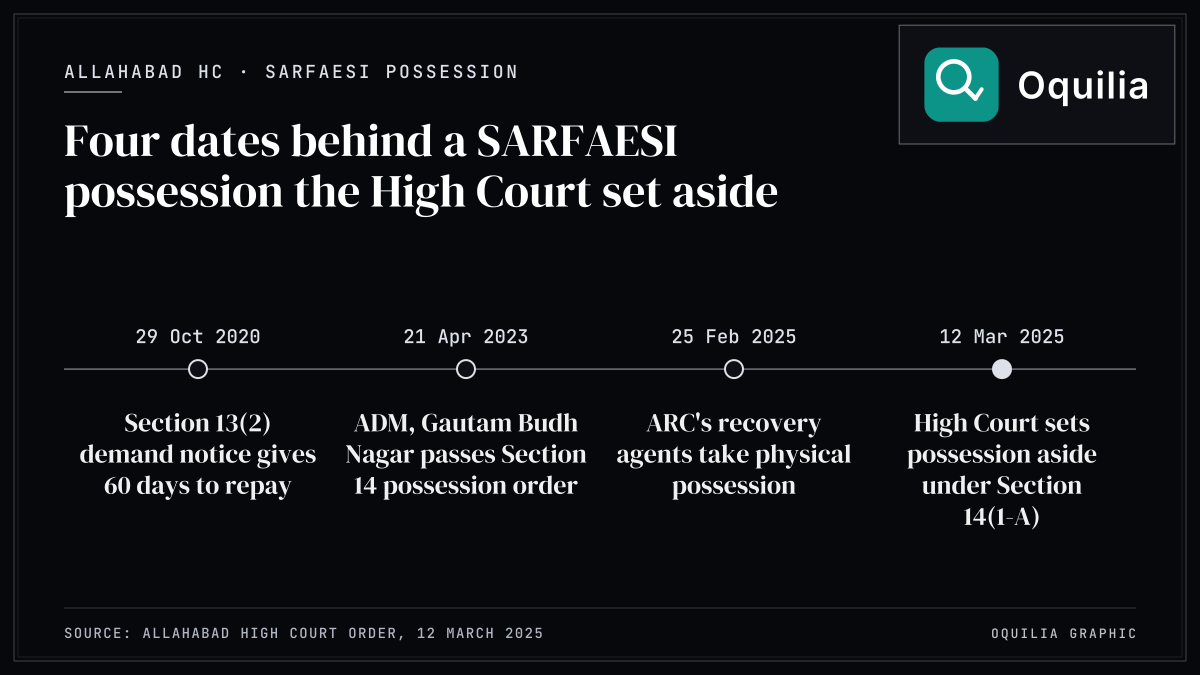
On 12 March 2025, the Lucknow Bench of the Allahabad High Court set aside a physical possession of a borrower's property that had been carried out on 25 February 2025 by recovery agents of an asset reconstruction company (ARC). The ruling in M/S Durga Travels through Proprietor v. Debts Recovery Tribunal, Lucknow and others (Matter under Article 227 No. 1133 of 2025, neutral citation 2025:AHC-LKO:15469, Pankaj Bhatia J.) turns on a single procedural question: who is legally allowed to take your property once a magistrate has passed an order under Section 14 of the SARFAESI Act, 2002?
The answer the court gave, in paragraphs 16 to 25 of the order, is that only the Chief Metropolitan Magistrate (CMM) or District Magistrate (DM) acting personally, an officer subordinate to that magistrate, or (per the Supreme Court in 2022) an advocate appointed as an officer of the court can take possession. Private recovery agents are not on that list. This playbook sets out the statutory position, the procedure, the defences a borrower can raise, and what the Durga Travels order adds. It is general information on the law, not legal advice on any individual case.
The Statutory Position
The Securitisation and Reconstruction of Financial Assets and Enforcement of Security Interest Act, 2002 (the SARFAESI Act) lets a secured creditor enforce its security over a secured loan without first filing a civil suit. The full text is available on India Code. Three provisions matter for possession disputes.
| Provision | What it does | Key time limit |
|---|---|---|
| Section 13(2) | Demand notice to the borrower after the account is classified as an NPA | 60 days to repay before measures begin |
| Section 13(4) | Creditor may take possession of the secured asset, take over management, or appoint a manager | After the 60-day notice period |
| Section 14 | Creditor applies to the CMM/DM for help in taking possession; magistrate passes an order | 30-day disposal mandate (post-2016 amendment) |
| Section 14(1-A) | CMM/DM may authorise an officer subordinate to him to take possession and hand it to the creditor | Applies to every Section 14 order executed through an officer |
| Section 17 | Borrower's application to the Debts Recovery Tribunal (DRT) against Section 13(4) measures | 45 days; pre-deposit not mandatory, but the tribunal may direct one |
Section 14 is the step that turns a paper possession under Section 13(4) into actual, physical possession. The creditor goes to the CMM (in metropolitan areas) or the DM (elsewhere), files an affidavit, and asks the magistrate to take possession of the asset and hand it over. Section 14(1-A) then allows the CMM or DM to authorise "any officer subordinate to him" to carry this out.
In NKGSB Co-operative Bank v. Subir Chakravarty (2022) 10 SCC 286, the Supreme Court held that the CMM or DM may also appoint an advocate as an officer of the court for this purpose. The Durga Travels order applies that 2022 reading directly: the person physically taking possession must fall into one of these two categories, and the record must show it.
The constitutional backdrop is Article 300A of the Constitution, which says that no person shall be deprived of their property save by authority of law. In paragraph 20 of the order, Pankaj Bhatia J. treated a possession taken outside the Section 14(1-A) route as a prima facie breach of Article 300A.
Procedure Step by Step
The Durga Travels facts follow the standard SARFAESI timeline, which runs from the original loan (around 2015, for school buses) to physical possession nearly a decade later. The general sequence is:
- Loan and security (around 2015 in Durga Travels). The borrower takes a loan against a mortgage or hypothecation. Any guarantee given by a third party is documented at this stage.
- NPA classification. The account is classified as a non-performing asset under RBI's prudential norms (see rbi.org.in for the current master circular).
- Section 13(2) demand notice (29 October 2020 in Durga Travels). The borrower gets 60 days to clear the dues.
- Representation and reply. Under Section 13(3A), the borrower may object to the notice within the 60-day window, and the creditor must communicate its reasons if it rejects the objection.
- Assignment to an ARC. The bank may assign the debt to an asset reconstruction company, which then steps into the bank's shoes. In Durga Travels, the bank assigned the debt to an ARC before possession.
- Section 13(4) symbolic possession. The creditor issues a possession notice and publishes it.
- Section 14 application and order (21 April 2023 in Durga Travels). The Additional District Magistrate (ADM), Gautam Budh Nagar, passed a Section 14 order for possession with police help.
- DRT directions (paras 3-4 and 21). The DRT later directed that at least 15 days' prior notice be given before physical possession.
- Physical possession under Section 14(1-A) (25 February 2025 in Durga Travels). This must be done by the CMM/DM, a subordinate officer, or an advocate-commissioner. In Durga Travels, recovery agents did it.
- Sale under Rules 8 and 9 of the Security Interest (Enforcement) Rules, 2002. Only after valid possession can the asset be valued and auctioned.
The gap between step 3 (October 2020) and step 9 (February 2025) in Durga Travels is about 4 years and 4 months. That long gap is common, and it is often where procedural defects build up: new parties (an ARC) enter, earlier orders are superseded by tribunal directions, and the people who finally turn up at the gate may not be the ones the statute authorises.
Borrower Defences Available
A borrower facing a Section 13 or Section 14 action has statutory and constitutional routes. The table below maps each defence to its forum and limits.
| Defence | Forum | Time limit / deposit | Durga Travels relevance |
|---|---|---|---|
| Objection to demand notice | Creditor (Section 13(3A)) | Within the 60-day notice period; creditor must give reasons for rejection | Notice dated 29.10.2020 |
| Challenge to Section 13(4) measures, including Section 14 possession | DRT (Section 17) | 45 days; deposit not mandatory, tribunal may direct | DRT had required 15 days' notice before possession |
| Appeal against DRT order | DRAT (Section 18) | Statutory pre-deposit applies under Section 18 | Not the route used here |
| Writ / supervisory petition | High Court (Articles 226 / 227) | Exceptional; usually only where an alternative remedy is inadequate | Matter under Article 227 No. 1133 of 2025 allowed |
| Redemption by full payment | Creditor (Section 13(8)) | Before the auction notice is published | Not in issue in the order |
The order points to four specific grounds that can be raised when possession has actually been taken.
1. Wrong person took possession (paras 16-19). The court found "no material" that the officer who took possession on 25 February 2025 was subordinate to the ADM or was an officer of the court. A borrower can ask for the authorisation order under Section 14(1-A) and the name and designation of the officer who executed it. If the people at the site were only the ARC's agents, that is the defect the court identified.
2. Notice to guarantors and prior-notice directions (para 21). The court recorded that no notice was given to the guarantors and that the DRT's direction for at least 15 days' prior notice before physical possession was not followed. Where a DRT or magistrate attaches a condition such as advance notice, skipping it is a separate ground.
3. Movables taken without authority (para 22). SARFAESI deals with the secured asset. The court commissioner found the petitioners' goods inside the property (para 12), and the court held that the movables were taken without legal authority. Household or business goods that are not part of the security cannot be seized with the building.
4. Partial or irregular possession (para 11). The police report recorded that only the ground floor was taken because of a child's board examination. Inconsistent or partial execution does not cure a defective process; it is evidence of how the possession was actually carried out.
On costs, a borrower weighing a settlement against litigation can model the numbers with the loan settlement cost calculator and, where refinancing is realistic, the balance transfer calculator or the foreclosure calculator. A further glossary entry on the Debts Recovery Tribunal explains the forum's role, and the collateral entry covers what counts as a secured asset.
Recent Tribunal/HC Position
The Durga Travels order, 12 March 2025
The petition, numbered 1133 of 2025, was heard under Article 227 of the Constitution against the DRT, Lucknow and others. The holdings, by paragraph, are set out below.
| Paragraph(s) | Finding |
|---|---|
| 3-4, 21 | DRT had required at least 15 days' prior notice before physical possession |
| 6 | Petitioners alleged no ADM official was present, the gate was broken, and they were abused |
| 11 | Police report: only the ground floor was taken because of a child's board exam |
| 12 | Court commissioner found the petitioners' goods inside the property |
| 16-19 | No material that the officer taking possession was subordinate to the ADM or an officer of the court |
| 20 | Writ maintainable despite Celir LLP v. Bafna Motors and PHR Invent because of a prima facie Article 300A violation |
| 21 | No notice to guarantors; the DRT's 15-day notice direction was not followed |
| 22 | Possession of the immovable property was contrary to Section 14(1-A); movables taken without legal authority |
| 24 | Relying on ICICI Bank v. Prakash Kaur (2007) 2 SCC 711, the procedure must be scrupulously followed |
| 24-25 | Petition allowed; the ARC may take possession again only strictly under Section 14(1-A); the ADM must ensure compliance |
The allegations in paragraph 6 (gate broken, abuse) are the petitioners' account as recorded in the order. The court's operative findings rest on the absence of proof of a valid officer (paras 16-19), the unmet notice requirements (para 21), and the unlawful taking of movables (para 22).
Why the writ was entertained
The order is notable because High Courts usually turn SARFAESI borrowers away to the DRT under Section 17. The Supreme Court's rulings in Celir LLP v. Bafna Motors and PHR Invent have stressed that writ jurisdiction should not be used where the statute provides an efficacious remedy. In paragraph 20, Pankaj Bhatia J. distinguished those rulings because the possession, on the face of the record, was taken without the authority of law, engaging Article 300A. The order does not decide that every SARFAESI grievance can go straight to a High Court; it decides that this possession, executed by agents outside Section 14(1-A), could be.
What the order did not do
The briefing record states that the court made no order on costs and gave no express direction on restoration of possession. The ARC was left free to take possession again, but only by strictly following Section 14(1-A), with the ADM responsible for compliance (paras 24-25). The underlying debt, the 2020 demand notice and the 2023 Section 14 order were not set aside on the material available. Borrowers should read the outcome as a procedural reset, not as a waiver of the dues.
The line of authority
| Case | Year / citation | Principle relied on |
|---|---|---|
| ICICI Bank v. Prakash Kaur | (2007) 2 SCC 711 | Recovery must follow the procedure laid down by law; force is impermissible |
| NKGSB Co-operative Bank v. Subir Chakravarty | (2022) 10 SCC 286 | An advocate may be appointed as an officer of the court under Section 14(1-A) |
| M/S Durga Travels v. DRT, Lucknow | 2025:AHC-LKO:15469 | Possession by agents not shown to be subordinate officers or officers of the court violates Section 14(1-A) and Article 300A |
The order can be read on Indian Kanoon.
FAQ
Can a bank's recovery agents take physical possession of my house under SARFAESI?
Not on their own. Under Section 14(1-A), possession under a magistrate's Section 14 order must be taken by the CMM/DM, an officer subordinate to the CMM/DM, or an advocate appointed as an officer of the court (NKGSB Co-operative Bank, (2022) 10 SCC 286). In Durga Travels (12 March 2025), possession by agents without proof of such authority was held contrary to Section 14(1-A).
What should I ask for if agents arrive with a Section 14 order?
Ask for a copy of the Section 14 order (in Durga Travels, dated 21 April 2023), the separate authorisation naming the officer under Section 14(1-A), and the officer's designation. Paragraphs 16-19 of the order turned on the absence of any material showing that the person who took possession was a subordinate officer or an officer of the court.
Do guarantors have to be given notice before possession?
In Durga Travels, paragraph 21 records that no notice was given to the guarantors, and the court treated that as one of the defects. Guarantors are also entitled to the Section 13(2) demand notice, which gives 60 days to pay.
Can the bank take my furniture and business goods along with the property?
The order says no where those goods are not part of the security. In paragraph 22, the court held that the movables inside the premises were taken without legal authority, after the court commissioner found the petitioners' goods inside (para 12).
Should I go to the DRT or the High Court?
The normal route is a Section 17 application to the DRT within 45 days; a pre-deposit is not mandatory, though the tribunal may direct one. A High Court petition under Article 226 or 227 is exceptional. Durga Travels was entertained in 2025 only because of a prima facie Article 300A violation (para 20), despite Celir LLP and PHR Invent.
Does winning on procedure cancel my loan?
No. In paragraphs 24-25, the court allowed the ARC to take possession again strictly under Section 14(1-A), with the ADM ensuring compliance. The debt and the 2020 demand notice were not set aside. A settlement can still be explored; the settlement cost calculator shows how a one-time settlement affects the total paid.
What if the DRT has ordered advance notice before possession?
The condition binds the creditor. In Durga Travels, the DRT had required at least 15 days' prior notice before physical possession, and the Allahabad High Court recorded in paragraph 21 that this was not followed.
This article summarises a court order and statutory provisions for general information. It is not legal advice. The Oquilia Research Desk does not act for any party. Consult a qualified advocate about your own case.
Sources & Citations
- M/S Durga Travels v. Debts Recovery Tribunal, Lucknow, Allahabad HC (Lucknow Bench), 12.03.2025 — Indian Kanoon
- SARFAESI Act, 2002 — India Code
- Reserve Bank of India — RBI