

Loan Intelligence
Know your true cost of borrowing
EMI calculators, prepayment benefit analysis, rent vs buy comparisons, and amortization schedules for every loan type. Make informed borrowing decisions.
Rent vs Buy — The definitive calculator
Compare total cost of renting vs buying over 5-30 years with real city data
Popular Loan Calculators
Browse by Category
Vehicle & Personal
All Loan Calculators
23 tools available
23+
Loan Calculators
30 cities
Rent vs Buy Data
FY 2025-26
Latest Rates
100%
Free & Unbiased
Understanding EMI and Loan Calculations
Every loan in India, whether from a public-sector bank, an NBFC, or a fintech lender, is repaid through Equated Monthly Instalments (EMIs). The standard EMI formula used by all regulated lenders in India is:
EMI = P x R x (1+R)^N / ((1+R)^N - 1)
Here, P is the principal loan amount, R is the monthly interest rate (annual rate divided by 12), and N is the total number of monthly instalments. This formula ensures that each EMI remains constant throughout the loan tenure while the split between principal and interest changes every month.
Worked Example: Rs 50 Lakh Home Loan
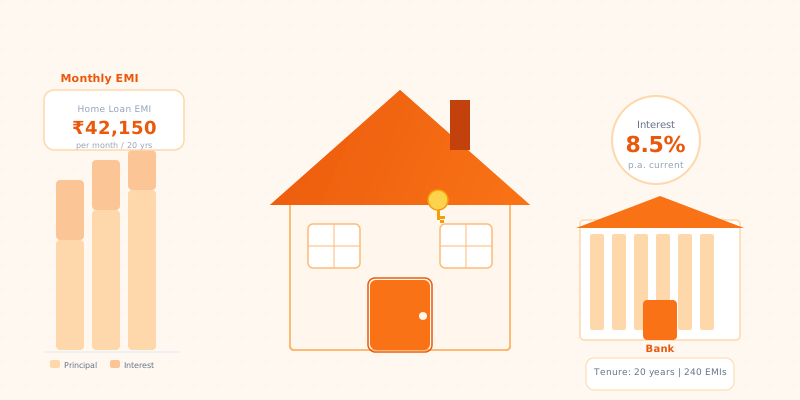
Consider a home loan of Rs 50,00,000 at an interest rate of 8.5% per annum for a tenure of 20 years (240 months). The monthly interest rate R = 8.5 / (12 x 100) = 0.007083. Plugging into the formula: EMI = 50,00,000 x 0.007083 x (1.007083)^240 / ((1.007083)^240 - 1). The resulting EMI works out to approximately Rs 43,391 per month. Over the full 20-year tenure, you pay a total of Rs 1,04,13,840, meaning the total interest component is roughly Rs 54.14 lakh -- more than the original principal itself.
How Amortization Works
What many borrowers do not realise is that in the early years of a loan, the majority of each EMI goes towards interest rather than principal repayment. In the example above, the very first EMI of Rs 43,391 includes approximately Rs 35,417 as interest and only Rs 7,974 as principal repayment. By month 120 (the halfway point), the interest portion drops to around Rs 24,000 while principal repayment rises to about Rs 19,400. Only in the final few years does principal repayment dominate each EMI. This front-loading of interest is precisely why prepaying a loan in the early years yields significantly higher savings than prepaying later.
Impact of Tenure on EMI vs Total Cost
Choosing a longer tenure reduces your monthly EMI but dramatically increases the total interest paid. For the same Rs 50 lakh loan at 8.5%, a 15-year tenure gives an EMI of about Rs 49,236 with total interest of Rs 38.62 lakh. Stretch it to 25 years and the EMI drops to Rs 40,260 but total interest balloons to Rs 70.78 lakh. A 30-year tenure lowers the EMI further to Rs 38,446 but costs Rs 88.40 lakh in interest -- nearly 1.77 times the principal. The sweet spot for most borrowers lies between 15 and 20 years, balancing affordability with total cost.
Types of Loans Available in India
The Indian lending market offers a wide range of loan products, each designed for specific purposes and carrying different risk profiles, interest rates, and eligibility criteria. Understanding the landscape helps you pick the right product and avoid paying more than necessary.
Home Loans
Home loans are the most common secured loans in India. As of FY 2025-26, interest rates from major lenders typically range from 8% to 9.5% per annum on a reducing balance basis. Most banks offer tenures of up to 30 years, though 20 years is the most popular choice. The Loan-to-Value (LTV) ratio is capped by the RBI: up to 90% for loans up to Rs 30 lakh, 80% for Rs 30-75 lakh, and 75% for loans above Rs 75 lakh. This means you need a down payment of at least 10-25% of the property value. Home loans are linked to external benchmarks such as the RBI repo rate, making them floating-rate products where your EMI or tenure can change when the benchmark moves.
Car Loans
Vehicle loans for new cars typically carry interest rates between 8% and 12% per annum with tenures ranging from 1 to 7 years. LTV can go up to 100% for new vehicles from some lenders, though a 10-20% down payment is common. Used car loans attract higher rates (10-16%) and shorter tenures (up to 5 years). Unlike home loans, car loans are depreciating-asset loans, so prepayment and shorter tenure are generally advisable. Processing fees usually range from 0.5% to 2% of the loan amount.
Personal Loans
Personal loans are unsecured, meaning no collateral is required. This higher risk for lenders translates to interest rates between 10% and 24% per annum, depending on your credit score, income, and employer profile. Tenures range from 1 to 5 years. Approval is typically fast (sometimes within hours from digital lenders), but the total cost of borrowing is significantly higher than secured loans. Personal loans are best used for genuine emergencies or consolidating higher-interest debt like credit card balances.
Education Loans
Education loans in India cover tuition fees, hostel expenses, books, and sometimes even a laptop. Interest rates range from 8% to 13% per annum. A key feature is the moratorium period: repayment begins only after course completion plus a grace period of 6-12 months. For loans up to Rs 7.5 lakh for economically weaker sections, the Central Sector Interest Subsidy (CSIS) scheme covers the full interest during the moratorium period. Loans up to Rs 4 lakh typically do not require collateral, while higher amounts may require property or fixed deposit as security.
Gold Loans, Loan Against Property, and Business Loans
Gold loans offer quick liquidity at rates between 7% and 15%, with LTV up to 75% of gold value (per RBI norms). Loan Against Property (LAP) provides larger amounts at 8-11% by mortgaging residential or commercial property, with tenures up to 15-20 years. Business loans for MSMEs and self-employed individuals range from 10% to 18% depending on vintage, turnover, and credit profile. Government schemes like MUDRA (up to Rs 10 lakh) and Stand-Up India offer subsidised rates for eligible entrepreneurs.
Smart Loan Management Strategies
When to Prepay Your Loan
The decision to prepay a loan versus investing the surplus depends on a simple comparison: is your post-tax return on investment higher or lower than your effective loan interest rate? For instance, if your home loan rate is 8.5% and you are in the 30% tax bracket, the effective cost after Section 24(b) deduction is roughly 5.95-6.8% depending on how much interest qualifies. If your equity mutual fund SIP has been delivering 12-14% CAGR (taxed at 12.5% LTCG above Rs 1.25 lakh), investing may be mathematically superior. However, prepaying a personal loan at 16-18% is almost always the better choice since very few investments reliably beat that rate after tax.
Balance Transfer Benefits
A home loan balance transfer involves moving your outstanding loan from one lender to another offering a lower interest rate. Even a seemingly small reduction of 0.5% can save a substantial amount over a long tenure. On a Rs 50 lakh outstanding balance with 18 years remaining, reducing the rate from 9% to 8.5% saves approximately Rs 5.4 lakh in total interest. However, you must factor in processing fees (typically 0.5-1% of outstanding), legal and valuation charges, and any foreclosure penalty with the existing lender (RBI has prohibited prepayment penalties on floating-rate loans for individuals, but fixed-rate loans may still carry them). As a rule of thumb, a balance transfer is worthwhile if the rate difference is at least 0.5% and you have more than 5 years of tenure remaining.
Flat Rate vs Reducing Rate: A Critical Distinction
Some lenders, particularly for car loans and personal loans from NBFCs, quote interest on a flat-rate basis. Under a flat rate, interest is calculated on the original principal for the entire tenure, ignoring the fact that you are repaying principal every month. A 10% flat rate sounds comparable to a 10% reducing rate, but the effective reducing rate equivalent is approximately 18-19%. This means you are paying nearly double the perceived interest. Always ask for the reducing balance rate (or the Annual Percentage Rate, APR) before comparing loan offers across lenders.
PMAY Subsidy: Who Qualifies?
Under the Pradhan Mantri Awas Yojana (PMAY), eligible first-time home buyers from Economically Weaker Sections (EWS) and Low-Income Groups (LIG) can receive an interest subsidy of up to 6.5% on home loans up to Rs 6 lakh for a tenure of 20 years, translating to a net present value benefit of approximately Rs 2.67 lakh. Middle-Income Group I (annual income Rs 6-12 lakh) gets a 4% subsidy on up to Rs 9 lakh, and MIG-II (Rs 12-18 lakh) gets 3% on up to Rs 12 lakh. The subsidy is credited upfront to the loan account, effectively reducing the outstanding principal and consequently the EMI or tenure.
Home Loan Tax Benefits Explained
Section 24(b): Interest Deduction
Under Section 24(b) of the Income Tax Act, interest paid on a home loan for a self-occupied property is deductible up to Rs 2,00,000 per financial year. If the property is let out (rented), the entire interest amount is deductible against rental income with no upper cap, though the resulting loss from house property that can be set off against other income is limited to Rs 2,00,000 per year. The excess loss can be carried forward for up to 8 assessment years and set off against future house property income. This deduction alone can reduce your tax liability by up to Rs 60,000 per year in the old regime (at the 30% slab) or Rs 52,000 under the new regime (where the effective benefit varies based on applicable slab rates).
Section 80C: Principal Repayment
The principal component of your home loan EMI qualifies for deduction under Section 80C, up to the overall limit of Rs 1,50,000 per financial year. This limit is shared with other eligible investments such as PPF, ELSS, EPF contributions, life insurance premiums, and children's tuition fees. If you are already exhausting your 80C limit through these instruments, the home loan principal deduction may not provide additional tax savings. Note that if you sell the property within 5 years of possession, the 80C deductions claimed on principal repayment are added back to your income in the year of sale. Stamp duty and registration charges paid on purchase are also eligible under Section 80C in the year they are incurred.
Section 80EEA: Additional Benefit for First-Time Buyers
First-time home buyers who took loans sanctioned between 1 April 2019 and 31 March 2022 for properties with a stamp duty value up to Rs 45 lakh could claim an additional interest deduction of Rs 1,50,000 under Section 80EEA. While this section has not been extended beyond March 2022 for new loans, borrowers who availed loans during the eligible window continue to claim this benefit until the loan is fully repaid. This deduction is over and above the Rs 2 lakh limit under Section 24(b), potentially allowing total interest deductions of up to Rs 3.5 lakh per year.
Joint Home Loan: Double the Benefits
When two or more co-borrowers (typically spouses) take a joint home loan and are also co-owners of the property, each co-borrower can independently claim the full set of tax deductions. This means up to Rs 2 lakh interest deduction under Section 24(b) each, and up to Rs 1.5 lakh principal deduction under Section 80C each, potentially doubling the household tax savings to Rs 7 lakh per year. Both co-borrowers must be co-owners and must be contributing to the EMI for their respective claims to be valid. This structure is particularly advantageous when both partners have independent taxable income.
How Oquilia's Loan Calculators Work
All loan calculators on Oquilia use the reducing balance method of interest calculation, which is the standard prescribed by the Reserve Bank of India for all regulated lending institutions. Unlike flat-rate calculators that overstate actual EMIs, our tools compute interest on the declining outstanding principal each month, giving you the exact EMI figure that matches your bank's computation.
Month-by-Month Amortization
Each EMI calculator generates a complete amortization schedule showing the precise split between principal and interest for every single month of your loan tenure. This schedule lets you see exactly when the crossover point occurs (the month where principal repayment begins exceeding interest), how much outstanding balance remains at any point, and what percentage of your total payment has gone towards interest versus actual debt reduction. You can download this schedule as a reference when planning prepayments or evaluating balance transfer offers.
Prepayments and Part-Payments
Our prepayment benefit calculator lets you model both lump-sum prepayments and recurring additional payments. You can see the exact impact on your remaining tenure, total interest saved, and revised amortization schedule. For instance, making a one-time prepayment of Rs 5 lakh in the third year of a Rs 50 lakh, 20-year home loan at 8.5% can reduce your tenure by approximately 2.5 years and save over Rs 9 lakh in interest. The calculator also helps you compare whether reducing EMI or reducing tenure is more beneficial for your situation.
Balance Transfer with All Fees Included
The balance transfer calculator does not just compare interest rates. It factors in the processing fee charged by the new lender, legal and valuation charges, any applicable foreclosure charges with the existing lender, and the time value of these upfront costs. The result is a true net savings figure, not an inflated headline number. It also shows you the break-even month -- the point after which the transfer starts yielding positive savings after recovering all switching costs.
Rent vs Buy: Beyond Simple Comparison
The Rent vs Buy calculator accounts for factors that most simplified calculators ignore. It considers the opportunity cost of the down payment (what it would have earned if invested instead), property appreciation rates specific to 30 Indian cities, rental yield and annual rent escalation, maintenance costs, property tax, home loan tax benefits under Sections 24(b) and 80C, and transaction costs like stamp duty, registration, and brokerage. The output is a year-by-year comparison of total wealth under both scenarios, helping you make a genuinely informed decision rather than relying on conventional wisdom that buying is always better.