

Investment Intelligence
Invest with clarity
Data-driven investment analysis. Compare FD rates across 15+ banks, project your SIP growth, understand NPS tier allocation, and make decisions backed by numbers.
Popular Calculators
Browse by Category
Gold & Real Estate
All Investment Calculators
32 tools available
35+
Investment Calculators
15+
Banks Compared
FY 2025-26
Latest Data
100%
Free & Unbiased
Investment Fundamentals for Indian Investors
India offers one of the most diverse investment landscapes in the world. Whether you are a salaried professional starting your first SIP or a business owner looking to deploy surplus capital, understanding the core asset classes is essential before putting money to work.
Asset Classes Available in India
Equity represents ownership in companies. You can invest through direct stocks on the BSE/NSE, equity mutual funds, or index funds tracking benchmarks like the Nifty 50 or Sensex. Historically, Indian equities have delivered 12-15% CAGR over long periods, though with significant short-term volatility. Equity is best suited for goals that are five or more years away.
Debt instruments include fixed deposits, government bonds, corporate bonds, debt mutual funds, and small savings schemes like PPF and NSC. These typically offer 6-8% returns with lower volatility, making them suitable for short- to medium-term goals and capital preservation.
Gold has been a traditional Indian investment. Today, you can invest through Sovereign Gold Bonds (SGBs) issued by the RBI, Gold ETFs, or digital gold platforms. SGBs additionally offer 2.5% annual interest on top of gold price appreciation and are exempt from capital gains tax if held to maturity (8 years).
Real estate remains a significant portion of Indian household wealth. Beyond physical property, REITs (Real Estate Investment Trusts) listed on Indian exchanges let you invest in commercial real estate with amounts as low as Rs 10,000-15,000 per unit, offering rental yields of 6-8% plus capital appreciation.
Alternative investments such as InvITs (Infrastructure Investment Trusts), P2P lending, and unlisted equity are gaining traction. These carry higher risk and lower liquidity but can improve portfolio diversification for experienced investors.
The Power of Compounding
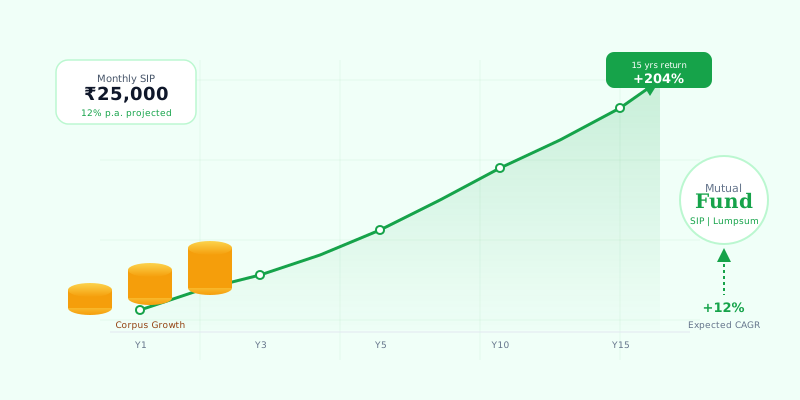
Albert Einstein reportedly called compound interest the eighth wonder of the world. In investing, compounding means your returns generate their own returns. The effect is modest in early years but becomes dramatic over time. Consider this: if you invest Rs 10,000 per month via SIP at a 12% annualised return, after 10 years you would have approximately Rs 23 lakh (on Rs 12 lakh invested). Continue for 20 years, and the corpus grows to roughly Rs 1 crore on a total investment of Rs 24 lakh. By year 30, it reaches approximately Rs 3.5 crore on Rs 36 lakh invested. Nearly 90% of the final amount comes from compounding, not your contributions.
SIP vs Lumpsum Investing
A Systematic Investment Plan (SIP) invests a fixed amount at regular intervals, typically monthly. This approach leverages rupee cost averaging: you buy more units when prices are low and fewer when prices are high, effectively smoothing out your purchase cost. SIPs are ideal for salaried investors who earn monthly income and want to build discipline.
Lumpsum investing deploys the entire amount at once. Statistically, lumpsum investing outperforms SIP about two-thirds of the time in rising markets because money is exposed to market growth for longer. However, the risk of entering at a market peak is real. For most retail investors, SIP is the more practical and psychologically comfortable approach. If you receive a windfall (bonus, inheritance, property sale), consider a Systematic Transfer Plan (STP) that moves the lumpsum from a liquid fund into equity over 6-12 months.
Risk and Return: The Unavoidable Tradeoff
Every investment involves a tradeoff between risk and return. A bank savings account (3-4% interest) carries near-zero risk but barely keeps up with inflation. Equity mutual funds offer higher expected returns but can fall 20-40% in a bad year. Your job as an investor is to accept the right level of risk for each financial goal. Short-term goals (1-3 years) warrant low-risk instruments like FDs and liquid funds. Medium-term goals (3-5 years) can include hybrid funds and short-duration debt funds. Long-term goals (5+ years) benefit from equity exposure where time helps smooth out volatility.
Why Starting Early Matters
Time is the single most powerful variable in wealth creation. Consider two investors: Priya starts investing Rs 5,000 per month at age 25 and stops at age 35 (10 years, Rs 6 lakh total investment). Rahul starts at age 35 and invests Rs 5,000 per month until age 60 (25 years, Rs 15 lakh total investment). Assuming 12% annual returns, Priya's corpus at age 60 would be approximately Rs 1.6 crore, while Rahul's would be about Rs 95 lakh. Despite investing less than half the amount, Priya ends up with significantly more wealth because her money had more time to compound. Every year of delay costs disproportionately more than the previous one.
How to Build a Diversified Portfolio
Asset Allocation by Age
A widely used rule of thumb is the "100 minus age" formula: subtract your age from 100 to determine the percentage of your portfolio that should be in equity. A 30-year-old would allocate 70% to equity and 30% to debt and other assets. A 50-year-old would hold 50% in equity and 50% in safer instruments. This is a starting point, not a rigid rule. Your actual allocation should account for income stability, existing liabilities, dependents, risk tolerance, and specific financial goals. Some financial planners now suggest using 110 or even 120 minus age, given increasing life expectancy in India (currently around 72 years).
Build Your Emergency Fund First
Before investing in any market-linked product, set aside 6-12 months of essential expenses in a highly liquid, low-risk vehicle. A combination of a high-yield savings account and a liquid mutual fund works well. This fund protects you from having to redeem long-term investments during emergencies like job loss, medical expenses, or urgent home repairs. Without an emergency fund, a market downturn coinciding with a personal crisis can force you to sell equity investments at a loss, permanently destroying wealth.
Goal-Based Investing
Rather than investing aimlessly, tie each investment to a specific financial goal. Common goals include building an emergency fund (1-2 years), buying a car (3-4 years), a house down payment (5-7 years), children's higher education (10-18 years), and retirement (20-35 years). Each goal has a different time horizon and therefore a different ideal asset allocation. A child's education fund 15 years away can be heavily equity-oriented today and gradually shifted to debt as the target date approaches. A house down payment needed in 3 years should primarily be in FDs or short-duration debt funds.
Tax-Efficient Portfolio Construction
Tax efficiency can add 1-2% to your effective annual returns. Under the old tax regime, use Section 80C (Rs 1.5 lakh limit) through ELSS mutual funds (3-year lock-in, equity returns), PPF (15-year lock-in, tax-free returns), or EPF. Section 80CCD(1B) allows an additional Rs 50,000 deduction for NPS contributions. Under the new tax regime (default from FY 2023-24), most deductions are unavailable, but the lower slab rates may still result in net tax savings for many. For investments held outside tax-saving instruments, be mindful of holding periods: equity investments held over 12 months attract long-term capital gains (LTCG) tax at 12.5% on gains above Rs 1.25 lakh per year (FY 2025-26 rates). Debt fund gains are taxed at your income tax slab rate regardless of holding period.
Portfolio Rebalancing
Over time, market movements cause your portfolio to drift from its target allocation. If equity markets rally strongly, your 70:30 equity-to-debt ratio might become 80:20. Rebalancing means selling some equity and buying debt (or redirecting new investments) to restore the target. Rebalance annually or when any asset class deviates by more than 5-10 percentage points from its target. This forces a disciplined "buy low, sell high" behaviour and keeps your risk level consistent with your goals.
Understanding Market-Linked Investments
Mutual Fund Categories
SEBI categorises mutual funds into five broad groups. Equity funds invest primarily in stocks and include large-cap, mid-cap, small-cap, multi-cap, flexi-cap, and sectoral/thematic funds. Debt funds invest in bonds and money market instruments, with sub-categories like liquid, ultra-short duration, short duration, corporate bond, and gilt funds. Hybrid funds combine equity and debt in varying proportions — aggressive hybrid (65-80% equity), balanced advantage/dynamic asset allocation, conservative hybrid, and equity savings funds. Solution-oriented fundstarget specific goals like retirement or children's education with a 5-year lock-in. Index funds and ETFs passively track benchmarks like Nifty 50, Nifty Next 50, or Nifty Midcap 150 at very low cost.
Direct vs Regular Plans
Every mutual fund scheme offers two plans: Direct and Regular. The Regular plan includes a distributor commission (trail commission) embedded in the expense ratio, typically 0.5-1.0% higher than the Direct plan. Over long periods, this difference compounds significantly. On a Rs 10,000 monthly SIP over 20 years at 12% (Direct) versus 11% (Regular), the difference is approximately Rs 8-10 lakh. Direct plans are available through AMC websites, apps like MFCentral, or platforms registered as RIAs (Registered Investment Advisers). If you need advisory support, a fee-only financial adviser charging a flat fee is usually more cost-effective than the embedded commission in regular plans.
Expense Ratios and Their Impact
The expense ratio is the annual fee charged by the fund house, expressed as a percentage of assets under management. SEBI caps expense ratios based on fund size and category. For equity funds, the range is typically 0.5-1.5% for Direct plans. Index funds charge as low as 0.1-0.2%. A seemingly small 1% difference in expense ratio over 25 years can reduce your final corpus by 15-20%. Always compare expense ratios within the same category when selecting funds. All else being equal, lower-cost funds deliver better net returns to the investor.
Growth vs IDCW (Dividend) Option
Under the Growth option, all profits remain invested in the fund, compounding over time. The NAV reflects total accumulated returns. Under the IDCW (Income Distribution cum Capital Withdrawal) option, the fund periodically distributes a portion of profits to investors. Importantly, IDCW is not "free income" — it reduces the NAV by the amount distributed. IDCW payouts are also taxed as income at your slab rate, making them tax-inefficient for most investors. Growth is almost always the better choice for wealth creation. Use IDCW only if you need regular cash flows and are in a low tax bracket.
NFOs: Rarely Worth It
A New Fund Offer (NFO) launches a new mutual fund scheme at a face value of Rs 10 per unit. Many investors mistakenly believe NFOs are "cheap" because of the low NAV. In reality, the NAV is irrelevant to value — what matters is the underlying portfolio. An existing fund with a NAV of Rs 500 and an NFO at Rs 10 can hold identical stocks and deliver identical percentage returns. NFOs lack a track record, making it impossible to evaluate the fund manager's execution. Unless the NFO offers a genuinely unique strategy unavailable in existing funds, investing in a proven fund with a 3-5 year track record is almost always the better decision.
Government-Backed Investment Options
India offers several government-backed savings schemes that combine safety with reasonable returns and tax benefits. These are ideal for the conservative portion of your portfolio and for investors who prioritise capital protection.
Public Provident Fund (PPF)
PPF is a 15-year savings scheme with the current interest rate at 7.1% per annum (Q1 FY 2025-26), compounded annually. The minimum annual deposit is Rs 500 and the maximum is Rs 1.5 lakh. PPF enjoys EEE (Exempt-Exempt-Exempt) tax status: contributions qualify for Section 80C deduction, interest earned is tax-free, and the maturity amount is fully tax-free. Partial withdrawals are allowed from the 7th year, and loans against the balance are available from the 3rd to 6th year. After the initial 15-year period, you can extend in blocks of 5 years with or without further contributions. PPF is one of the safest long-term instruments available and is suitable for the debt allocation of any investor's portfolio.
National Pension System (NPS)
NPS is a market-linked retirement savings scheme regulated by PFRDA. It offers two account types: Tier I is the primary retirement account with a lock-in until age 60 (partial withdrawals allowed after 3 years for specific purposes). At maturity, 60% of the corpus can be withdrawn tax-free as a lump sum, and the remaining 40% must be used to purchase an annuity. Tier II is a voluntary savings account with no lock-in, functioning like an open-ended mutual fund (no tax benefits except for government employees).
NPS allows allocation across Equity (E), Corporate Bonds (C), Government Securities (G), and Alternative assets (A). Under the Active choice, you can allocate up to 75% to equity (reducing by 2.5% per year after age 50). Tax benefits include Rs 1.5 lakh under Section 80CCD(1) within the 80C limit, plus an additional Rs 50,000 under Section 80CCD(1B) exclusive to NPS. Employer contributions up to 10% of salary (14% for government employees) are deductible under Section 80CCD(2) with no upper cap — this is one of the most underutilised tax benefits for salaried individuals in the old regime.
EPF and VPF
The Employee Provident Fund (EPF) is mandatory for organisations with 20+ employees. Both employer and employee contribute 12% of basic salary. The current interest rate is 8.25% per annum (FY 2024-25), making it one of the highest-yielding risk-free instruments. Interest on EPF contributions up to Rs 2.5 lakh per year (Rs 5 lakh if there is no employer contribution) remains tax-free; interest on contributions exceeding this threshold is taxable. The Voluntary Provident Fund (VPF) allows employees to contribute beyond the mandatory 12%, up to 100% of basic salary, at the same EPF interest rate. VPF is an excellent option for risk-averse investors seeking high fixed returns with sovereign backing.
Sukanya Samriddhi Yojana (SSY)
SSY is designed for the girl child and offers one of the highest interest rates among small savings schemes — currently 8.2% per annum. The account can be opened for a girl child below age 10, with a minimum deposit of Rs 250 and maximum of Rs 1.5 lakh per year. Deposits are required for 15 years, and the account matures when the girl turns 21. Like PPF, SSY enjoys EEE tax status. Partial withdrawal (up to 50% of the balance) is allowed after the girl turns 18 for higher education expenses.
Senior Citizens Savings Scheme (SCSS)
SCSS is available to individuals aged 60+ (or 55+ for those who have taken voluntary retirement). It offers 8.2% per annum with quarterly interest payouts, making it ideal for regular income needs in retirement. The maximum investment limit is Rs 30 lakh. The tenure is 5 years, extendable by 3 years. Contributions qualify for Section 80C deduction, but the interest income is taxable. TDS is deducted if annual interest exceeds Rs 50,000 (the higher threshold for senior citizens).
Post Office Monthly Income Scheme (POMIS)
POMIS offers monthly interest payouts at 7.4% per annum on a 5-year deposit. The maximum investment is Rs 9 lakh for single accounts and Rs 15 lakh for joint accounts. There is no tax benefit on the deposit, and interest is fully taxable. POMIS is suitable for retirees or conservative investors seeking predictable monthly income. Unlike SCSS, there is no age restriction — any adult resident can open a POMIS account.
Investment Mistakes to Avoid
Chasing Past Performance
The most common mistake is selecting funds or stocks based solely on recent returns. A fund that delivered 40% last year may have taken concentrated bets that happened to pay off — the same strategy can produce steep losses the following year. SEBI mandates the disclaimer "past performance is not indicative of future results" for good reason. Instead of chasing last year's topper, evaluate a fund's consistency across market cycles (at least 5-7 years), the fund manager's tenure and track record, the expense ratio, and how the fund's risk-adjusted returns (measured by Sharpe ratio or Sortino ratio) compare to its benchmark and peers.
Investing Without Clear Goals
Investing without a defined purpose leads to haphazard asset allocation and frequent portfolio changes. When you do not know what you are investing for, every market dip feels threatening and every rally tempts you to book profits. Define specific goals with target amounts and timelines. A Rs 50 lakh corpus for a child's education in 15 years is actionable; "I want to grow my money" is not. Goal clarity determines your asset allocation, investment horizon, and the level of risk you can rationally accept.
Timing the Market
Attempting to buy at the bottom and sell at the top sounds logical but is practically impossible to execute consistently. Research by CRISIL and other agencies shows that missing just the 10 best trading days over a 20-year period can reduce your returns by more than half. These best days often occur during periods of extreme volatility — precisely when market timers are sitting on the sidelines. Time in the market beats timing the market. A disciplined SIP that continues through bull and bear markets outperforms most attempts at tactical entry and exit.
Ignoring Fees and Expenses
Investment fees feel small in percentage terms but compound just like returns — except they compound against you. A 1.5% annual expense ratio on a Rs 50 lakh portfolio costs Rs 75,000 per year. Over 20 years, the cumulative fee drag can amount to several lakhs of foregone returns. Pay attention to mutual fund expense ratios, brokerage charges on stock trades, platform fees, advisory charges, and exit loads. Switching to Direct plans, using discount brokers, and choosing low-cost index funds are simple ways to reduce fee drag.
Over-Diversification
While diversification is essential, owning too many funds defeats the purpose. Holding 8-10 equity mutual funds often results in significant overlap — you end up holding the same stocks across multiple funds, effectively creating an expensive index fund. A well-constructed portfolio for most investors needs no more than 4-6 mutual funds: 1-2 equity funds (a flexi-cap or index fund plus optionally a mid-cap fund), 1 debt fund, 1 ELSS for tax saving (if using the old regime), and optionally a hybrid or international fund. Review your portfolio for overlap using tools that analyse underlying stock holdings across your funds.
Emotional Investing
Fear and greed are the two emotions that destroy investment returns. Fear causes panic selling during market corrections — locking in losses at the worst possible time. Greed leads to over-allocation to a single hot stock, sector, or asset class — creating concentration risk. Behavioural biases like anchoring (fixating on your purchase price), recency bias (overweighting recent events), and herd mentality (buying because everyone else is buying) lead to systematically poor decisions. The antidote is a written investment policy: pre-commit to your asset allocation, rebalancing schedule, and the conditions under which you will buy or sell. Follow the plan, not the headlines.