

Kerala High Court rules tax and utility attachment cannot bind bank-mortgaged property
The Kerala High Court held on 18 November 2026 that a Tahsildar's attachment for VAT, electricity and water dues does not bind a property mortgaged to Union Bank of India in 2008 and sold at auction.
Key points
- The Kerala High Court allowed Union Bank of India's petition against a Tahsildar's attachment of a property it had sold at auction.
- The court declared on 18 November 2026 that the attachment for VAT, electricity and water dues does not bind the property mortgaged in 2008.
- The court directed the Sub Registrar to register the auction buyer's sale certificate within ten days of its production.
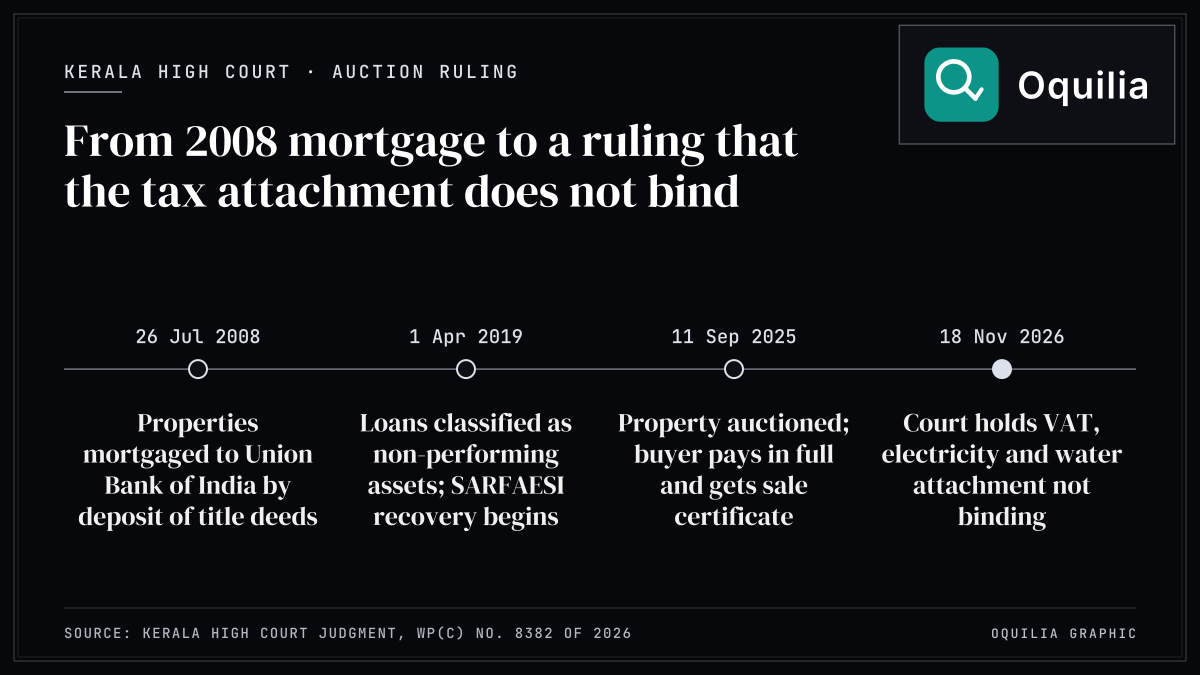
The Kerala High Court on 18 November 2026 held that an attachment ordered by a Tahsildar to recover VAT, electricity and water dues does not bind a property that had been mortgaged to Union Bank of India in 2008 and later sold at a bank auction for Rs 3.66 crore. The court allowed the bank's writ petition (WP(C) No. 8382 of 2026, 2026:KER:88493) and ordered the Sub Registrar to register the buyer's sale certificate.
What Happened
According to the judgment, the borrowers mortgaged several properties to the bank by depositing title deeds on 26 July 2008. The bank registered its security interest with the Central Registry. The loans were classified as non-performing assets (loans in default) on 1 April 2019, and the bank started recovery under the SARFAESI Act, which lets banks sell secured property without going to court.
The property was auctioned on 11 September 2025. The buyer paid in full and received a sale certificate. The bank then learnt that the Kodungallur Tahsildar had attached the property for VAT, electricity and water dues, at the request of the State tax department, the Kerala State Electricity Board and the Kerala Water Authority. The bank said it received no notice of these dues.
The State argued that VAT is a first charge on a dealer's property under Section 38 of the Kerala Value Added Tax Act, 2003, and that the auction was held on an "as is where is" basis. The court rejected both arguments, citing Division Bench rulings of the Kerala and Madras High Courts and a Supreme Court judgment.
The court declared that the attachment and the recovery proceedings are not binding on the property, and directed the Sub Registrar at Maradu to register the sale certificate within ten days of its production.
What It Means
For people who buy property at bank auctions, the ruling holds that later government dues attached by revenue authorities do not override a mortgage the bank created and registered earlier, once the property has been sold and the buyer has paid in full. It also holds that the Sub Registrar must register such a sale certificate. The bank's security interest in this case was recorded with the Central Registry, where buyers can check charges on a property.
Source: High Court judgment
Sources & Citations
- High Court judgment — Kerala High Court