

Inherited money stuck in India: how a non-resident widow, widower or foreign-citizen heir remits it under FEMA 13(R)
RBI's Remittance of Assets rules let a non-resident widow, widower or foreign-citizen heir remit up to USD 1 million a financial year of inherited money. Who qualifies, tax and RBI approval.
Key points
- RBI's Remittance of Assets Regulations, 2016 (FEMA 13(R)/2016-RB, 1 April 2016) set how heirs living abroad can send inherited Indian assets out.
- A non-resident widow or widower, a foreign-citizen heir under FEMA section 6(5), or an NRI or PIO heir may remit up to USD 1 million per financial year.
- Above USD 1 million a year, or on hardship grounds, RBI's prior approval is needed, and the bank must first confirm Indian taxes are paid.
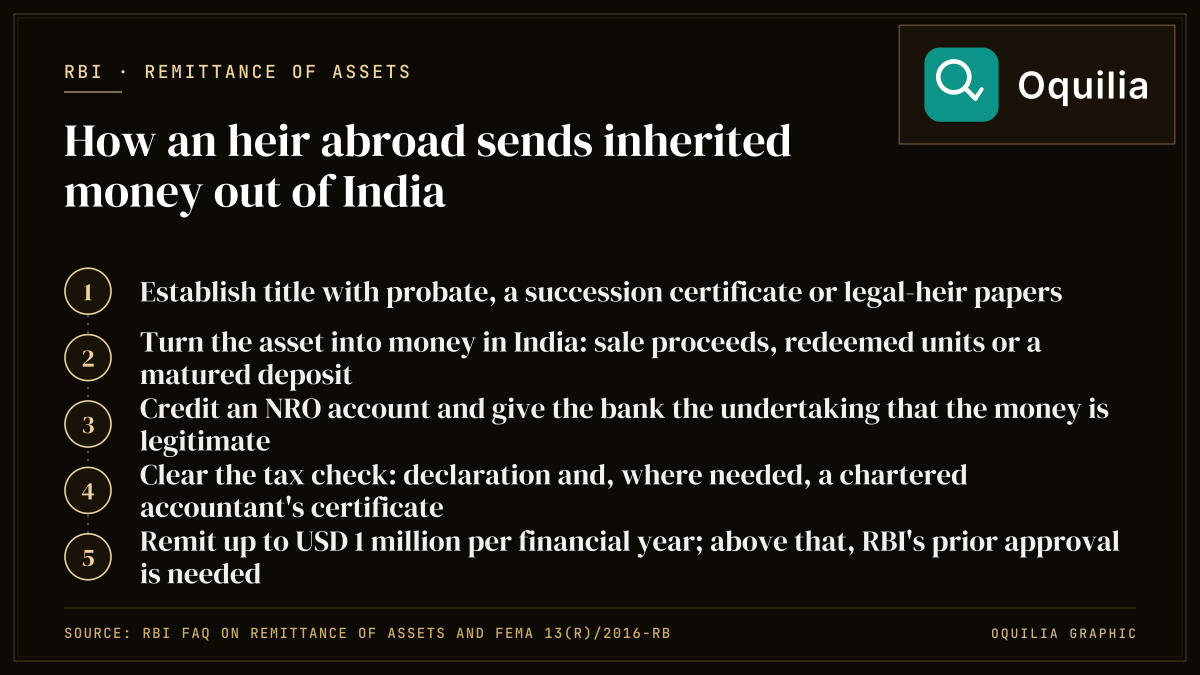
When a resident Indian dies and the heir lives abroad, the money rarely moves on its own. Fixed deposits, a provident fund balance, insurance maturity proceeds, shares and the sale price of a flat all sit in India until a bank agrees to send them out. The rulebook for that is the Foreign Exchange Management (Remittance of Assets) Regulations, 2016, issued by the Reserve Bank of India as Notification No. FEMA 13(R)/2016-RB dated 1 April 2016, with the working detail consolidated in Master Direction No. 13 on Remittance of Assets.
This explainer walks through who qualifies, the USD 1 million per financial year ceiling, when RBI's prior approval is needed, how Indian tax interacts with the remittance, and how a treaty country treats the money on arrival. It draws on the RBI FAQ on Remittance of Assets (dated 2 September 2016) and RBI's FAQ on immovable property (FAQ Id 117, updated 6 April 2023). It is general information, not advice on any individual estate.
FEMA / DTAA Position
What counts as "remittance of assets"
RBI's FAQ Q1 defines remittance of assets as the remittance outside India of funds representing any of five things held in India. The list matters, because anything outside it travels by a different route.
| Asset class (RBI FAQ Q1) | Typical inherited example |
|---|---|
| Deposit with a bank, firm or company | Fixed deposit or savings balance of the deceased |
| Provident fund balance | EPF or PPF balance paid to the nominee or legal heir |
| Superannuation benefits | Employer pension or superannuation fund payout |
| Insurance claim or maturity proceeds | Death claim on a life policy |
| Sale proceeds of shares, securities, immovable property or any other asset held in India | Flat, plot, listed shares, mutual fund units |
Because the definition covers sale proceeds, a house is not remitted as a house: the heir sells it in India and the rupee price is what the 2016 Regulations let go out.
Three groups of foreign-citizen heirs who qualify
RBI's FAQ Q2 lets a foreign national of non-Indian origin (other than a citizen of Nepal or Bhutan, or a Person of Indian Origin) remit up to USD 1 million in a financial year in three situations:
- The person has retired from employment in India.
- The person has inherited assets from a person referred to in section 6(5) of FEMA.
- The person is a non-resident widow or widower who has inherited assets from a deceased spouse who was an Indian national resident in India.
Section 6(5) of FEMA, as RBI's FAQ footnote quotes it, allows a person resident outside India to hold, own, transfer or invest in Indian currency, securities or immovable property in India if it was acquired, held or owned when that person was resident in India, or inherited from a person who was resident in India. In plain terms, the second limb covers a foreign citizen who inherits from someone who held the asset lawfully as a resident.
NRIs and PIOs have a parallel USD 1 million window
The same FAQ Q2 allows an NRI or PIO to remit up to USD 1 million in a financial year from three pools: balances in an NRO account, sale proceeds of assets, and assets acquired by way of legacy, inheritance or deed of settlement.
| Heir profile | Route in RBI FAQ Q2 | Annual ceiling |
|---|---|---|
| Non-resident widow or widower of an Indian national resident in India (foreign citizen, non-Indian origin) | Category 3 for foreign nationals | USD 1 million per financial year |
| Foreign citizen who inherits from a person covered by FEMA section 6(5) | Category 2 for foreign nationals | USD 1 million per financial year |
| NRI or PIO heir | Legacy / inheritance / deed of settlement, NRO balances, sale proceeds | USD 1 million per financial year |
| Citizen of Nepal or Bhutan | Excluded from the foreign-national rows | Not covered by these rows |
Who is "resident" and who is "not permanently resident"
RBI's FAQ Q3 points to section 2(v) of FEMA: broadly, a person residing in India for more than 182 days during the preceding financial year, subject to exclusions for those who have left India for employment, business or any purpose indicating an intention to stay outside for an uncertain period. FAQ Q3 adds that the onus is on the individual to prove residential status if questioned. FAQ Q4 defines "not permanently resident" as a person resident in India for employment of a specified duration, or for a specific job, not exceeding three years.
Where the treaty fits
A Double Taxation Avoidance Agreement (DTAA) does not override FEMA. FEMA decides whether money can leave India and how much; the treaty decides which country taxes the income generated along the way, such as interest, dividends and capital gains on sale. Oquilia's treaty data records India's capital-gains rate under the USA, UK, UAE and Canada treaties at 12.5% for long-term gains, and none of those treaties makes the gain exempt in India.
Tax Treatment in India
The inheritance itself versus income on it
India levies no separate charge on the act of inheriting, and receipts under a will or by inheritance sit outside the gift-tax provisions of the Income-tax Act. What is taxed is income the inherited assets earn after the date of death, and gains when they are sold. RBI's FAQ Q6 makes the link explicit: all remittances are subject to payment of taxes as applicable in India, and the Authorised Dealer bank must satisfy itself on this before it sends the money.
One timing point: the Income-tax Act, 2025 has been in force from 1 April 2026, replacing the 1961 Act for tax year 2026-27 onwards. The section numbers below follow the 1961 Act, under which most existing guidance, forms and bank checklists were written; confirm the corresponding provision of the 2025 Act for any transaction after 1 April 2026.
Rates that apply to a typical estate
| Income on inherited asset | Rate in Oquilia's rate data | Notes |
|---|---|---|
| Long-term gain on listed equity | 12.5% above Rs 1,25,000 | Budget 2024, from 23 July 2024 |
| Short-term gain on listed equity | 20% | Budget 2024, from 23 July 2024 |
| Long-term gain on property or gold | 12.5% without indexation | Older computation of 20% with indexation is recorded for assets acquired before 23 July 2024; confirm eligibility for a non-resident seller |
| Health and education cess | 4% of tax plus surcharge | Applies on top |
| Surcharge | 10% (Rs 50 lakh to Rs 1 crore), 15% (Rs 1 crore to Rs 2 crore), 25% (Rs 2 crore to Rs 5 crore) | Slab-based, on base tax |
For an inherited asset, the cost and the holding period of the previous owner generally carry over to the heir under the Income-tax Act's rules on assets acquired by inheritance, so a flat bought decades ago by a parent is usually a long-term asset in the heir's hands from day one. Run the numbers before signing a sale deed with the NRI tax calculator.
TDS on payments to a non-resident
Section 195 of the Income-tax Act, 1961 governs withholding on payments to non-residents. Oquilia's section brief summarises the rule as withholding at the DTAA rate or the Act's rate, whichever is lower. In practice, the buyer of an NRI heir's flat deducts TDS from the price, and the bank paying out interest on an NRO deposit deducts tax on that interest. A heir who expects the final liability to be lower can apply for a lower-deduction certificate before the sale rather than wait for a refund.
Rental income from an inherited property collected between the date of death and the date of sale is also taxable in India; the rental income tax calculator models that interim period.
The remittance paperwork
Because FAQ Q6 places the tax check on the Authorised Dealer, banks ask for the remitter's online declaration and, where the rules require it, a chartered accountant's certificate, known under the 1961-Act rules as Form 15CA and Form 15CB and filed through the Income Tax e-filing portal. The thresholds for which part of the form applies are set in the Income-tax Rules; check them with the bank or a chartered accountant rather than relying on a figure quoted second-hand.
Tax Treatment Abroad
Foreign tax credit, not double tax
Once the gain or interest has been taxed in India, the country of residence usually taxes the same income again under its own law and then gives a credit for Indian tax under the treaty. Oquilia's treaty dataset records the mechanism country by country.
| Country | Treaty in force from | LTCG rate retained by India | Interest rate cap | Credit mechanism noted |
|---|---|---|---|---|
| United States | 12 September 1991 | 12.5% | 15% | Article 24: foreign tax credit in country of residence |
| United Kingdom | 26 October 1993 | 12.5% | 15% | Tie-breaker for dual residents in Article 4 |
| United Arab Emirates | 22 September 1993 | 12.5% | 12.5% | Tax Residency Certificate needs proof of UAE establishment |
| Canada | 6 May 1997 | 12.5% | 15% | Foreign tax credit via section 126 of Canada's Income Tax Act |
Keep the Indian TDS certificate and the Indian return, because the foreign tax authority will want proof of tax actually paid in India before allowing a credit. The 1 April 2016 Regulations govern the movement of money, not how the residence country treats an inheritance received from abroad, including any disclosure it requires; confirm that with a local adviser. The foreign tax credit calculator shows how the Indian tax offsets the foreign liability on a given gain.
Claiming the treaty rate in India
To get the treaty rate on interest or dividends paid in India, the heir normally furnishes a Tax Residency Certificate from the country of residence. For the UAE, Oquilia's treaty notes record that the certificate requires proof of UAE establishment. For US-resident heirs, the US dataset notes that the 15% dividend rate applies only where the recipient holds at least 10% of the voting stock; portfolio dividends carry 25% under Article 10.
Repatriation Mechanics
Step by step through the Authorised Dealer bank
- Establish title. Obtain the succession document the bank or registrar requires (will with probate where needed, succession certificate, or legal-heir documentation) and transmit the asset into the heir's name.
- Convert the asset to money in India. Sell the flat, redeem the units, or let the deposit mature. RBI's FAQ Q1 treats the sale proceeds, not the asset, as what is remitted.
- Credit an NRO account. Inherited rupee money and sale proceeds are not foreign-exchange inflows, so they go into a non-repatriable rupee account first; unlike an NRE account, which holds repatriable foreign inflows.
- Give the NRO undertaking. Where the remittance is from NRO balances, RBI's FAQ Q2 requires the bank to obtain an undertaking that the money comes from the remitter's legitimate receivables in India, not from borrowing or a transfer from another NRO account, failing which the account holder is liable to penal action under FEMA.
- Clear the tax check. Provide the declaration and, where needed, the chartered accountant's certificate discussed above, so the bank can meet its FAQ Q6 obligation.
- Remit within the annual ceiling. Up to USD 1 million per financial year (1 April to 31 March) can go out without RBI's prior approval.
The repatriation calculator and the NRO-to-NRE calculator help plan how much moves in each financial year.
When RBI's prior approval is needed
RBI's FAQ Q5 lists two cases that need prior approval from the Reserve Bank:
| Trigger (RBI FAQ Q5) | What it means for the heir |
|---|---|
| Remittance above USD 1,000,000 per financial year on account of legacy, bequest or inheritance to a foreign citizen resident outside India, or by NRIs / PIOs from NRO balances, sale proceeds or inherited assets | Either spread the remittance across financial years or apply to RBI through the bank |
| Hardship will be caused to a person if the remittance is not made | An application on hardship grounds, even within or above the ceiling |
An estate worth USD 2.4 million, for example, can be remitted by an NRI heir in three financial years at USD 1 million, USD 1 million and USD 0.4 million without an approval, or in one year with RBI's approval. The ceiling resets on 1 April each year.
Property inherited under section 6(5)
RBI's FAQ on immovable property (Id 117, Q7) adds a layer. Its answer (a) says a person who acquired property under section 6(5) of FEMA, or that person's successor, cannot repatriate the sale proceeds without RBI approval. Answer (b) in the same reply then states that repatriation up to USD 1 million per financial year is allowed, along with other assets, under the 2016 Regulations for NRIs and PIOs, and for a foreign citizen (other than Nepal, Bhutan or PIO) who inherited from a person referred to in section 6(5), retired from employment in India, or is a non-resident widow or widower of an Indian national resident in India. Read together, the 2016 Regulations route within USD 1 million is the permitted path; beyond it, RBI approval is the gate.
Answer (c) of the same reply applies to property an NRI or PIO bought, not inherited: repatriation is allowed if the property was acquired in line with the foreign exchange law of the time and paid for through banking channels or NRE / FCNR funds, and for residential property is limited to not more than two properties. An heir who inherits a property the deceased had bought with NRE money should ask the bank which limb it falls under before planning the sale.
FAQ
Can a non-resident widow remit her late husband's Indian savings abroad?
Yes, if the husband was an Indian national resident in India. RBI's FAQ Q2 allows a non-resident widow or widower who is a foreign national of non-Indian origin to remit up to USD 1 million per financial year from inherited assets, and NRI or PIO widows have the same USD 1 million ceiling through the legacy and inheritance route.
Is the USD 1 million limit per asset or per year?
Per financial year, across all assets. RBI's FAQ Q2 and Q5 set the ceiling at USD 1,000,000 per financial year, so deposits, sale proceeds and other inherited money remitted in the same April to March year count towards one limit.
Do I pay tax in India just for inheriting?
No separate charge applies to the inheritance itself, but income and gains on the inherited assets are taxable. A long-term gain on listed equity is taxed at 12.5% above Rs 1,25,000 and a long-term gain on property at 12.5% without indexation, plus surcharge where applicable and 4% cess.
Can I avoid capital gains tax in India under the DTAA?
No. Under the USA, UK, UAE and Canada treaties in Oquilia's data, India retains the right to tax long-term capital gains at 12.5%. Relief comes through a foreign tax credit in the country of residence, such as Article 24 of the India-US treaty.
What if the estate is worth more than USD 1 million?
Spread the remittance over more than one financial year, or apply for RBI's prior approval through the Authorised Dealer bank. RBI's FAQ Q5 also allows an application where hardship would be caused if the remittance were not made.
Are citizens of Nepal and Bhutan covered?
Not by the foreign-national rows of RBI's FAQ Q2, which expressly exclude citizens of Nepal and Bhutan and Persons of Indian Origin. PIOs use the separate NRI / PIO route with its own USD 1 million ceiling.
Primary texts: RBI Notification No. FEMA 13(R)/2016-RB (1 April 2016) and Master Direction No. 13. Related: RFC and RFC(D) accounts; RBI's remittance-app framework.
Sources & Citations
- FAQ: Remittance of Assets — Reserve Bank of India
- FAQ: Purchase of Immovable Property — Reserve Bank of India
- Notification No. FEMA 13(R)/2016-RB — Reserve Bank of India
- Master Direction No. 13 on Remittance of Assets — Reserve Bank of India