

RBI's new recovery agent code from January 2027: call recording, one-day notice and a public agency list
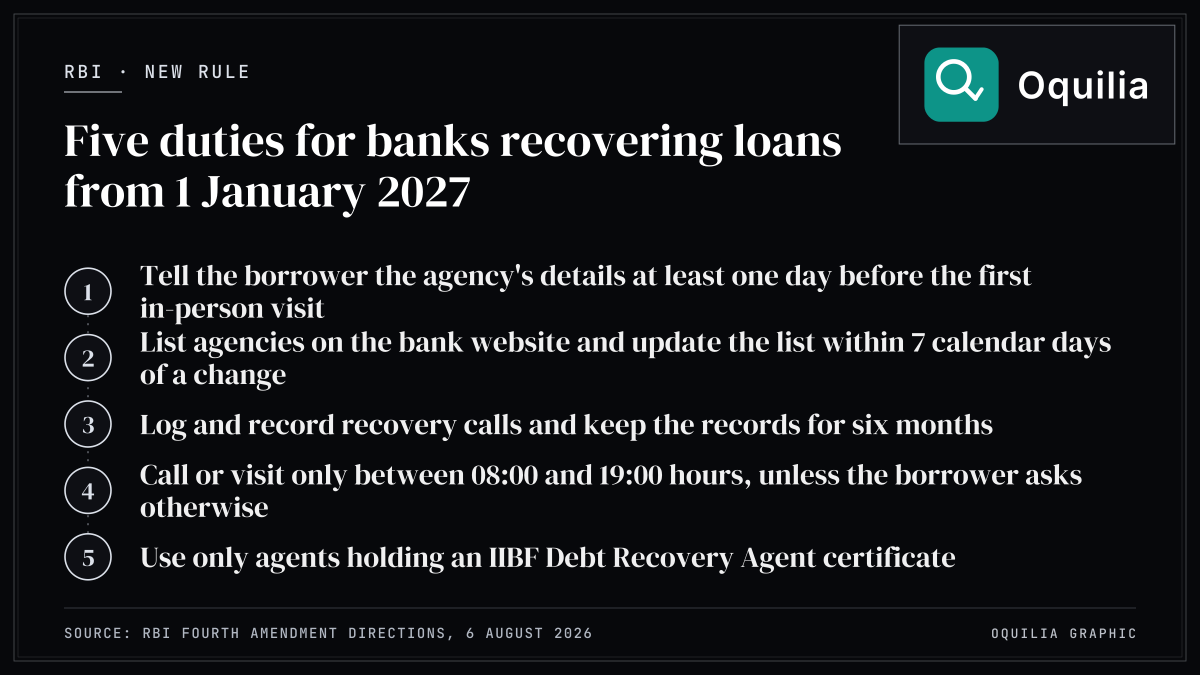
From January 1, 2027, RBI's Fourth Amendment Directions make banks give one day's notice of an agent visit, list agencies online, record calls for six months and cap contact at 08:00-19:00.
Key points
- The RBI issued the Commercial Banks Responsible Business Conduct Fourth Amendment Directions on August 6, 2026, rewriting how banks recover loan dues.
- From January 1, 2027, banks must notify borrowers at least one day before an agent's first visit and keep call recordings for six months.
- Borrowers can complain if agents call outside 08:00-19:00 hours, contact relatives or co-workers, or misstate the debt, and seek compensation under the bank's policy.
From January 1, 2027, every commercial bank in India has to follow a rewritten rulebook on how it chases borrowers who have fallen behind. The Reserve Bank of India issued the Reserve Bank of India (Commercial Banks - Responsible Business Conduct) Fourth Amendment Directions, 2026 on August 6, 2026 (reference RBI/2026-27/223, DOR.MCS.REC.No.193/01-01-032/2026-27). The circular deletes the old recovery paragraphs 408 to 416 and 442 to 454 of the 2025 Master Direction and inserts a new Part L, paragraphs 454A to 454AB, titled "Conduct of Banks in Recovery of Loan Dues and Engagement of Recovery Agencies".
For a borrower or guarantor under pressure, the practical result is a set of checkable duties: a notice at least one day before an agent's first visit, a public list of agencies on the bank's website, call logs and recordings kept for six months, and contact only between 08:00 and 19:00 hours. This playbook sets out the statutory position, the procedure a bank must now follow, the defences a borrower can raise, and what the courts have already said about recovery by force.
If you are already in default, run your numbers first. Oquilia's loan settlement cost calculator shows what a one-time settlement may cost against full repayment, and the loan foreclosure calculator shows the payoff figure if you can close the account outright.
The Statutory Position
The 2026 Amendment is issued under Sections 21 and 35A of the Banking Regulation Act, 1949, which let the RBI give binding directions to banks "in public interest". It amends the Reserve Bank of India (Commercial Banks - Responsible Business Conduct) Directions, 2025. The full text is on the RBI notification page.
Who it covers. The Directions apply to commercial banks other than Small Finance Banks, Payments Banks, Regional Rural Banks and Local Area Banks. If your loan is with a non-banking finance company, these specific paragraphs do not bind it; the circular of August 6, 2026 is addressed to commercial banks only.
What it covers. Paragraph 454A applies Part L to "recovery of loan dues by a bank from borrowers in default, including taking possession of a security". Where the text says so expressly, the rules also apply to normal-course collection from borrowers who are not in default.
What it does not override. Paragraph 454B says the provisions are "without prejudice to any statutory rights available to a bank". That means a bank's power to enforce security under the SARFAESI Act, 2002, or to file a recovery application before the Debts Recovery Tribunal under the Recovery of Debts and Bankruptcy Act, 1993, is untouched. One-time settlement rules in other RBI Directions also continue to apply separately.
Two new definitions. Paragraph 4(24A) defines a recovery agency as any entity or individual, other than the bank's own employees, engaged under an outsourcing arrangement to recover dues from a borrower in default, "irrespective of the contractual designation / nomenclature used". The RBI's own illustration: a Business Correspondent doing recovery work is a recovery agency. Paragraph 4(24B) defines a recovery agent as the agency's representative at the point of customer interface. Paragraph 454C adds that bank employees deployed on recovery are covered too.
The table below maps the key paragraphs to what they require.
| Paragraph | Subject | What the bank must do |
|---|---|---|
| 454D | Recovery policy | Board-level policy with triggers, escalation matrix, rules on death of borrower, documented pre-escalation engagement in financial distress |
| 454F | Compensation | Policy must provide compensation to borrowers / guarantors for loss from non-compliant recovery actions |
| 454I | Training | Agents must hold an IIBF Debt Recovery Agent certificate |
| 454K | Public list | Up-to-date list of agencies on the bank website, updated within 7 calendar days of any change |
| 454L | Advance notice | Agency details sent to borrower / guarantor at least 1 day before the first in-person visit |
| 454M-454N | Change or exit | Immediate notice if the agency is changed or its agreement terminated |
| 454P | Call records | Log time and number of calls; record content; keep 6 months or till a sub judice case is disposed of |
| 454Q | Incentives | Targets and incentives must not induce harsh practices |
| 454R | Possession clause | Loan contract must state notice period, final chance to repay before sale, procedure to return security |
| 454Y | Conduct | Contact only 08:00-19:00 hours, at a place of the borrower's choice |
| 454Z | Harsh methods | Eight listed practices are banned outright |
| 454AA | Grievances | Grievance officer's name, email, phone and address on every recovery communication |
Procedure Step by Step
From January 1, 2027, a bank that hands your account to a recovery agency must follow this sequence. Each step is tied to a paragraph number, so you can check it against what actually happened.
- Policy in place (454D-454G). Before any recovery action, the bank must have a board-approved policy covering triggers for starting recovery, graded actions under an escalation matrix, a code of conduct, recovery where the borrower has died, and "a structured framework for handling cases involving financial distress including documented pre-escalation engagement and guidance regarding available resolution options". The word "documented" in 454D matters: the bank should have a record of engaging with you before escalating.
- Agency vetted (454H). The bank must do due diligence on the agency in line with the RBI's 2025 outsourcing Directions and verify the antecedents of each agent before engagement and then at a periodicity set in its policy.
- Agent certified (454I). Only agents holding a certificate from the Indian Institute of Banking and Finance (IIBF), after completing its Debt Recovery Agents training programme or one run by an institute with an IIBF tie-up, may be used.
- Agency listed publicly (454K). The agency must appear on the bank's website list, showing its name, type (corporate or individual), correspondence address, period of engagement and purpose (recovery or possession of security). Any change must be reflected within 7 calendar days; a termination must be reflected "promptly".
- Advance notice to you (454L). Where your case is forwarded for an in-person visit, the bank must tell you the agency's details at least one day before the first visit. The notice must also carry the grievance mechanism under 454AA.
- Identification at the door (454X). The agent must show an identity card from the agency and carry an authorisation letter plus a copy of the 454L notice. Both documents must include the agency's telephone number and the bank's grievance redressal officer's number.
- Calls logged and recorded (454P). The bank must document the time and number of each call, record the content of calls made to you and calls you make to the number the bank gave you, and tell you the call is being recorded. Records are kept for six months from the call date, or longer if a case is sub judice.
- Contact rules (454Y). Visits and calls only between 08:00 and 19:00 hours unless you have expressly asked otherwise; discussion only with the borrower or guarantor; contact at your chosen place, with home or workplace allowed only if you name no place or fail to appear on two or more successive occasions; and a written receipt for every payment collected.
- Possession of security (454R). If the bank relies on a possession clause in the loan agreement, the clause must be legally valid, brought to your notice when you signed, and must set out six things: notice period, when that notice can be waived, the possession procedure, a final chance to repay before sale or auction, the procedure to return the security, and the sale procedure.
- Change or termination (454M-454N). If the agency changes mid-way, or its contract ends, the bank must notify you "immediately" so that you stop dealing with that agency.
The glossary entry on secured loans explains which security a bank can take possession of in the first place.
Borrower Defences Available
These Directions are not a defence to the debt itself. Paragraph 454B keeps the bank's statutory rights intact, so the amount owed remains owed. What the Directions give you is a set of process grounds for complaint, and a basis to seek compensation under the bank's own policy (454F). The table sets out the main grounds.
| Ground | Paragraph | Evidence to keep |
|---|---|---|
| Visit with no prior notice of agency | 454L | Date of visit; absence of any notice at least 1 day earlier |
| Agency not on the bank's website list | 454K | Screenshot of the list with date; list not updated within 7 days |
| Agent without ID or authorisation letter | 454X | Note of what was shown; witness names |
| Call or visit before 08:00 or after 19:00 | 454Y(4), 454Z(4) | Call log on your phone with timestamps |
| Calls to relatives, friends or co-workers | 454Y(1), 454Z(6) | Statements or messages from those contacted |
| Posting your details or recordings on social media | 454Z(2) | Screenshots with URL and date |
| Overstating the debt or its consequences | 454Z(8) | The message or recording; your statement of account |
| Visit during bereavement, medical emergency or wedding | 454Y(6) | Dates and supporting documents |
| No grievance officer details on a recovery letter | 454AA | The letter itself |
| Lender-locked phone not unlocked within 1 hour of payment | 454T(5)-(6) | Payment receipt and time of unlock |
The eight banned practices. Paragraph 454Z lists eight practices "deemed as harsh": (1) minatory or abusive language; (2) posting video, audio or personal details on social media; (3) inappropriate messages on mobile or social media; (4) excessive calling or messaging, or contact outside permitted hours; (5) threatening or anonymous calls; (6) intimidating or harassing the borrower or guarantor or their relatives, referees, friends or co-workers, including public humiliation or intrusion on privacy; (7) use or threat of violence to the person, family, assets or reputation; and (8) false or misleading statements, "especially about the extent of the debt or the consequences of non-repayment".
Use the call recordings. Under 454P the bank, not you, must hold the recordings for six months. If you complain, ask the bank in writing to preserve and produce the recording of the specific call, giving the date and time. If you file a case within the six-month window, the record must be kept until the case is disposed of.
Device-lock limits. If your phone, tablet or laptop was itself financed by the bank, 454S allows restrictions only when the loan is 30 days past due and notices have been served, with the full set of restrictions only after 60 days past due; outgoing calls cannot be blocked before 60 days. Incoming calls, SMS and emergency SOS must never be blocked (454T(2)). After you pay, restrictions must be reversed within one hour, failing which the bank pays Rs 250 per hour, capped at the loan amount disbursed (454T(6)). Paragraph 454U bars the bank from using contacts, SMS, call logs, photos or location history on the device for any purpose.
Ask about resolution options. Paragraph 454D requires the policy to include "guidance regarding available resolution options" for borrowers in financial distress. Write to the bank asking for that guidance before the account escalates. Settlement talks still run under the separate one-time settlement Directions that 454B preserves, so use the debt consolidation calculator to test whether refinancing other loans frees up cash for a settlement offer, and check your credit score impact before you sign.
Where to complain. Start with the grievance redressal officer named on the recovery letter under 454AA. If the bank does not resolve the complaint, the RBI's complaint channel is listed on rbi.org.in. Where there is a threat or use of force, the police remain the right authority, as the Supreme Court made clear in 2007.
Recent Tribunal/HC Position
The 2026 Directions take effect on January 1, 2027, so no tribunal or High Court has yet ruled on paragraphs 454A to 454AB. The judicial baseline for recovery conduct remains the Supreme Court's decision in Manager, ICICI Bank Ltd vs Prakash Kaur & Ors, Criminal Appeal No. 267 of 2007, decided on February 26, 2007 by a bench of Justice AR. Lakshmanan and Justice Altamas Kabir, reported at (2007) 2 SCC 711 and AIR 2007 SC 1349.
In his concurring opinion, Justice Lakshmanan concluded: "we are governed by a rule of law in the country. The recovery of loans or seizure of vehicles could be done only through legal means. The Banks cannot employ goondas to take possession by force." The opinion also said that "merely because the Agency System is convenient to the banks, and has been approved by RBI, it should not lead to lawlessness and conduct resulting in challenge to rule of law."
Three of the suggestions in that 2007 opinion read closely against the 2026 text:
| 2007 opinion (Prakash Kaur) | 2026 Directions |
|---|---|
| Agency should be "coupled with a license issued after conducting examination"; "appropriate training should be given to the agents" | 454I: only IIBF-certified Debt Recovery Agents |
| Agents "have to be identified as registered agents of the bank" | 454K: public list on the bank website; 454X: ID card and authorisation letter |
| A recovery agent "had gone and threatened a school going child" | 454Z(6): intimidating relatives is a deemed harsh practice |
The 2007 opinion records that, at the time, "no prescribed qualification or licence" was required of agents. Nineteen years later, 454I makes the IIBF certificate mandatory. The judgement has been cited by 365 later decisions on Indian Kanoon, which is why it remains the starting citation for any borrower alleging forcible repossession.
What the 2026 Directions add to that baseline is evidence. A borrower in 2007 had to prove harassment largely by testimony. From 2027, the bank itself must hold call logs and recordings for six months (454P), and must show a dated 454L notice for every first visit. A bank that cannot produce those records will find it harder to answer a complaint.
FAQ
When do the new RBI recovery agent rules start?
The Fourth Amendment Directions, 2026, dated August 6, 2026, come into effect on January 1, 2027. Until then, the earlier paragraphs of the 2025 Responsible Business Conduct Directions continue to apply.
Do these rules apply to NBFCs and small finance banks?
No. The August 6, 2026 circular covers commercial banks other than Small Finance Banks, Payments Banks, Regional Rural Banks and Local Area Banks. Lenders outside that group are governed by their own RBI Directions.
How much notice must a bank give before an agent visits?
Under paragraph 454L, the bank must tell the borrower or guarantor the recovery agency's details at least one day before the first in-person visit. The agent must carry a copy of that notice under 454X.
At what times can a recovery agent call or visit?
Only between 08:00 and 19:00 hours under 454Y(4), unless the borrower or guarantor has expressly asked or authorised contact at another time. Calling outside these hours is a deemed harsh practice under 454Z(4).
Can an agent contact my family or employer?
No. Paragraph 454Y(1) limits discussion of the dues to the borrower or guarantor, and 454Z(6) treats intimidating or harassing relatives, referees, friends or co-workers as a harsh practice.
How long does the bank keep recovery call recordings?
Paragraph 454P requires recordings to be kept for six months from the date of the call, or, where the matter is sub judice, until the case is disposed of. The bank must also tell you the call is being recorded.
Do these rules stop SARFAESI action or a DRT case?
No. Paragraph 454B says the rules are without prejudice to the bank's statutory rights to enforce security. A SARFAESI notice or a DRT application proceeds under its own Act; the 2026 Directions govern how the bank and its agents behave while recovering.
This article explains RBI Directions and a reported judgement for general information. It is not legal advice. For a dispute about a specific loan, consult an advocate practising before the Debts Recovery Tribunal or the High Court in your jurisdiction.