

Kerala High Court refuses borrower second plea for instalments against SBI under SARFAESI
The Kerala High Court dismissed a borrower's second writ petition seeking instalments to repay SBI, holding that she could not seek the same relief again after failing to meet the court's earlier terms.
Key points
- The Kerala High Court dismissed a borrower's second writ petition seeking instalments to clear an SBI loan under SARFAESI recovery.
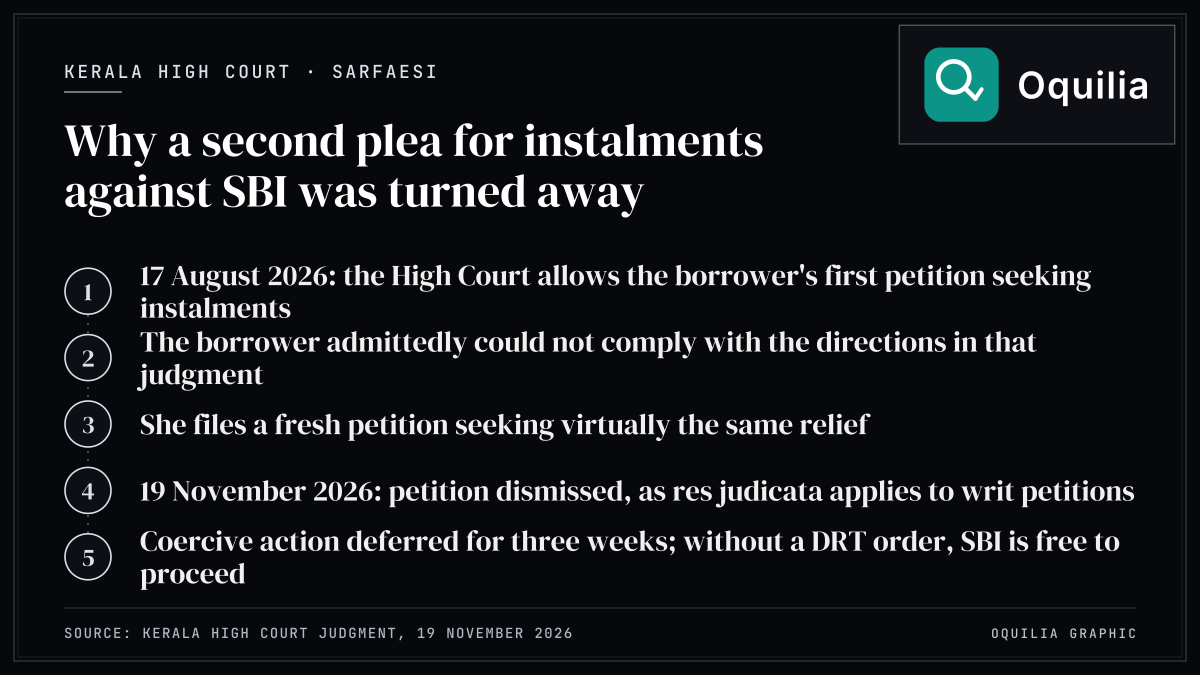
- The court held on 19 November 2026 that the plea was barred by res judicata, after she failed to comply with its 17 August 2026 judgment.
- The court deferred coercive action for three weeks so she could approach the Debts Recovery Tribunal; after that SBI may proceed.
The Kerala High Court has dismissed a borrower's second writ petition seeking time to repay a State Bank of India (SBI) loan in instalments, holding that she could not ask for the same relief again after failing to comply with the court's earlier judgment. The judgment was delivered on 19 November 2026 (WP(C) No. 39185 of 2026, neutral citation 2026:KER:88852).
What Happened
According to the judgment, the borrower took a loan from SBI and the account was not properly serviced, so the bank started proceedings under the SARFAESI Act, the 2002 law that lets lenders take over and sell secured property. She first approached the High Court seeking instalments, and the court allowed that petition by a judgment dated 17 August 2026. The judgment records that she admittedly could not comply with the directions in it, and then filed a fresh petition seeking virtually the same relief.
The court held that the principle of res judicata, which stops the same matter being litigated twice between the same parties, applies to writ petitions. It said that a litigant who has failed to meet the conditions of an earlier judgment in the same transaction, and seeks the same directions again at a later stage, is abusing the court's process. It added that the Supreme Court has held that the scope for interfering with SARFAESI proceedings in writ jurisdiction is "exceedingly limited", and dismissed the petition.
What It Means
The court gave the borrower a short window. On her counsel's statement that she would approach the Debts Recovery Tribunal (DRT), it directed that coercive action against her be deferred for three weeks. If she does not get a favourable order from the DRT within that period, the bank is free to proceed.
For borrowers facing SARFAESI recovery, the ruling is a reminder that an instalment plan allowed by a court has to be kept: in this case, failing to meet it closed the door to a second writ petition, and the remedy pointed to is the DRT. Complaints about a bank can be filed at https://cms.rbi.org.in.
Source: High Court judgment
Sources & Citations
- High Court judgment — Kerala High Court