

Can a government withhold pension or gratuity while a case is pending? The Supreme Court's Article 300A answer in Jitendra Kumar Srivastava
The Supreme Court held on 14 August 2013 that without a pension rule allowing it, a State cannot withhold pension, gratuity or leave encashment during a pending inquiry. Tax and costs explained.
Key points
- The Supreme Court ruled on 14 August 2013 that Jharkhand could not withhold pension or gratuity during pending proceedings without a statutory rule.
- The State had paid only 90% provisional pension and held back the rest, plus all gratuity and leave encashment, citing an executive circular.
- Pensioners facing a withholding order should check whether their own service rules contain an express power, since that decides the outcome.
A retiring government servant with a case pending against them often finds that the pension office releases only part of what is due. The Supreme Court answered whether that is lawful on 14 August 2013, in State of Jharkhand v. Jitendra Kumar Srivastava (Civil Appeal No. 6770 of 2013, with Civil Appeal No. 6771 of 2013). The two-judge bench of Justice A.K. Sikri, who wrote the judgment, and Justice K.S. Radhakrishnan held that where the pension rules give no power to withhold pension or gratuity while proceedings are pending, the State cannot do it through an executive circular. The full judgment is on Indian Kanoon, which lists it as cited by 722 later decisions.
This guide explains what the court decided, how the different retirement dues are treated, how the money is taxed when it is finally released, and what a delay costs in hard rupees.
The Scheme Explained: Pension, Gratuity and the Rule That Decided the Case
The facts, in date order
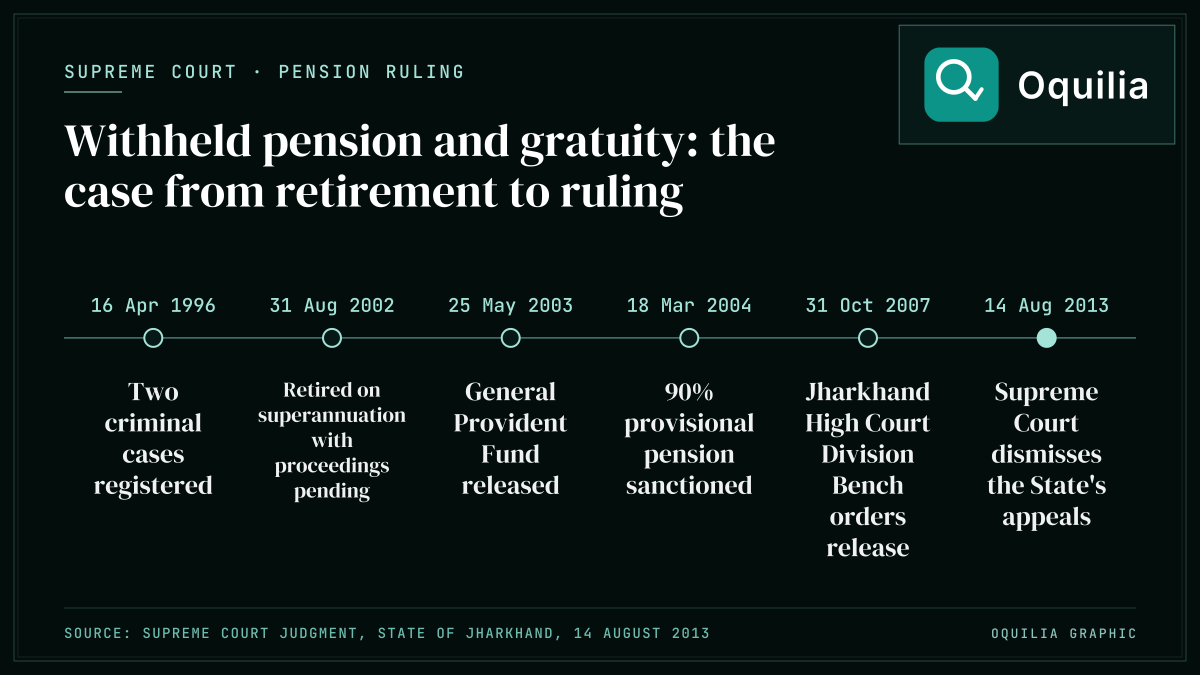
The officer joined the Department of Animal Husbandry and Fisheries of the Government of Bihar on 2 November 1966. On 16 April 1996, two criminal cases were registered against him under the Indian Penal Code and the Prevention of Corruption Act, alleging financial irregularities in 1990-91 and 1991-92. Those are allegations; the 2013 judgment records that the prosecution was still pending and makes no finding on them.
After the Bihar Reorganisation Act, 2000 created Jharkhand, he became an employee of the new State. Disciplinary action was ordered on 30 January 2002, and he retired on superannuation on 31 August 2002 while both sets of proceedings were pending.
| Date | Event (per the judgment, para 3) |
|---|---|
| 2 Nov 1966 | Joined the Government of Bihar |
| 16 Apr 1996 | Two criminal cases registered |
| 30 Jan 2002 | Disciplinary action ordered |
| 31 Aug 2002 | Retired on superannuation |
| 25 May 2003 | General Provident Fund released |
| 18 Mar 2004 | 90% provisional pension sanctioned |
| 16 Mar 2006 | Representation rejected by the State |
| 31 Oct 2007 | Jharkhand High Court Division Bench orders release |
| 14 Aug 2013 | Supreme Court dismisses the State's appeals |
What was held back is the core of the dispute. The State paid 90% provisional pension from 18 March 2004 and withheld the remaining 10%, the salary for the suspension period of 30 January 2002 to 30 August 2002, the leave encashment and the entire gratuity. The General Provident Fund was released on 25 May 2003, about nine months after retirement.
What Rule 43(b) actually allows
The case was governed by the Bihar Pension Rules as they apply to Jharkhand. Rule 43(b) reserves to the State the right to withhold or withdraw a pension, in whole or part, and to recover a pecuniary loss from it, "if the pensioner is found in departmental or judicial proceeding to have been guilty to grave misconduct" or to have caused loss by misconduct or negligence. In paragraph 9 the court read four propositions out of that rule:
- The power arises when the pensioner is found guilty of grave misconduct in a departmental or judicial proceeding.
- It cannot be invoked while those proceedings are still pending.
- Rule 43(b) gives no power at all over leave encashment, whatever the outcome.
- It can be used only after the proceedings conclude with a finding of guilt.
The proviso to Rule 43(b), discussed in paragraph 10, limits proceedings started after retirement: they need the State Government's sanction, must concern an event not more than four years before they are instituted, and require the Bihar Public Service Commission to be consulted before final orders. The court said in paragraph 11 that "there is no provision in the rules for withholding of the pension/ gratuity when such departmental proceedings or judicial proceedings are still pending."
Why a circular was not enough: Article 300A
The State's counsel accepted that the Pension Rules contained no such power and relied instead on administrative instructions, including Resolution No. 3014 dated 31 July 1980, arguing on the strength of Sant Ram Sharma v. Union of India (1968) that instructions may fill gaps in silent rules. The court rejected that in paragraph 6, holding that the question before it was "altogether different".
In paragraphs 7 and 8 the court described gratuity and pension as "not the bounties" but benefits earned through long service, and so in the nature of property. In paragraph 12 it relied on the Constitution Bench in Deokinandan Prasad v. State of Bihar (1971) 2 SCC 330, and in paragraph 13 on State of West Bengal v. Haresh C. Banerjee (2006) 7 SCC 651, which held that after the Forty-Fourth Amendment removed Articles 19(1)(f) and 31(1) with effect from 20 June 1979, the right to property survives as a constitutional right under Article 300A. Article 300A says no person "shall be deprived of his property save by authority of law", and the text is on India Code.
Paragraph 15 is the operative holding: executive instructions lack statutory character, are not "law" for Article 300A, and so the State "cannot withhold even a part of pension or gratuity" on their strength. The appeals were dismissed with costs of Rs 10,000 each.
The limit every reader must note
The same paragraph 15 adds: "Had there been any such provision in these rules, the position would have been different." The judgment does not say pension can never be withheld during a pending case. It says the withholding must rest on a statutory rule, so the answer for any individual depends on the specific service rules that govern them.
| Retirement due | Withheld in this case? | Court's answer (pending proceedings, rules silent) |
|---|---|---|
| Pension (10% balance) | Yes | Cannot be withheld without a rule (paras 11, 15) |
| Gratuity (100%) | Yes | Cannot be withheld without a rule (paras 14, 15) |
| Leave encashment | Yes | Rule 43(b) gives no power at any stage (para 9) |
| Suspension-period salary | Yes | High Court's release order upheld (para 16) |
| General Provident Fund | No, released 25 May 2003 | Not in dispute |
The same logic extends to savings that sit alongside pension. An EPF balance, which currently earns 8.25% for FY 2025-26 as declared by EPFO, and a PPF account at 7.1% for October-December 2026 are the member's own accumulations under their own statutes, and the judgment's reasoning on property applies with greater force to them.
Tax on Withdrawal: How Released Dues Are Taxed
When withheld dues are finally paid, often years later, the tax treatment follows the nature of each payment, not the date it is received. The rules below apply to government servants, which is the group the Jitendra Kumar Srivastava judgment concerns.
Gratuity
Under section 19(1) of the Income-tax Act, 2025, in force from 1 April 2026, a government servant's death-cum-retirement gratuity is exempt in full. For other employees, the exempt part of gratuity is limited to Rs 20 lakh. For payments in FY 2025-26 and earlier, the corresponding provision was section 10(10) of the Income-tax Act, 1961. A gratuity released after a pending inquiry closes therefore carries no tax for a government pensioner, whatever its size. The gratuity calculator works out the amount and the exempt portion.
Pension
Uncommuted pension is taxed as salary, at slab rates, in the year it is received or accrues. A pensioner may claim the standard deduction of Rs 75,000 under the new regime or Rs 50,000 under the old regime. Commuted pension of a government servant was fully exempt under section 10(10A)(i) of the 1961 Act; readers commuting in tax year 2026-27 should confirm the matching entry in section 19 of the 2025 Act on the Income Tax Department's site.
Leave encashment
Leave encashment paid to a Central or State Government employee on retirement was fully exempt under section 10(10AA)(i) of the 1961 Act. The limits for non-government employees differ, and the 2025 Act carries the computation in section 19(2)(f).
Arrears received in a lump
If the withheld 10% of pension is paid as arrears covering several years, all of it may fall into one tax year and push the pensioner into a higher slab. Relief under section 89 of the 1961 Act, claimed by filing Form 10E before the return, spreads the arrears back over the years to which they relate; for tax year 2026-27, confirm the matching relief provision in the 2025 Act. Under the new regime for tax year 2026-27, the section 87A rebate of up to Rs 60,000 makes income up to Rs 12 lakh tax-free, which covers many pensioners even with arrears added.
| Payment on release | Government servant | Notes |
|---|---|---|
| Gratuity | Exempt in full | Section 19(1), 2025 Act; non-government cap Rs 20 lakh |
| Commuted pension | Exempt in full | Section 10(10A)(i), 1961 Act |
| Monthly pension | Taxed at slab | Standard deduction Rs 75,000 new / Rs 50,000 old |
| Pension arrears | Taxed at slab | Section 89 relief via Form 10E |
| Leave encashment | Exempt in full | Section 10(10AA)(i), 1961 Act |
| GPF balance | Exempt | Section 10(11), 1961 Act |
| SCSS interest after reinvestment | Taxed at slab | Paid quarterly at 8.2% |
Worked Drawdown: What a Three-Year Hold Costs
The judgment's facts span more than a decade between retirement in August 2002 and the Supreme Court ruling in August 2013. The example below uses round, hypothetical figures to show the cost of a shorter hold, using only the current rates in Oquilia's rate table.
The assumptions
- Full monthly pension: Rs 50,000, so Rs 6,00,000 a year.
- Provisional pension paid: 90%, so Rs 45,000 a month; Rs 5,000 a month is withheld.
- Gratuity withheld: Rs 15,00,000.
- Leave encashment withheld: Rs 8,00,000.
- Proceedings pending: 3 years, after which everything is released with no penalty imposed.
- Comparison: what the money would have earned in the Senior Citizens' Savings Scheme at 8.2% (October-December 2026 rate), assuming it fits within the scheme's deposit ceiling and the pensioner is eligible.
Year-by-year position
| Year | Pension withheld (cumulative) | Gratuity + leave held | SCSS interest forgone that year | Forgone interest (cumulative) |
|---|---|---|---|---|
| 1 | Rs 60,000 | Rs 23,00,000 | Rs 1,88,600 | Rs 1,88,600 |
| 2 | Rs 1,20,000 | Rs 23,00,000 | Rs 1,88,600 | Rs 3,77,200 |
| 3 | Rs 1,80,000 | Rs 23,00,000 | Rs 1,88,600 | Rs 5,65,800 |
At 8.2%, Rs 23 lakh of gratuity and leave encashment yields Rs 1,88,600 a year, or Rs 47,150 a quarter, since SCSS pays interest quarterly. Over 3 years the retiree forgoes Rs 5,65,800 of income on those two dues alone, before counting the Rs 1,80,000 of pension held back, which is 10% of the Rs 18,00,000 of pension due over those 3 years.
After release
Once the dues are paid in year 4, the retiree receives Rs 1,80,000 of pension arrears and Rs 23,00,000 of gratuity and leave encashment. If Rs 23,00,000 goes into SCSS at 8.2%, the quarterly payout of Rs 47,150 works out to Rs 15,717 a month on top of a full Rs 50,000 pension, a monthly income of about Rs 65,717.
On tax for that year under the new regime: pension of Rs 6,00,000 less the Rs 75,000 standard deduction gives Rs 5,25,000; adding SCSS interest of Rs 1,88,600 and arrears of Rs 1,80,000 gives Rs 8,93,600. That is below Rs 12 lakh, so the 87A rebate of up to Rs 60,000 wipes out the slab tax and the retiree pays nothing. Gratuity and leave encashment add nothing to taxable income for a government servant. The retirement drawdown calculator and the SCSS calculator let readers rerun the numbers with their own figures.
If the money had gone to PPF instead
A retiree with an existing PPF account earning 7.1% would have forgone Rs 1,63,300 a year on the same Rs 23 lakh, or Rs 4,89,900 over 3 years, though PPF contributions are capped each year and the comparison only shows the scale of the opportunity cost. The annuity vs SWP calculator compares lifetime income options once the corpus is in hand.
What the cost says about the remedy
The Jharkhand High Court's Division Bench ordered release on 31 October 2007, more than 5 years after retirement, and the State's appeal kept the dispute alive until 14 August 2013. At the rates above, a five-year hold on Rs 23 lakh would forgo Rs 9,43,000 of SCSS interest. The judgment itself awarded costs of Rs 10,000 per appeal and does not set an interest rate on delayed dues; whether interest is payable depends on the governing rules and on what the court orders in each case.
How to Use This Ruling
The practical route laid out by the 2013 judgment has three steps, each tied to a paragraph of the ruling.
- Find the rule. Ask the pension sanctioning authority in writing which statutory rule it relies on to withhold the amount. Paragraph 15 makes the existence of such a rule the deciding fact.
- Separate the dues. Paragraph 9 treats leave encashment differently from pension under Rule 43(b), so check each due against the rule separately rather than accepting a single blanket withholding order.
- Check whether a finding exists. Under the rule the court read, withholding follows a finding of grave misconduct, not the mere pendency of a case (paragraph 11).
Where the governing rules do contain an express power to withhold during pending proceedings, the position is different, as paragraph 15 says, and the Jitendra Kumar Srivastava ruling will not by itself secure release. Legal advice on the specific rules is the safer course in that situation.
FAQ
Can the government withhold my pension while a departmental inquiry is pending?
Only if a statutory rule allows it. In the 14 August 2013 judgment, the Supreme Court held that Rule 43(b) of the Bihar Pension Rules permits withholding only after a finding of grave misconduct, and that an executive circular cannot fill the gap because it is not "law" under Article 300A.
Does the ruling apply to gratuity too?
Yes. Paragraph 14 holds that the State cannot take away "a part of pension or gratuity or even leave encashment" without a statutory provision. In the case, 100% of the gratuity had been withheld and the court upheld the order to release it.
Is pension a fundamental right?
It is a right to property, which since 20 June 1979 is a constitutional right under Article 300A rather than a fundamental right. The court relied on Deokinandan Prasad (1971) 2 SCC 330 and Haresh C. Banerjee (2006) 7 SCC 651 for this.
What if my service rules do allow withholding pending proceedings?
Then the outcome may differ. Paragraph 15 of the judgment states that had the rules contained such a provision, "the position would have been different". Check the rule that governs your service.
Is gratuity released after an inquiry taxable?
Not for a government servant: section 19(1) of the Income-tax Act, 2025 exempts their death-cum-retirement gratuity in full. For other employees the exempt part is limited to Rs 20 lakh.
How do I reduce tax on pension arrears paid in one year?
For FY 2025-26 and earlier, claim relief under section 89 of the 1961 Act by filing Form 10E before your return. Under the new regime for tax year 2026-27, total income up to Rs 12 lakh is covered by the 87A rebate of up to Rs 60,000.
Did the court say the officer was innocent?
No. The judgment, delivered on 14 August 2013, decided only whether dues could be withheld while the cases were pending. It records that the prosecution registered on 16 April 1996 was still pending and makes no finding on the allegations.
This article explains a court judgment and the tax rules for information only. It is not legal or tax advice for any individual case.
Sources & Citations
- State of Jharkhand & Ors vs Jitendra Kumar Srivastava & Anr, 14 August 2013 — Supreme Court of India (via Indian Kanoon)
- Constitution of India, Article 300A — India Code
- Income-tax Act, 2025, section 19 — Income Tax Department