

Private school teachers and gratuity: how the Supreme Court's 2022 Independent Schools Federation ruling backdated the right to April 1997
The Supreme Court on 29 August 2022 upheld gratuity for private school teachers from 3 April 1997. Who qualifies, how it is calculated and taxed, and a worked Rs 9 lakh drawdown.
Key points
- The Supreme Court on 29 August 2022 upheld the 2009 amendment that made private school teachers employees under the Payment of Gratuity Act from 3 April 1997.
- Teachers in service on 3 April 1997 with at least 5 years of service, counting earlier years, qualify, subject to the Rs 20 lakh ceiling.
- Schools were ordered to pay with interest within 6 weeks, and unpaid teachers may approach the forum under the Act; the gratuity is tax-exempt up to Rs 20 lakh.
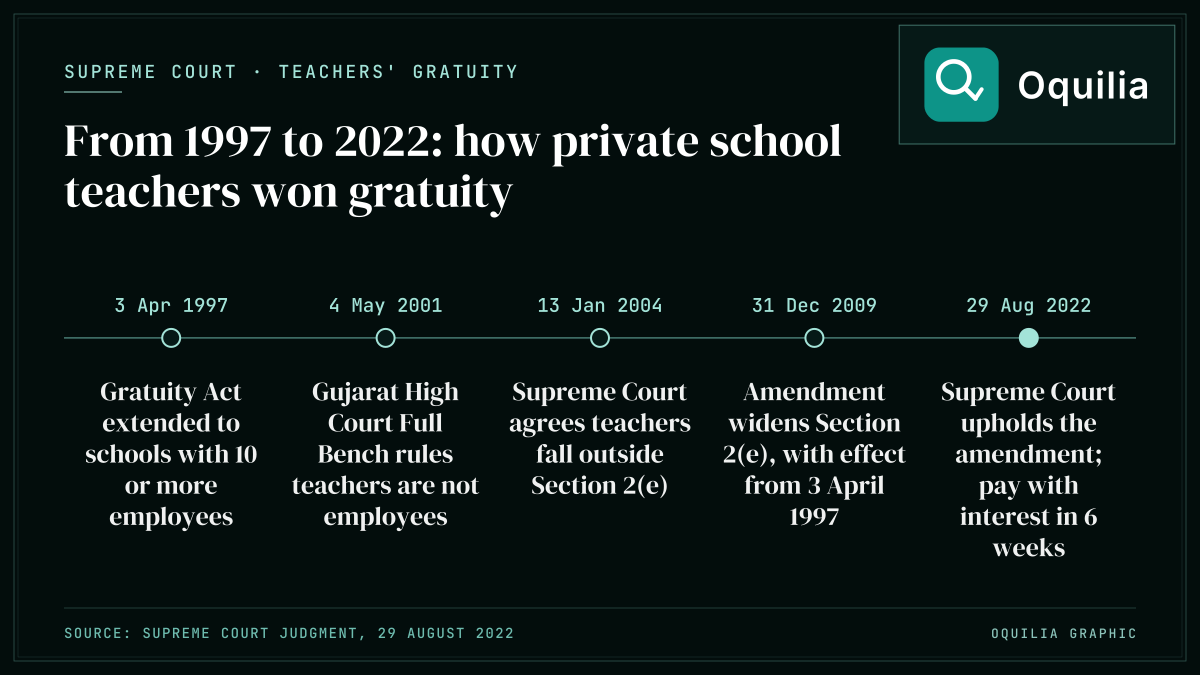
For more than 25 years, teachers in private schools across India have been told two different things about gratuity. On 3 April 1997 the Centre extended the Payment of Gratuity Act, 1972 to educational institutions with ten or more employees. Courts then held that teachers were not "employees" under the Act, Parliament changed the definition in 2009, and private schools challenged that change. On 29 August 2022 the Supreme Court settled it in Independent Schools' Federation of India (Regd.) v. Union of India (Civil Appeal No. 8162 of 2012 with connected matters), upholding teachers' right to gratuity from 3 April 1997 and ordering schools to pay with interest within six weeks (judgment on Indian Kanoon).
This explainer sets out what the ruling decided, who it covers, how the gratuity is worked out and taxed, and how a retired teacher might draw down a lump sum of Rs 9 lakh once it is paid. Every figure below comes from the judgment, the statute or Oquilia's verified rate tables; anything we could not verify has been left out.
The Scheme Explained
How the dispute began: 1997 to 2009
The sequence of events runs across five dates, each of which matters for whether a particular teacher can claim.
| Date | Event | Effect for teachers |
|---|---|---|
| 3 April 1997 | Notification S.O. 1080 (No. S-42013/1/95-SS.(II)) extends the 1972 Act to educational institutions with 10 or more employees | Schools brought within the Act |
| 4 May 2001 | Gujarat High Court Full Bench rules teachers are not "employees" under Section 2(e) | Teachers excluded in practice |
| 13 January 2004 | Supreme Court, Ahmedabad Private Primary Teachers' Association, agrees teachers fall outside Section 2(e) | Exclusion confirmed nationally |
| 31 December 2009 | Payment of Gratuity (Amendment) Act, 2009 passed (introduced 24 February 2009) | Section 2(e) widened; Section 13A inserted, both from 3 April 1997 |
| 29 August 2022 | Supreme Court upholds the 2009 amendment | Gratuity payable with interest within 6 weeks |
The 2004 judgment turned on the old wording of Section 2(e), which covered people employed in skilled, semi-skilled, unskilled, manual, supervisory, technical or clerical work. Teaching fitted none of those labels. The 2009 amendment replaced that list with any person employed for wages "in any kind of work, manual or otherwise", and Section 13A validated gratuity payable from 3 April 1997 notwithstanding any court judgment.
What the Supreme Court held in 2022
According to the judgment published on Indian Kanoon, the Court made four findings that decide most claims:
- Retrospective amendment is valid. Parliament may legislate retrospectively to remove the basis of an earlier judgment; doing so does not "overrule" the court, and the 2009 amendment does not violate Articles 14, 19(1)(g), 21 or 300-A (para 20).
- The 2016 repeal changes nothing. The Repealing and Amending Act, 2016 removed the 2009 amending Act from the statute book, but Section 6A of the General Clauses Act, 1897 preserves the amendments it had already made.
- Who qualifies. The benefit applies to teachers in service on 3 April 1997 whose service ended after that date with at least 5 years of continuous service, and service before 3 April 1997 counts toward the 5 years (para 19).
- Payment orders. All appeals and writ petitions were dismissed, interim stays were vacated, and schools were directed to pay gratuity with interest under the Act within 6 weeks; on default, teachers may approach the appropriate forum under the Act (para 26).
How gratuity is calculated
The formula is 15 days' wages for every completed year of service, or part of a year over 6 months, at the rate of wages last drawn. For a monthly-rated employee, 15 days' wages means monthly wages divided by 26 and multiplied by 15. Wages here are basic pay plus dearness allowance, not house rent allowance or conveyance. The statutory ceiling has been Rs 20 lakh since 29 March 2018 (S.O. 1420(E)). You can run your own figures through Oquilia's gratuity calculator, and the gratuity glossary entry covers the basics.
The law today: the Code on Social Security, 2020
Section 164 of the Code on Social Security, 2020 repealed the 1972 Act, and the Ministry of Labour and Employment's FAQ of 30 December 2025 (items 8 and 9) says gratuity under the Code applies from 21 November 2025. The core rules carried over: 5 years of continuous service (section 53(1)), 15 days' wages per year (section 53(2)), a Rs 20 lakh notified ceiling (section 53(3)), and payment within 30 days with simple interest for delay (section 56). The 2022 ruling decides entitlement for service that ended under the 1972 Act; a teacher retiring after 21 November 2025 claims under the Code.
Tax on Withdrawal
Gratuity is not a withdrawal from a fund the way an EPF or PPF exit is, but it is the retirement lump sum that the tax law treats most generously. The exemption depends on which category the employer falls into and on the tax year in which the money is received.
| Recipient | Year received | Provision | Exempt amount |
|---|---|---|---|
| Teacher of a school covered by the gratuity law | FY 2025-26 or earlier | Section 10(10)(ii), Income-tax Act, 1961 | Amount under section 4(2)-(3) of the 1972 Act, up to Rs 20 lakh |
| Teacher of a school covered by the gratuity law | Tax year 2026-27 onwards | Section 19(1), Table Sl. No. 5, Income-tax Act, 2025 | Same limit, up to Rs 20 lakh |
| Employee of an employer outside the gratuity law | Tax year 2026-27 onwards | Section 19(1), Table Sl. No. 6, Income-tax Act, 2025 | Least of gratuity received, Rs 20 lakh, and half a month's salary per completed year |
| Government school teacher under CCS (Pension) Rules, 2021 or similar | Tax year 2026-27 onwards | Section 19(1), Table Sl. No. 3, Income-tax Act, 2025 | Entire gratuity |
Three points follow from the table. First, the Rs 20 lakh limit is lifetime and aggregate: section 19(2)(a) of the 2025 Act counts gratuity exempted in earlier years against it. Second, any gratuity above the exempt amount is taxed as salary at slab rates in the year of receipt. Third, because a teacher who retired in, say, 2012 may receive the money in 2026, the taxable excess (if any) bunches into one year.
For that bunching problem, relief for arrears exists. The Income Tax Department's guidance for salaried individuals for AY 2026-27 lists gratuity among the items for which relief under section 89(1) can be claimed through Form 10E when salary is received in arrears (incometax.gov.in).
Once the lump sum is reinvested, the income it produces is taxed separately. Interest from the Senior Citizens' Savings Scheme, bank deposits and post office schemes is taxed at slab rates and may attract TDS. Under the FY 2025-26 rules in Oquilia's rate tables, the new regime gives a Section 87A rebate of up to Rs 60,000 where taxable income is up to Rs 12 lakh, with a Rs 75,000 standard deduction for pension income treated as salary.
Worked Drawdown
Example 1: a teacher well within the ceiling
Take a teacher who joined a private school with 40 staff on 1 July 1993 and retired on 30 June 2019 after exactly 26 years. The last drawn basic pay plus DA was Rs 60,000 a month. The teacher was in service on 3 April 1997 and the service ended after it, so para 19 of the judgment applies, and the 3 years and 9 months before 1997 count.
| Step | Working | Amount |
|---|---|---|
| 15 days' wages | Rs 60,000 x 15 / 26 | Rs 34,615 |
| Years counted | 1 July 1993 to 30 June 2019 | 26 |
| Gratuity due | Rs 34,615 x 26 (exact: 60,000 x 15 x 26 / 26) | Rs 9,00,000 |
| Statutory ceiling (from 29 March 2018) | Rs 20 lakh | Not reached |
| Tax-exempt portion | Whole amount, up to formula and Rs 20 lakh | Rs 9,00,000 |
| Interest for delay | Under the Act, at the notified rate | Payable in addition |
The interest is owed separately under para 26 of the judgment and the Act's delayed-payment provision; we have not estimated it because the notified rate is not in our verified tables.
Example 2: when the formula crosses Rs 20 lakh
A senior teacher with Rs 1,50,000 basic plus DA and 30 years of service produces Rs 1,50,000 x 15 / 26 x 30 = Rs 25,96,154 under the formula. Gratuity payable under the Act is capped at Rs 20 lakh unless the school pays more under an award, agreement or contract. If only the statutory Rs 20 lakh is paid, all of it is exempt; if the school voluntarily pays the full Rs 25,96,154, the Rs 5,96,154 excess is taxed as salary.
Turning Rs 9 lakh into retirement income
Suppose the teacher in Example 1 receives Rs 9,00,000 in November 2026. One common route for a retiree aged 60 or more is the Senior Citizens' Savings Scheme, which pays 8.2% a year for Q3 FY 2026-27 (October to December 2026), locked for the deposit's term. On Rs 9 lakh that is Rs 73,800 a year, or Rs 18,450 a quarter, with the principal returned at maturity.
If the teacher instead needs Rs 1,20,000 a year, more than the interest alone, the corpus must be drawn down. The table assumes the corpus earns 8.2% throughout and that Rs 1,20,000 is withdrawn at the end of each year; actual rates for later deposits will be set by future quarterly notifications.
| Year | Opening corpus (Rs) | Interest at 8.2% (Rs) | Withdrawal (Rs) | Closing corpus (Rs) |
|---|---|---|---|---|
| 1 | 9,00,000 | 73,800 | 1,20,000 | 8,53,800 |
| 2 | 8,53,800 | 70,012 | 1,20,000 | 8,03,812 |
| 3 | 8,03,812 | 65,913 | 1,20,000 | 7,49,724 |
| 4 | 7,49,724 | 61,477 | 1,20,000 | 6,91,202 |
| 5 | 6,91,202 | 56,679 | 1,20,000 | 6,27,880 |
| 6 | 6,27,880 | 51,486 | 1,20,000 | 5,59,366 |
| 7 | 5,59,366 | 45,868 | 1,20,000 | 4,85,234 |
| 8 | 4,85,234 | 39,789 | 1,20,000 | 4,05,023 |
| 9 | 4,05,023 | 33,212 | 1,20,000 | 3,18,235 |
| 10 | 3,18,235 | 26,095 | 1,20,000 | 2,24,331 |
After 10 years and Rs 12,00,000 of withdrawals, Rs 2,24,331 remains. Withdrawing Rs 73,800 or less a year keeps the Rs 9 lakh intact at the same rate. Because the gratuity in Example 1 is fully exempt, only the yearly interest enters taxable income. To model other withdrawal rates or a market-linked portfolio, use the retirement drawdown calculator or compare an annuity with a systematic withdrawal plan in the annuity vs SWP calculator.
Claiming arrears that are still unpaid
The 6-week deadline in para 26 ran from 29 August 2022. A teacher whose school still has not paid can approach the appropriate forum under the Act, which the judgment expressly preserves. A practical file includes the appointment letter, the last salary slip showing basic and DA, the relieving or retirement letter, proof of service on 3 April 1997, and a copy of the 29 August 2022 judgment.
FAQ
Does the 2022 ruling cover teachers who retired before 3 April 1997?
No. Para 19 applies to teachers who were in service on 3 April 1997 and whose service ended after that date. A teacher who retired on, for example, 31 March 1997 falls outside the retrospective amendment.
My service before April 1997 was 4 years. Does it count?
Yes. Para 19 counts the entire length of service, including the period before 3 April 1997, toward the 5-year minimum and toward the number of years in the formula.
Is the school required to pay interest as well?
Yes. Para 26 directs schools to pay gratuity together with interest under the Act. Under the Code on Social Security, 2020, simple interest is payable after 30 days at a rate not above the one notified for long-term deposits (section 56(3) and (4)).
Does the 2016 Repealing and Amending Act cancel the 2009 amendment?
No. The Supreme Court held that Section 6A of the General Clauses Act, 1897 preserves amendments already made by an amending Act, so the repeal in 2016 does not undo the 2009 changes to Sections 2(e) and 13A.
Is gratuity received in 2026 taxable for a teacher of a private school?
Gratuity up to the formula amount and the Rs 20 lakh ceiling is exempt under section 19(1), Table Sl. No. 5 of the Income-tax Act, 2025 for tax year 2026-27 onwards. Any amount above that is taxed as salary, and Form 10E relief under section 89(1) may apply to arrears.
Which law governs a teacher retiring in 2026?
The Code on Social Security, 2020, which the Labour Ministry says applies to gratuity from 21 November 2025. Eligibility remains 5 years of continuous service and the ceiling remains Rs 20 lakh.
This article explains the law and a court ruling; it is not legal or investment advice. Rates are as published for October to December 2026 and are revised quarterly.
Sources & Citations
- Independent Schools' Federation of India (Regd.) v. Union of India, Civil Appeal No. 8162 of 2012 (29 August 2022) — Supreme Court of India via Indian Kanoon
- Salaried Individuals for AY 2026-27 — Income Tax Department