

When Your Tenant, Buyer or Relative Becomes the Taxman's 'Agent' for an NRI: Section 306 of the Income-tax Act 2025
Section 306 of the Income-tax Act 2025 lets the tax officer treat a tenant, buyer or relative paying an NRI as the NRI's agent, but only after a hearing. Here is who is caught and how TDS protects you.
Key points
- Section 306 of the Income-tax Act 2025, in force from 1 April 2026, defines who may be treated as the agent of a non-resident.
- A buyer of an Indian capital asset or anyone through whom an NRI receives income can be assessed as agent, but only after an Assessing Officer hearing.
- Deducting tax correctly under section 393(2) protects tenants and buyers, and an agency order can be appealed to the Commissioner (Appeals).
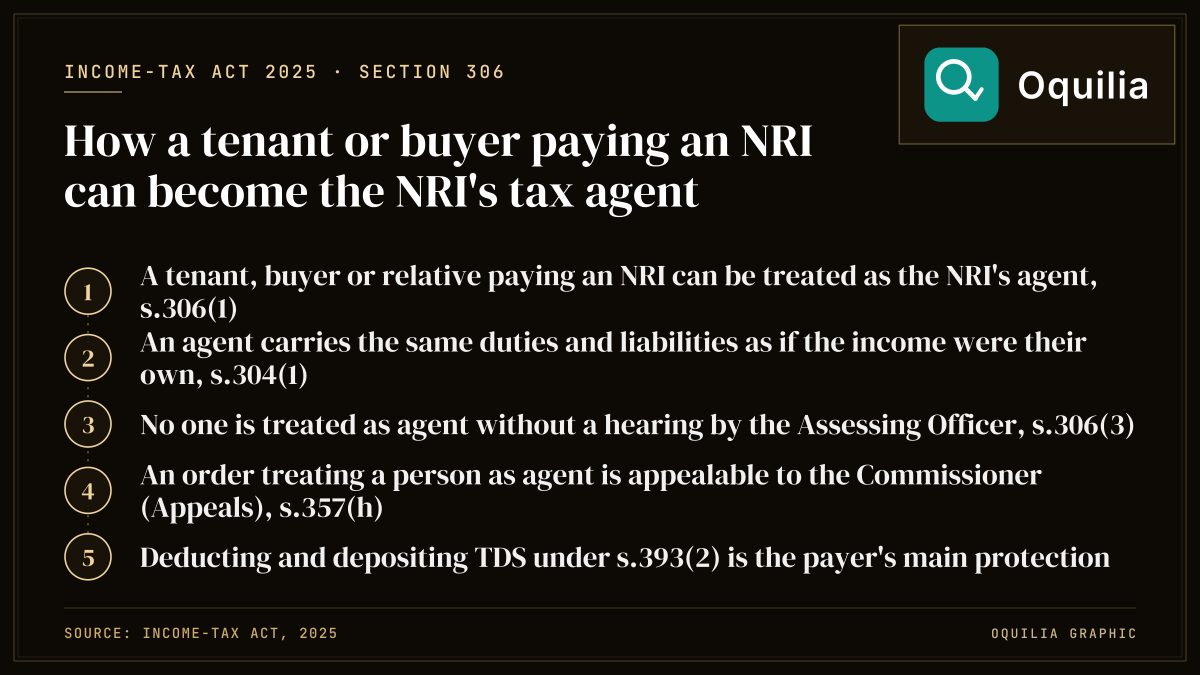
If you pay rent to a landlord who lives in Dubai, buy a flat from a seller in New Jersey, or collect money in India for a relative working in London, the Income-tax Act, 2025 can treat you as that person's "agent". Section 306 of the new Act, which came into force on 1 April 2026 and succeeds section 163 of the Income-tax Act, 1961, sets out who may be regarded as the agent of a non-resident. Once a person is treated as an agent, section 303(1)(a) makes them a "representative assessee", and section 304(1) says they carry "the same duties, responsibilities and liabilities" for that income as if it were their own.
This piece walks through the statutory text, the tax mechanics, the treaty and foreign-credit angle, and the money-movement rules, so that both NRIs and the residents who deal with them know where the line sits. The full text of the 2025 Act is available on Indian Kanoon, and every section quoted below is taken from it.
FEMA / DTAA Position
What section 306 actually says
Section 306(1) lists two groups. Clause (a) covers "any person in India" in four situations, and clause (b) adds "any other person who, whether a resident or non-resident, has acquired by means of a transfer, a capital asset in India". The four limbs of clause (a) are reproduced in the table below.
| Limb of s.306(1) | Who it catches | Everyday NRI example |
|---|---|---|
| (a)(i) | Person in India employed by or on behalf of the non-resident | A caretaker or property manager paid by the NRI |
| (a)(ii) | Person in India with a business connection with the non-resident | An Indian firm with a "business connection" as defined in s.9(9)(a) |
| (a)(iii) | Person in India from or through whom the non-resident receives any income, directly or indirectly | A tenant paying rent, or a relative collecting it |
| (a)(iv) | Trustee of the non-resident | A trustee holding Indian assets for an NRI beneficiary |
| (b) | Any person, resident or non-resident, who has acquired a capital asset in India by transfer | The buyer of an NRI's flat, land or shares |
Limb (a)(iii) is the widest of the five, because it reaches anyone "from or through whom" income flows, "whether directly or indirectly". Clause (b) is the one most buyers overlook: it applies even when the buyer is itself a non-resident, which matters in NRI-to-NRI property deals.
The three statutory safeguards
Section 306 does not make every tenant or buyer an agent automatically. Three limits are written into the provision and the surrounding chapter.
| Safeguard | Statutory source | What it means in practice |
|---|---|---|
| Right to be heard | s.306(3) | No one is treated as agent "unless he has had an opportunity of being heard by the Assessing Officer" |
| Broker carve-out | s.306(2) | An Indian broker dealing through a non-resident broker in the ordinary course is not an agent |
| Right of appeal | s.357(h) | "An order made under section 306 treating the assessee as the agent of a non-resident" is appealable to the Commissioner (Appeals) |
The hearing requirement in section 306(3) is the key point. Agency is a status the Assessing Officer must decide by order, after a hearing, and section 357 makes that order appealable. A tenant or buyer is not liable as an agent merely because a payment passed through their hands.
Where FEMA and the treaties fit
Section 306 is a domestic income-tax rule; it is not found in the Foreign Exchange Management Act, 1999 (FEMA). FEMA governs how the money moves, through NRO and NRE accounts, while the DTAA between India and the NRI's country of residence governs how much India may tax. Under section 304(1)(b), the agent's tax is levied "in like manner and to the same extent" as it would be on the non-resident. In other words, the agent stands in the NRI's shoes, including, in our reading, the treaty rate the NRI could have claimed.
Tax Treatment in India
How liability is assessed
Section 304(1)(a) says the representative assessee "shall be liable to assessment in his own name", but that the assessment is "deemed to be made upon him in his representative capacity only". Section 304(2) then bars the same income from being assessed on that person under any other provision of the Act. Section 304(3) preserves the department's option to go directly after the NRI instead, so agency is an additional route for collection, not a substitute for the NRI's own liability.
Section 304(5) gives the Assessing Officer "the same remedies" against property vested in or controlled by the representative assessee as against any taxpayer. For a relative managing an NRI's flat, that means property under their control can be proceeded against for the NRI's tax on that income.
Section 422: recovery from the NRI's Indian assets
Section 422 is the successor to section 173 of the 1961 Act (text on Indian Kanoon for the old provision). It says that where the person entitled to income referred to in section 9(2) is a non-resident, the tax, "whether in his name or in the name of his agent", (a) "may be recovered by deduction" under the TDS chapter, and (b) arrears "may also be recovered ... from any assets of the non-resident which are, or may at any time come, within India".
Clause (a) of section 422 explains why correct TDS is the payer's best protection. When the tenant or buyer deducts and deposits the right amount, the department collects the NRI's tax at source and has far less reason to pursue the payer as agent.
The TDS rules that matter
Payments to non-residents fall under section 393(2), not section 393(1), which covers payments "to a resident". The contrast is sharp for the two most common NRI transactions.
| Transaction | Resident payee | Non-resident payee |
|---|---|---|
| Rent | s.393(1) Sl. 2(i): 2%, threshold Rs 50,000 for a month or part of a month | s.393(2) Sl. 17: "rates in force", no threshold in the table |
| Purchase of immovable property | s.393(1) Sl. 3(i): 1% of the higher of consideration or stamp duty value, threshold Rs 50 lakh | s.393(2) Sl. 17: "rates in force" on the sum chargeable |
| TAN needed by payer? | Not for Sl. 2(i) and 3(i), per s.397(1)(c)(i) | Yes, s.397(1)(a) applies |
Section 393(2) Sl. 17 covers "any other sum chargeable" to a non-resident other than salary, at "rates in force". Those rates come from the annual Finance Act, and surcharge plus the 4% health and education cess sit on top. Because the TAN exemption in section 397(1)(c)(i) is limited to the resident rows, a tenant or buyer paying an NRI must obtain a TAN; section 468(1) allows a penalty of Rs 10,000 for failing to comply with section 397.
A worked illustration
Suppose an NRI sells a flat acquired after 23 July 2024 and the long-term capital gain is Rs 40 lakh. At the 12.5% rate for long-term gains on property under the post-Budget 2024 regime, tax is Rs 5,00,000. Adding 4% cess of Rs 20,000 gives Rs 5,20,000. As the gain is below Rs 50 lakh, the first surcharge band (10% for income between Rs 50 lakh and Rs 1 crore) does not apply in this simplified case, assuming no other Indian income. You can model your own figures with the NRI tax calculator.
| Item | Amount |
|---|---|
| Long-term capital gain | Rs 40,00,000 |
| Tax at 12.5% | Rs 5,00,000 |
| Health and education cess at 4% | Rs 20,000 |
| Total tax on the gain | Rs 5,20,000 |
| Interest if not deducted for 6 months (1% a month, s.398(3)(a)(i)) | Rs 31,200 |
If the buyer fails to deduct, section 398(1) deems the buyer "an assessee in default", and section 398(3)(a) adds simple interest at 1% a month from the date tax was deductible until it is deducted, and 1.5% a month from deduction until payment. On Rs 5,20,000 left undeducted for six months, the 1% interest alone is Rs 31,200. Section 306(1)(b) also lets the Assessing Officer, after a hearing, treat that buyer as the NRI's agent for the gain.
Lower-deduction routes
Section 395 offers two lawful ways to deduct less. Under section 395(1)(a), the NRI payee can apply to the Assessing Officer for a lower or nil deduction certificate, and under section 395(1)(c) the payer must then deduct at the certified rate "till its validity". Under section 395(2), the payer can apply for a determination of "the appropriate proportion of the sum chargeable to tax", and then deduct only on that proportion. For a property sale, a section 395(1) certificate tied to the actual capital gain is often the cleanest route, because the gain is usually far smaller than the price.
For rent, the rental income tax calculator helps estimate what the NRI owes, which is a useful starting point for any section 395(1) application.
Tax Treatment Abroad
Treaty rates and the credit mechanism
The NRI remains taxable in their country of residence on worldwide income in most cases, so the Indian tax collected through TDS or through an agent becomes a credit claim abroad. Oquilia's treaty data records the following rates for two of the largest NRI corridors.
| Item | India-USA DTAA (in force from 12 September 1991) | India-UAE DTAA (in force from 22 September 1993) |
|---|---|---|
| Capital gains (long-term, India's rate) | 12.5% | 12.5% |
| Interest | 15% | 12.5% |
| Portfolio dividends | 25% | 10% |
| Royalties and fees for technical services | 15% | 10% |
| Treaty note | Article 24: foreign tax credit in the country of residence | TRC requires proof of UAE establishment |
The treaty does not make capital gains on Indian property tax-free. India retains its right to tax the gain at 12.5%, and the NRI's home country then decides how much credit to give. Under Article 24 of the India-USA treaty, the credit is available in the country of residence, so a US-resident NRI generally claims the Indian tax paid against US tax on the same gain.
Why the agent's payment still counts
Section 305(1) entitles a representative assessee who pays tax "as such" to recover the sum from the NRI, or to retain it out of money they hold for the NRI. Because section 304(1)(a) deems the assessment to be made in a "representative capacity only", the tax is economically the NRI's. For a credit claim abroad, the NRI will usually need evidence of the Indian tax, such as Form 26AS entries for TDS or the agent's assessment and challan. Keep these papers for at least as long as your home country's assessment period.
To claim the lower treaty rate at source, the NRI typically needs a Tax Residency Certificate. See our glossary note on the TRC. The UAE treaty note in our data records that a UAE TRC requires proof of UAE establishment.
Repatriation Mechanics
Where the money must land
Income such as rent from Indian property, and sale proceeds of property acquired from rupee funds, is normally credited to the NRI's NRO account. Section 305(2) lets a person who "apprehends that he may be assessed as a representative assessee" retain from money payable to the NRI "a sum equal to his estimated liability". A buyer or tenant who has not deducted correctly can therefore hold back an amount before the funds reach the NRO account, and section 305(3) allows them to obtain an Assessing Officer certificate fixing the amount if the NRI disagrees.
Moving money out of India
Repatriation from an NRO account is capped at USD 1 million per financial year under the Reserve Bank of India's remittance-of-assets rules, published on the RBI website. Banks generally ask for Form 15CA and 15CB before remitting, which is where a chartered accountant confirms that Indian tax on the remittance has been paid or deducted. An unresolved section 306 proceeding or a missing TDS deposit can surface at this step, so clean TDS records under section 393(2) make the 15CB certification simpler.
| Account | Repatriability | Typical NRI use |
|---|---|---|
| NRE | Freely repatriable | Foreign earnings remitted to India |
| NRO | Up to USD 1 million per financial year, after tax | Indian rent, property sale proceeds, dividends |
| FCNR(B) | Freely repatriable, held in foreign currency | Term deposits in USD, GBP and others |
The repatriation calculator estimates how much reaches your foreign account after Indian tax and the USD 1 million NRO cap. Section 422(b) is a reminder that any Indian tax arrears can still be recovered from assets that "are, or may at any time come, within India", so settling them before repatriating is prudent.
FAQ
Am I automatically my NRI landlord's agent because I pay them rent?
No. Section 306(1)(a)(iii) makes a person "from or through whom" a non-resident receives income eligible to be treated as an agent, but section 306(3) says no one is treated as agent unless the Assessing Officer has given them an opportunity of being heard. Deducting tax under section 393(2) Sl. 17 and depositing it is the payer's main protection.
Does section 306 apply if both the buyer and the seller are NRIs?
Yes, it can. Section 306(1)(b) covers "any other person who, whether a resident or non-resident, has acquired by means of a transfer, a capital asset in India". A non-resident buyer of an Indian flat from an NRI seller is therefore within the clause, and still has the TDS duty under section 393(2).
Can I challenge an order treating me as an agent?
Yes. Section 357(h) lists "an order made under section 306 treating the assessee as the agent of a non-resident" among orders appealable to the Commissioner (Appeals). The hearing under section 306(3) comes first, so put your facts on record at that stage.
If I pay the NRI's tax as their agent, can I get it back?
Section 305(1) entitles a representative assessee who pays tax "as such" to recover it from the non-resident, or to retain it from money in their hands for the NRI. Section 305(2) also lets a person who expects to be assessed hold back their estimated liability in advance.
Does a relative who manages my flat need a TAN?
If the relative pays you rent or passes rent to you as a payer, the section 393(2) TDS duty applies, and the TAN exemption in section 397(1)(c)(i) covers only the resident rows. Section 468(1) allows a Rs 10,000 penalty for not complying with section 397. Whether a relative who merely collects rent on your behalf is a "payer" depends on the facts, so take advice.
Is the capital gain exempt in India under the DTAA?
No. India retains the right to tax capital gains on Indian property at 12.5% under the treaty data Oquilia holds for the USA and the UAE. Relief normally comes as a foreign tax credit in the country of residence, for example under Article 24 of the India-USA treaty.
Does section 306 apply to transactions before 1 April 2026?
The 2025 Act came into force on 1 April 2026 under section 1(3). Section 163 of the 1961 Act, which section 306 replaces, governed earlier periods, and the repeal clause preserves the previous operation of the old Act. The wording of the two provisions is substantially similar.
This article is for general information. It is not tax or legal advice. Confirm your position with a chartered accountant before acting, and check current rates on the Income Tax Department portal.
Sources & Citations
- Income-tax Act, 2025 (full text), sections 303 to 306, 357, 393, 395, 398 and 422 — Indian Kanoon
- Section 173, Income Tax Act, 1961: recovery of tax in respect of non-resident from his assets — Indian Kanoon
- RBI Master Directions — Reserve Bank of India
- Income Tax Department e-filing portal — Income Tax Department