

Moved Back With a 401(k) or Foreign Pension Account? How Section 158 of the Income-tax Act 2025 Avoids Taxing It Twice
Section 158 of the Income-tax Act 2025 lets returning residents align Indian tax on a 401(k), UK pension or RRSP with the year of withdrawal, via Form 40. What the law says.
Key points
- Section 158 of the Income-tax Act, 2025, successor to Section 89A, lets India tax foreign retirement account income in a prescribed tax year.
- It covers accounts opened while non-resident in India in a notified country; the 2022 notification named the USA, the UK and Canada.
- Returning residents exercise the option on Form 40 by the return due date; it replaced Form 10-EE and cannot be revoked for that year.
An Indian professional who spent ten years in the United States, the United Kingdom or Canada usually comes home with a retirement account that cannot simply be closed: a 401(k) or IRA, a UK personal pension, or a Canadian RRSP. The problem is timing. Once that person becomes resident in India, Indian law taxes worldwide income as it accrues, while the country holding the account taxes it only on withdrawal. Section 158 of the Income-tax Act, 2025, which carries forward Section 89A of the Income-tax Act, 1961, exists to close that gap. This explainer sets out what the provision says, how the earlier 2022 rules worked, what changed with Form 40 under the Income-tax Rules, 2026, and how the money moves under FEMA. It is information only, not advice on whether to withdraw.
What Section 158 actually says
The verified text of Section 158 of the Income-tax Act, 2025 is short. It is titled "Relief from taxation in income from retirement benefit account maintained in a notified country" and has two sub-sections.
- Sub-section (1): "The income accrued to a specified person in a specified account shall be taxed in such manner and in such tax year, as may be prescribed."
- Sub-section (2)(a): a "notified country" is a country notified by the Central Government.
- Sub-section (2)(b): a "specified account" is an account maintained in a notified country by the specified person for retirement benefits, "the income from which is taxed by that notified country at the time of withdrawal or redemption and, not on accrual basis".
- Sub-section (2)(c): a "specified person" is "a person resident in India having opened a specified account in a notified country while being non-resident in India and resident in that country".
All three tests must be met together. An account opened after the person had already become resident in India fails test (c), and an account in a country that has not been notified fails test (a), however similar the product looks.
| Element | Section 89A, Income-tax Act 1961 | Section 158, Income-tax Act 2025 |
|---|---|---|
| Introduced by | Finance Act, 2021 | Income-tax Act, 2025 (in force from 1 April 2026) |
| Time unit | Previous year | Tax year |
| Prescribed rule (as reported) | Rule 21AAA, Income-tax Rules 1962 | Rule 74, Income-tax Rules 2026 |
| Option form | Form 10-EE | Form 40 |
| Countries notified | Notification No. 25/2022: USA, UK, Canada | Form 40 FAQ lists USA, UK, Canada and Australia "at present" |
FEMA / DTAA Position
The foreign-exchange side
The Foreign Exchange Management Act, 1999 does not force a returning resident to liquidate a foreign pension. Section 6(4) of FEMA allows a person resident in India to hold, own, transfer or invest in foreign currency, foreign securities or immovable property outside India if it was acquired, held or owned while that person was resident outside India. A 401(k) or RRSP built from overseas salary falls in that category, so keeping it after the move is permitted; the full Act is available on India Code. The Liberalised Remittance Scheme limit of USD 250,000 under Section 6 applies to money a resident sends out of India, not to assets lawfully acquired abroad before returning (see the LRS glossary entry).
The treaty side
A Double Taxation Avoidance Agreement decides which country may tax an item of income and how the other country gives credit. It does not fix the timing mismatch on its own, which is why a domestic provision like Section 158 was needed. Oquilia's treaty table records the following headline rates for the three countries named in the 2022 notification.
| Treaty item | India-USA (from 12 Sep 1991) | India-UK (from 26 Oct 1993) | India-Canada (from 6 May 1997) |
|---|---|---|---|
| Long-term capital gains (India's taxing right) | 12.5% | 12.5% | 12.5% |
| Interest | 15% | 15% | 15% |
| Portfolio dividends | 25% | 15% | 25% |
| Royalties and fees for technical services | 15% | 15% | 15% |
| Credit mechanism noted | Article 24 foreign tax credit | Article 4 tie-breaker for dual residents | Section 126, Canadian Income Tax Act |
Two points matter for a returning resident. First, India retains its right to tax capital gains at 12.5% under each of these treaties, so no treaty makes gains inside or outside the account tax-free in India. Second, the dual-residence tie-breaker (Article 4 in the India-UK treaty) matters in the year of return, when a person may be treated as resident by both countries for part of the year.
Tax Treatment in India
The problem the provision solves
Under ordinary rules, once a returning individual becomes resident (and is no longer "not ordinarily resident"), interest, dividends and gains accruing inside a foreign retirement account each year are part of Indian total income. The notified country, by definition in Section 158(2)(b), taxes the same income only at withdrawal. India would therefore tax in, say, year one, while the foreign country taxes in year fifteen. A foreign tax credit normally works only when both countries tax the same income in the same year, so the person could pay twice with no credit to match. Section 158(1) lets the government prescribe a different "tax year" for that income, which in practice aligns Indian taxation with the year of withdrawal. Your residential status in each year is therefore the first fact to settle.
The earlier mechanism: Rule 21AAA and Form 10-EE (1961 regime)
Under the 1961 Act, the Central Board of Direct Taxes issued two notifications dated 4 April 2022. Notification No. 24/2022 inserted Rule 21AAA and Form 10-EE into the Income-tax Rules, 1962, with effect from assessment year 2022-23. Notification No. 25/2022 notified Canada, the United Kingdom of Great Britain and Northern Ireland, and the United States of America for Section 89A. As summarised in published commentary on Rule 21AAA, the earlier rule worked as follows:
- Income accrued in the specified account was included in total income in the previous year in which the notified country taxed it, that is, on withdrawal or redemption.
- The option was exercised by e-filing Form 10-EE on or before furnishing the return of income for the year.
- Once exercised, the option applied to all subsequent previous years and could not be withdrawn.
- If the person later became non-resident, the option was treated as never having been exercised, and accrued income from that year became taxable in India.
These four points describe the 1961-regime rule. They remain relevant for anyone who filed Form 10-EE for assessment year 2022-23 onwards and is now reading back through old returns.
The current mechanism: Form 40 under the 2026 Rules
From 1 April 2026, the Income-tax Act, 2025 and the Income-tax Rules, 2026 replaced the 1961 framework. CBDT's FAQs and guidance notes on forms under the 2026 Rules map Form 10-EE to Form 40, described as the "exercise of option for relief from taxation in income from retirement benefit account maintained in a notified country under section 158 of the Act". Published reproductions of the Form 40 FAQ state that:
- Form 40 is prescribed under Rule 74 of the Income-tax Rules, 2026.
- It must be filed electronically on or before the due date for the return under section 263(1)(c) of the 2025 Act.
- Filing a valid Form 40 within that time is a mandatory condition for the relief.
- Once exercised for a tax year, the option cannot be revoked for that year, applies to later tax years, and must cover all specified accounts in the notified country.
- The countries notified "at present" are the USA, the UK, Canada and Australia.
Oquilia has not been able to read the text of Rule 74 or the country notification under the 2025 Act on an official page, so treat the Australia entry and the precise wording of Rule 74 as items to confirm on the Income Tax e-filing portal before filing.
What the withdrawal costs in India
Once the option is in force, the withdrawal is added to total income in the tax year it is taxed abroad, and charged at slab rates. The FY 2025-26 new-regime slabs in Oquilia's rate table are:
| Taxable income band | New-regime rate |
|---|---|
| Up to Rs 4 lakh | 0% |
| Rs 4 lakh to Rs 8 lakh | 5% |
| Rs 8 lakh to Rs 12 lakh | 10% |
| Rs 12 lakh to Rs 16 lakh | 15% |
| Rs 16 lakh to Rs 20 lakh | 20% |
| Rs 20 lakh to Rs 24 lakh | 25% |
| Above Rs 24 lakh | 30% |
A worked illustration, using only these figures: a resident with Rs 20 lakh of taxable income in the new regime pays Rs 20,000 on the 5% band, Rs 40,000 on the 10% band, Rs 60,000 on the 15% band and Rs 80,000 on the 20% band, a total of Rs 2,00,000, plus 4% health and education cess of Rs 8,000, or Rs 2,08,000. The Section 87A rebate of up to Rs 60,000 is available only where taxable income does not exceed Rs 12 lakh, so a large withdrawal usually takes the person out of the rebate. The NRI tax calculator runs the same slabs.
Surcharge applies on top for higher incomes: 10% between Rs 50 lakh and Rs 1 crore, 15% between Rs 1 crore and Rs 2 crore, and 25% between Rs 2 crore and Rs 5 crore. In the new regime the rate stays capped at 25% above Rs 5 crore; the higher top rate of 37 per cent survives only in the old regime. A single large lump-sum withdrawal can therefore push one tax year into a surcharge band that annual accrual never would have reached.
Tax Treatment Abroad
By the statutory definition, every specified account is one that the notified country taxes "at the time of withdrawal or redemption". The foreign tax is therefore usually paid in the same year as the withdrawal, which is exactly the year Section 158 makes taxable in India.
| Step | Country holding the account | India (after exercising the option) |
|---|---|---|
| Annual growth inside the account | Not taxed (taxed on withdrawal) | Deferred under Section 158 and the prescribed rule |
| Year of withdrawal | Taxed under that country's law | Included in total income for the same tax year |
| Double-tax relief | Treaty credit runs from the residence country | Credit claimed in India for foreign tax on that income |
With both countries taxing in one year, the treaty's credit article can operate. For the United States the treaty table records Article 24 as the foreign-tax-credit article; for Canada the credit mechanism in the treaty table is Section 126 of the Canadian Income Tax Act, which matters only if Canada treats the person as its resident. Under the 1961 regime, the Indian credit was claimed under Rule 128 of the Income-tax Rules, 1962 with Form 67; the corresponding 2026-Rules form should be checked on the e-filing portal for tax year 2026-27 onwards.
Two cautions apply abroad. First, the foreign country's own early-withdrawal charges and withholding are set by that country's law and are outside Section 158 entirely. Second, the relief deals with income that accrues inside the account; it does not change how the foreign country taxes the withdrawal.
Repatriation Mechanics
Because the account holder is now a resident, the rules for non-resident accounts change on return.
- NRE and NRO accounts. RBI's deposit regulations require accounts held as a non-resident to be redesignated as resident accounts once the holder returns for employment or residence. An NRE account cannot simply keep receiving the pension after the change of status.
- FCNR(B) deposits. An FCNR deposit may continue until maturity at the contracted rate, and is then converted.
- Resident Foreign Currency (RFC) account. A returning Indian can hold foreign currency, including withdrawals from a foreign pension account, in an RFC account with an authorised dealer bank in India, without converting it to rupees.
- Holding abroad. Under FEMA Section 6(4), the proceeds may also stay outside India, because the asset was acquired while the person was resident outside India.
Two recent Oquilia reports cover adjacent FEMA changes: the FEMA Deposit (Sixth Amendment) 2026 note on moving NRO balances to NRE or SNRR accounts, and the Currency Declaration Form explainer on carrying foreign cash on arrival. For non-residents moving money out of NRO accounts, the repatriation calculator models the flows.
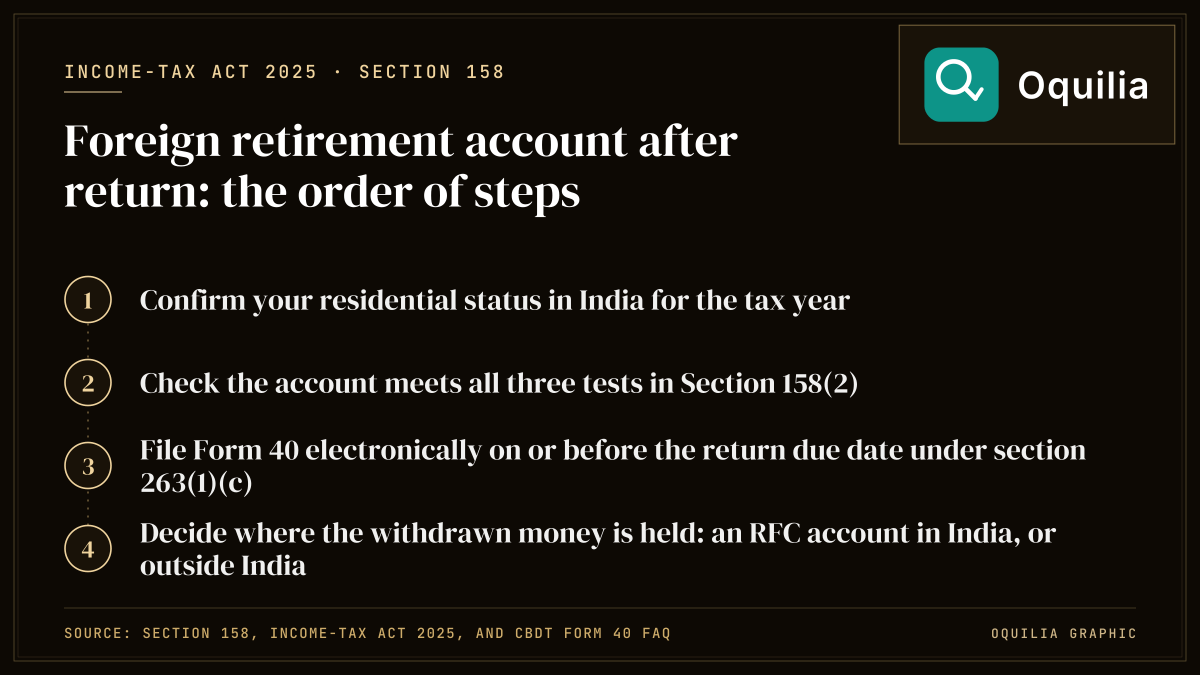
The order of steps rarely changes: confirm residential status for the tax year, confirm the account meets all three tests in Section 158(2), file Form 40 (or Form 10-EE for a 1961-regime year) by the return due date, then decide where the withdrawn money is held.
FAQ
Does Section 158 make my 401(k) tax-free in India?
No. Section 158(1) changes the tax year in which the income is taxed, not whether it is taxed. Under the earlier Rule 21AAA, the income was included in the year the notified country taxed it, at withdrawal.
Which countries are covered?
Notification No. 25/2022 of 4 April 2022 named the USA, the UK and Canada for Section 89A. Published reproductions of CBDT's Form 40 FAQ list the USA, the UK, Canada and Australia as notified "at present" for Section 158. Confirm the list on the e-filing portal before relying on it.
I opened my IRA after returning to India. Does the relief apply?
Not on the statutory text. Section 158(2)(c) covers only accounts opened while the person was non-resident in India and resident in the notified country.
Is there a deadline, and can I change my mind?
Form 40 must be filed electronically on or before the return due date under section 263(1)(c) of the 2025 Act. Published FAQ reproductions say the option cannot be revoked for that tax year and applies to later years; the earlier Rule 21AAA option could not be withdrawn at all.
I filed Form 10-EE under the old Act. What happens now?
Form 10-EE was the 1961-regime form, introduced by Notification No. 24/2022 from assessment year 2022-23. CBDT's 2026 forms guidance maps it to Form 40 for tax years under the 2025 Act. Whether an earlier option carries over automatically is not stated in the material Oquilia has verified, so check with the e-filing portal or a chartered accountant.
What if I move abroad again?
Under the earlier Rule 21AAA, becoming non-resident after exercising the option meant it was treated as never exercised, and accrued income from that year became taxable in India. Whether Rule 74 repeats this has not been verified by Oquilia.
Does the surcharge cap help on a large withdrawal?
In the new regime, surcharge on slab income tops out at 25% above Rs 5 crore, plus 4% cess. A large single-year withdrawal can still cross the Rs 50 lakh, Rs 1 crore or Rs 2 crore surcharge thresholds.
This article is for information only and is not tax, legal or investment advice. Statutory text quoted is from Section 158 of the Income-tax Act, 2025 as published on Indian Kanoon; rates are from Oquilia's FY 2025-26 rate table.
Sources & Citations
- Section 158 in The Income Tax Act, 2025 — Indian Kanoon
- Income Tax e-filing portal — Income Tax Department
- India Code: Foreign Exchange Management Act, 1999 — India Code