

Emigrating Mid-Year With No Plan to Return? How Section 317 Lets the Tax Officer Assess Your Income Before You Leave
Section 317 of the Income-tax Act, 2025 lets the Assessing Officer assess income from 1 April to your departure date on a notice of at least 7 days. What it covers, and what it is not.
Key points
- Section 317 of the Income-tax Act, 2025 lets the Assessing Officer assess an emigrant's income before departure where it appears they will not return.
- A notice under section 317(4) must allow at least 7 days, and income from 1 April to the probable departure date is taxed at that tax year's rates.
- It is not an exit tax: emigrants should keep Form 16 and Form 26AS ready and settle any demand before moving money out through NRO accounts.
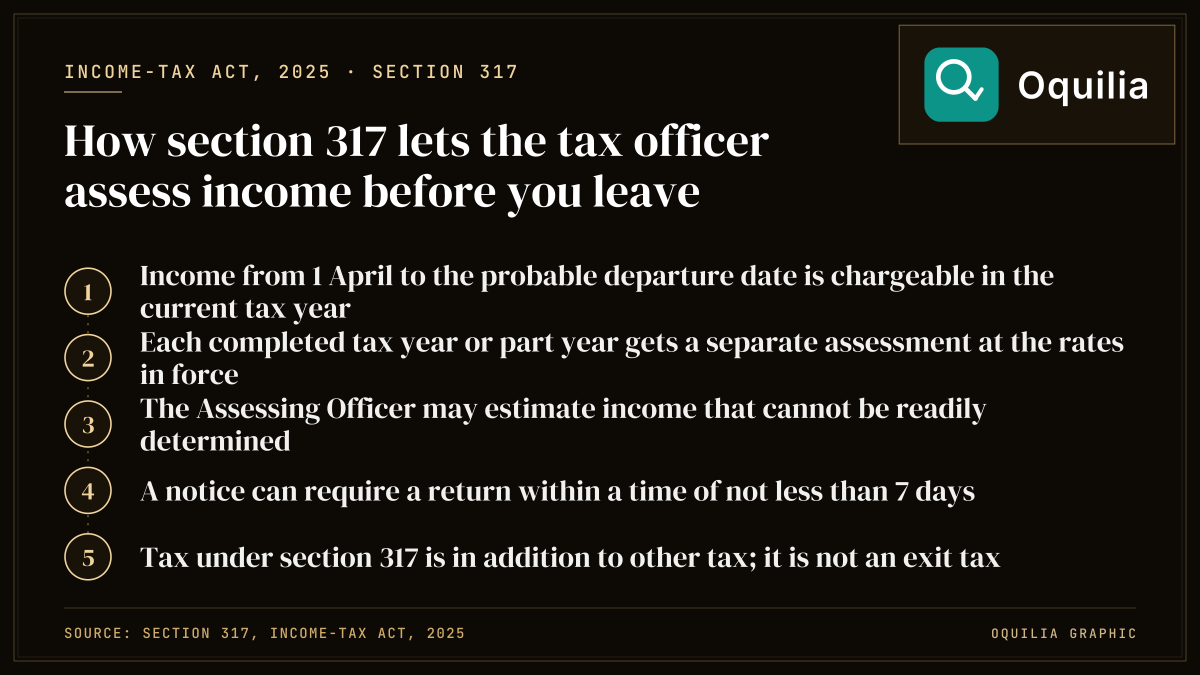
An individual who decides in the middle of a tax year to leave India for good usually assumes the tax department will deal with that year's income in the normal course, after the year closes on 31 March. Section 317 of the Income-tax Act, 2025, titled "Assessment of persons leaving India", gives the Assessing Officer (AO) a power to do something different: to assess income from 1 April of the current tax year up to the probable date of departure, before the individual goes. The provision carries forward section 174 of the Income-tax Act, 1961 (text available on Indian Kanoon), and applies under the 2025 Act, which governs income from 1 April 2026.
Two points frame everything that follows. First, section 317 is discretionary: it operates "where it appears to the Assessing Officer" that an individual may leave India during the current tax year or shortly after it ends, with no present intention of returning. Second, it is a timing and procedure provision, not a separate levy. It does not tax unrealised gains on departure and it is not an exit tax; section 317(6) simply provides that tax under it is in addition to tax payable under the other provisions of the Act, and the income it reaches is the same income the Act would tax anyway.
Rates quoted are those recorded for FY 2025-26 unless stated otherwise; section 317(2) itself requires the rates in force in each tax year to be applied, so confirm the figures for tax year 2026-27 on the Income Tax Department portal before filing.
FEMA / DTAA Position
What section 317 of the 2025 Act actually provides
The verified text of section 317 has six operative parts. They are summarised below in the order in which the Act sets them out.
| Sub-section | What it provides | Practical effect for an emigrant |
|---|---|---|
| 317(1) | Irrespective of section 4, income from the first day of the current tax year to the probable date of departure (the "specified period") is chargeable in that current tax year | Income is taxed in the year of departure, not left to the following year's return cycle |
| 317(2) | Income of each completed tax year, or part of a tax year, in the specified period is charged at the rates in force in that tax year, with a separate assessment for each | A departure soon after 31 March can produce two assessments: one for the year just ended and one for the part year |
| 317(3) | The AO may estimate income for the specified period where it cannot be readily determined | Missing records can lead to an estimate rather than an exact figure |
| 317(4) | The AO may serve a notice requiring a return within a time of not less than 7 days, in the same form and verification as a return under section 268(1) | The response window can be as short as 7 days |
| 317(5) | The AO may also issue notices under section 268(1) or section 280 for tax chargeable under other provisions, again within not less than 7 days | Other pending years can be called up at the same time |
| 317(6) | Tax under section 317 is in addition to tax under other provisions | The section adds a procedure; it does not replace ordinary assessment |
Under section 317(4), the Act applies to the notice as if it were a notice under section 268(1), so the usual verification requirements and consequences of non-compliance with a return notice attach to it.
The 1961 Act predecessor
Section 174 of the 1961 Act served the same purpose, but it was written around the two-year vocabulary of "previous year" and "assessment year". The 2025 Act replaces both with a single "tax year", which is why section 317 speaks of "the current tax year". For income of years up to 31 March 2026, section 174 remains the relevant reference; the current text of both Acts is on India Code.
Where FEMA and tax residence diverge
The Foreign Exchange Management Act, 1999 (FEMA) and the Income-tax Act use different tests of residence, and an emigrant has to satisfy both sets of rules separately. Residential status for the tax year of departure is determined under section 6 of the 2025 Act, which works on day counts and has nothing to do with section 317; section 317 decides only when and how the income is assessed. Our residential status explainer walks through the tax test. Under FEMA, a person who leaves India to take up employment or to settle abroad becomes a person resident outside India for exchange-control purposes, which is what triggers the redesignation of resident bank accounts as NRO accounts.
What the treaties change, and what they do not
A Double Taxation Avoidance Agreement (DTAA) allocates taxing rights between India and the new country of residence. It does not override section 317's procedure, because the income being assessed under section 317 is income earned while the person was still in India. Treaty relief becomes relevant for income that continues to arise in India after departure. Oquilia's treaty data records the following rates for the two most common destinations:
| Item (India-source income) | India-USA DTAA (effective 12 September 1991) | India-UK DTAA (effective 26 October 1993) |
|---|---|---|
| Interest | 15% | 15% |
| Dividends, portfolio holdings | 25% | 15% |
| Royalties and fees for technical services | 15% | 15% |
| Long-term capital gains | India retains taxing rights at 12.5% | India retains taxing rights at 12.5% |
| Notable article | Article 24: foreign tax credit in country of residence | Article 4: tie-breaker for dual residents |
On long-term capital gains from Indian assets, India keeps its taxing right under both treaties, at 12.5%. Under the India-USA treaty, the 15% dividend rate applies only where the recipient holds at least 10% of the voting stock (Article 10); portfolio investors face 25%. You can model these rates with the DTAA benefit calculator.
Tax Treatment in India
Computing the part-year income
Under section 317(1), the specified period runs from 1 April of the current tax year to the probable date of departure. For a person leaving on 30 September 2026, that is the 6 months from 1 April 2026 to 30 September 2026. If the departure falls shortly after 31 March 2027, section 317(2) requires a separate assessment for the completed tax year 2026-27 and another for the part of tax year 2027-28.
The income itself is computed under the ordinary heads: salary, house property, capital gains, other sources and business income. Salary to the last working day, interest and gains on investments sold before departure all fall in the specified period. Where the AO cannot readily determine the figure, section 317(3) allows an estimate, which is the strongest reason to arrive at any meeting or hearing with complete records: Form 16 from the employer, interest certificates from each bank and the Form 26AS statement of tax deducted.
Slabs, rebate, surcharge and cess
The new tax regime slabs recorded for FY 2025-26 are set out below. Section 317(2) applies the rates "in force in that tax year", so confirm that they carry over unchanged for tax year 2026-27 before relying on them.
| Taxable income (new regime) | Rate |
|---|---|
| Up to Rs 4,00,000 | Nil |
| Rs 4,00,001 to Rs 8,00,000 | 5% |
| Rs 8,00,001 to Rs 12,00,000 | 10% |
| Rs 12,00,001 to Rs 16,00,000 | 15% |
| Rs 16,00,001 to Rs 20,00,000 | 20% |
| Rs 20,00,001 to Rs 24,00,000 | 25% |
| Above Rs 24,00,000 | 30% |
Salaried taxpayers in the new regime get a standard deduction of Rs 75,000 (Rs 50,000 in the old regime). The rebate known under the 1961 Act numbering as section 87A removes tax entirely for income up to Rs 12,00,000 in the new regime, with a maximum rebate of Rs 60,000, but it is available only to resident individuals. Whether an emigrant qualifies therefore turns on the section 6 status for the year of departure. Surcharge applies at 10% between Rs 50 lakh and Rs 1 crore, 15% between Rs 1 crore and Rs 2 crore and 25% above Rs 2 crore, and in the new regime it is capped at 25%. Health and education cess is 4% of tax plus surcharge.
Two worked examples
Both examples assume a departure on 30 September 2026, salary as the only income for the 6-month specified period, the new regime, resident status for the year, and the FY 2025-26 rates shown above.
| Step | Example A: salary Rs 9,00,000 | Example B: salary Rs 30,00,000 |
|---|---|---|
| Less standard deduction | Rs 75,000 | Rs 75,000 |
| Taxable income | Rs 8,25,000 | Rs 29,25,000 |
| Tax on Rs 4-8 lakh at 5% | Rs 20,000 | Rs 20,000 |
| Tax on Rs 8-12 lakh at 10% | Rs 2,500 (on Rs 25,000) | Rs 40,000 |
| Tax on Rs 12-24 lakh at 15%, 20%, 25% | Nil | Rs 2,40,000 |
| Tax above Rs 24 lakh at 30% | Nil | Rs 1,57,500 (on Rs 5,25,000) |
| Tax before rebate | Rs 22,500 | Rs 4,57,500 |
| Rebate (income up to Rs 12 lakh) | Rs 22,500 | Not available |
| Cess at 4% | Nil | Rs 18,300 |
| Tax payable | Nil | Rs 4,75,800 |
Example B attracts no surcharge because taxable income is below Rs 50 lakh. If the employer has deducted TDS correctly through September, most of the Rs 4,75,800 should already appear in Form 26AS, and the section 317 return becomes largely a reconciliation exercise. The NRI tax calculator can rerun the arithmetic for your own figures.
Capital gains on assets sold before leaving
Many emigrants sell shares, mutual fund units or property in the months before departure. For listed equity and equity-oriented funds, long-term gains are taxed at 12.5% above an annual exemption of Rs 1,25,000, and short-term gains at 20%, under the rates in force since Budget 2024 (23 July 2024). Long-term gains on property and gold are taxed at 12.5% without indexation; for land or buildings acquired before 23 July 2024, resident individuals and HUFs may instead compute tax at 20% with indexation where that is lower. Gains realised during the specified period form part of the income the AO can assess under section 317.
Responding to a section 317 notice
A notice under section 317(4) can allow as few as 7 days. The sequence below is a practical checklist, not a statutory procedure:
- Count the 7-day minimum from the date the notice is served.
- Collect Form 16, salary slips, bank interest certificates and Form 26AS from 1 April to the last working day.
- Compute income for each completed tax year and estimated income for the part year, as section 317(4) requires.
- Pay any balance as self-assessment tax, then file and verify the return.
- Settle or formally contest any demand before departure and keep every order.
A separate question is whether a tax clearance is needed to leave at all; our report on what section 420 of the 2025 Act requires and from whom deals with that.
Tax Treatment Abroad
Two countries, two calendars
The new country of residence will generally tax worldwide income from the date residence begins there, under its own calendar. The US tax year runs January to December, while India's runs April to March, so a departure on 30 September 2026 means income from 1 April to 30 September 2026 is assessed in India under section 317, while income from 1 October onwards falls into the US system.
Foreign tax credit for continuing Indian income
Income that keeps arising in India after departure, such as interest on NRO deposits, rent or dividends, continues to be taxable in India at the treaty-limited rates shown in the DTAA table. Under Article 24 of the India-USA treaty, the country of residence grants a credit for Indian tax paid on that income, so the same rupee of income is not taxed in full twice. The credit is usually limited to the tax the new country would itself charge on that income. The foreign tax credit calculator shows how the two figures interact.
Dual residence in the year of departure
In the year of departure an individual can be resident in both countries for part of the year. The India-UK treaty resolves this through the tie-breaker in Article 4, but that decides treaty residence only; it does not cancel India's right under section 317 to assess income earned in India before departure.
Repatriation Mechanics
Redesignating accounts
Once a person becomes resident outside India under FEMA, resident savings and deposit accounts must be redesignated as NRO accounts. Income earned in India after departure, such as rent, dividends and interest, is credited to the NRO account. An NRE account holds funds remitted from abroad and is freely repatriable; an FCNR deposit holds foreign currency term deposits. Use the NRO to NRE calculator to see what a transfer leaves after tax.
The USD 1 million NRO window
Balances in an NRO account, including sale proceeds of assets, can be repatriated up to USD 1 million per financial year, subject to tax having been paid. Banks generally require Form 15CA and Form 15CB before processing the remittance, and a settled section 317 assessment or Form 26AS showing the tax paid makes that paperwork straightforward. The repatriation calculator and the remittance cost calculator help plan the amounts.
Sequencing the move
The cleanest order is settled tax first, then Form 15CA/15CB, then the NRO remittance; that reduces the chance a bank holds a transfer because the tax position is unclear. Interest on residual NRO balances stays taxable in India each year, capped at 15% for UK and USA residents.
FAQ
Is section 317 an exit tax?
No. Section 317 of the Income-tax Act, 2025 does not tax unrealised gains or charge a fee for leaving. It lets the AO assess income from 1 April to the probable departure date early, at the normal rates in force for that tax year.
Does every emigrant receive a section 317 notice?
No. The power applies only "where it appears to the Assessing Officer" that the individual may leave India with no present intention of returning. Many emigrants simply file after 31 March in the ordinary course.
How long do I have to reply to a notice under section 317(4)?
The notice must allow not less than 7 days. The return must be in the same form and verification as a return under section 268(1) and set out total income for each completed tax year and estimated income for any part tax year.
Can the AO assess two years at once?
Yes. Section 317(2) requires a separate assessment for each completed tax year and part tax year in the specified period, each at the rates in force in that year. A person leaving in April 2027, for example, could face one assessment for tax year 2026-27 and one for the part of tax year 2027-28.
What if I cannot produce full income records?
Section 317(3) allows the AO to estimate income where it cannot be readily determined. Form 16, interest certificates and Form 26AS for the whole period keep the assessment on actual figures.
Do I lose the Rs 60,000 rebate once I leave?
The rebate of up to Rs 60,000 on income up to Rs 12,00,000 in the new regime is available only to resident individuals. Whether you qualify in the year of departure depends on your residential status under section 6 of the 2025 Act for that tax year.
Can I repatriate my Indian savings after a section 317 assessment?
Yes, within FEMA limits: NRO balances up to USD 1 million per financial year once tax is paid, usually with Form 15CA and Form 15CB. NRE and FCNR balances are freely repatriable.
This article explains the law as set out in the Income-tax Act, 2025 and the treaties cited. It is not tax advice; confirm the position for your own facts with a qualified professional or the Income Tax Department.
Sources & Citations
- Section 174, Income-tax Act, 1961: Assessment of persons leaving India — Indian Kanoon
- Income-tax Act, 2025 — India Code
- Income Tax Department e-filing portal — Income Tax Department