

Phone bought on EMI locked by your lender? RBI's 2026 rule: no lock before 30 days overdue, unlock within an hour or Rs 250 per hour
RBI's 2026 directions bar NBFCs from locking an EMI-financed phone before 30 days past due, require unlocking within an hour of payment, and set Rs 250 per hour compensation.
Key points
- The RBI notified directions on 6 August 2026 limiting how NBFCs may lock phones, tablets and laptops they financed, effective 1 January 2027.
- No restriction may begin before the loan is 30 days past due, full restriction only after 60 days, and incoming calls, SMS and SOS must always work.
- Borrowers who pay up must be unlocked within one hour, or the NBFC owes Rs 250 per hour of delay, capped at the loan amount disbursed.
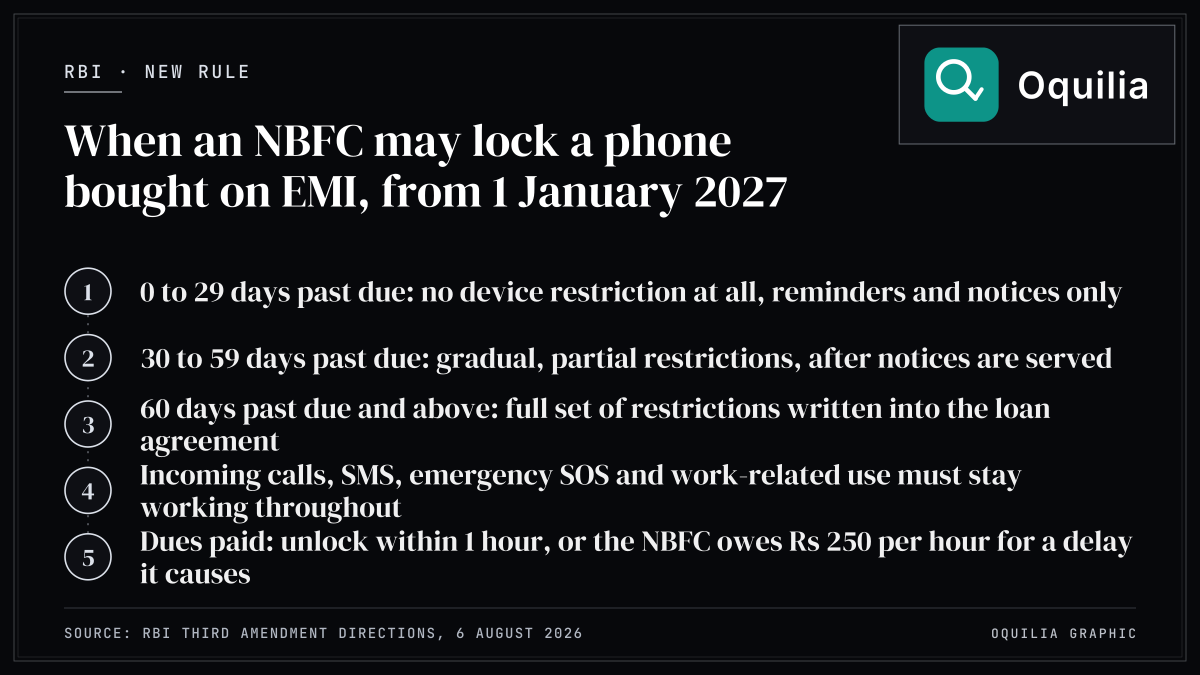
If you bought a phone, tablet or laptop on EMI from a non-banking finance company (NBFC) and fell behind, the lender may already have software on the device that can lock it. On 6 August 2026 the Reserve Bank of India (RBI) issued the Reserve Bank of India (Non-Banking Financial Companies - Responsible Business Conduct) Third Amendment Directions, 2026 (RBI/2026-27/230, DOR.MCS.REC.No.199/01-01-039/2026-27). From 1 January 2027 they set hard limits on when and how an NBFC may restrict a financed device: no restriction before the loan is 30 days past due, no full lock before 60 days, and unlocking within one hour of the dues being paid, failing which the lender owes Rs 250 per hour.
This playbook sets out the exact paragraphs, the step-by-step sequence a lender must follow, and the defences a borrower can raise at each stage. It is a reading of the published text, not legal advice, and the Oquilia Research Desk does not represent borrowers before any court or tribunal.
The Statutory Position
The RBI issued the directions under Sections 45JA, 45L and 45M of the Reserve Bank of India Act, 1934, which empower it to give binding directions to NBFCs in the public interest. They amend the Reserve Bank of India (Non-Banking Financial Companies - Responsible Business Conduct) Directions, 2025 by inserting a new Section J, "Conduct of NBFCs in Recovery of Loan Dues and Engagement of Recovery Agencies", running from paragraph 100A to 100AB.
The new section applies to all NBFCs except six categories excluded in paragraph 1 of the circular: Mortgage Guarantee Companies, Core Investment Companies, NBFC-Account Aggregators, Standalone Primary Dealers, Non-Operating Financial Holding Companies, and NBFCs that have no customer interface. In practice, that means the consumer-finance NBFCs that fund phones at retail counters and through digital lending apps are covered. The circular is addressed to NBFCs; it does not by its own terms bind banks.
The device-lock rules sit in three paragraphs under the sub-heading J.3.4, "Deployment of technology-based mechanism for recovery of loan dues".
| Paragraph | What it does | Key number |
|---|---|---|
| 100S | Bans device restriction except to recover a loan that financed that same device; sets four pre-conditions | 30 and 60 days past due |
| 100T | Nine operating rules: gradual approach, essential functions, unlock deadline, compensation, prepayment | 1 hour; Rs 250 per hour |
| 100U | Bars the NBFC and its vendor from accessing or using personal data on the device | No exceptions ("under any circumstances") |
| 100G | Requires the NBFC's recovery policy to set out the gradual restrictions and notice timelines | Policy-level requirement |
| 100Y(4) | Recovery calls and visits only within set hours | 08:00 to 19:00 hours |
Paragraph 100B adds that Section J is "without prejudice to any statutory rights" of an NBFC relating to enforcement of security under any statute, and to recovery routes such as a one-time settlement under other directions. So the device-lock rules do not replace a lender's right to sue or to use a statute such as SARFAESI where it applies; they govern only the technology-based lock.
The directions were first released in draft on 12 February 2026 (RBI press release 2025-2026/2099) for public comment. The final text was notified on 6 August 2026 and commences on 1 January 2027, giving NBFCs a window of nearly five months to rebuild their lock software, loan agreements and grievance systems.
Procedure Step by Step
Paragraph 100S opens with a prohibition: an NBFC "shall not deploy any technology-based mechanism" that restricts or disables a borrower's mobile phone, tablet or laptop as a recovery tool, "except to recover its loan dues arising out from financing of such a device". Everything that follows is a conditional exception to that ban. Read in sequence, the lender must clear these steps in this order:
- Finance the device itself. Under para 100S(1), the acquisition of the device must have been funded by the NBFC through a loan. A personal loan used to buy something else does not let the lender lock your existing phone.
- Write it into the agreement. Under para 100S(2), the loan agreement must "expressly and unambiguously" permit restriction and must include the procedure the lender will follow under Section J. A vague clause about "recovery measures" does not satisfy this.
- Get the software certified. Under para 100S(4), the NBFC or its third-party provider must obtain certification of the lock mechanism from the device's Original Equipment Manufacturer and/or the operating system platform, if such certification is provided.
- Put it in the recovery policy. Under para 100G, the NBFC's board-level policy on collection must cover the gradual restrictions, the timelines for notice to a defaulting borrower, and the role of any third-party provider.
- Serve due notice. Under para 100S(3), the borrower must receive notice to repay within the timelines in the loan agreement, and that notice must describe the gradual restrictions that will be imposed.
- Wait until 30 days past due. No restriction may begin until the loan "has become 30 days past due" and the borrower has not paid despite being served notices.
- Restrict gradually from day 30. After 30 days past due, the lender may start partial restrictions, but never on essential functions: incoming calls, SMS and emergency SOS under para 100T(2). Outgoing calls must also stay open until 60 days past due.
- Full restriction only after 60 days past due. The complete set of restrictions in the loan agreement may take effect only once the loan is 60 days past due. Even then, para 100T(3) says restrictions must not deny access to the borrower's work or employment activities.
- Show the borrower the status. Para 100T(4) requires that the borrower can see the current status of restrictions on the device "at any point of time".
- Unlock within one hour of payment. Under para 100T(5), restrictions must be reversed "not later than one hour of realisation of the dues".
- Release control on full repayment. Para 100T(7) requires the NBFC to relinquish access or disable the mechanism promptly once the loan is repaid in full, and to tell the borrower the steps if uninstallation is up to them.
The timeline can be read as a ladder of overdue days:
| Days past due | What the NBFC may do | What must stay working |
|---|---|---|
| 0 to 29 | No device restriction at all; reminders and notices only | Everything |
| 30 to 59 | Gradual, partial restrictions, after notices are served | Incoming calls, SMS, SOS, outgoing calls, work-related use |
| 60 and above | Full set of restrictions written into the loan agreement | Incoming calls, SMS, SOS, work-related use |
| Dues paid | Reverse the restriction within 1 hour | Everything |
| Loan fully repaid | Release or disable the lock mechanism | Everything |
To see how quickly a missed instalment reaches these thresholds, run your own numbers through the personal loan EMI calculator. An EMI that falls due and stays unpaid must be overdue for a full 30 days before any restriction can lawfully begin, and only if notices have been served in that period.
Borrower Defences Available
Each of the conditions above is also a defence. If the NBFC skipped a step, the restriction is open to challenge as "wrongful" under para 100T(6), which is the trigger for compensation. The table below maps the common situations to the paragraph that answers them.
| Situation | Defence | Paragraph |
|---|---|---|
| Phone locked, but the loan funded a different purchase | Restriction allowed only for a loan that financed that device | 100S, 100S(1) |
| Lock applied at 10 or 20 days overdue | No restriction before 30 days past due | 100S(3) |
| No notice received before the lock | Due notice with details of gradual restrictions is a pre-condition | 100S(3) |
| Outgoing calls blocked at 45 days overdue | Outgoing calls protected until 60 days past due | 100S(3) |
| Incoming calls, SMS or SOS blocked at any stage | Essential functions can never be restricted | 100T(2) |
| Work apps or email blocked | Restrictions must not deny work or employment activity | 100T(3) |
| Device fully disabled at once | Gradual approach mandatory; no disabling ab initio | 100T(1) |
| Still locked hours after payment | Reversal within 1 hour; Rs 250 per hour after that | 100T(5), 100T(6) |
| Recovery app reading contacts, photos or location | Personal data use barred "under any circumstances" | 100U |
The compensation right. Para 100T(6) applies in two cases: a wrongful restriction, or a delay in reversal after the dues are realised, where the reason for the delay is attributable to the NBFC. The lender "shall compensate the borrower at the rate of Rs 250 per hour till the wrongful action is remedied", with the total capped at "the amount of loan disbursed". There is no deposit or pre-payment required to claim it, unlike a DRT appeal under the SARFAESI Act.
A worked example on a Rs 24,000 phone loan shows how the cap works. If the lock stays on 7 hours after you pay, the NBFC has overshot its 1-hour window by 6 hours; at Rs 250 per hour, that is Rs 1,500. The text says compensation runs "till the wrongful action is remedied" and does not state whether the first hour counts in a delay case, so a borrower may argue for the full 7 hours, or Rs 1,750. For a lock imposed wrongfully, say at 15 days overdue, the clock arguably runs from the moment of the lock. On a Rs 24,000 disbursal the cap is reached after 96 hours (24,000 divided by 250), or 4 days.
| Hours of wrongful lock or delay | Compensation at Rs 250/hour | Capped on a Rs 24,000 loan? |
|---|---|---|
| 2 | Rs 500 | No |
| 6 | Rs 1,500 | No |
| 24 | Rs 6,000 | No |
| 96 | Rs 24,000 | Reaches the cap |
| 120 | Rs 30,000 calculated | Yes, limited to Rs 24,000 |
Prepayment at any stage. Para 100T(8) states that "the borrower shall have the right to prepay the loan, either partly or fully, at any stage". If a lock is imminent at day 30, a part-payment that clears the overdue amount should stop it, and paying the loan off ends the lender's right to control the device under para 100T(7). Use the prepayment benefit calculator and the foreclosure calculator to see what clearing the balance costs, and check your agreement for any prepayment penalty clause, since the direction confirms the right to prepay but does not itself set charges.
Privacy. Para 100U bars both the NBFC and its third-party provider from accessing or using "contacts, SMS, call logs, photos, location history, etc." on the device "for the purpose of loan recovery or any other purpose under any circumstances". Messages to people in your contact list, prompted by data taken from your phone, would fall foul of this paragraph and also of para 100Z(6), which lists harassing a borrower's relatives, referees, friends or co-workers as a "harsh" recovery practice.
Calling hours and conduct. Para 100Y(4) limits recovery calls and visits to between 08:00 and 19:00 hours unless you have expressly asked otherwise. Para 100P requires the NBFC to record recovery calls and preserve the recordings for 6 months, or until a pending dispute is disposed of. Those recordings are evidence if you complain about threats.
Where to complain. Para 100T(9) requires a "robust grievance redressal mechanism" specifically for unlocking delays, and para 100AA requires every recovery communication to carry the name, email address, telephone number and address of the NBFC's grievance redressal officer. Complain in writing to that officer first, quoting the paragraph number and the exact time of payment and of the unlock. If the NBFC does not resolve it, the next forum is the RBI's Integrated Ombudsman, reached through the RBI Complaint Management System.
Keep a timeline. Your strongest evidence is a timestamped record: the UPI or bank reference and time of payment, screenshots of the device's restriction status screen (which para 100T(4) says you must be able to see), and the time the lock lifted. A two-column log of "paid at" and "unlocked at" converts directly into the Rs 250-per-hour arithmetic above.
Recent Tribunal/HC Position
The editorial briefing for this piece identifies no Debt Recovery Tribunal or High Court judgement that has yet interpreted paragraphs 100S to 100U, and none could have applied them: the directions take effect only on 1 January 2027. Oquilia will not cite a ruling it has not verified, so this section records the regulatory history and the questions a tribunal or court is likely to face once the rules are live.
The record so far has three dated steps:
| Date | Event | Reference |
|---|---|---|
| 12 February 2026 | Draft directions on recovery conduct released for comment | RBI press release 2025-2026/2099 |
| 6 August 2026 | Final Third Amendment Directions notified | RBI/2026-27/230, DOR.MCS.REC.No.199/01-01-039/2026-27 |
| 1 January 2027 | Directions come into effect | Para 3(2) of the circular |
Three points of interpretation stand out from the text itself. First, para 100T(6) ties compensation to delay "attributable to the NBFC", so an NBFC may argue that an OEM or network outage was outside its control; the borrower's answer is that para 100S(4) makes the NBFC responsible for its third-party provider's certified mechanism. Second, the cap is "the amount of loan disbursed", not the amount outstanding, so a borrower who has repaid most of a Rs 24,000 loan still has a Rs 24,000 ceiling. Third, para 100B preserves an NBFC's other statutory recovery rights, so a lawful lock does not stop a lender from also suing for the debt, and an unlawful lock does not wipe the debt out.
Until a forum rules, the text of the directions is the controlling authority, and the RBI's own circular on rbi.org.in is the document to quote in any complaint.
FAQ
When do the RBI device lock rules start?
They come into effect on 1 January 2027 under para 3(2) of the RBI Third Amendment Directions, 2026, dated 6 August 2026. Locks applied before that date are governed by whatever the loan agreement and earlier directions said.
Can my NBFC lock my phone if I miss one EMI?
No. Under para 100S(3), no restriction may start until the loan is 30 days past due and notices have been served. Full restriction is allowed only after 60 days past due, and outgoing calls cannot be blocked before then.
What must always keep working on a locked phone?
Incoming calls, SMS and emergency SOS features must never be restricted, under para 100T(2). Under para 100T(3), work or employment-related activity must not be blocked either.
How fast must the lender unlock my phone after I pay?
Within one hour of the dues being realised, under para 100T(5). If the delay is attributable to the NBFC, it owes Rs 250 per hour until the lock is lifted, capped at the loan amount disbursed.
Can the lender read my contacts or photos through the lock app?
No. Para 100U bars the NBFC and its third-party provider from accessing or using personal data such as contacts, SMS, call logs, photos and location history for recovery "or any other purpose under any circumstances".
Can my lender lock a phone it did not finance?
No. Para 100S allows restriction only to recover dues "arising out from financing of such a device". A phone you bought yourself, or one financed by another lender, cannot be locked by this NBFC.
Do these rules apply to banks?
The circular is issued to NBFCs, excluding six categories such as Core Investment Companies and NBFCs with no customer interface. It does not by its own terms cover banks, so check the lender's licence type on your loan agreement.
Sources & Citations
- Reserve Bank of India (Non-Banking Financial Companies - Responsible Business Conduct) Third Amendment Directions, 2026 — Reserve Bank of India
- RBI Complaint Management System (Integrated Ombudsman) — Reserve Bank of India