

Andhra Pradesh High Court upholds ESIC demand on college that failed to produce records
The Andhra Pradesh High Court upheld an ESIC demand of Rs 5,63,063 in contributions on an engineering college, holding that it was for the employer to prove which staff were outside ESI coverage.
Key points
- The Andhra Pradesh High Court on 13 November 2026 dismissed an engineering college's appeal against an ESIC demand for unpaid contributions.
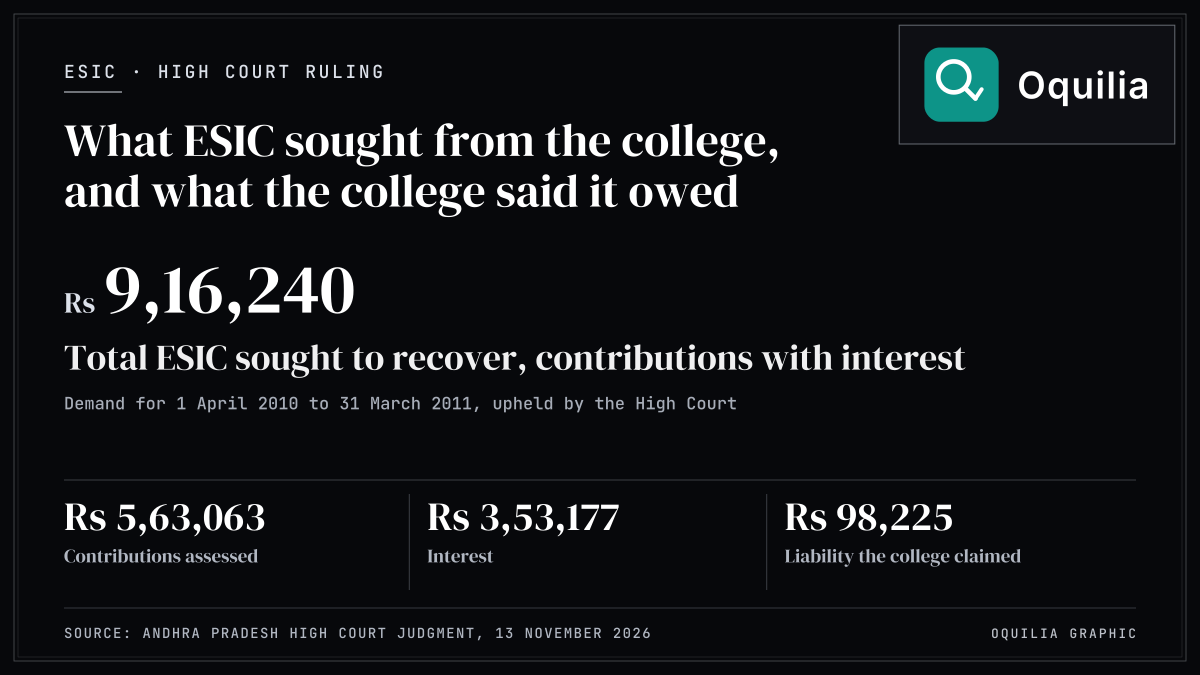
- ESIC had assessed Rs 5,63,063 in contributions for 2010-11 and sought Rs 9,16,240 with interest, per the judgment.
- The court held that an employer which fails to produce its records cannot later claim its staff earned above the ESI wage ceiling.
The Andhra Pradesh High Court on 13 November 2026 dismissed an appeal by Madanapally Institute of Technology and Sciences, an engineering and management college in Chittoor district, against a demand from the Employees' State Insurance Corporation (ESIC). The court held that the college, having failed to produce its records, could not later argue that its staff earned too much to be covered by the scheme.
What Happened
According to the judgment, an ESIC inspection on 17 January 2009 recorded 90 employees at the college, in a report signed by its principal. As contributions were not paid, ESIC issued a notice and, by an order of 19 January 2015 under Section 45-A of the Employees' State Insurance Act, 1948, assessed contributions of Rs 5,63,063 for 1 April 2010 to 31 March 2011. Section 45-A lets ESIC fix the amount itself on the information available when an employer does not file returns or produce records. With interest of Rs 3,53,177, ESIC sought to recover Rs 9,16,240.
The college argued that many teaching staff earned about Rs 40,000 a month, above the Rs 15,000 wage ceiling that applied then, and that its real liability was only Rs 98,225. It also said it was not given a fair hearing. An earlier appeal to ESIC was rejected as time-barred, and the Industrial Tribunal-cum-Labour Court at Guntur dismissed its petition on 24 March 2025.
The High Court found that the college's representative had sought time to produce records but did not produce them. It held that the burden was on the employer to show which employees were outside the scheme, and that the college placed no such evidence on record.
What It Means
The judgment shows that an employer which does not file ESI returns or produce wage records when asked can be assessed by ESIC on the information it has, and will find it hard to challenge the amount later. The court also noted evidence that more than 130 employees worked at the college in the period. Any claim that staff are outside the scheme, for example because their wages are above the ceiling, has to be backed by records at the time of the assessment.
Source: High Court judgment
Sources & Citations
- High Court judgment — Andhra Pradesh High Court