

M. Rajendran v KPK Oils (2025): SC says one Rule 8(6) sale notice, and redemption ends on the day the auction notice is published
Supreme Court in M. Rajendran v KPK Oils (2025 INSC 1137) holds one Rule 8(6) sale notice suffices and SARFAESI redemption ends when the auction notice is published.
Key points
- The Supreme Court on 22 September 2025 set aside a Madras High Court order and upheld an auction sale under the SARFAESI Act in M. Rajendran v KPK Oils.
- Under Section 13(8) as amended from 1 September 2016, a borrower can redeem only before the auction notice is published, and one Rule 8(6) sale notice is enough.
- Borrowers facing a SARFAESI sale should tender full dues before the auction notice is published, as paying later or paying only the auction price will not save the property.
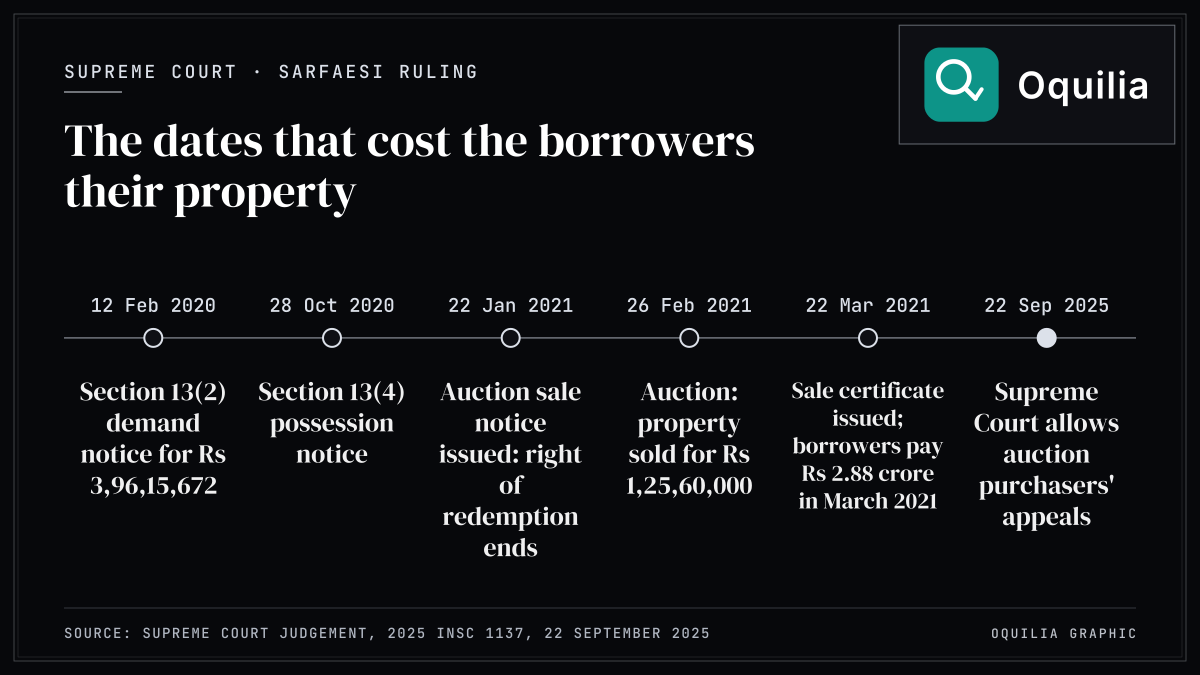
On 22 September 2025, a two-judge bench of the Supreme Court of India (J.B. Pardiwala and R. Mahadevan JJ.) decided M. Rajendran & Ors. v. M/s KPK Oils and Proteins India Pvt. Ltd., Civil Appeal Nos. 12174-12175 of 2025, reported as 2025 INSC 1137. The 139-page judgement settles two questions that come up in almost every contested SARFAESI auction: how many sale notices a bank must issue under Rule 8(6) of the Security Interest (Enforcement) Rules, 2002, and the last date on which a borrower can still pay off the dues and get the mortgaged property back.
The answers are blunt. Under the Rules, a bank needs to issue only one notice of sale. And under Section 13(8) of the SARFAESI Act, 2002, as amended with effect from 1 September 2016, the borrower's right to redeem ends on the date the auction notice is published, not on the date of the auction. In this case the borrowers paid Rs 2.88 crore in March 2021, after the auction of 26 February 2021, and still lost the property. This playbook explains the law, the procedure, the defences that survive the ruling and what a borrower facing a Section 13(2) notice should do differently. It is general information, not legal advice.
The Statutory Position
Three provisions do the work in this judgement. The full text of the Act is on India Code and the judgement itself is on Indian Kanoon.
Section 13(2), SARFAESI Act. Once a secured debt is classified as a non-performing asset, the secured creditor may by written notice require the borrower to discharge the liability in full "within sixty days from the date of notice". If the borrower does not pay within those 60 days, the creditor may act under Section 13(4).
Section 13(3A). The borrower may make a representation or objection against the Section 13(2) notice. The creditor must consider it and, if it rejects it, communicate its reasons "within fifteen days of receipt". In Rajendran the Supreme Court recorded that the borrowers had made no Section 13(3A) representation at all.
Section 13(8), before and after 1 September 2016. Before Act 44 of 2016, the borrower could tender the full dues, costs and charges "at any time before the date fixed for sale or transfer". The amended provision, in force from 1 September 2016, allows redemption only "at any time before the date of publication of notice for public auction or inviting quotations or tender from public or private treaty". That single change moved the cut-off from auction day to notice day.
Rules 8(6), 8(7) and 9(1), Security Interest (Enforcement) Rules, 2002. Rule 8(6) requires the authorised officer to serve on the borrower "a notice of thirty days for sale of the immovable secured assets". Its proviso requires the notice to be published in newspapers where the sale is by public auction or tender. Rule 9(1) says no first sale can take place "before the expiry of thirty days" from publication or service. A second proviso to Rule 9(1) cuts this to "not less than fifteen days" for a re-auction after a failed sale.
| Provision | What it says | Time limit |
|---|---|---|
| Section 13(2) | Demand notice after NPA classification | 60 days to pay in full |
| Section 13(3A) | Borrower's representation; bank must reply | Bank replies within 15 days |
| Section 13(8) (post-1 Sept 2016) | Redemption allowed only before auction notice is published | Ends on publication date |
| Rule 8(6) with Rule 9(1) | One notice of sale, served and published | 30 days before first sale |
| Rule 9(1), second proviso | Fresh notice for a re-auction | Not less than 15 days |
| Section 17 | Securitisation application to the DRT | 45 days |
| Section 18 | Appeal to the DRAT | 30 days, 50% pre-deposit (reducible to 25%) |
Procedure Step by Step
The Rajendran timeline is a useful template because every date is on record in the judgement. The borrowers took a cash credit limit of Rs 5 crore and a term loan of Rs 30 lakh on 6 January 2016, secured by equitable mortgage of properties offered by the guarantors.
- NPA classification (31 December 2019). The account was classified as a non-performing asset after default.
- Section 13(2) demand notice (12 February 2020). The bank demanded Rs 3,96,15,672 due as on 31 December 2019. The 60-day window opened here.
- No Section 13(3A) representation. The Supreme Court noted the borrowers did not object to the demand notice.
- Section 13(4) possession notice (28 October 2020). The bank moved to take possession for Rs 4,39,82,862.20 due as on 30 September 2020, and published the possession notice on 31 October 2020.
- First DRT challenge (28 December 2020). The borrowers filed securitisation applications under Section 17 before the Debts Recovery Tribunal, Coimbatore, against the possession notice.
- Auction sale notice (22 January 2021). The bank issued its Rule 8 and Rule 9 sale notice for recovery of Rs 4,55,64,590.20. This is the date on which the right of redemption ended.
- Second DRT challenge (February 2021). S.A. No. 160 of 2021 was filed against the sale notice.
- Auction (26 February 2021). The auction purchasers bid successfully at Rs 1,25,60,000.
- Full deposit and sale certificate (20 and 22 March 2021). The purchasers paid the full price on 20 March 2021 and the bank issued the sale certificate on 22 March 2021.
- Late payment by borrowers (March and May 2021). The borrowers paid Rs 2,88,00,000 in March 2021 and Rs 62,74,123.74 in May 2021 to release other properties, and the bank closed the loan account on 7 May 2021.
- Writ petition instead of DRAT appeal. After the DRT dismissed both securitisation applications, the borrowers did not appeal to the Debts Recovery Appellate Tribunal. They filed Writ Petition No. 1882 of 2023 in the Madras High Court, which on 24 April 2023 quashed the sale certificate.
- Supreme Court (22 September 2025). The auction purchasers' appeals were allowed and the High Court order set aside (para 202).
The gap that mattered was 35 days: from 22 January 2021, when the notice was published, to 26 February 2021, when the auction took place. Under the pre-2016 law, a full tender in that window would have saved the asset. Under the amended Section 13(8), it would not.
Borrower Defences Available
The ruling narrows the field but does not close it. The table below maps each defence to its status after 22 September 2025.
| Defence | Status after Rajendran | Source |
|---|---|---|
| Pay full dues before the auction notice is published | Available, and now the main safe harbour | Section 13(8), as amended |
| Pay full dues after notice but before auction | Not a statutory right for post-1 Sept 2016 notices | Paras 179-193; Celir LLP (2024) 2 SCC 1 |
| Pay only the auction amount to release the property | Rejected | Para 61 |
| "Two separate notices were required" | Rejected; one composite notice suffices | Paras 130-169 |
| "My loan predates 1 September 2016" | Rejected where auction notice issued after that date | Paras 179-193 |
| Less than 30 days between notice and first sale | Still a valid ground | Rule 8(6), Rule 9(1) |
| Object to the Section 13(2) demand | Available; bank must reply within 15 days | Section 13(3A) |
| Challenge Section 13(4) measures before the DRT | Available within 45 days | Section 17 |
Defence 1: tender the dues before publication. Paras 179-193 hold that redemption under Section 13(8) is a statutory right, not a contractual one. The Court followed Celir LLP v. Bafna Motors (Mumbai) Pvt. Ltd., (2024) 2 SCC 1. The practical rule is that the money must reach the bank before the date of publication of the auction notice. Use the loan foreclosure calculator to estimate the full closure figure early.
Defence 2: check the 30-day gap. Paras 130-169 hold that Rule 8(6), its proviso, Rule 8(7) and Rule 9(1) form one composite notice. Service on the borrower and newspaper publication may happen on the same day, provided the 30-day gap before the first sale is kept. The Rule 9(1) embargo runs from the later of publication or service. If the sale took place on day 29 counted from the later event, that is still a live ground.
Defence 3: the "old loan" argument no longer works. The borrowers argued their loan of 6 January 2016 predated the amendment of 1 September 2016. The Court held that the amended Section 13(8) applies where the auction notice issued after 1 September 2016, whatever the date of the loan.
Defence 4: paying the auction price is not enough. Para 61 reads Mathew Varghese v. Amritha Kumar, (2014) 5 SCC 610, narrowly. Paying only the Rs 1,25,60,000 auction price, or any equivalent sum, does not entitle a borrower to release once the sale has gone through.
Defence 5: use the statutory route, in time. The Section 17 brief for this desk records a 45-day limitation and notes that deposit is not mandatory, though the tribunal may direct one. A Section 18 appeal to the DRAT must be filed within 30 days and needs a 50% pre-deposit of the debt due (the lower of the bank's claim or the DRT's figure), which the DRAT may reduce to no less than 25% for recorded reasons. Use the settlement cost calculator to compare that deposit with a negotiated exit. In Rajendran the borrowers skipped the DRAT and filed a writ in 2023; the Supreme Court set the resulting order aside. The DRT glossary entry sets out the tribunal hierarchy.
Defence 6: negotiate early. A one-time settlement is a commercial decision for the lender, not a statutory right. A settlement agreed after the auction notice is published does not revive the Section 13(8) right. If a settlement is on the table, sign it before the notice date. The debt consolidation calculator can help test whether refinancing other secured loans frees enough cash to do so.
Recent Tribunal/HC Position
The Madras High Court's order of 24 April 2023 in W.P. No. 1882 of 2023 is the clearest example of how courts had been reading the old law into the new provision. Relying on Mathew Varghese (2014) 5 SCC 610, the High Court treated the borrowers' later payments as a valid redemption and quashed the sale certificate issued on 22 March 2021.
The Supreme Court disagreed on three points. First, Mathew Varghese construed the pre-2016 text of Section 13(8), which used the words "date fixed for sale or transfer"; the 2016 amendment replaced them. Second, after Celir LLP (2024), the right of redemption "stood extinguished" once the bank published the auction notice on 22 January 2021 (paras 181-183). Third, the borrowers' payment of Rs 2.88 crore in March 2021 came after the sale had been confirmed, so it could not undo the sale.
On notices, the Court said at para 157 that the Rules "all speak of only one single notice of sale", the distinction lying only in the manner in which it is given: served on the borrower, published in newspapers, affixed on the property and uploaded on the creditor's website. A borrower who argues that the bank should have sent a second, separate notice now has a Supreme Court ruling against them.
The Court went beyond the dispute in para 201: "We humbly urge the Ministry of Finance to take a serious look at these provisions and bring about necessary changes, before it is too late in the day." Para 203 directs that a copy go to every High Court and to the Principal Secretaries of the Ministry of Finance and the Ministry of Law and Justice. Until Parliament acts, the amended Section 13(8) as read in Celir LLP and Rajendran is the law that the DRT, the DRAT and High Courts must apply.
| Decision | Court and year | Holding relevant to borrowers |
|---|---|---|
| Mathew Varghese v. Amritha Kumar | SC, (2014) 5 SCC 610 | Read the pre-2016 text; redemption up to the sale date |
| Celir LLP v. Bafna Motors | SC, (2024) 2 SCC 1 | Amended Section 13(8) ends redemption on publication of the auction notice |
| Madras HC, W.P. 1882 of 2023 | HC, 24 April 2023 | Quashed sale certificate relying on Mathew Varghese; set aside |
| M. Rajendran v. KPK Oils | SC, 22 September 2025, 2025 INSC 1137 | One composite sale notice; amended Section 13(8) applies to pre-2016 loans |
FAQ
When does my right to redeem a mortgaged property end under SARFAESI?
For any auction notice issued after 1 September 2016, it ends on the date the notice for public auction, quotations or tender is published. M. Rajendran v. KPK Oils (2025 INSC 1137), following Celir LLP (2024) 2 SCC 1, confirms this.
Does the bank have to send me two separate sale notices?
No. Paras 130-169 of the 22 September 2025 judgement hold that Rule 8(6), its proviso, Rule 8(7) and Rule 9(1) describe one composite notice. It must be served and published, with at least 30 days before the first sale.
My loan was taken before September 2016. Does the old rule apply?
No. The borrowers in Rajendran took their loan on 6 January 2016 and still lost, because the auction notice issued on 22 January 2021. The Court held redemption is a statutory right governed by the law in force when the notice issues.
Can I stop the sale by paying the auction price?
No. Para 61 of the judgement rejects that reading of Mathew Varghese. Paying the Rs 1,25,60,000 auction figure, or any equivalent, after the sale does not secure release of the property.
How long do I have to challenge a possession notice before the DRT?
A Section 17 securitisation application must be filed within 45 days. A pre-deposit is not mandatory at that stage, but the DRT may direct one. The loan eligibility calculator can help test refinancing options alongside.
What deposit is needed to appeal to the DRAT?
Under Section 18, the appeal lies within 30 days and needs a deposit of 50% of the debt due, which the DRAT may reduce to not less than 25% for recorded reasons.
What did the Supreme Court ask the government to do?
In para 201 it urged the Ministry of Finance to "take a serious look at these provisions and bring about necessary changes". Until Parliament amends it, Section 13(8) applies as read in the 2024 and 2025 rulings.
This article is general information based on the Supreme Court's judgement of 22 September 2025 and the text of the SARFAESI Act, 2002. It is not legal advice. A borrower who has received a Section 13(2) or sale notice should consult an advocate practising before the Debts Recovery Tribunal.