

OCI card cancelled? The revision and review route under the substituted Rule 42 and new Rule 42A of the Citizenship Rules
MHA's G.S.R. 323(E) of 30 April 2026 rewrote Rules 35 and 42 and added Rule 42A: who hears an OCI cancellation revision or review, and what it means for an NRI's tax and bank accounts.
Key points
- The Ministry of Home Affairs notified the Citizenship (Amendment) Rules, 2026 as G.S.R. 323(E) on 30 April 2026, rewriting rules 35 and 42 and adding rule 42A.
- Rule 42(2) sends a revision against a Mission or FRRO order under section 7A or 7D to an authority the Centre specifies; rule 42A sends section 15A reviews to the Centre.
- Cancellation does not change Indian tax residence, DTAA rates or the USD 1 million NRO remittance limit, but banks that relied on the card should be told in writing.
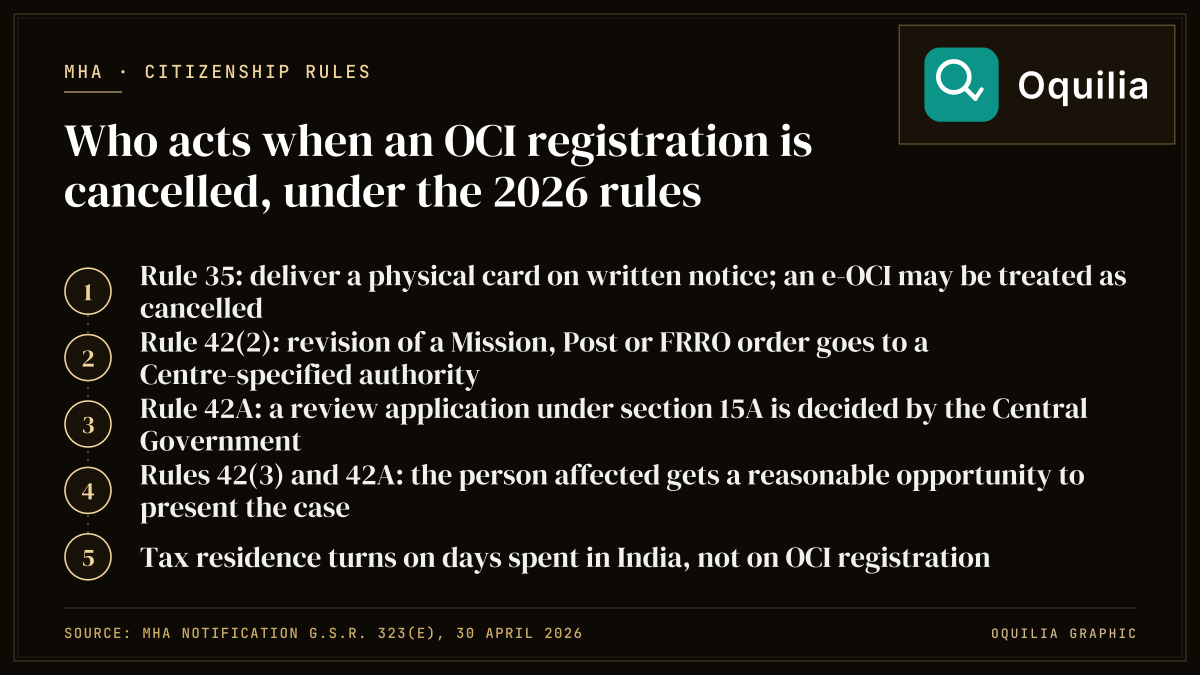
On 30 April 2026 the Ministry of Home Affairs published notification G.S.R. 323(E), the Citizenship (Amendment) Rules, 2026, made under section 18 of the Citizenship Act, 1955. The rules came into force on the date of their publication in the Official Gazette. Among nine amendments to the Citizenship Rules, 2009, three matter most to an Overseas Citizen of India (OCI) cardholder whose registration has been, or may be, cancelled: a substituted rule 35 on what happens to the card itself, a substituted rule 42 that names who hears a revision, and a new rule 42A on review applications.
This piece sets out what those three rules now say, word for word where it matters, and then works through the money questions a cancellation raises for an overseas Indian: whether your bank accounts, your Indian tax position and your ability to move money abroad change when the card goes. The short answer, explained below with the statute behind each point, is that the card and your tax or foreign-exchange status are decided under different laws, by different tests.
What the 2026 amendment changed: the three rules at a glance
The notification is signed under file number 24021/02/2026-OCI. The original Citizenship Rules were published as G.S.R. 124(E) on 25 February 2009, and the last amendment before this one was G.S.R. 172(E) of 11 March 2024. The table below compares the three provisions that govern a cancelled OCI registration.
| Provision (Citizenship Rules, 2009) | What it now says after G.S.R. 323(E) | Who acts |
|---|---|---|
| Rule 35(1)-(2), substituted | After an order cancelling OCI registration, the holder, or anyone in possession of the physical card, must deliver the original when required by written notice, within the period in the notice; an undelivered card may be directed to be treated as cancelled | Central Government |
| Rule 35(3)-(4), substituted | Where the person holds an e-OCI registration, the Central Government may direct that it be treated as cancelled; the issuing authority records the cancellation in the electronic register kept under rule 33(2) | Central Government; issuing authority |
| Rule 42(2), substituted | A revision under section 15 against an order of an Indian Mission or Post, or a Foreigners Regional Registration Officer (FRRO), on OCI registration (section 7A) or cancellation (section 7D) is disposed of by an authority specified by the Central Government | Authority specified by the Central Government |
| Rule 42(3), substituted | Every revision under rule 42(1) or 42(2) is disposed of after a reasonable opportunity to the affected person to present the case | Revising authority |
| Rule 42A, inserted | A review application under section 15A is disposed of by the Central Government after a reasonable opportunity to present the case | Central Government |
Two features stand out. First, rule 42(2) now ties the revision route expressly to orders made by a Mission, Post or FRRO under sections 7A and 7D, which is where most OCI decisions are taken. Second, rule 42A creates a separate, written procedure for a review under section 15A, decided at the level of the Central Government itself. Both rules carry the same hearing guarantee: a "reasonable opportunity to the person affected to present his case".
The new physical card and e-OCI split
The same notification substituted rule 33 so that every person registered under section 7A is issued either an OCI card in physical form or an electronic OCI (e-OCI) registration, with details as in Form XXIX. Rule 29(1) now requires the application in Form XXVIII to be made electronically on https://ociservices.gov.in. That split is why substituted rule 35 has two limbs: sub-rules (1) and (2) deal with a card that can be physically delivered, and sub-rule (3) deals with an e-OCI registration that can only be marked as cancelled.
FEMA / DTAA Position
The Citizenship Act decides whether you hold OCI registration. It does not decide your status under the Foreign Exchange Management Act, 1999 (FEMA) or under a Double Taxation Avoidance Agreement (DTAA). Under section 6 of FEMA, capital account transactions need Reserve Bank of India (RBI) permission unless specifically permitted, and the permissions that matter to overseas Indians, such as holding Non-Resident External (NRE) and Non-Resident Ordinary (NRO) accounts, are granted to classes of "persons resident outside India" through RBI's regulations and Master Directions on rbi.org.in.
Residence under FEMA turns on where you live and why, not on your passport or your card. That means a cancellation order under section 7D does not, by itself, convert a person resident outside India into a resident, or the reverse. What it can change is the specific route you relied on. Some FEMA permissions are framed for "Non-Resident Indians" (Indian citizens resident outside India) and others for "Overseas Citizens of India", so a foreign citizen whose OCI registration is cancelled may need to check whether a particular account, investment or property holding was opened on the strength of the card. Oquilia's June 2026 report on Schedule III of the NDI Rules explains how listed-share investment for foreign individuals was widened that month.
FEMA section 13 sets the penalty for a contravention at up to three times the sum involved where it is quantifiable, or up to Rs 2 lakh where it is not, with up to Rs 5,000 for every day a contravention continues. That is the practical reason to regularise any card-dependent holding promptly rather than waiting for the outcome of a revision.
DTAA rates do not depend on OCI status
A tax treaty applies to a "resident" of a contracting state as that state's law defines residence. Citizenship status in India, including OCI registration, is not the test. The withholding rates India applies to the four most common treaty partners, from Oquilia's DTAA truth table, are below.
| Treaty partner (in force from) | Capital gains on Indian shares (long term) | Interest | Portfolio dividends | Royalties and FTS |
|---|---|---|---|---|
| United States (12 September 1991) | India taxes at 12.5% | 15% | 25% | 15% |
| United Kingdom (26 October 1993) | India taxes at 12.5% | 15% | 15% | 15% |
| United Arab Emirates (22 September 1993) | India taxes at 12.5% | 12.5% | 10% | 10% |
| Canada (6 May 1997) | India taxes at 12.5% | 15% | 25% | 15% |
In each of these four treaties India retains the right to tax gains on shares of Indian companies, so a cancelled card neither adds nor removes treaty relief. Under the US treaty, the 15% dividend rate applies only where the recipient holds at least 10% of the voting stock (Article 10); portfolio holders face 25%. The UAE treaty requires a Tax Residency Certificate backed by proof of a UAE establishment.
Tax Treatment in India
For income tax, residence is decided by section 6 of the Income-tax Act, 1961 for FY 2025-26 and earlier years, on the basis of days spent in India during the financial year. The Income-tax Act, 2025 has governed income from 1 April 2026, with renumbered provisions. Neither statute uses OCI registration as a test, so the cancellation of a card on, say, 15 June 2026 has no effect on whether you are a resident or non-resident for FY 2026-27. See our glossary entry on residential status for the categories.
What a cancellation can change indirectly is the number of days you spend in India. A person who loses the card and has to travel on a different visa may spend fewer days in the country, which can push them further into non-resident status. That is a consequence of travel, not of rule 35.
The table below summarises the Indian rates that apply to the most common income of a non-resident, taken from Oquilia's rate configuration.
| Income | Rate in India | Notes |
|---|---|---|
| Long-term capital gains on listed equity | 12.5% | Gains above Rs 1.25 lakh a year; rate since Budget 2024 (23 July 2024) |
| Short-term capital gains on listed equity | 20% | Rate since 23 July 2024 |
| Long-term gains on property or gold bought on or after 23 July 2024 | 12.5% | No indexation |
| Long-term gains on property or gold bought before 23 July 2024 | 20% with indexation, or 12.5% without | Grandfathered option per rate configuration |
| Other income, new regime FY 2025-26 | 0% to 30% | Slabs at Rs 4 lakh, 8 lakh, 12 lakh, 16 lakh, 20 lakh and 24 lakh |
Withholding on payments to non-residents is governed by section 195 of the 1961 Act, which allows tax to be deducted at the treaty rate or the domestic rate, whichever is lower. Surcharge in the new regime is capped at 25%. Run your own figures on Oquilia's NRI tax calculator and, if you let out property in India, the rental income tax calculator.
Tax Treatment Abroad
Your country of residence taxes your worldwide income under its own law, and the treaty decides who gives credit. The US treaty's Article 24 provides a foreign tax credit in the country of residence; under the Canada treaty, credit is given through section 126 of Canada's Income Tax Act. The UK treaty's Article 4 contains the tie-breaker for a person who is resident in both countries in the same year.
None of these provisions refers to OCI status. If India withholds 12.5% on a long-term gain on Indian shares, your claim abroad is for the Indian tax actually paid, supported by your Indian TDS certificate or return, whatever has happened to your card. Our glossary entry on DTAA explains how relief and credit interact, and the DTAA benefit calculator estimates the credit on a given payment.
There is one timing point to watch. A revision under section 15 or a review under section 15A can take months, and during that period your foreign return may fall due. Report Indian income on the normal basis for that year; the outcome of a citizenship revision does not reopen your foreign tax position.
Repatriation Mechanics
Moving money out of India is governed by FEMA and RBI's Master Directions, and the limits turn on the type of account rather than on the card in your wallet.
| Account | Repatriation position | Figure from Oquilia's research desk |
|---|---|---|
| NRE savings or deposit | Principal and interest freely repatriable | No annual cap |
| FCNR(B) deposit | Held in foreign currency, freely repatriable | No annual cap |
| NRO account | Repatriation of current income, plus remittance of assets within an annual limit | USD 1 million per financial year, with tax paid or provided for |
| Resident account after return to India | Liberalised Remittance Scheme | USD 250,000 per financial year |
If your NRE or NRO account was opened on the basis that you are an OCI cardholder, a cancellation order under section 7D is a change your bank should know about, because the OCI card may have been one of the documents behind your know-your-customer record. The bank decides whether the account can continue under another category FEMA permits or must be re-designated. Ask the bank in writing and keep the reply. For the mechanics of moving NRO balances, see our NRO account glossary entry and the repatriation calculator.
Steps after a cancellation order
- Read the order and note the section under which it was made: section 7A (refusal of registration) or section 7D (cancellation).
- If a written notice under rule 35(1) arrives, deliver the physical card to the person named, within the period stated; failure lets the Central Government direct that the card be treated as cancelled under rule 35(2).
- File a revision under section 15 against a Mission, Post or FRRO order within the time the Act allows; under rule 42(2) it goes to the authority the Central Government specifies.
- Where the order is one the Act allows to be reviewed, apply under section 15A; under rule 42A the Central Government decides it.
- In either case, ask for the hearing rule 42(3) or rule 42A guarantees, and submit documents before the hearing date.
- Write to each Indian bank, depository participant and mutual fund house where the OCI card was a KYC document, and record their response.
Read the full text of G.S.R. 323(E) of 30 April 2026 on the Ministry of Home Affairs website, the Citizenship Act, 1955 (sections 7A, 7D, 15 and 15A) on India Code at indiacode.nic.in, and check your tax position on the Income Tax Department's portal.
FAQ
What did G.S.R. 323(E) of 30 April 2026 change for OCI cardholders?
It substituted rules 33, 34, 35 and 42 of the Citizenship Rules, 2009, inserted a new rule 42A, and moved OCI applications and renunciations to the online portal at ociservices.gov.in. For cancellations, rule 35 now covers both physical cards and e-OCI registrations, rule 42(2) names who hears a revision, and rule 42A sets out who decides a review.
Who hears a revision against an FRRO or Mission order cancelling my OCI registration?
Under substituted rule 42(2), a revision under section 15 against an order of an Indian Mission or Post, or an FRRO, made under section 7A or section 7D, is disposed of by an authority specified by the Central Government. Rule 42(3) requires that you be given a reasonable opportunity to present your case.
What is the difference between a revision under section 15 and a review under section 15A?
A revision under section 15 is decided under rule 42 by the authority the rules point to, which for OCI orders of a Mission, Post or FRRO is an authority specified by the Central Government. A review under section 15A is decided under new rule 42A by the Central Government itself. Both rules require a hearing before a decision.
Do I have to return my physical OCI card after cancellation?
Only when you receive a written notice from the Central Government under rule 35(1). You must then deliver the original card to the person, and within the period, specified in the notice. If the card is not delivered, rule 35(2) allows the Central Government to direct that it be treated as cancelled.
Does cancellation of my OCI card change my Indian tax residence?
No. Tax residence for FY 2025-26 and earlier depends on section 6 of the Income-tax Act, 1961, and from 1 April 2026 on the Income-tax Act, 2025; both use days spent in India, not citizenship registration. Your rates, such as 12.5% on long-term listed-equity gains above Rs 1.25 lakh, are unchanged.
Can I keep my NRE and NRO accounts if my OCI registration is cancelled?
Account eligibility is set by FEMA section 6 and RBI's regulations, which permit accounts for defined classes of persons resident outside India. If your account was opened as an OCI cardholder, tell the bank in writing; it will decide whether the account continues under another permitted category. The NRO remittance limit of USD 1 million per financial year is a FEMA rule and does not depend on the card.
Does a cancelled OCI card affect DTAA relief?
No. Treaties with the United States (from 12 September 1991), the United Kingdom (from 26 October 1993), the UAE (from 22 September 1993) and Canada (from 6 May 1997) apply to residents of the contracting states. India taxes long-term gains on Indian shares at 12.5% under each, with or without an OCI card.
This explainer is general information based on G.S.R. 323(E) dated 30 April 2026 and Oquilia's rate and treaty tables as at 9 November 2026. It is not legal or tax advice; for a cancellation order, consult a lawyer in India before the revision deadline.
Sources & Citations
- Citizenship (Amendment) Rules, 2026, G.S.R. 323(E) dated 30 April 2026 — Ministry of Home Affairs
- RBI Master Directions (FEMA) — Reserve Bank of India
- Income Tax Department e-filing portal — Income Tax Department