

RBI's June 2026 FCNR(B) swap window: what the 3-to-5-year deposit scheme meant for NRI depositors
RBI's June 8, 2026 circular gave banks a dollar swap for 3-to-5-year FCNR(B) deposits taken to September 30. What the one-year lock-in, tax and repatriation rules mean for NRIs.
Key points
- The RBI's June 8, 2026 circular gave banks a US Dollar-Rupee swap facility for fresh or renewed FCNR(B) deposits of three to five years.
- Deposits had to be mobilised by September 30, 2026, carry a one-year lock-in, and banks could swap with the RBI until October 16, 2026.
- The scheme changed no tax rule: FCNR(B) interest stays outside Indian tax only while the depositor is non-resident or not ordinarily resident.
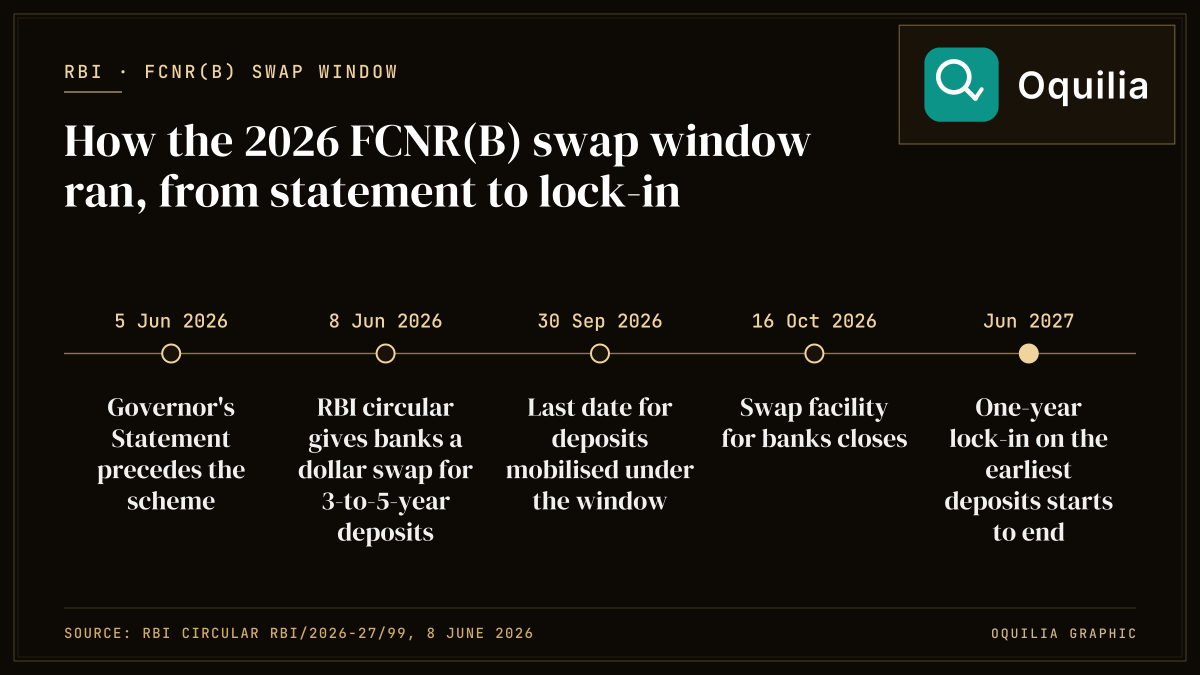
On June 8, 2026, the Reserve Bank of India issued circular RBI/2026-27/99 (FMOD.MAOG.No.S-56/01.06.016/2026-27), giving banks a US Dollar-Rupee forex swap facility for fresh Foreign Currency Non-Resident (Bank) deposits of three to five years. The window followed the Governor's Statement of June 5, 2026, covered deposits mobilised up to September 30, 2026, and stayed open to banks until October 16, 2026. It has now closed, but every deposit booked under it is still running, and the one-year lock-in on the earliest of them ends only from June 2027. This explainer sets out what the scheme changed for an NRI depositor, what it did not change, and how the tax and repatriation rules apply to the deposits it produced.
The swap was a contract between a bank and the RBI, not with you. What reached the depositor, under paragraph 3 of the circular, was a 3-to-5-year tenor, a one-year lock-in, and pricing set by each bank "within the overall ceiling" in RBI guidelines. The full circular is on the RBI website.
The scheme at a glance
| Feature (circular para 3) | What the RBI laid down |
|---|---|
| Eligible deposits | Fresh FCNR(B) deposits, including renewals on maturity |
| Tenor | Minimum 3 years, maximum 5 years |
| Deposit currency | Any freely convertible currency |
| Swap currency with RBI | US Dollars only |
| Swap size | Multiples of USD 1 million |
| Frequency | Once a week per bank, on Mumbai working days |
| Rate | FBIL Reference Rate on the first leg; same rate on the second leg; at par |
| Lock-in on deposit | 1 year; premature withdrawal after that at the bank's discretion |
| Cancellation of swap | Not permitted |
| Deposit window | Circular date (June 8, 2026) to September 30, 2026 |
| Swap window for banks | Up to October 16, 2026 |
| Para 402, Credit Facilities Directions 2025 | Not applicable to these deposits |
FEMA / DTAA Position
An FCNR(B) account is a term deposit that a person resident outside India may hold with an Authorised Dealer Category-I bank, denominated in foreign currency. The legal footing is the Foreign Exchange Management Act, 1999 (text on India Code), under which Section 6 treats capital account transactions as needing RBI permission unless specifically permitted. Deposits by non-residents are specifically permitted through the RBI's deposit regulations, and the June 8, 2026 circular states in its final paragraph that deposits mobilised under the swap window "shall be undertaken as per the extant guidelines applicable to such deposits". In other words, the 2026 scheme did not create a new account type: it attached a hedging facility to an existing one.
Two FEMA points matter for a depositor. First, eligibility to hold an FCNR(B) deposit rests on being a person resident outside India under FEMA, which is a test of where you live and why, not the 182-day count used for income tax. Second, the circular let banks accept deposits "in any freely convertible currency", while confining the swap with the RBI to US Dollars. A bank that took a deposit in another currency had to convert it to its US Dollar equivalent "at the prevailing market rates on the day of the swap deal" (para 3(c)) and keep audit trails of the conversion. Your deposit stays, and is repaid, in the currency you placed it in.
The Double Taxation Avoidance Agreement (DTAA) is relevant only if India taxes the interest, which, as the next section explains, it generally does not while you remain non-resident or not ordinarily resident. The treaty rates below are what India may levy on Indian-source interest in other cases, such as NRO deposits. They are drawn from Oquilia's treaty table for the two corridors where FCNR(B) deposits are most often booked.
| Treaty | In force from | Interest | Dividends (portfolio) | Royalties / FTS | Credit article |
|---|---|---|---|---|---|
| India-United States | 12 September 1991 | 15% | 25% | 15% | Article 24 |
| India-United Arab Emirates | 22 September 1993 | 12.5% | 10% | 10% | Residency certificate needed |
For the India-US treaty, the 15% dividend rate applies only where the recipient holds at least 10% of the voting stock, under Article 10; portfolio holders face 25%. For the India-UAE treaty, a Tax Residency Certificate requires proof of UAE establishment. Neither point changes the treatment of FCNR(B) interest, but both decide what you can claim on other Indian income held alongside the deposit. Our DTAA glossary entry explains how treaty relief is claimed.
Tax Treatment in India
Interest on an FCNR(B) deposit has long been outside the Indian tax net for a person who is non-resident or not ordinarily resident, under Section 10(15)(iv)(fa) of the Income-tax Act, 1961. From 1 April 2026, the Income-tax Act, 2025 replaced the 1961 Act, so deposits booked between June 8 and September 30, 2026 earn their interest in tax years governed by the new statute. The carried-over provision should be confirmed on the Income Tax Department portal before you file for tax year 2026-27, and the ITR forms for that year will reflect the new section references.
The 2026 swap scheme did not alter any of this: circular RBI/2026-27/99 contains no tax provision, so a 3-to-5-year deposit placed under the window is treated exactly like a 1-year FCNR(B) deposit placed in 2025.
The exemption follows residential status, which is tested each tax year. That is the risk for a 5-year depositor: a deposit opened in July 2026 matures in July 2031, and a person who returns to India in that period can move from non-resident to not ordinarily resident to resident and ordinarily resident. Once you are resident and ordinarily resident, the exemption stops for that year, and the interest is taxed at your slab rate. Our residential status glossary entry sets out the day-count tests.
| Residential status in a tax year | FCNR(B) interest in India | Comparable NRO interest |
|---|---|---|
| Non-resident | Not taxed | Taxed; TDS under Section 195 at treaty or Act rate, whichever lower |
| Not ordinarily resident | Not taxed | Taxed at slab rate |
| Resident and ordinarily resident | Taxed at slab rate | Taxed at slab rate |
If the interest becomes taxable, the rates are those in Oquilia's rate configuration for FY 2025-26, which apply until updated. Under the new regime, slabs run from 0% up to Rs 4 lakh to 30% above Rs 24 lakh. Surcharge is 10% between Rs 50 lakh and Rs 1 crore, 15% between Rs 1 crore and Rs 2 crore, and 25% above Rs 2 crore, with the new-regime surcharge capped at 25% even above Rs 5 crore (the old regime retains 37% at that level). Health and education cess of 4% applies on tax plus surcharge. The NRI tax calculator applies these slabs to your own figures.
Withholding follows the same split. Section 195 TDS, deducted "under DTAA rates or rates in IT Act, whichever is lower", applies to payments to non-residents that are chargeable to tax in India. Because FCNR(B) interest for a non-resident is not chargeable, banks do not normally deduct on it; if your status changes, tell your bank in writing so that it can apply the correct treatment from that date. Our TDS glossary entry covers how to claim back excess deduction through a return.
Tax Treatment Abroad
India not taxing the interest does not mean the interest is untaxed. Most countries with an income tax, including the United States, tax their residents on worldwide income, so the interest on a 3-to-5-year FCNR(B) deposit is reportable in your country of residence every year in which it accrues or is paid, as that country's law decides.
Foreign tax credit works only where tax has actually been paid in India. Article 24 of the India-US treaty provides for credit in the country of residence for Indian tax paid; if India has levied 0% on your FCNR(B) interest, there is nothing to credit, and the full interest is taxed in the United States at US rates. The same logic holds for any treaty partner: the 15% US and 12.5% UAE interest caps in the table above limit Indian tax, but they do not reduce tax in the country where you live.
For a UAE resident, the deposit's interest typically attracts no Indian tax and no UAE personal income tax, but treaty rates on other taxable Indian income, such as the 12.5% interest cap on NRO interest, still depend on a valid Tax Residency Certificate for each year.
Currency is the other foreign-side issue. A depositor who placed funds in a currency other than the one they report in at home may have a translation gain or loss to account for on maturity under local rules. The swap with the RBI, settled at the FBIL Reference Rate, was the bank's hedge, not yours.
Repatriation Mechanics
FCNR(B) deposits are fully repatriable, principal and interest, which is why the RBI chose this channel when it wanted longer-tenor foreign currency inflows in June 2026. The comparison with other NRI accounts is below.
| Feature | NRE account | NRO account | FCNR(B) deposit |
|---|---|---|---|
| Currency | Indian rupee | Indian rupee | Freely convertible foreign currency |
| Exchange-rate risk to depositor | Yes | Yes | No, if repaid in deposit currency |
| Repatriation | Fully repatriable | Up to USD 1 million per financial year, subject to tax compliance | Fully repatriable |
| Interest taxed in India (NR status) | No | Yes | No |
| 2026 swap window | Not covered | Not covered | Covered for 3-to-5-year fresh or renewed deposits |
The 2026 scheme added one repatriation constraint that ordinary FCNR(B) deposits do not have: the one-year lock-in in para 3(i). A deposit placed on July 1, 2026 could not be withdrawn before July 1, 2027, and after that, premature withdrawal is allowed only "at their discretion" and "as per their internal policy", meaning your bank may refuse, or may apply a penalty on the interest rate. The repatriation calculator shows how timing and currency affect what reaches your overseas account.
On maturity, proceeds can be credited to an NRE or a fresh FCNR(B) account, or remitted abroad, without the USD 1 million NRO ceiling applying. Renewal on maturity was itself eligible under the window, but only for deposits renewed by September 30, 2026; a deposit maturing and renewing in, say, December 2026 falls outside the scheme and is an ordinary FCNR(B) renewal. Our FCNR deposit glossary entry explains the general maturity options.
If you return to India before maturity, the deposit does not automatically break. Under the RBI's deposit framework, FCNR(B) deposits held at the time of return can generally run to maturity at the contracted rate, after which the proceeds move to a Resident Foreign Currency or resident account. The tax position changes on the timetable in the residential-status table above, not on the deposit's maturity date. For rupee rental income held alongside, see the rental income tax calculator.
Why the RBI offered the swap
The circular's mechanics explain the motive. In the first leg, a bank sold US Dollars to the RBI at the FBIL Reference Rate, settled on spot basis; in the second leg, at the end of the swap tenor, it bought them back "at the same rate as the first leg", with the swap "undertaken at par". A bank that takes foreign currency deposits and lends in rupees normally pays a forward premium to cover that mismatch for 3 to 5 years. Swapping at par with the RBI removed that cost, which is what let banks raise longer FCNR(B) deposits on competitive terms while staying "within the overall ceiling" on rates.
The circular also excluded these deposits from para 402 of the Reserve Bank of India (Commercial Banks - Credit Facilities) Directions, 2025, dated November 28, 2025. The circular does not explain that exclusion's effect on depositors, so we do not describe it. If you have borrowed, or plan to borrow, against an FCNR(B) deposit placed under the window, ask your bank how that exclusion applies to your loan.
FAQ
Can I still place a deposit under the June 2026 FCNR(B) swap window?
No. The circular covered deposits mobilised between June 8, 2026 and September 30, 2026, and the swap facility for banks closed on October 16, 2026. An FCNR(B) deposit you open today is an ordinary deposit under the extant RBI guidelines, without the scheme's one-year lock-in.
Did the swap scheme make FCNR(B) interest tax-free?
No. The scheme contained no tax provision. Interest on FCNR(B) deposits was already outside Indian tax for non-residents and not ordinarily resident persons under Section 10(15)(iv)(fa) of the 1961 Act, with the Income-tax Act, 2025 governing tax years from 1 April 2026. The exemption depends on your residential status each year, not on the scheme.
Can I withdraw a swap-window deposit before maturity?
Not in the first year: para 3(i) imposed a one-year lock-in. After 12 months, premature withdrawal is at the bank's discretion under its internal policy, so get that policy in writing before relying on it.
Was my deposit converted into US Dollars?
No. Deposits could be in any freely convertible currency. Only the bank's swap with the RBI had to be in US Dollars, in multiples of USD 1 million, with non-dollar deposits converted to a dollar equivalent for that purpose at market rates on the swap date.
What happens if I become a resident of India before my 5-year deposit matures?
The deposit can generally continue to maturity at its contracted rate under the RBI's deposit rules. The interest stays outside Indian tax while you are not ordinarily resident, and becomes taxable at slab rates, with 4% cess, once you are resident and ordinarily resident.
Will I pay tax on the interest in the US?
If you are a US tax resident, generally yes, under US law on worldwide income. Article 24 of the India-US treaty gives credit only for Indian tax paid, and since India normally levies none on FCNR(B) interest for a non-resident, there is no Indian tax to offset.
Did the swap protect me against currency movements?
No. The swap at the FBIL Reference Rate hedged the bank's position. Your protection comes from the deposit being held and repaid in its own foreign currency.
This article explains RBI circular RBI/2026-27/99 dated June 8, 2026 and the general tax rules that apply to FCNR(B) deposits. It is not tax or investment advice; confirm your residential status and the tax-year 2026-27 provisions with a qualified adviser.
Sources & Citations
- Swap Facility for FCNR (B) Deposits (RBI/2026-27/99, June 8, 2026) — Reserve Bank of India
- Income Tax Department e-filing portal — Income Tax Department
- Foreign Exchange Management Act, 1999 — India Code