

NRI Working for a Foreign Employer During a Long India Visit? Section 9(3) Can Make That Salary Taxable in India
Section 9(3) of the Income-tax Act, 2025 treats salary for work done in India as Indian-source, even if a foreign employer pays it abroad. How NRIs apportion it, compute tax and claim treaty relief.
Key points
- Section 9(3)(a)(i) of the Income-tax Act, 2025 deems salary for services rendered in India to accrue in India, wherever it is paid.
- In an illustration, 73 India workdays out of 240 on a Rs 60,00,000 salary give Rs 18,25,000 of Indian-source pay and Rs 1,56,000 of tax.
- NRIs should check their treaty's employment article and 183-day test, and claim any relief under section 159 with a tax residency certificate.
An NRI who flies home for three months, opens a laptop at a parent's dining table and keeps working for a London, Dubai or New Jersey employer often assumes the salary stays foreign income because it is paid abroad, in a foreign currency, into a foreign bank account. Section 9 of the Income-tax Act, 2025, the successor to section 9 of the Income-tax Act, 1961, does not look at where the money lands. Under section 9(3)(a)(i), salary is deemed to accrue or arise in India if it is "earned in India", and income payable for services rendered in India is regarded as earned in India. The working days you physically spend in India can therefore create Indian-source salary, even for a person who stays a non-resident for the whole tax year.
This guide is written for tax year 2026-27, the first year of the 2025 Act, which came into force on 1 April 2026.
FEMA / DTAA Position
What section 9 actually says
Sub-section (1) of section 9 says that income described in sub-sections (2) to (8) is deemed to accrue or arise in India. The parts that matter to a typical NRI are these:
| Sub-section | What is deemed to accrue in India | Why it matters to an NRI |
|---|---|---|
| 9(2)(a) to (d) | Income through or from any asset or source of income in India, property in India, a business connection in India, or transfer of a capital asset situated in India | Rent, capital gains on Indian shares or land |
| 9(3)(a)(i) | Salary earned in India, meaning salary payable for services rendered in India | Remote work done from India for a foreign employer |
| 9(3)(a)(ii) | Salary for a rest or leave period preceded and succeeded by services rendered in India, where it forms part of the service contract | Paid leave sandwiched between India workdays |
| 9(3)(b) | Salary payable by the Government to an Indian citizen for services rendered outside India | Indian government postings abroad |
| 9(4) | Dividend paid by an Indian company outside India | Dividends on Indian shares, even if paid abroad |
| 9(5) | Interest payable by the Government, by a resident (with business and foreign-source exceptions), or by a non-resident on debt used for an Indian business | Interest from Indian borrowers and deposits |
The test in 9(3)(a)(i) is the place where the services are rendered, not the place of payment or the employer's location. Section 5 of the 2025 Act (mentioned here only for context) taxes a non-resident on income received or deemed received in India, or accruing or arising, or deemed to accrue or arise, in India. Section 9 supplies the "deemed to accrue" limb, which is how a foreign-paid salary can enter the Indian tax net. For the wider idea, see our glossary entry on deemed income and on residential status.
The leave clause is narrower than it looks
Section 9(3)(a)(ii) treats salary for a "rest or leave period" as earned in India only when that period is preceded and succeeded by services rendered in India and forms part of the service contract. A week of leave in the middle of a six-week India work stint fits; a holiday with no India workdays on either side does not.
Where a tax treaty comes in
India's Double Taxation Avoidance Agreements (DTAA) usually contain a "dependent personal services" or "income from employment" article. In many treaties, the country where the work is physically done may tax it, but that right falls away if three broad conditions are met together: the employee is present there for no more than 183 days in the relevant period, the employer is not a resident of that country, and the salary is not borne by a permanent establishment there. The wording and the period for counting the 183 days differ, so check the specific treaty.
Treaty relief does not make the income "exempt": it stays Indian-source under section 9, and relief is claimed under section 159 with a tax residency certificate.
FEMA does not bless or block the salary
The Foreign Exchange Management Act, 1999 (FEMA) governs where money may sit and move, not whether it is taxable. Salary paid abroad into a foreign account raises no FEMA question by itself; FEMA matters when you move Indian-source income such as 9(4) dividends and 9(5) interest out.
Tax Treatment in India
Step one: work out the India share of the salary
The Act does not contain a formula for splitting a single salary between countries. The practical approach most taxpayers and advisers use is apportionment by working days: Indian-source salary equals total salary for the period multiplied by working days physically spent in India, divided by total working days in that period. This is an approach, not a statutory formula; apply it consistently and keep travel records.
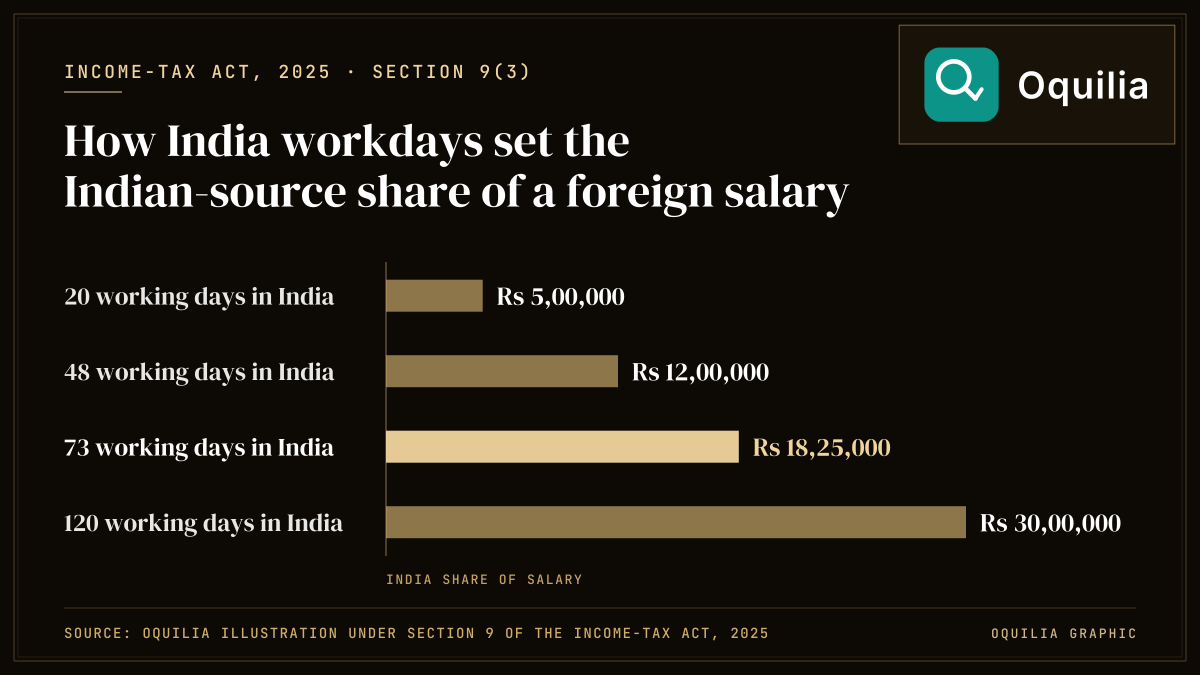
Here is an illustration. Assume a foreign salary equivalent to Rs 60,00,000 for tax year 2026-27 and 240 working days in the year.
| Working days in India | India share of salary | Foreign share of salary |
|---|---|---|
| 20 | Rs 5,00,000 | Rs 55,00,000 |
| 48 | Rs 12,00,000 | Rs 48,00,000 |
| 73 | Rs 18,25,000 | Rs 41,75,000 |
| 120 | Rs 30,00,000 | Rs 30,00,000 |
These figures are illustrative arithmetic only; contract terms and bonus timing can move the result.
Step two: compute the tax
Take the 73-day row. Indian-source salary is Rs 18,25,000. Under the new regime for tax year 2026-27, a salaried individual can claim the Rs 75,000 standard deduction, leaving Rs 17,50,000 taxable. The slabs in section 202(1) of the 2025 Act apply:
| Slab | Rate | Tax on Rs 17,50,000 |
|---|---|---|
| Up to Rs 4,00,000 | 0% | Rs 0 |
| Rs 4,00,001 to Rs 8,00,000 | 5% | Rs 20,000 |
| Rs 8,00,001 to Rs 12,00,000 | 10% | Rs 40,000 |
| Rs 12,00,001 to Rs 16,00,000 | 15% | Rs 60,000 |
| Rs 16,00,001 to Rs 17,50,000 | 20% | Rs 30,000 |
| Tax before cess | Rs 1,50,000 | |
| Health and education cess at 4% | Rs 6,000 | |
| Total | Rs 1,56,000 |
The rebate of up to Rs 60,000 for income up to Rs 12,00,000 in the new regime is a relief for resident individuals, so a non-resident cannot use it to wipe out tax on a small India share. So the 20-day and 48-day rows above still attract slab tax above Rs 4,00,000. You can rerun these numbers in our NRI tax calculator.
Surcharge and cess
If total Indian income crosses Rs 50 lakh, surcharge applies on the tax: 10% between Rs 50 lakh and Rs 1 crore, 15% between Rs 1 crore and Rs 2 crore, and 25% above Rs 2 crore. In the new regime the surcharge is capped at 25% even above Rs 5 crore; the higher 37% band survives only in the old regime. The 4% cess is charged on tax plus surcharge. See our surcharge entry for marginal relief.
TDS and the foreign employer
A foreign employer with no Indian presence may not deduct Indian TDS. If 9(3)(a)(i) applies, you pay the tax yourself as advance or self-assessment tax and report the India share in your tax year 2026-27 return.
The other Indian-source income NRIs forget
Section 9 also reaches investment income. Under 9(4), dividends paid by an Indian company outside India are deemed to accrue in India. Under 9(5), interest paid by a resident or by the Government is Indian-source, subject to the exceptions in the clause. Long-term capital gains on Indian listed equity remain taxable in India at 12.5% above the Rs 1,25,000 exemption; no treaty makes them exempt for any country. Our recent guides on section 216 and section 217 cover the concessional regime for some of this income.
Tax Treatment Abroad
The double-count problem
A residence country that taxes worldwide income will tax your full salary, while India taxes the India share under section 9(3)(a)(i). Without relief, the Rs 18,25,000 slice in our example could be taxed twice.
How foreign tax credit works
The usual fix sits in the residence country. The India-US treaty, in force from 12 September 1991, provides in Article 24 for a foreign tax credit in the country of residence. Broadly, the residence country sets Indian tax paid on the India share against its own tax on that income, usually capped at its own tax on that slice. If the Indian tax is Rs 1,56,000 and the residence country's tax on the same Rs 18,25,000 is higher, you would typically pay only the difference abroad. If the residence country's tax is lower, the excess Indian tax is generally a cost you bear.
When the treaty test applies first
If you meet the employment article's conditions in your specific treaty, including the 183-day presence limit where it applies, India may give up its right to tax the India share, and the foreign-tax-credit question does not arise for that income. You would claim this under section 159 with a tax residency certificate. If you do not meet the conditions, India keeps its right and credit abroad becomes the relief route.
Treaty rates on investment income at a glance
Treaty rates cap India's withholding on 9(4) and 9(5) income. Capital gains on Indian assets stay taxable in India at 12.5% in every row.
| Country (treaty in force from) | Portfolio dividends | Interest | LTCG in India |
|---|---|---|---|
| United States (12 Sep 1991) | 25% (15% if 10%+ voting stock) | 15% | 12.5% |
| United Kingdom (26 Oct 1993) | 15% | 15% | 12.5% |
| UAE (22 Sep 1993) | 10% | 12.5% | 12.5% |
| Singapore (27 May 1994) | 15% | 15% | 12.5% |
For the UAE, a tax residency certificate requires proof of UAE establishment. Singapore's 2017 Protocol keeps gains on shares acquired after 1 April 2017 taxable in India, and the UK treaty's Article 4 carries the tie-breaker for dual residents.
Repatriation Mechanics
Salary paid abroad stays abroad
If the foreign employer pays into a foreign account, nothing needs repatriating under FEMA, 1999. Indian tax on the India share can be paid from an NRE account, which holds freely repatriable money, or an NRO account, which holds Indian-source balances.
Dividends and interest land in NRO
Dividends under 9(4) and interest under 9(5) that are paid into India generally go to an NRO account, because they are Indian-source income. Taking them out is a remittance from NRO. Balances from NRO, including sale proceeds of assets, can be remitted within the USD 1 million per financial year ceiling, after tax has been paid and with the chartered accountant's certificate and the online remittance declaration that banks ask for. Our repatriation calculator estimates the cost of moving money out.
NRE and FCNR for fresh foreign money
Foreign salary you bring in can go into an NRE account or an FCNR deposit; both are repatriable. NRE interest is exempt only while you remain non-resident for the tax year, so count your 2026-27 India days.
| Account | Accepts | Repatriable | Fits which income |
|---|---|---|---|
| NRE (rupee) | Inward remittances from abroad | Yes, freely | Foreign salary you bring in |
| FCNR (foreign currency) | Inward remittances, held in foreign currency | Yes, freely | Foreign salary held without rupee risk |
| NRO (rupee) | Indian-source income: rent, 9(4) dividends, 9(5) interest | Up to USD 1 million per financial year, after tax | Indian dividends, interest, rent |
FEMA and the resident who stays too long
Under section 6 of FEMA, residents need RBI permission for capital-account transactions unless specifically permitted, and the Liberalised Remittance Scheme (LRS) sets the annual limit for residents at USD 250,000. If a long India visit ends with you becoming resident, your accounts must be redesignated and the LRS framework starts to apply. Section 9 taxation and FEMA status are separate tests, so track both.
FAQ
My employer pays me in dollars into a US account. Can India still tax that salary?
Yes, for the part earned in India. Section 9(3)(a)(i) treats salary for services rendered in India as earned in India, wherever it is paid. Whether India keeps that tax depends on your treaty's employment article, including any 183-day condition.
How do I calculate how much of my salary is Indian-source?
The Act gives no formula. The practical approach apportions by India workdays: 73 out of 240 on a Rs 60,00,000 salary gives Rs 18,25,000.
Does the DTAA make this salary exempt?
No. The income stays Indian-source under section 9. Where you meet the specific treaty's conditions, you claim relief under section 159 with a tax residency certificate.
Can I use the Rs 60,000 rebate to cancel tax on a small India share?
No. The new-regime rebate of up to Rs 60,000 for income up to Rs 12,00,000 is available to resident individuals. A non-resident pays slab tax on taxable income above Rs 4,00,000, plus 4% cess, after the Rs 75,000 standard deduction on salary.
Does paid leave I take in India count as Indian salary?
Only under section 9(3)(a)(ii): leave preceded and succeeded by services rendered in India and forming part of the service contract.
Are my Indian dividends and FD interest also Indian-source?
Yes, under sections 9(4) and 9(5). Treaty rates can cap withholding: for a UAE resident, 10% on portfolio dividends and 12.5% on interest.
Can a long India stay create a problem for my employer too?
Possibly. Sustained work from India can raise a question of whether the foreign employer has a permanent establishment or business connection in India under section 9(2)(c). That is a question to put to your employer's advisers before an extended stay; this guide takes no view on any arrangement.
This article explains the law as it stands on 19 November 2026 and is general information, not tax advice. Statutory text is from section 9 of the Income-tax Act, 2025; check the full text on India Code and filing guidance on the Income Tax Department portal. Account rules are set by the Reserve Bank of India.
Sources & Citations
- Section 9, Income-tax Act: Income deemed to accrue or arise in India — Indian Kanoon
- India Code: Central Acts — India Code
- Income Tax Department e-filing portal — Income Tax Department
- Reserve Bank of India — RBI