

NRI stock and mutual fund investing: RBI's 2026 rewrite of Schedule III payment and LEC reporting rules
RBI's FEMA.395(4)/2026-RB of 13 June 2026 rewrites how NRIs and OCIs pay for and repatriate shares, mutual funds and NPS, with a designated account and Form LEC (IFI) bank reporting.
Key points
- The RBI issued Notification FEMA.395(4)/2026-RB on 13 June 2026, replacing the Schedule III and Schedule XI payment rules for non-resident individual investors.
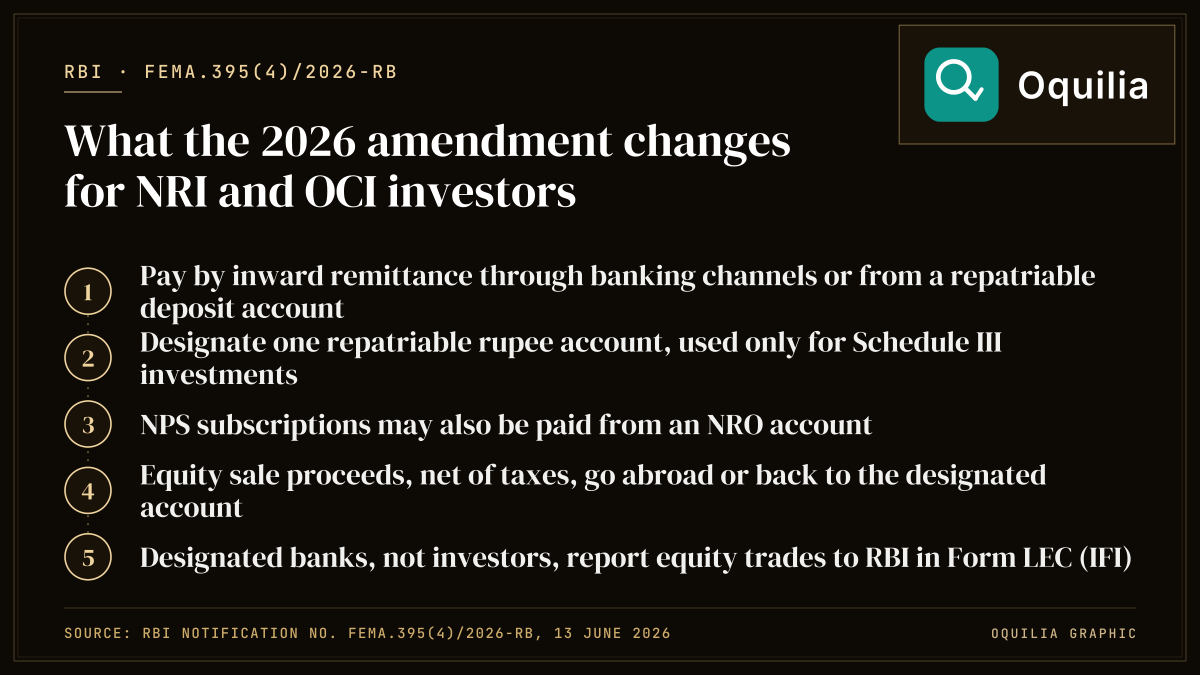
- Repatriable share purchases must be paid by inward remittance or from a repatriable account, and one designated rupee account must be used only for Schedule III investments.
- NRIs should confirm their designated account with the bank; NPS may still be paid from an NRO account, and banks now report trades to the RBI in Form LEC (IFI).
On 13 June 2026 the Reserve Bank of India issued Notification No. FEMA.395(4)/2026-RB, the Foreign Exchange Management (Mode of Payment and Reporting of Non-Debt Instruments) (Amendment) Regulations, 2026. It rewrites how a Non-Resident Indian (NRI) or Overseas Citizen of India (OCI) pays for shares, mutual fund units and National Pension System (NPS) contributions on a repatriation basis, where the sale money may go, and how banks report the trades. The full text is on the RBI's FEMA notifications page.
This guide covers the Schedule III and Schedule XI changes, Indian tax under the Income-tax Act, 2025 (in force from 1 April 2026), treaty relief for investors in the US, UK and UAE, and how money moves back out.
FEMA / DTAA Position
What the 2026 amendment is
The amendment was made under section 47 of the Foreign Exchange Management Act, 1999 (42 of 1999), which lets the RBI make regulations to carry out the Act. It amends the principal regulations, Notification No. FEMA.395/2019-RB dated 17 October 2019, published as G.S.R. 795(E) on the same date. Under paragraph 1(ii), the 2026 amendment comes into force on the date it is published in the Official Gazette.
This is the fourth amendment to the 2019 regulations. The footnote to the notification lists the earlier three, and the table below gives the dates from that footnote.
| Amendment | Notification | Dated |
|---|---|---|
| Principal Regulations | FEMA.395/2019-RB (G.S.R. 795(E)) | 17 October 2019 |
| First | FEMA 395(1)/2020-RB | 15 June 2020 |
| Second | FEMA 395(2)/2024-RB | 19 April 2024 |
| Third | FEMA 395(3)/2025-RB | 15 January 2025 |
| Fourth (this one) | FEMA.395(4)/2026-RB | 13 June 2026 |
Paragraph 2 of the 2026 notification substitutes the entries at Sl. No. III and X of regulation 3.1. Sl. No. III is Schedule III (investments by an individual person resident outside India, including an NRI or OCI, on repatriation basis). Sl. No. X is Schedule XI (equity shares of Indian companies listed on International Exchanges). Paragraph 3 substitutes regulation 4(9), the reporting rule. Readers new to the terms can start with the FEMA and PIS account entries in our glossary.
Schedule III: how an NRI must now pay
The new Schedule III, Part A, has 3 payment rules:
- Rule A(1): the price must be paid as an inward remittance from abroad through banking channels, or out of funds held in any repatriable deposit account maintained under the Foreign Exchange Management (Deposit) Regulations, 2016.
- Rule A(2): the investor must designate a repatriable rupee account maintained under the 2016 Deposit Regulations, and that account is to be used exclusively for investments permitted under Schedule III.
- Rule A(3): NPS subscriptions by NRIs and OCIs may be paid by inward remittance, or from any repatriable foreign currency or rupee account, or from an NRO account, all maintained under the 2016 Deposit Regulations.
The practical effect of rule A(2) is that the rupee account an NRI uses for repatriable share purchases must be ring-fenced. A repatriable rupee account under the Deposit Regulations is, in everyday banking, an NRE account; the 2026 text says "designated" and "exclusively" but does not name the account type, so confirm with the bank which of your accounts it treats as the designated one.
Rule A(3) is the one relaxation in the text: NPS is the only Schedule III investment for which the amendment expressly allows payment from an NRO account.
Schedule III: where the sale money goes
Part B has 2 rules on the sale proceeds, both "net of taxes":
| Investment | Sale proceeds (net of taxes) may be | Rule |
|---|---|---|
| Equity instruments | Remitted outside India, or credited to the designated rupee account | Schedule III, B(1) |
| Mutual fund units | Remitted outside India, or credited to any account under the 2016 Deposit Regulations, at the investor's option | Schedule III, B(2) |
| NPS | Remitted outside India, or credited to any account under the 2016 Deposit Regulations, at the investor's option | Schedule III, B(2) |
So under rule B(1) equity money goes abroad or back to the designated account, while under rule B(2) fund and NPS money may go to any 2016 Deposit Regulations account.
Schedule XI: shares listed on International Exchanges
The substituted Schedule XI deals with a "permissible holder" buying equity shares of an Indian company listed on an International Exchange. Under Part A(1), the price is paid either (i) through banking channels to the Indian company's foreign currency account held under the Foreign Exchange Management (Foreign currency accounts by a person resident in India) Regulations, 2015, or (ii) as an inward remittance or out of a repatriable foreign currency or rupee account under the 2016 Deposit Regulations. Under Part B, sale proceeds net of taxes may be remitted abroad or credited to the holder's bank account under the 2016 Deposit Regulations.
Reporting: Form LEC (IFI)
Substituted regulation 4(9) now reads, in summary: designated Authorised Dealer Category-I banks shall report to the RBI in Form LEC (IFI), "Individual Foreign Investor", every purchase or transfer of equity instruments on Indian stock exchanges by an individual person resident outside India, including NRIs and OCIs. The duty sits with the bank, not the investor, but the bank can only report what passes through the designated account, which is one reason rule A(2) exists.
Where the treaties come in
FEMA decides how money may move; it says nothing about tax. The tax side is set by the Income-tax Act and India's Double Taxation Avoidance Agreements (DTAA). On capital gains from shares of an Indian company, India keeps its right to tax under all 3 treaties covered here: the Act's 12.5% long-term rate applies, and no treaty makes these gains exempt. Treaties mainly change the rate on dividends and interest, set out in the next sections.
Tax Treatment in India
Which Act applies
Tax years beginning on or after 1 April 2026 fall under the Income-tax Act, 2025; FY 2025-26 and earlier fall under the Income-tax Act, 1961. The Income Tax Department's non-resident FAQs explain the transition. A sale made in November 2026 falls in tax year 2026-27, so the 2025 Act sections apply, though the rates are the same as under the 1961 Act.
Rates on shares, equity funds and dividends
| Income | Rate for a non-resident | 2025 Act | 1961 Act equivalent |
|---|---|---|---|
| Short-term gains, listed equity or equity funds (STT paid) | 20% | Section 196(1) | Section 111A |
| Long-term gains, listed equity or equity funds (STT paid) | 12.5% on gains above Rs 1,25,000 | Section 198(2) | Section 112A |
| Long-term gains, unlisted shares and other assets | 12.5%, without indexation | Section 197(1)(b) | Section 112 |
| Dividends from an Indian company | 20% flat | Section 207(1), Table item 1 | Section 115A |
| Interest on an NRE account | Exempt | Schedule IV | Section 10(4)(ii) |
Equity holdings count as long-term after more than 12 months. A holding of exactly 12 months is still short-term under section 2(101) of the 2025 Act. Short-term gains on assets other than STT-paid equity are taxed at slab rates.
Two points catch NRIs out. First, the Rs 1,25,000 long-term exemption applies to non-residents too. Second, a non-resident cannot set unused basic exemption against these special-rate gains; sections 196(2), 197(2) and 198(3) of the 2025 Act limit that to residents. An NRI with Rs 3 lakh of gains and no other Indian income pays the full special rate.
A worked example
Assume an NRI in tax year 2026-27 sells listed shares held for 3 years at a gain of Rs 5,00,000, and separately sells shares held for 8 months at a gain of Rs 2,00,000. Total income stays below Rs 50 lakh, so there is no surcharge. The 4% health and education cess applies to tax.
| Step | Long-term | Short-term |
|---|---|---|
| Gain | Rs 5,00,000 | Rs 2,00,000 |
| Less exemption | Rs 1,25,000 | Nil |
| Taxable gain | Rs 3,75,000 | Rs 2,00,000 |
| Rate | 12.5% | 20% |
| Tax | Rs 46,875 | Rs 40,000 |
| Cess at 4% | Rs 1,875 | Rs 1,600 |
| Total | Rs 48,750 | Rs 41,600 |
You can run your own figures through the NRI tax calculator, which applies these same sections.
Surcharge, cess and TDS
Surcharge is 10% where total income exceeds Rs 50 lakh, 15% above Rs 1 crore and 25% above Rs 2 crore in the new regime, but on tax on dividends and on gains under sections 196, 197 and 198 the surcharge may not exceed 15%. Cess is 4% of tax plus surcharge.
Tax is deducted at source on payments to a non-resident under section 393(2), Table item 17, of the 2025 Act (section 195 of the 1961 Act for FY 2025-26). The rates are 12.5% on long-term gains (on listed equity, on gains above Rs 1.25 lakh), 20% on short-term gains on listed equity and 20% on dividends under item 17(h), plus surcharge and cess. See our TDS, LTCG and STCG entries for the terms.
Tax Treatment Abroad
The treaty or the Act, whichever is lower
Under section 159(4) of the 2025 Act (section 90(2) of the 1961 Act), a non-resident may apply the treaty where it gives a lower tax than the Act. To claim a treaty rate, the investor needs a Tax Residency Certificate (TRC) from the country of residence, plus the prescribed information, under section 159(8) of the 2025 Act (section 90(4) and (5) of the 1961 Act; Form 10F under the 1961 rules).
| Country | Treaty rate on portfolio dividends | Treaty rate on interest | Capital gains on Indian shares | In force from |
|---|---|---|---|---|
| United States | 25% (15% only for a holder of 10% or more of the voting stock, Article 10) | 15% | Taxable in India, 12.5% long-term | 12 September 1991 |
| United Kingdom | 15% | 15% | Taxable in India, 12.5% long-term | 26 October 1993 |
| UAE | 10% | 12.5% | Taxable in India, 12.5% long-term | 22 September 1993 |
For a US resident with ordinary portfolio holdings, the treaty's 25% dividend rate is higher than the Act's 20%, so section 159(4) means the 20% Act rate applies. For a UK resident the treaty's 15% beats the Act's 20%, and for a UAE resident the treaty's 10% does, provided the TRC and other conditions are in place. For the UAE, the TRC requires proof of a UAE establishment. Our DTAA benefit calculator compares the two rates side by side.
Foreign tax credit in the country of residence
What the country of residence does with Indian income is set by its own law, and this guide does not state US, UK or UAE domestic tax rates. The treaties set the framework. Article 24 of the India-US treaty provides that the United States, as the country of residence, gives a credit for Indian tax on the same income. The foreign tax credit calculator shows how a credit of that kind works against a home-country bill.
Two practical points follow from the Indian side. First, keep the TDS certificate for every sale and dividend: it records the Indian tax deducted under section 393(2) on that income. Second, the treaty rate is not automatic. A UK resident who gives no TRC will see dividends taxed at the Act's 20% rather than the treaty's 15%, so the TRC under section 159(8) should be in place before the payment date. The Income Tax Department's non-resident FAQs explain how non-residents file.
Repatriation Mechanics
Money in
From the date of Gazette publication, Schedule III, rule A(1), allows only 2 sources for a repatriable investment: an inward remittance through banking channels, or a repatriable deposit account under the 2016 Deposit Regulations. Rule A(2) adds that one repatriable rupee account must be designated and used only for Schedule III investments. The table summarises the 3 account types an NRI typically holds.
| Account | Repatriable? | Use for Schedule III shares | Use for NPS |
|---|---|---|---|
| NRE account (rupee) | Yes | Yes, if designated | Yes |
| FCNR(B) deposit (foreign currency) | Yes | As a repatriable source under rule A(1) | Yes |
| NRO account (rupee) | Subject to limits | No | Yes, under rule A(3) |
Money out
Under Part B, the money that may leave is the sale proceeds net of taxes. In practice the bank or broker deducts tax at the section 393(2) rates before the remittance, and for equity the net amount either leaves India or returns to the designated account under rule B(1). For mutual fund units and NPS, rule B(2) lets the investor pick any account under the 2016 Deposit Regulations. Interest earned in an NRE account stays exempt under Schedule IV of the 2025 Act; interest on FCNR deposits with a scheduled bank was exempt for a non-resident under section 10(15)(iv)(fa) of the 1961 Act.
The repatriation calculator works through the costs of sending money abroad, and our LRS entry covers the separate scheme for residents.
FAQ
When did the 2026 PIS payment rules take effect?
Notification FEMA.395(4)/2026-RB is dated 13 June 2026 and, under paragraph 1(ii), came into force on its date of publication in the Official Gazette.
Can I still buy shares on repatriation basis from my NRO account?
No. Schedule III, rule A(1), allows only an inward remittance or a repatriable account under the 2016 Deposit Regulations. Only NPS subscriptions may be paid from an NRO account, under rule A(3).
Do I need a separate bank account?
Rule A(2) requires a repatriable rupee account to be designated and used exclusively for Schedule III investments. Whether your current account qualifies is for your Authorised Dealer Category-I bank to confirm.
What is Form LEC (IFI) and do I file it?
Form LEC (IFI) is the RBI report of purchases and transfers of equity instruments on Indian exchanges by individual non-residents. Under substituted regulation 4(9), the designated bank files it, not the investor.
Are my capital gains exempt under the India-US, India-UK or India-UAE treaty?
No. India keeps the right to tax gains on Indian shares. Long-term gains on listed equity are taxed at 12.5% above Rs 1,25,000 under section 198(2) of the 2025 Act, and short-term gains at 20% under section 196(1).
Which dividend rate applies to me?
The Act rate is 20% under section 207(1). Under section 159(4) you may use the treaty rate if lower: 15% for the UK and 10% for the UAE, with a TRC. The US treaty's 25% portfolio rate is higher, so the 20% Act rate applies.
Where can my mutual fund redemption money go?
Under Schedule III, rule B(2), proceeds net of taxes may be remitted abroad or credited to any account under the 2016 Deposit Regulations, at your option.
Sources & Citations
- Foreign Exchange Management (Mode of Payment and Reporting of Non-Debt Instruments) (Amendment) Regulations, 2026 (FEMA.395(4)/2026-RB) — Reserve Bank of India
- Non-resident FAQs — Income Tax Department