

Form 41 under the Income Tax Act, 2025: how a non-resident furnishes DTAA details online, including without a PAN
Form 41 under the Income-tax Act, 2025 is how a non-resident furnishes DTAA relief details online. What the e-Filing manual requires, the NR ID route without a PAN, and the 16 steps.
Key points
- The Income Tax Department's e-Filing portal prescribes Form 41 for non-residents to furnish DTAA relief details under section 159 of the Income-tax Act, 2025.
- The form is online only, has 3 panels, and non-residents without a PAN can file through a separate NR ID login verified by email and mobile OTPs.
- Filers need a foreign Tax Identification Number and the section 159(8) certificate; the manual sets no deadline and India keeps taxing rights over capital gains.
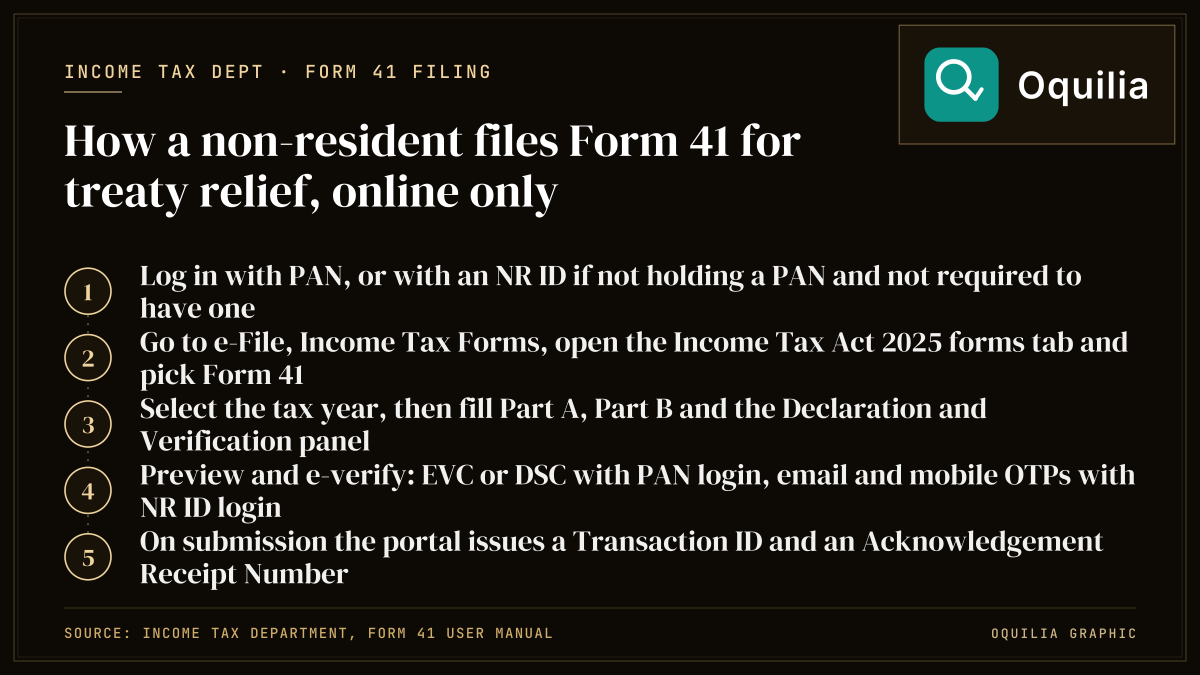
The Income-tax Act, 2025 came into force on 1 April 2026, and with it the forms a non-resident uses to claim treaty relief have new numbers. On the Income Tax e-Filing portal, the form a non-resident files to give the department the details it needs for a Double Taxation Avoidance Agreement (DTAA) claim is now Form 41. According to the department's own Form 41 User Manual, the form exists to furnish the particulars required under section 159 and Rule 75, and it "can be submitted through online only".
This guide sets out what the manual says, step by step, and places Form 41 alongside the rest of the paperwork a non-resident deals with: the Tax Residency Certificate, withholding at treaty rates, the foreign tax credit back home, and moving money out through NRO, NRE and FCNR accounts. It is a description of the process, not advice on whether any particular income qualifies for relief.
FEMA / DTAA Position
A DTAA is a treaty between India and another country that allocates taxing rights over income that both countries could otherwise tax. The manual frames it this way: relief is available to taxpayers "who have income that is taxed both in India and in another country under a tax treaty", and to let the department verify such claims, "non-resident taxpayers are required to submit certain additional information". Form 41 is the form prescribed for that information. Our DTAA glossary entry covers the treaty mechanics in more depth.
What the statute requires
The manual cites two provisions of the Income-tax Act, 2025 and one rule:
| Provision | What the Form 41 User Manual says it does |
|---|---|
| Section 159 | Allows a non-resident to claim relief where the same income is taxed in India and in another country under a tax treaty |
| Section 159(8) | Mandates the information that Form 41 is used to provide; a copy of the certificate referred to in this sub-section is a prerequisite |
| Rule 75 | Specifies the supporting information that must be "properly furnished" so the claim can be made correctly |
| Filing mode | Online only, on the e-Filing portal |
Two points of attribution matter here. First, the manual itself gives no filing deadline, so this guide does not state one. Second, the manual does not say in terms that Form 41 replaces Form 10F under the Income-tax Act, 1961. The department's e-Filing Forms page lists "Form 10F / Form 41" together, and on that basis Form 41 can be described as the corresponding form under the 2025 Act, which is how this article uses it.
What a treaty actually changes
A treaty does not make income disappear from the Indian tax net. For capital gains in particular, India retains taxing rights, and Oquilia's treaty data records a long-term capital gains rate of 12.5% for each of the three treaties below. What a treaty can do is cap the rate India applies to certain streams such as interest, dividends, royalties and fees for technical services.
| Income stream | India-USA (in force from 12 Sep 1991) | India-UK (from 26 Oct 1993) | India-UAE (from 22 Sep 1993) |
|---|---|---|---|
| Interest | 15% | 15% | 12.5% |
| Dividends (portfolio holding) | 25% | 15% | 10% |
| Royalties and fees for technical services | 15% | 15% | 10% |
| Long-term capital gains | 12.5% (India retains taxing rights) | 12.5% (India retains taxing rights) | 12.5% (India retains taxing rights) |
The treaty notes carry conditions that the headline rates hide. Under Article 10 of the India-USA treaty, the 15% dividend rate applies only where the recipient holds at least 10% of the voting stock; in all other, portfolio, cases the rate is 25%. Article 12 of both the USA and UK treaties includes a "make available" test for fees for technical services. The UAE treaty note records that capital gains on shares of an Indian company are taxable in India, and that a UAE Tax Residency Certificate requires proof of establishment in the UAE. You can model the effect of a capped rate with the DTAA benefit calculator.
Where FEMA fits
The Foreign Exchange Management Act, 1999 governs the money, not the tax. Section 6 of FEMA deals with capital account transactions, which need Reserve Bank of India (RBI) permission unless specifically permitted. Form 41 is a tax form and has no FEMA function; a treaty claim does not by itself authorise any remittance. The remittance rules are covered in the repatriation section below.
Tax Treatment in India
Under the 2025 Act the unit of time is the tax year, and Step 5 of the manual asks the filer to "select the applicable Tax Year (T.Y)". For a non-resident earning Indian income in 2026-27, that is the tax year to pick.
Who can file, and how they log in
The manual's section 3.2 says "all non-resident registered users on the e-Filing portal" can furnish the details in Form 41. There are two routes in, and the distinction matters for anyone without a PAN:
| Login type | User ID | Who it is for | How the form is e-verified |
|---|---|---|---|
| PAN login | PAN | A non-resident who holds a PAN | EVC, or DSC (a valid, registered, unexpired Digital Signature Certificate) |
| NR ID login | NR ID | A non-resident not holding a PAN and not required to have one | One-time passwords sent to the registered email and mobile number |
The NR ID route is the change most likely to help foreign heirs, overseas investors with a single Indian income stream, and others who have never needed a PAN. The manual states that such taxpayers file "through a separate login created specifically for this category of taxpayers".
The four prerequisites
Section 2 of the manual lists what must be in hand before starting:
- A registered user account with a valid User ID and password on the e-Filing portal.
- The applicant's Tax Identification Number in the country or region of residence.
- A copy of the certificate referred to in section 159(8).
- For PAN-login users verifying by DSC, a valid DSC registered on the portal and not expired.
The 16 steps, condensed
The manual sets out 16 numbered steps. In summary:
- Steps 1-2: Log in, using PAN or NR ID as the User ID.
- Step 3: Go to e-File > Income Tax Forms > File Income Tax Forms.
- Step 4: Open the "Forms as per Income Tax Act 2025" tab, search for Form 41 and click File Now.
- Steps 5-6: Select the tax year, click Continue, then "Let's Get Started".
- Steps 7-8: Open Part A, Particulars of the Applicant, confirm the details and save. The manual warns that all mandatory details in "My Profile", including the address, must be complete.
- Steps 9-10: Complete Part B, Residential Information, and save.
- Steps 11-12: Complete the Declaration and Verification panel and save.
- Steps 13-15: Preview, click Proceed To E-Verify, and confirm with Yes.
- Step 16: E-verify by EVC or DSC (PAN login) or by email and mobile OTPs (NR ID login).
On successful submission the portal issues a Transaction ID and an Acknowledgement Receipt Number.
Withholding, surcharge and cess
Treaty relief usually shows up first at the point of withholding, when an Indian payer deducts TDS from a payment to a non-resident. Under the 1961 Act, section 195 governed this, and the rule was to withhold at the DTAA rate or the rate in the Act, whichever is lower. A payer applying a treaty rate will typically want to see the residency certificate and the treaty details, which is the information Form 41 captures.
Where income is taxed at normal rates rather than treaty rates, the domestic structure under the 2025 Act applies. Oquilia's rate configuration records the slabs under section 202(1) for tax year 2026-27, with health and education cess of 4% on tax plus surcharge.
| Element | New regime | Old regime |
|---|---|---|
| Nil-rate band | Up to Rs 4 lakh | Up to Rs 2.5 lakh |
| Top slab | 30% above Rs 24 lakh | 30% above Rs 10 lakh |
| Surcharge, income Rs 50 lakh - Rs 1 crore | 10% | 10% |
| Surcharge, Rs 1 crore - Rs 2 crore | 15% | 15% |
| Surcharge, Rs 2 crore - Rs 5 crore | 25% | 25% |
| Surcharge, above Rs 5 crore | 25% (capped) | 37% |
| Health and education cess | 4% | 4% |
A non-resident's overall liability depends on the mix of treaty-rate and slab-rate income. The NRI tax calculator runs the slab arithmetic, and our guide to residential status explains how the day-count tests decide who is a non-resident in the first place.
Tax Treatment Abroad
Form 41 deals with the Indian side of a treaty claim. The other half happens in the country of residence, where the same income is usually reported again and the tax paid in India is credited.
The India-USA treaty note in Oquilia's data records that Article 24 provides for a foreign tax credit in the country of residence. In practice, a US-resident who suffers 15% Indian withholding on interest would look to claim that Indian tax as a credit against US tax on the same income, subject to US rules this article does not cover. The foreign tax credit calculator models the arithmetic.
Two practical consequences follow from the Indian paperwork:
- The rate you pay in India sets the credit you claim abroad. If a payer withholds at a domestic rate above the treaty cap because the residency details were missing, the non-resident is left to recover the difference, so filing Form 41 before the payment date matters.
- Residency must be consistent. The Tax Identification Number entered in Part B is the one from the country of residence, and the certificate under section 159(8) must come from the same jurisdiction. Under Article 4 of the India-UK treaty, a tie-breaker rule decides residence for someone treated as resident by both countries.
| Country | Treaty note relevant to the home-country side |
|---|---|
| United States | Article 24 provides for a foreign tax credit in the country of residence |
| United Kingdom | Article 4 tie-breaker rule for dual residents |
| United Arab Emirates | A Tax Residency Certificate requires proof of UAE establishment |
Repatriation Mechanics
A treaty claim reduces the tax deducted; it does not decide where the money can go. That is a question for the account the income lands in and for the RBI's rules under FEMA.
| Account | Currency | Repatriability | Typical credits |
|---|---|---|---|
| NRE account | Indian rupees | Freely repatriable | Inward remittances from abroad |
| NRO account | Indian rupees | Repatriable up to USD 1 million per financial year, subject to conditions | Indian income such as rent, dividends, interest and sale proceeds |
| FCNR(B) deposit | Foreign currency | Freely repatriable | Inward remittances held in foreign currency |
Most income on which a non-resident claims treaty relief, including Indian interest, dividends and rent, is credited to an NRO account. The RBI's Remittance of Assets FAQ, dated 2 September 2016, states that RBI approval is required where a remittance exceeds USD 1,000,000 per financial year by NRIs or PIOs out of NRO balances, sale proceeds of assets or assets acquired by inheritance or legacy. The same FAQ records that where the remittance comes from NRO balances, the authorised dealer bank obtains an undertaking from the account holder.
The sequence for a non-resident receiving, say, interest from an Indian borrower therefore runs in four stages:
- Before payment: file Form 41 and obtain the Transaction ID and Acknowledgement Receipt Number, so the payer has the details to apply the treaty rate.
- At payment: the payer deducts TDS at the treaty rate or the domestic rate, whichever applies, and credits the net amount, usually to the NRO account.
- On remittance: the bank processes the outward transfer within the USD 1 million annual limit for NRO balances, with the paperwork it requires.
- Back home: the non-resident reports the income and claims credit for the Indian tax under the treaty's relief article.
The repatriation calculator estimates the net amount reaching an overseas account after withholding. For rental income specifically, the rental income tax calculator shows the Indian liability before treaty relief. Recent Oquilia guides cover related cases, including remitting inherited money under FEMA and interest-free rupee loans to an NRI relative.
FAQ
What is Form 41 under the Income-tax Act, 2025?
According to the department's Form 41 User Manual, it is the form prescribed for a non-resident to furnish the details required under section 159 and Rule 75 to claim relief under a DTAA. It has 3 panels: Part A, Part B and Declaration and Verification.
Can a non-resident without a PAN file Form 41?
Yes. The manual says non-residents not holding a PAN and not required to have one file through a separate login, using an NR ID as the User ID, and e-verify with OTPs sent to their registered email and mobile number.
Is Form 41 the same as Form 10F?
The manual does not say so in terms. The e-Filing Forms page lists "Form 10F / Form 41" together, so Form 41 can be described as the corresponding form under the 2025 Act on that basis.
Can Form 41 be filed on paper?
No. Section 1 of the manual states the form is available on the e-Filing portal and "can be submitted through online only".
What documents are needed before starting?
The manual lists 4 prerequisites: a registered e-Filing account, the Tax Identification Number from the country of residence, a copy of the certificate referred to in section 159(8), and, for PAN-login users verifying by DSC, a valid registered DSC.
Does a DTAA make capital gains exempt in India?
No. India retains taxing rights over capital gains under the treaties in Oquilia's data, which record a long-term capital gains rate of 12.5% for the USA, UK and UAE. Relief is claimed as per the specific treaty article.
What does the portal issue after filing?
On successful submission the portal issues a Transaction ID and an Acknowledgement Receipt Number, according to the manual. The manual gives no filing deadline.
Sources: Income Tax Department, Form 41 User Manual; Reserve Bank of India, FAQ: Remittance of Assets, 2 September 2016. This article explains a filing process and does not constitute tax or legal advice.
Sources & Citations
- Form 41 User Manual — Income Tax Department
- Frequently Asked Questions: Remittance of Assets — Reserve Bank of India