

NRIs and OCIs in the Fully Accessible Route: which Government securities they can hold under RBI's debt-instruments Master Direction
RBI's debt Master Direction, updated 10 April 2026, lists NRIs and OCIs as Fully Accessible Route investors. Which G-secs qualify, how coupons are taxed and how proceeds are repatriated.
Key points
- RBI's Master Direction on non-resident investment in debt instruments, updated on 10 April 2026, names NRIs and OCIs as eligible investors in the Fully Accessible Route.
- Annex 3 listed 53 specified Central Government securities as on 5 June 2026, and every new 5, 7, 10, 15, 30 and 40-year issue joins automatically.
- NRI investment carries no limit under the Directions, but coupons are taxable in India at up to 15% for US and UK residents under the treaties.
The Reserve Bank of India's Master Direction on non-resident investment in debt instruments, first issued on 7 January 2025 (RBI/2024-25/126), now says in plain words what was earlier spread across several circulars: Non-Resident Indians (NRIs) and Overseas Citizens of India (OCIs) are eligible investors in the Fully Accessible Route (FAR) for Central Government securities. The text was revised through A.P. (DIR Series) Circular No. 06 of 10 April 2026, and the version on the RBI website is shown as updated on 5 June 2026. Below: which bonds qualify, what the Foreign Exchange Management Act, 1999 (FEMA) and the treaties allow, how India taxes the income, and how the money leaves India.
FEMA / DTAA Position
What the Master Direction says
The Master Direction is issued under section 6, read with section 47, of FEMA. Four of its paragraphs matter most to an individual investor living abroad:
| Paragraph | What it says | Why it matters to an NRI or OCI |
|---|---|---|
| 2(ja) | "Non-Resident Indian (NRI)" means an individual resident outside India who is a citizen of India | Inserted by Circular No. 06 of 10 April 2026; a foreign passport holder is not an NRI under this definition |
| 6.1(i) | Eligible FAR investors are Foreign Portfolio Investors (FPIs), NRIs and OCIs | Individuals can hold FAR bonds directly, not only FPIs |
| 6.2(i) to (iii) | 'Specified securities' are those in Annex 3, plus all new 5, 7, 10, 15, 30 and 40-year Central Government issues, including Sovereign Green Bonds in those tenors; once designated, a security stays FAR-eligible until maturity | Tells you which bonds are in the route |
| 7B | NRIs may invest in debt instruments under sub-paragraphs (B) and (C) of paragraph 1 of Schedule 1 to the FEM (Debt Instruments) Regulations, 2019, not subject to any investment limit under these Directions | Confirms there is no cap on the amount |
Paragraph 3(ii), inserted on 10 April 2026, routes NRI debt investment to Part 5(B), which is paragraph 7B; paragraph 10B, inserted the same day, sends payment and proceeds for all non-residents to paragraphs 2 and 4 of Schedule 1 to the 2019 Regulations.
Which securities are 'specified'
Annex 3 to the Master Direction lists every security designated under the FAR since the route began. As on 5 June 2026 it held 53 entries, both outstanding and matured. Counting against today's date, 10 November 2026, five of them have already been redeemed: the 07.32% GS 2024 (28 January 2024), the 06.18% GS 2024 (4 November 2024), the 05.22% GS 2025 (15 June 2025), the 05.15% GS 2025 (9 November 2025) and the 05.63% GS 2026 (12 April 2026). That leaves 48 outstanding, and the 05.74% GS 2026 falls due on 15 November 2026.
| Maturity band (Annex 3, as on 5 June 2026) | Example ISIN and security | Date of maturity |
|---|---|---|
| Up to 2030 | IN0020180454, 07.26% GS 2029 | 14 January 2029 |
| 2031 to 2036 | IN0020260025, 06.94% GS 2036 | 11 May 2036 |
| 2037 to 2055 | IN0020250075, 07.24% GS 2055 | 18 August 2055 |
| Longest | IN0020260033, 07.71% GS 2066 | 18 May 2066 |
| Sovereign Green Bond | IN0020240159, 06.79% GOI SGrB 2034 | 2 December 2034 |
Six of the 53 entries are Sovereign Green Bonds (SGrB), with maturities from 27 January 2028 to 23 January 2054. The two newest additions in the June 2026 list were issued on 11 May 2026 and 18 May 2026. Because paragraph 6.2(i) makes every new 5, 7, 10, 15, 30 and 40-year issue eligible, the live list may now exceed 53 rows; check the current Annex 3 before buying.
What the FAR does not cover
Paragraph 6.2 is limited to Central Government securities. State Government securities and Treasury Bills are not 'specified securities'. The General Route limits in paragraph 4.2, being 6% of outstanding Central Government securities outside the FAR, 2% of State Government securities and 15% of corporate bonds, are FPI limits and are not the channel for an NRI individual. An NRI's wider permissions come from Schedule 1 of the FEM (Debt Instruments) Regulations, 2019, Notification No. FEMA 396/2019-RB of 17 October 2019, amended up to 1 October 2025:
- Paragraph 1(B)(1), repatriation basis: an NRI or OCI may, without limit, buy Government dated securities (other than bearer securities), Treasury Bills, units of domestic mutual funds or ETFs investing 50% or less in equity, PSU bonds, Infrastructure Debt Fund bonds and certain listed non-convertible instruments.
- Paragraph 1(C)(1), non-repatriation basis: an NRI or OCI may, without limit, buy dated Government securities (other than bearer securities), Treasury Bills, the same class of mutual fund and ETF units, and National Plan/Savings Certificates.
Where the tax treaty fits
FEMA decides whether you may hold the bond; the Double Taxation Avoidance Agreement (DTAA) between India and your country of residence decides how much India may tax the coupon. The treaty data held by Oquilia caps Indian tax on interest as follows: United States 15% (treaty effective 12 September 1991), United Kingdom 15% (effective 26 October 1993) and United Arab Emirates 12.5% (effective 22 September 1993). For long-term capital gains, India keeps its right to tax at 12.5% under all three treaties; no treaty makes such gains exempt. See our DTAA glossary entry for how these articles are read.
Tax Treatment in India
Interest (coupon) income
Coupons on Government securities are taxable in India for a non-resident because the payer is the Government of India. Under Section 195 of the Income-tax Act, 1961, tax is withheld at the DTAA rate or the rate in the Act, whichever is lower, provided the investor furnishes a Tax Residency Certificate and the supporting forms the payer asks for. The Income-tax Act, 2025 replaced the 1961 Act from 1 April 2026, so income from tax year 2026-27 onwards is assessed under the new Act's renumbered sections; the lower-of-the-two principle for treaty residents comes from the treaty itself and continues.
The exemption in Section 10(4)(ii) of the 1961 Act covers interest credited on an NRE account balance. It does not follow the money out of the account: once NRE funds buy a 07.10% GS 2034, the coupon is interest on a security, not NRE deposit interest, and is taxable. Our TDS glossary entry explains how the deduction then shows in Form 26AS.
Capital gains on sale before maturity
A Government security bought and sold on a recognised exchange is a listed security. Held for more than 12 months, the gain is long-term and, for transfers on or after 23 July 2024, taxed at 12.5% without indexation. The Rs 1,25,000 annual exemption applies only to listed equity and equity-oriented funds under Section 112A, not to Government bonds. Held for 12 months or less, the gain is short-term and taxed at slab rates; the 20% rate in Section 111A covers only STT-paid equity, so it does not apply to a G-sec.
Slabs, surcharge and the rebate that does not apply
Total Indian income, including coupons and short-term gains, is charged at the slab rates for FY 2025-26:
| New regime slab (FY 2025-26) | Rate | Old regime slab | Rate |
|---|---|---|---|
| Up to Rs 4,00,000 | 0% | Up to Rs 2,50,000 | 0% |
| Rs 4,00,001 to Rs 8,00,000 | 5% | Rs 2,50,001 to Rs 5,00,000 | 5% |
| Rs 8,00,001 to Rs 12,00,000 | 10% | Rs 5,00,001 to Rs 10,00,000 | 20% |
| Rs 12,00,001 to Rs 16,00,000 | 15% | Above Rs 10,00,000 | 30% |
| Rs 16,00,001 to Rs 20,00,000 | 20% | ||
| Rs 20,00,001 to Rs 24,00,000 | 25% | ||
| Above Rs 24,00,000 | 30% |
The Section 87A rebate, Rs 60,000 in the new regime for income up to Rs 12,00,000, is available only to a resident individual. An NRI with Rs 9,00,000 of Indian coupon income in the new regime owes Rs 30,000 plus 4% cess, Rs 31,200 in all, where a resident with the same income would owe nothing after the rebate. Surcharge applies at 10% on income above Rs 50 lakh, 15% above Rs 1 crore and 25% above Rs 2 crore, with the new regime capped at 25%; health and education cess of 4% is added on tax plus surcharge. Run your figures through the NRI income tax calculator before deciding whether to file to recover excess TDS.
Tax Treatment Abroad
Foreign tax credit
The India-US treaty's Article 24 gives a foreign tax credit in the country of residence, so Indian tax withheld at up to 15% is credited against US tax on the same interest, claimed on IRS Form 1116. A UK resident claims Foreign Tax Credit Relief on the Self Assessment return, limited to the lower of the Indian tax paid and the UK tax due on that income. Our foreign tax credit calculator shows how much of the Indian tax comes back.
| Country of residence | DTAA cap on Indian tax on interest | LTCG: India's taxing right | Credit route abroad |
|---|---|---|---|
| United States | 15% | 12.5% | Article 24 credit; Form 1116 |
| United Kingdom | 15% | 12.5% | Foreign Tax Credit Relief on Self Assessment |
| United Arab Emirates | 12.5% | 12.5% | TRC needs proof of UAE establishment |
Where the credit runs out
A credit cannot exceed the tax the residence country charges on the same income. If your marginal rate abroad on that coupon is below the 15% withheld in India, the surplus is not refunded by the foreign tax authority, and your only route to recover it is an Indian return claiming the lower slab-based liability. UAE residents face a different problem: the treaty data notes that a Tax Residency Certificate requires proof of UAE establishment, and without it the payer may not apply the 12.5% cap. The DTAA benefit calculator compares the treaty rate with the Act rate for your income.
Repatriation Mechanics
Paying for the bonds
Schedule 1, paragraph 2 of the 2019 Regulations fixes which account may fund the purchase, and that choice decides everything that happens on exit.
| How the purchase was funded | Basis | Where sale or maturity proceeds go (Schedule 1, para 4(2)) |
|---|---|---|
| Inward remittance or NRE / FCNR(B) account | Repatriation | Remitted abroad, or at your option credited to NRE, FCNR(B) or NRO |
| Inward remittance or NRE / FCNR(B) account, bought on non-repatriation basis | Non-repatriation | Credited to NRO |
| NRO account | Non-repatriation | Credited to NRO |
Paragraph 2(2) says purchases on repatriation basis must be paid from inward remittances through banking channels or from an NRE account or FCNR(B) deposit. Paragraph 2(3) allows the NRO account as well, but only for non-repatriation purchases.
Getting money out
Proceeds are "net of taxes" under paragraph 4(2). A bond bought from NRE funds on repatriation basis can be redeemed at maturity, for example on 7 October 2034 for the 06.79% GS 2034, and the full net amount sent abroad without any annual cap. Proceeds that land in an NRO account are different: moving them out uses the separate NRO remittance facility of up to USD 1 million a financial year, which we covered in an earlier explainer. The repatriation calculator estimates the cost of each route.
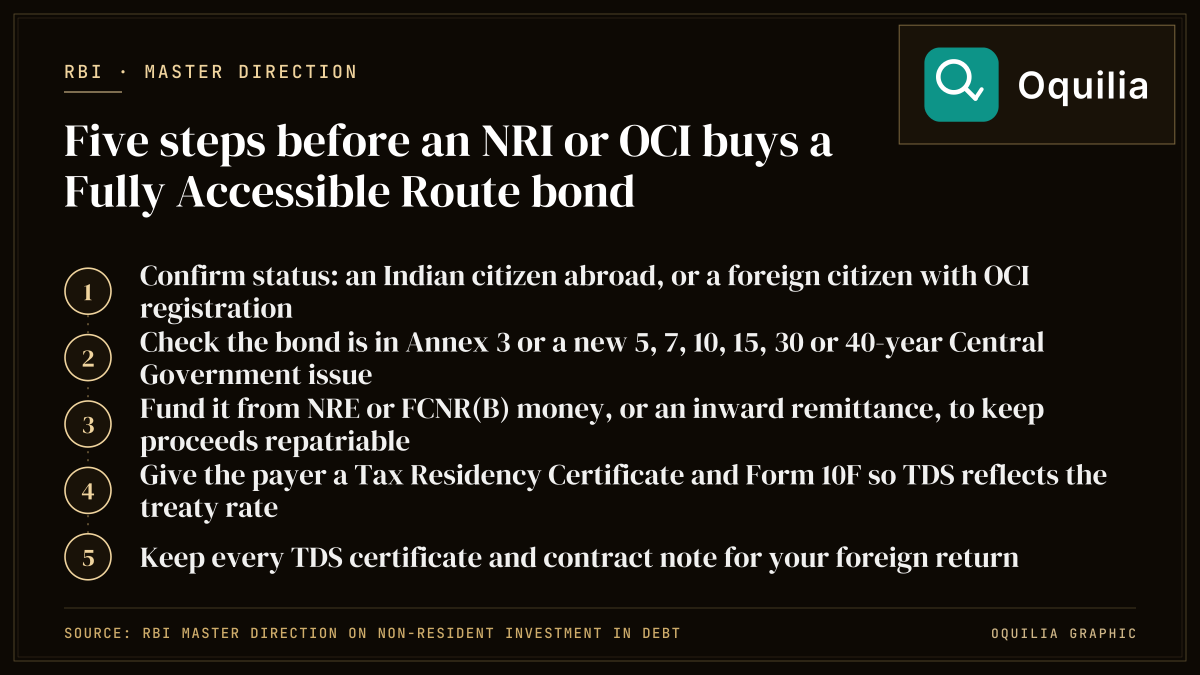
Practical sequence for a first purchase
- Confirm your status: under paragraph 2(ja) you are an NRI only if you are an Indian citizen resident outside India; a foreign citizen needs a valid OCI registration under section 7A of the Citizenship Act, 1955.
- Check the security against the current Annex 3, or confirm it is a new 5, 7, 10, 15, 30 or 40-year Central Government issue under paragraph 6.2(i).
- Fund it from NRE or FCNR(B) money, or a fresh inward remittance, if you want the proceeds to be freely repatriable.
- Give the payer your Tax Residency Certificate and Form 10F so withholding reflects the treaty rate.
- Keep every TDS certificate and contract note for your foreign return.
FAQ
Can an OCI cardholder invest under the Fully Accessible Route?
Yes. Paragraph 6.1(i) of the Master Direction, as updated on 10 April 2026, names Overseas Citizens of India alongside FPIs and NRIs as eligible investors. The 2019 Regulations define an OCI as an individual resident outside India registered under section 7A of the Citizenship Act, 1955; if that registration is cancelled, see our guide to the OCI revision route.
Is there a ceiling on how much an NRI can put into FAR bonds?
No ceiling applies under the Master Direction. Paragraph 7B says NRI investment in debt instruments is "not subject to any investment limit under these Directions", and paragraphs 1(B)(1) and 1(C)(1) of Schedule 1 to the 2019 Regulations use the words "without limit".
Does a FAR bond stop qualifying if RBI changes the tenors?
No. Paragraph 6.2(iii) says a 'specified security', once designated, stays eligible under the FAR until maturity, even if RBI later changes the tenors under paragraph 6.2(ii). The 07.72% GS 2049, issued on 15 April 2019 and listed in Annex 3, stays eligible until 15 June 2049.
Is the coupon on a G-sec bought from my NRE account tax-free?
No. Section 10(4)(ii) of the Income-tax Act, 1961 exempts interest on the NRE account balance itself. Interest on a Government security is taxable in India, with TDS at the lower of the treaty rate (15% for US and UK residents, 12.5% for UAE residents) and the Act rate under Section 195.
Are long-term gains on these bonds exempt under the India-US treaty?
No. Under the treaty data for the US, UK and UAE, India keeps its right to tax long-term capital gains at 12.5%. The gain on a listed G-sec held for more than 12 months is taxed in India at that rate without indexation, and you then claim a credit in your country of residence.
Can I buy State Government bonds or Treasury Bills through the FAR?
Not through the FAR, which is limited to Central Government 'specified securities' under paragraph 6.2. You can still buy Treasury Bills under Schedule 1, paragraph 1(B)(1) or 1(C)(1) of the 2019 Regulations; those permissions sit outside Annex 3.
What happens to my bond if I return to India and become resident?
The Master Direction of 7 January 2025 does not deal with a change in residential status. Under FEMA your investment status changes when you become a person resident in India, so tell your bank or custodian promptly and check how your holding and account need to be re-designated.
Sources & Citations
- Master Direction - Reserve Bank of India (Non-resident Investment in Debt Instruments) Directions, 2025 — Reserve Bank of India
- Foreign Exchange Management (Debt Instruments) Regulations, 2019 (FEMA 396/2019-RB) — Reserve Bank of India