

Carrying foreign cash into India: the Currency Declaration Form now annexed to FEMA's currency regulations by the February 2026 amendment
RBI's February 2026 FEMA amendment annexes the Currency Declaration Form to the 2015 currency rules. When NRIs must declare above USD 10,000 or USD 5,000 in notes, and how to take unspent cash out.
Key points
- The RBI inserted the full Currency Declaration Form as an Annex to the 2015 Export and Import of Currency Regulations by a notification dated February 23, 2026.
- A declaration to Customs is needed on arrival when foreign notes, bank notes and travellers' cheques exceed USD 10,000 in aggregate or foreign notes alone exceed USD 5,000.
- Travellers should keep the Customs-certified form, endorsed at each encashment, to take out unspent foreign exchange up to the declared amount when leaving India.
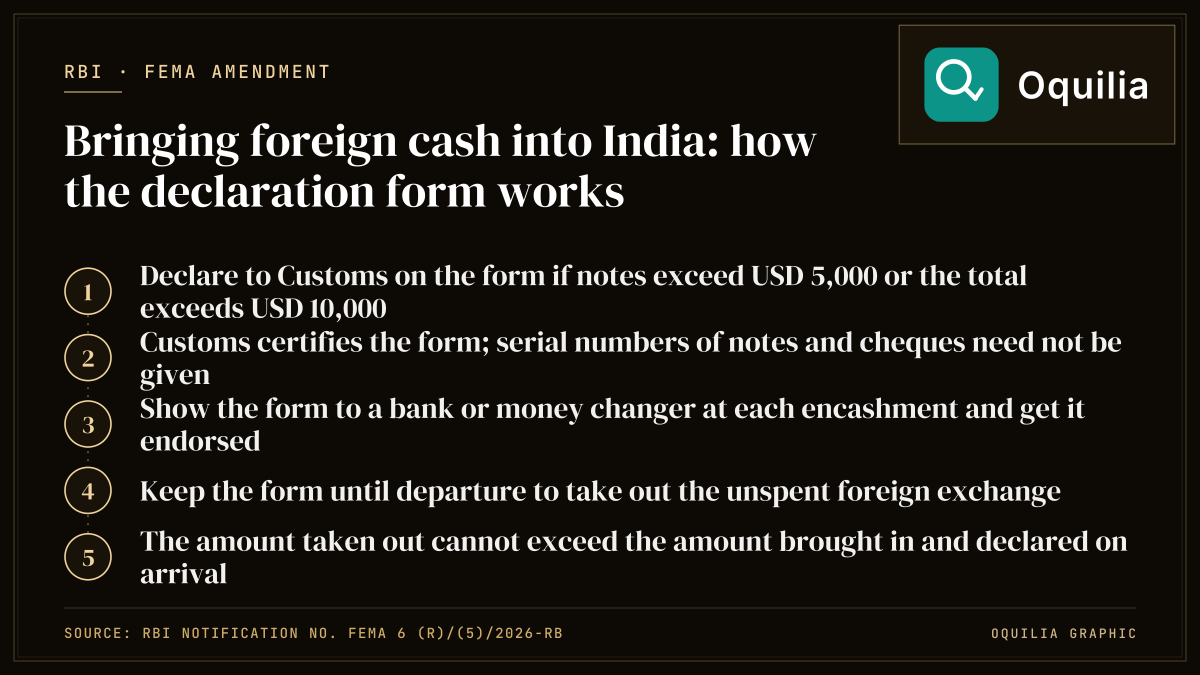
On February 23, 2026, the Reserve Bank of India (RBI) issued Notification No. FEMA 6 (R)/(5)/2026-RB, the Foreign Exchange Management (Export and Import of Currency) (Amendment) Regulations, 2026. It was published in the Gazette of India, Extraordinary, Part III, Section 4, on February 24, 2026, and took effect from that date of publication. The amendment does one thing: it inserts an Annex containing the full Currency Declaration Form (CDF) into the 2015 currency regulations (Notification No. FEMA 6 (R)/RB-2015 dated December 29, 2015).
For a non-resident Indian (NRI) or Overseas Citizen of India landing at an Indian airport with dollars, dirhams or pounds in a wallet, the practical question has not changed since 2015: at what value must the cash be declared to Customs, and what happens to the unspent balance on the way out? What the February 2026 amendment changes is where the answer lives. Regulation 6 of the 2015 Regulations has always referred to a CDF "annexed to these Regulations"; since February 24, 2026, that Annex actually sits in the regulation text published by the RBI, with five numbered instructions for passengers, a declaration for the passenger, a certificate for the Customs officer and an endorsement grid for banks and money changers.
FEMA / DTAA Position
What the statute says
The 2015 Regulations were made under clause (g) of sub-section (3) of Section 6 and sub-section (2) of Section 47 of the Foreign Exchange Management Act, 1999 (42 of 1999). The February 2026 amendment was made under clause (ga) of sub-section (2) of Section 47. Under FEMA, the default rule in Regulation 5 is restrictive: except as otherwise provided, no person may export or import any foreign currency without the general or special permission of the RBI.
Regulation 6 is the general permission for bringing money in. It lets a person (a) send into India, without limit, foreign exchange in any form other than currency notes, bank notes and travellers' cheques, and (b) bring into India from any place outside India, without limit, foreign exchange other than unissued notes. Clause (b) carries a condition: the person must, on arrival, make a declaration to Customs in the CDF annexed to the Regulations.
The proviso then sets two thresholds below which no declaration is needed, measured "at any one time":
| What you carry on arrival | Threshold in Regulation 6 | Declaration needed? |
|---|---|---|
| Foreign currency notes, bank notes and travellers' cheques, taken together | Up to USD 10,000 or equivalent | No |
| Foreign currency notes alone | Up to USD 5,000 or equivalent | No |
| Aggregate above USD 10,000 or equivalent | Above the limit | Yes, CDF to Customs |
| Foreign currency notes above USD 5,000 or equivalent | Above the limit | Yes, CDF to Customs |
| Remittances by wire, card or other non-cash form | No limit under clause (a) | No CDF |
The regulation uses "and/or" between the two thresholds. Read together, the safest reading for a traveller is that both limits must be respected: a passenger carrying USD 6,000 in notes is within the USD 10,000 aggregate limit but above the USD 5,000 limit for notes, and should declare.
What the new Annex adds
The Annex, headed "Currency Declaration Form (CDF) [See Regulation 6]", contains five instructions for passengers:
- The form need not be completed where the aggregate value of foreign exchange in notes, bank notes or travellers' cheques does not exceed USD 10,000 or equivalent and/or foreign currency notes do not exceed USD 5,000 or equivalent.
- Passengers are advised to produce the form to a bank authorised to deal in foreign exchange, or a money changer, when converting foreign exchange into rupees or reconverting rupees into foreign exchange.
- Visitors who do not wish to encash all the declared foreign exchange should retain the form for production to Customs at departure, so they can take out the unutilised balance.
- Details (serial numbers) of travellers' cheques or currency notes need not be furnished.
- Foreign tourists need not indicate their address.
The passenger section asks for the aggregate value only, in three columns: name of the currency, currency notes and travellers' cheques, with a total. It is signed by the passenger, with passport number and nationality. A Customs officer then certifies, with date, stamp and signature, that the named person has brought in the foreign exchange shown. Below that sits a four-column endorsement grid for each encashment: date, distinctive number of the encashment certificate, amount changed, and the stamp and signature of the bank or money changer.
Where DTAA fits
A Double Taxation Avoidance Agreement allocates taxing rights over income. It has no bearing on the CDF: the declaration is a foreign exchange control under FEMA, made to Customs, and no treaty article overrides Regulation 6. The treaty position becomes relevant only for the income that produced the cash, or the income it later earns in India, which is covered in the next two sections.
Tax Treatment in India
The declaration itself is not a tax event
Nothing in the 2015 Regulations or the February 2026 Annex imposes a tax, duty or fee on declared foreign currency. The CDF records aggregate value, currency and the passenger's passport details; it contains no field for income, tax identification or the source of the money. Whether the money is taxable in India depends on the income it represents and the holder's residential status for the financial year under the Income Tax Act, 1961, not on how it crossed the border.
That said, the CDF is an official record of value brought in on a specific date, certified by a Customs officer. An NRI who later deposits the money in an Indian bank account, or uses it toward a property purchase, may find the certified form useful evidence that the funds came from abroad on that date. The regulation does not make it mandatory to keep the form beyond the departure use in instruction 3, but retaining it costs nothing.
Once the money is invested in India
After conversion, ordinary Income Tax Act rules apply to whatever the money earns. Three provisions matter most to NRIs:
| Income earned in India | Provision | Rate or rule |
|---|---|---|
| Payments of interest and other sums to a non-resident | Section 195 | TDS at the DTAA rate or the Income Tax Act rate, whichever is lower |
| Long-term capital gains on listed equity | Section 112A | 12.5% above Rs 1.25 lakh exemption (since July 23, 2024) |
| Short-term capital gains on STT-paid equity | Section 111A | 20% (raised from 15% by Budget 2024) |
| Health and education cess | Finance Act | 4% of tax plus surcharge |
| Surcharge above Rs 5 crore | New regime | Capped at 25% (37% retained in old regime) |
Readers can model the combined effect of slabs, surcharge and cess for their own figures with the NRI income tax calculator, which applies the FY 2025-26 rules.
The FEMA penalty is separate from tax
Failure to declare above the threshold is a contravention of FEMA, not a tax default. Under Section 13 of FEMA, the penalty can reach up to three times the sum involved in the contravention or up to Rs 2 lakh, with up to Rs 5,000 for every day the contravention continues. The quickest way to stay outside Section 13 is to fill in the CDF whenever either threshold, USD 10,000 aggregate or USD 5,000 in notes, is crossed.
Tax Treatment Abroad
Carrying cash does not reset the foreign tax position
Leaving a country with savings already taxed there does not, under anything in the February 2026 notification or the 2015 Regulations, by itself, create a new tax liability in India. The relevant question in the country of residence is usually whether the income that produced the savings was taxed there, and whether income later earned in India must also be reported there. The CDF has no role in either; under Regulation 6 it is a document of Indian Customs and Indian authorised dealers.
Foreign tax credit when the money earns in India
Where Indian income is taxed both in India and in the country of residence, the treaty decides who taxes first and how the second country gives relief. Two common corridors for Indian travellers carrying cash are the United States and the United Arab Emirates, whose treaties with India date from 1991 and 1993:
| Treaty item (per Oquilia's DTAA table) | India-USA (in force from 1991-09-12) | India-UAE (in force from 1993-09-22) |
|---|---|---|
| Interest | 15% | 12.5% |
| Dividends, portfolio holding | 25% | 10% |
| Royalties and fees for technical services | 15% | 10% |
| Long-term capital gains on Indian shares | Taxable in India, 12.5% | Taxable in India, 12.5% |
For the United States, Article 24 provides for a foreign tax credit in the country of residence, so Indian tax withheld under Section 195 on interest can generally be claimed against the US liability on the same income. For dividends, the 15% rate under Article 10 applies only where the recipient holds at least 10% of the voting stock; portfolio investors face 25%. For the UAE, claiming treaty rates requires a Tax Residency Certificate, which in turn requires proof of UAE establishment. In neither treaty are capital gains on shares of an Indian company exempt: India retains taxing rights at 12.5%. The foreign tax credit calculator shows how a credit offsets double taxation for a given amount.
Repatriation Mechanics
Step 1: declare at arrival
Above USD 10,000 aggregate, or USD 5,000 in notes, the passenger completes the CDF and has it certified by Customs on arrival. The form records aggregate value only, per instruction 4, so a passenger does not need to list serial numbers. Under instruction 5, foreign tourists need not give an address.
Step 2: convert through an authorised dealer or money changer
Instruction 2 advises passengers to produce the CDF at the time of converting foreign exchange into rupees, or reconverting rupees into foreign exchange, at a bank authorised to deal in foreign exchange or a money changer. Each encashment is then endorsed in the four-column grid with the date, the encashment certificate number and the amount changed. A bank may also ask for the form when foreign currency notes are deposited into an account; whether it does is the bank's own procedure, so confirm with your branch before visiting.
Step 3: take out the unspent balance
Regulation 7(4) of the 2015 Regulations allows any person resident outside India to take out of India unspent foreign exchange not exceeding the amount brought in and declared under the proviso to Regulation 6(b) on arrival. This is why instruction 3 tells visitors to keep the CDF until departure. A visitor who declared USD 12,000 on arrival and encashed USD 4,000, endorsed on the form, has a documented basis to carry out up to USD 8,000.
Regulation 7(3) separately allows any person to take out foreign exchange possessed in accordance with the Foreign Exchange Management (Possession and Retention of Foreign Currency) Regulations, 2015, including unspent foreign exchange brought back after travel abroad and retained under those regulations.
Step 4: money that goes into an NRI account
Once foreign currency is converted and deposited, the account type decides how freely it can be repatriated later. The NRE account and FCNR deposit are designed for funds from abroad, while the NRO account holds rupee income earned in India. Oquilia has reported on the FEMA Deposit (Sixth Amendment) 2026, under which NRO balances can now move to NRE or SNRR accounts within the remittance-of-assets limit, and on the USD 1 million limit on remittance of assets from NRO accounts. The repatriation calculator helps estimate the outflow position for a given balance.
| Situation on departure | Rule that applies | Document to keep |
|---|---|---|
| Unspent foreign cash, declared on arrival | Regulation 7(4) | Customs-certified CDF with encashment endorsements |
| Unspent foreign cash, below threshold on arrival | Regulation 7(3), Possession and Retention Regulations 2015 | Exchange receipts where available |
| Rupee notes carried out by a visiting non-resident | Regulation 3(2), Rs 25,000 per person | None specified |
| Larger sums that must leave India | Remittance through a bank under the account rules | Bank's own forms |
A worked example
Consider an NRI arriving from Dubai on March 10, 2026, carrying the equivalent of USD 7,000 in dirham notes and USD 4,000 in travellers' cheques, an aggregate of USD 11,000. Both thresholds are crossed: the aggregate exceeds USD 10,000 and the notes exceed USD 5,000. The passenger declares on the CDF, which Customs certifies. Over two weeks, the passenger encashes the equivalent of USD 6,000 at an authorised money changer, with each transaction endorsed on the form. On departure, the passenger may take out up to the equivalent of USD 5,000 in unspent foreign exchange under Regulation 7(4), showing the form to Customs.
FAQ
Do I need to fill in the Currency Declaration Form if I carry USD 9,000 in cash?
Yes, if all USD 9,000 is in foreign currency notes. Regulation 6 exempts the declaration only where notes do not exceed USD 5,000 and the aggregate of notes, bank notes and travellers' cheques does not exceed USD 10,000. At USD 9,000 in notes, the USD 5,000 limit is crossed.
What exactly did the February 2026 amendment change?
Notification No. FEMA 6 (R)/(5)/2026-RB dated February 23, 2026 inserted an Annex containing the full CDF after the existing regulations of the 2015 Regulations. It took effect on publication in the Gazette on February 24, 2026. The thresholds in Regulation 6, USD 10,000 and USD 5,000, are unchanged.
Do I pay tax on foreign cash I bring into India?
The 2015 Regulations and the 2026 Annex impose no tax on declared currency. Tax depends on the income the money represents and your residential status under the Income Tax Act, 1961. Income the money later earns in India, such as interest, attracts TDS under Section 195 at the lower of the DTAA rate and the Act rate.
What is the penalty for not declaring?
Not declaring above the threshold contravenes FEMA. Section 13 allows a penalty of up to three times the sum involved in the contravention or up to Rs 2 lakh, plus up to Rs 5,000 per day for a continuing contravention.
Can I take my unspent dollars back when I leave?
Yes. Regulation 7(4) lets a person resident outside India take out unspent foreign exchange up to the amount brought in and declared on arrival. Keep the Customs-certified CDF, with each encashment endorsed, for production to Customs at departure, as instruction 3 of the Annex advises.
How much Indian rupee cash can an NRI carry?
A person resident outside India visiting India, other than a citizen of Pakistan or Bangladesh, may bring in and take out up to Rs 25,000 per person in Government of India and RBI notes under Regulation 3(2), or such other amount as the RBI notifies.
This explainer is for information only. Sources: RBI Notification No. FEMA 6 (R)/(5)/2026-RB dated February 23, 2026, and the RBI's consolidated text of the Foreign Exchange Management (Export and Import of Currency) Regulations, 2015, amended up to February 24, 2026. Read the amendment notification and the consolidated regulations on rbi.org.in.