

Filing an FIR against bank officers over a SARFAESI auction? What K. Virupaksha v State of Karnataka (SC, 2020) says
The Supreme Court in K. Virupaksha (2020) quashed an FIR against Canara Bank officers over a SARFAESI auction, holding that undervaluation complaints belong before the DRT under Section 17.
Key points
- On 3 March 2020 the Supreme Court quashed FIR 0152/2016 against Canara Bank officers in K. Virupaksha v. State of Karnataka.
- The auction reserve price had been cut from Rs 2,28,51,000 to Rs 1.10 crore after the first auction drew no bids.
- Borrowers must raise undervaluation before the DRT under Section 17 within 45 days, with an appeal to the DRAT under Section 18.
A borrower who watches a secured asset go under the hammer at less than half its first reserve price often reaches for the most forceful tool in sight: a criminal complaint against the bank officers who ran the auction. On 3 March 2020, in K. Virupaksha v. State of Karnataka (Criminal Appeal No. 377 of 2020, AIR 2020 SC 3648), the Supreme Court of India closed that route for grievances that are, in substance, about how a SARFAESI sale was conducted. This playbook explains what the judgement held, why it matters for anyone facing a Section 13(2) notice, and which forum actually hears an undervaluation complaint.
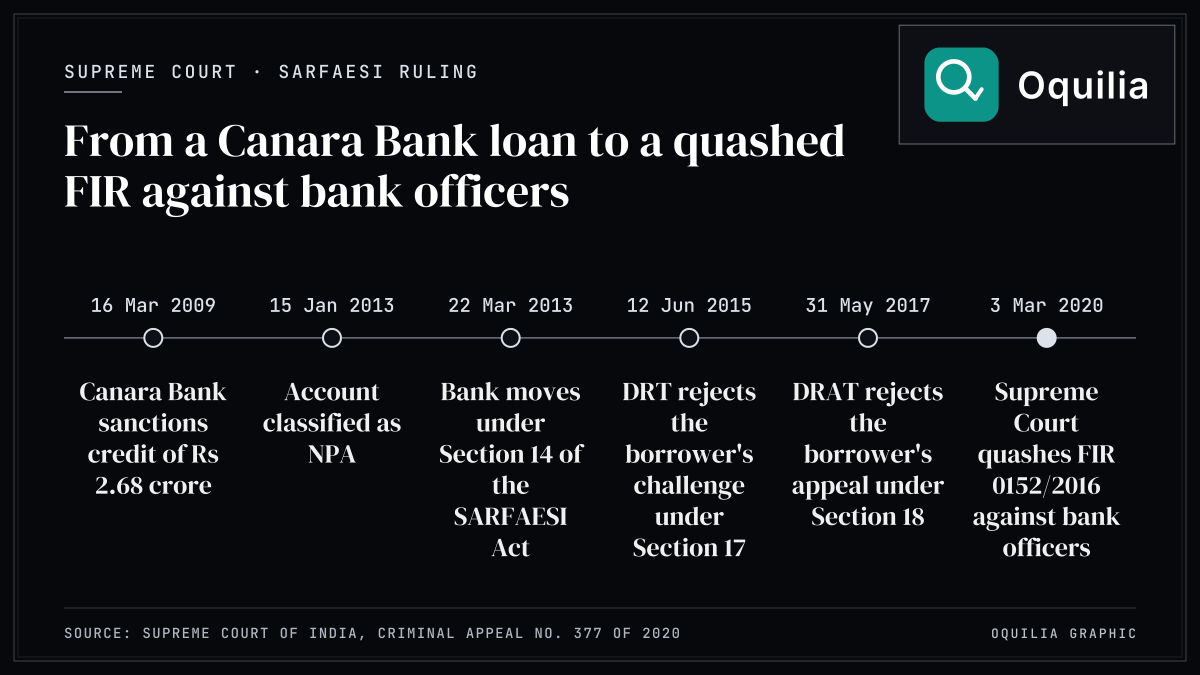
The facts are a familiar pattern. A borrower company received credit of Rs 2.68 crore from Canara Bank, sanctioned on 16 March 2009. The account was classified as a non-performing asset (NPA) on 15 January 2013, and the bank moved under Section 14 of the SARFAESI Act on 22 March 2013. The first auction, at a reserve price of Rs 2,28,51,000, drew no bids; the bank then cut the reserve price to Rs 1.10 crore. After losing before the Debts Recovery Tribunal (DRT) on 12 June 2015 and the Debts Recovery Appellate Tribunal (DRAT) on 31 May 2017, the borrower filed a private complaint, and FIR 0152/2016 was registered against the bank officers.
| Event | Date | Figure or forum |
|---|---|---|
| Credit facility sanctioned by Canara Bank | 16 Mar 2009 | Rs 2.68 crore |
| Account classified as NPA | 15 Jan 2013 | - |
| Section 14 possession step | 22 Mar 2013 | Magistrate route |
| First auction (no bids) | - | Reserve Rs 2,28,51,000 |
| Revised reserve price | - | Rs 1.10 crore |
| DRT rejects borrower's challenge | 12 Jun 2015 | Section 17 |
| FIR registered on private complaint | 2016 | FIR 0152/2016 |
| DRAT rejects appeal | 31 May 2017 | Section 18 |
| Supreme Court quashes FIR | 3 Mar 2020 | Crl. Appeal 377/2020 |
The revised reserve was roughly 48% of the original figure (Rs 1.10 crore against Rs 2.2851 crore), a cut of about Rs 1.19 crore. That gap is precisely the sort of number that makes a borrower feel cheated. The Supreme Court's answer was not that the grievance was baseless, but that the SARFAESI Act already provides the forum to test it.
The Statutory Position
The Securitisation and Reconstruction of Financial Assets and Enforcement of Security Interest Act, 2002 (SARFAESI Act) lets a secured creditor enforce security without first going to a civil court. The relevant provisions, as summarised in Oquilia's statute catalogue, are set out below.
| Provision | What it does | Time limit or figure |
|---|---|---|
| Section 13(2) | Demand notice once the account is an NPA | 60 days to pay |
| Section 13(3A) | Borrower's representation or objection; creditor must reply with reasons | Reply within 15 days |
| Section 13(4) | Creditor may take possession (symbolic or physical), sell, lease or appoint a manager, without court intervention | After the 60-day period |
| Section 14 | Application to the Chief Metropolitan Magistrate or District Magistrate for physical possession | 30-day disposal mandate (post-2016 amendment) |
| Section 17 | Borrower's application to the DRT against measures under Section 13(4) | 45 days; deposit not mandatory but tribunal may direct |
| Section 18 | Appeal from the DRT to the DRAT | 30 days; 50% pre-deposit, reducible to not less than 25% |
| Section 32 | No suit or prosecution against the creditor or its officers for acts done in good faith | Good-faith protection |
Two points from this table carry the Virupaksha reasoning. First, Section 17 is drafted to cover "measures" under Section 13(4), and a sale is one of those measures, so a complaint that a sale was undervalued is a Section 17 complaint. Second, Section 32 protects acts done in good faith, which means a criminal case against officers needs something more than a disputed valuation.
The Supreme Court described the SARFAESI Act as a complete code (para 16). The phrase matters: when a statute builds its own machinery for a dispute, including a tribunal under the Recovery of Debts and Bankruptcy Act, 1993 (RDDB Act) and an appellate tribunal above it, a party cannot side-step that machinery by re-labelling the same dispute as cheating or breach of trust.
For readers new to the vocabulary, see Oquilia's glossary entries on SARFAESI, the Debts Recovery Tribunal, and collateral.
Procedure Step by Step
The sequence below follows the statute brief for each section and shows the point at which each kind of objection belongs. A borrower who raises the right objection at the right step keeps it alive; one who saves it for a police station after 2 tribunal losses, as in Virupaksha, usually loses it.
- NPA classification. The lender classifies the account as an NPA. In Virupaksha this happened on 15 January 2013, almost 4 years after sanction.
- Section 13(2) demand notice. The borrower gets 60 days to discharge the liability. Check the amount claimed, the date of NPA classification and the description of the secured asset in this notice.
- Section 13(3A) representation. Within the 60-day window, file a written objection. The creditor must reply with reasons within 15 days. A reasoned reply, or the lack of one, becomes evidence before the DRT.
- Section 13(4) measures. If the 60 days lapse without payment, the creditor may take symbolic or physical possession, sell, lease or appoint a manager, all without court intervention.
- Section 14 application (if needed). Where physical possession is resisted, the creditor applies to the Chief Metropolitan Magistrate or District Magistrate, who is expected to dispose of it within 30 days after the 2016 amendment. In Virupaksha this step was taken on 22 March 2013.
- Valuation and reserve price. The creditor fixes a reserve price and notifies the sale. In Virupaksha the first reserve was Rs 2,28,51,000; when no bids came, it was cut to Rs 1.10 crore.
- Section 17 application to the DRT. Any challenge to a Section 13(4) measure, including the sale and its price, goes here within 45 days. Deposit is not mandatory, though the DRT may direct one. The borrower in Virupaksha lost at this stage on 12 June 2015.
- Section 18 appeal to the DRAT. Within 30 days of the DRT order, with a pre-deposit of 50% of the debt (as claimed by the creditor or determined by the DRT, whichever is less), reducible to not less than 25% for recorded reasons. The DRAT ruled against the borrower on 31 May 2017.
- Constitutional remedy. After the DRAT, the route is a challenge in law to the tribunal orders before the High Court. The Supreme Court in Virupaksha expressly left the borrower free to challenge the DRT and DRAT orders in law (para 19).
| Stage | Who decides | Clock | Money on the table |
|---|---|---|---|
| Section 13(3A) objection | Secured creditor | Reply in 15 days | None |
| Section 17 application | DRT | 45 days from the measure | Discretionary deposit |
| Section 18 appeal | DRAT | 30 days from DRT order | 50% of debt, reducible to 25% |
| Criminal complaint over auction price | Magistrate / police | - | Quashed in Virupaksha as abuse of process |
To size what is at stake before a hearing, run the outstanding balance through Oquilia's loan foreclosure calculator; if a refinance is realistic, the balance transfer calculator and loan eligibility calculator show whether a new lender could take out the debt before Section 13(4) steps begin.
Borrower Defences Available
Virupaksha does not strip borrowers of defences. It tells them where to plead them. The grounds below are the ones that, on the Act's scheme as summarised in the section briefs, sit inside Section 17.
1. Defective Section 13(2) notice. A notice must give the 60-day window. A wrong amount, a wrong asset description or a premature NPA date are all objections to raise first under Section 13(3A) and then before the DRT within 45 days.
2. No reasoned reply to the representation. Section 13(3A) requires the creditor to reply with reasons within 15 days. A missing or mechanical reply is a ground before the DRT; it is not a crime.
3. Undervaluation and reserve-price cuts. This was the heart of Virupaksha. A drop from Rs 2,28,51,000 to Rs 1.10 crore may well be arguable, but the Supreme Court held that undervaluation or any irregularity in the auction must be raised before the DRT under Section 17, with an appeal to the DRAT (para 17). A borrower who has evidence of a higher market value should put a valuation report before the DRT inside the 45-day window.
4. Exempt security. Section 31 lists securities outside the Act, including a lien, agricultural land, crops and financial assets below Rs 1 lakh. If the secured asset falls in that list, the SARFAESI route itself is unavailable to the lender.
5. Section 14 procedure. If the magistrate's order was passed without the material the statute requires, that is again a matter for challenge under the SARFAESI framework rather than a police complaint.
6. Settlement before sale. A one-time settlement offer, made in writing and backed by a realistic payment plan, can stop the sale. The debt consolidation calculator helps test whether a cheaper single loan can fund an offer.
When a criminal complaint is still possible. Virupaksha concerned a complaint the Court found to be an afterthought, filed after the borrower had already litigated before the DRT from at least 2015. The judgement does not say bank officers can never be prosecuted; Section 32 itself protects only acts done in good faith. What it says is that a dispute about valuation and auction conduct, which the DRT can decide, cannot be turned into a cheating or breach-of-trust case under IPC Sections 406, 409, 420 and 120B. Since 1 July 2024 the IPC has been replaced by the Bharatiya Nyaya Sanhita, 2023, but the principle, which rests on the SARFAESI scheme rather than on the penal code, is unaffected.
| Defence | Correct forum | Deadline (statute brief) | Deposit |
|---|---|---|---|
| Faulty 13(2) notice | Creditor, then DRT | 60 days / 45 days | Discretionary at DRT |
| No reasoned 13(3A) reply | DRT | 45 days | Discretionary |
| Undervalued sale | DRT under Section 17 | 45 days | Discretionary |
| Adverse DRT order | DRAT under Section 18 | 30 days | 50%, reducible to 25% |
| Exempt asset (Section 31) | DRT | 45 days | Discretionary |
Recent Tribunal/HC Position
The governing authority on this question remains K. Virupaksha v. State of Karnataka, decided by a 3-judge bench of Justices R. Banumathi, S. Abdul Nazeer and A.S. Bopanna (who wrote the judgement) on 3 March 2020. The full text is on Indian Kanoon, and the Act itself can be read on India Code.
The judgement's reasoning can be traced through 3 paragraphs:
- Para 16: a complete code. The SARFAESI Act provides its own procedure for enforcement and its own remedy against every measure, through Section 17 to the DRT and Section 18 to the DRAT.
- Para 17: afterthought and abuse of process. The borrower had taken the valuation dispute to the DRT, lost on 12 June 2015, and only then pursued a criminal complaint. The Court treated the complaint as an afterthought and an abuse of the process of law.
- Para 19: FIR quashed. FIR 0152/2016 was quashed against the bank officers, while the borrower was left free to challenge the DRT and DRAT orders in law.
Three practical lessons follow for borrowers and their advisers.
First, the timeline counts against late criminal complaints. In Virupaksha, FIR 0152/2016 came some 3 years after the 22 March 2013 possession step. Courts read that kind of gap as a sign that the complaint is a pressure tactic.
Second, losing before the DRT does not convert a civil grievance into a criminal one. The borrower had 2 adverse orders, dated 12 June 2015 and 31 May 2017; the Court pointed the borrower back to a legal challenge against those orders, not to the police.
Third, bank officers carrying out a Section 13(4) sale have a statutory shield under Section 32 for good-faith acts. A complaint that says only "the price was too low" does not plead the absence of good faith; it pleads a valuation dispute.
| Question | Virupaksha answer | Paragraph |
|---|---|---|
| Is SARFAESI a self-contained scheme? | Yes, a complete code | 16 |
| Where does an undervaluation complaint go? | DRT under Section 17, then DRAT | 17 |
| Was the criminal complaint maintainable? | No, an afterthought and abuse of process | 17 |
| What happened to the FIR? | Quashed against the bank officers | 19 |
| Can the borrower still challenge the tribunal orders? | Yes, in law | 19 |
The Oquilia Research Desk does not appear in any court; this analysis is general information on a reported judgement, not legal advice on a particular account. For a parallel look at how cheque-dishonour cases against loan borrowers are being treated, see our recent report on a High Court refusing to quash an HDFC Bank cheque bounce case.
FAQ
Can I file an FIR against bank officers because my property was auctioned below market value?
Not on that ground alone. In K. Virupaksha v. State of Karnataka (3 March 2020), the Supreme Court held that undervaluation or irregularity in a SARFAESI auction must be raised before the DRT under Section 17, with an appeal to the DRAT, and quashed FIR 0152/2016 as an abuse of process.
How long do I have to approach the DRT after a sale notice or possession?
Oquilia's statute brief for Section 17 gives a 45-day limitation for an application against measures under Section 13(4). A deposit is not mandatory at this stage, although the tribunal may direct one.
What do I need to deposit to appeal a DRT order?
Under Section 18, the appeal to the DRAT must be filed within 30 days and is not entertained unless the borrower deposits 50% of the debt due (as claimed by the creditor or determined by the DRT, whichever is less). The DRAT may reduce this to not less than 25% for reasons recorded in writing.
Does Section 32 mean bank officers can never be prosecuted?
No. Section 32 bars suits and prosecutions only for acts done in good faith. Virupaksha (para 17) turned on the complaint being an afterthought about a valuation dispute that the DRT could decide, not on a blanket immunity.
What should I do when I receive a Section 13(2) notice?
Use the 60-day window. File a written representation under Section 13(3A); the creditor must reply with reasons within 15 days. Keep copies, because the reply, or its absence, is evidence if you later go to the DRT within 45 days of a Section 13(4) measure.
Are any assets outside SARFAESI altogether?
Yes. Section 31 exempts certain securities, including a lien, agricultural land, crops and financial assets below Rs 1 lakh. If the asset falls in that list, the lender cannot enforce it under SARFAESI.
Did the Supreme Court leave the borrower with any remedy in Virupaksha?
Yes. While quashing the FIR against the bank officers (para 19), the Court left the borrower free to challenge the DRT order of 12 June 2015 and the DRAT order of 31 May 2017 in law.