

High Court refuses to quash HDFC Bank cheque bounce case against vehicle loan borrower
The Punjab and Haryana High Court refused to quash HDFC Bank's cheque bounce complaint against a borrower who said his loan was settled after the bank sold his vehicle, leaving it to the trial court.
Key points
- The Punjab and Haryana High Court on 3 November 2026 dismissed a borrower's plea to quash HDFC Bank's cheque bounce complaint.
- The complaint concerns a Rs 1,78,470 cheque that was returned unpaid for insufficient funds on 6 November 2017, per the High Court's order.
- The court held that whether the loan was settled from the sale of the seized vehicle is a disputed fact for the trial court to decide.
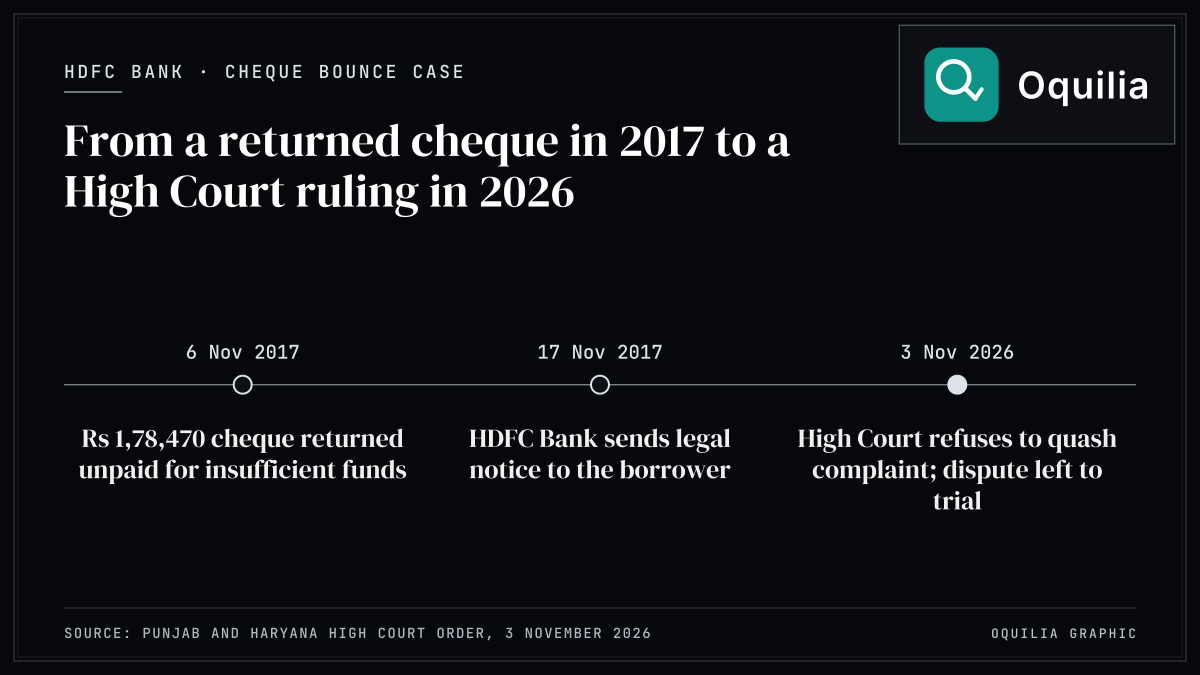
The Punjab and Haryana High Court on 3 November 2026 refused to quash a cheque bounce complaint filed by HDFC Bank against a borrower who said nothing was due because the bank had seized and sold his vehicle. The court held that the dispute over whether the loan was settled must be decided at trial, not in a petition to quash the case.
What Happened
According to the High Court's order, the borrower took a loan from HDFC Bank for a commercial vehicle and gave post-dated cheques. A cheque for Rs 1,78,470 dated 6 November 2017 was returned unpaid for insufficient funds the same day. The bank sent a legal notice on 17 November 2017 and, when the amount was not paid within 15 days, filed a complaint under Section 138 of the Negotiable Instruments Act, which makes the dishonour of a cheque given for a debt an offence. The case is pending before a judicial magistrate in Amritsar.
The borrower argued that the bank had seized and sold the vehicle, adjusted the sale proceeds and that a statement of account showed a nil balance with the loan marked closed. The bank disputed that statement and said its records showed Rs 8,89,251 outstanding in the loan account.
The court held that a prima facie case was made out. Whether the vehicle was sold and whether the proceeds were adjusted against the loan are disputed questions of fact that need oral and documentary evidence at trial, it said, adding that the law presumes in favour of the holder of a cheque. The petition was dismissed. The borrower's defence remains open before the trial court.
What It Means
For borrowers, the ruling shows that a High Court may not end a cheque bounce case early just because the lender has repossessed and sold the asset. If the lender disputes that the loan is fully paid, the borrower's account statement and the sale of the vehicle become matters of evidence at trial.
A complaint about a bank's handling of a loan account can be filed with the RBI at https://cms.rbi.org.in.
Source: High Court judgment
Sources & Citations
- High Court judgment — Punjab and Haryana High Court