

Writing a Book? Section 151 of the Income-tax Act 2025 Lets Resident Authors Deduct Up to Rs 3 Lakh of Royalty
Section 151 of the Income-tax Act 2025 lets resident authors deduct book royalty up to Rs 3 lakh in the old regime, subject to a 15% sales test, a payer certificate and a six-month rule.
Key points
- Section 151 of the Income-tax Act 2025, successor to section 80QQB, lets a resident author deduct book royalty or copyright income.
- The deduction is the lower of the qualifying income or Rs 3,00,000, and royalty above 15% of the value of books sold is ignored.
- The claim is allowed only in the old regime and needs a payer-verified certificate filed with the return.
A resident author who earns royalty on a book can knock up to Rs 3,00,000 off taxable income under section 151 of the Income-tax Act, 2025, the provision that took over from section 80QQB of the 1961 Act when the new law came into force on 1 April 2026. The deduction is small next to the headline numbers in a tax return, but for a writer in the 30% bracket of the old regime it is worth up to Rs 93,600 a year once 4% cess is added. It also comes with three conditions that trip people up: a 15% cap tied to book sales, a six-month repatriation window for foreign royalty, and a certificate that has to travel with the return of income.
This guide walks through the text of section 151, works a full example with a Rs 20 lakh income, and lists the errors that most often cost authors the claim.
What the Section Says
Section 151 sits in Chapter VIII of the 2025 Act, the chapter of deductions from gross total income. Its heading is "Deduction in respect of royalty income, etc., of authors of certain books other than text-books", and it has 8 sub-sections. In plain English, they say this:
| Sub-section | What it requires |
|---|---|
| 151(1) | Only an individual author who is resident in India qualifies. The income must be earned in the exercise of the profession, as a lump sum for assigning or granting copyright in a book, or as royalty or copyright fees for that book |
| 151(2) | Deduction is the whole of that income or Rs 3,00,000, whichever is less |
| 151(3) | If the royalty is not a lump sum in lieu of all rights, any part above 15% of the value of books sold in the tax year (before expenses) is ignored |
| 151(4) | Income from outside India counts only to the extent brought into India in convertible foreign exchange within 6 months of the end of the tax year, or a longer period the competent authority allows |
| 151(5) | A certificate in the prescribed form, verified by the payer, must be furnished with the return |
| 151(6) | For foreign-source income, a certificate from the prescribed authority must also be furnished with the return |
| 151(7) | Income allowed under section 151 cannot be deducted again under any other provision, in any tax year |
| 151(8) | Definitions of "author", "books", "competent authority" and "lump sum" |
Sub-section (1) covers a book "being a work of literary, artistic or scientific nature". That covers a novel, a poetry collection, a book of photographs or a scientific monograph, provided the work qualifies as a "book" under sub-section (8).
Sub-section (8)(b) is where many claims fail. It says "books" shall not include brochures, commentaries, diaries, guides, journals, magazines, newspapers, pamphlets, text-books for schools, tracts "and other publications of similar nature, by whatever name called". A school text-book author or a guide-book writer is outside section 151, even if the payments are labelled royalty.
The other 3 definitions in sub-section (8) matter in practice:
- Author includes a joint author, so each co-author can claim on their own share, each up to Rs 3,00,000.
- Competent authority means the Reserve Bank of India, or another authority empowered under foreign-exchange law, and it is the body that can extend the 6-month window in sub-section (4).
- Lump sum, for royalties or copyright fees, includes an advance on royalties that is not returnable.
Two limits sit outside the section itself. First, the deduction is an old-regime benefit: under section 202(2)(a)(xii) of the 2025 Act, Chapter VIII deductions are not allowed in the new regime, other than those under sections 124(1), 124(2), 125(2) and 146, and section 151 is not on that list. Second, the section applies from tax year 2026-27, which began on 1 April 2026; royalty earned up to 31 March 2026 is still governed by section 80QQB of the 1961 Act, as the indiacode.nic.in text of that Act shows.
Worked Example
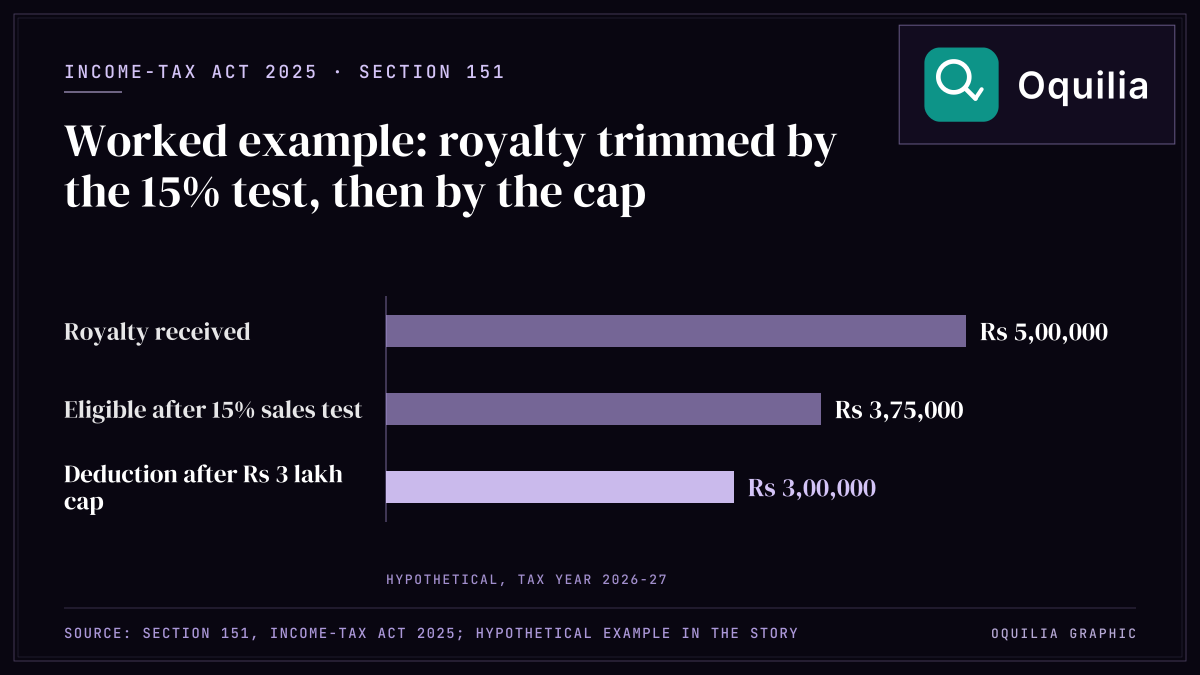
Take a resident author whose gross total income for tax year 2026-27 is Rs 20,00,000. Of that, Rs 15,00,000 comes from other professional work and Rs 5,00,000 is royalty from a publisher, paid as a percentage of sales rather than as a lump sum in lieu of all rights. During the year the publisher sold copies worth Rs 25,00,000. The author is not salaried, so no standard deduction applies, and the figures are hypothetical.
Step 1: apply the 15% sales test
Because the royalty is not a lump sum for all rights, sub-section (3) applies. 15% of Rs 25,00,000 is Rs 3,75,000. The Rs 1,25,000 of royalty above that line is ignored for the deduction, though it remains taxable income.
Step 2: apply the Rs 3 lakh cap
The eligible royalty is Rs 3,75,000. Sub-section (2) caps the deduction at Rs 3,00,000, so the claim is Rs 3,00,000.
| Line | Amount (Rs) |
|---|---|
| Royalty received | 5,00,000 |
| Value of books sold in the tax year | 25,00,000 |
| 15% of books sold | 3,75,000 |
| Royalty ignored under 151(3) | 1,25,000 |
| Eligible royalty | 3,75,000 |
| Deduction under 151(2), capped | 3,00,000 |
Two variations show how the same rules bite differently. If the royalty were Rs 2,00,000 on sales of Rs 10,00,000, the 15% test would trim it to Rs 1,50,000, and the deduction would be Rs 1,50,000. If the author had instead sold all rights in the book for a single payment of Rs 2,40,000, sub-section (3) would not apply at all, and the deduction would be the full Rs 2,40,000.
Step 3: compare the regimes
The table below uses the old-regime slabs (0% to Rs 2.5 lakh, 5% to Rs 5 lakh, 20% to Rs 10 lakh, 30% above) and the new-regime slabs of section 202(1) (nil to Rs 4 lakh, then 5%, 10%, 15%, 20%, 25% and 30% in Rs 4 lakh bands), with 4% health and education cess.
| Scenario | Taxable income (Rs) | Tax + 4% cess (Rs) |
|---|---|---|
| Old regime, no deductions | 20,00,000 | 4,29,000 |
| Old regime, section 151 only | 17,00,000 | 3,35,400 |
| Old regime, section 151 plus Rs 5,00,000 of other old-regime deductions | 12,00,000 | 1,79,400 |
| New regime (section 151 not allowed) | 20,00,000 | 2,08,000 |
The section 151 claim saves Rs 93,600 inside the old regime, which is Rs 3,00,000 at 30% plus 4% cess. Even so, the new regime at Rs 2,08,000 beats the old regime with section 151 alone at Rs 3,35,400 by Rs 1,27,400. The old regime wins only in the third row, where other deductions of Rs 5,00,000 bring the bill to Rs 1,79,400. Run your own figures through the old vs new regime calculator and the income tax calculator before you choose.
Common Mistakes
These are the errors that most often lead to the claim being cut in processing or in scrutiny, measured against the text of section 151.
- Claiming in the new regime. Section 202(2)(a)(xii) bars Chapter VIII deductions in the new regime except sections 124(1), 124(2), 125(2) and 146. A Rs 3,00,000 claim under section 151 in a new-regime return will be disallowed.
- Writing the wrong kind of book. Sub-section (8)(b) excludes text-books for schools, guides, commentaries, journals, magazines, diaries and 4 other listed categories. A royalty statement does not turn a guide into a "book".
- Skipping the 15% test. Where royalty is not a lump sum for all rights, income above 15% of the value of books sold in the year is ignored. An author who receives Rs 4,00,000 on sales of Rs 20,00,000 can claim only Rs 3,00,000, which here happens to equal both 15% of sales and the cap.
- Filing without the payer's certificate. Sub-section (5) says no deduction "shall be allowed" unless a certificate in the prescribed form, verified by the person who paid the royalty, is furnished with the return. Ask the publisher for it well before the filing due date.
- Leaving foreign royalty abroad. Under sub-section (4), only the part brought into India in convertible foreign exchange within 6 months of the end of the tax year counts, so for tax year 2026-27 the window closes on 30 September 2027 unless the competent authority extends it. Sub-section (6) adds a second certificate for foreign-source income.
- Claiming as a non-resident. Sub-section (1) is limited to an author "resident in India". An author who is non-resident for the year cannot claim, however much of the royalty comes from Indian sales.
- Quoting the old section number. For income from 1 April 2026 the claim is under section 151 of the 2025 Act. Section 80QQB of the 1961 Act still governs royalty earned in FY 2025-26 and earlier years.
- Claiming twice. Sub-section (7) stops the same income from being deducted again under any other provision, in any tax year.
Royalty is also subject to TDS when a publisher pays it, so match the amount in your return to the tax credit statement on the income-tax e-filing portal and use the TDS calculator to check the deduction. The tax deduction glossary entry explains how Chapter VIII claims reduce total income rather than tax.
FAQ
Who can claim the deduction under section 151?
Only an individual author, including a joint author, who is resident in India for the tax year. The income must be earned in the exercise of the profession, from copyright in a book of literary, artistic or scientific nature, per section 151(1).
What is the maximum deduction under section 151?
The whole of the qualifying income or Rs 3,00,000, whichever is less, under section 151(2). A co-author claims on their own share of the income, subject to the same Rs 3,00,000 cap.
Can I claim section 151 under the new tax regime?
No. Section 202(2)(a)(xii) of the Income-tax Act, 2025 disallows Chapter VIII deductions in the new regime except those under sections 124(1), 124(2), 125(2) and 146. Section 151 is available only to an author who opts for the old regime.
Do school text-books and guides qualify?
No. Section 151(8)(b) excludes brochures, commentaries, diaries, guides, journals, magazines, newspapers, pamphlets, text-books for schools, tracts and other publications of a similar nature.
How does the 15% rule work?
If the royalty is not a lump sum in lieu of all rights, any income above 15% of the value of books sold in the tax year, before expenses, is ignored. On sales of Rs 25,00,000 the eligible ceiling is Rs 3,75,000, which the Rs 3,00,000 cap then reduces further.
Is a non-returnable advance from the publisher treated as a lump sum?
Yes. Section 151(8)(d) says "lump sum" includes an advance payment on account of royalties or copyright fees that is not returnable.
What about royalty earned from a foreign publisher?
It counts only to the extent brought into India in convertible foreign exchange within 6 months of the end of the tax year, or a longer period allowed by the Reserve Bank of India or another competent authority, and a certificate from the prescribed authority must be filed with the return under section 151(6).
Sources & Citations
- Section 151 in The Income Tax Act, 2025 — Indian Kanoon
- India Code: Income-tax Act, 1961 and Income-tax Act, 2025 — India Code
- Income Tax e-Filing Portal — Income Tax Department