

Sold Farmland? Section 83 of the Income-tax Act 2025 Exempts the Gain if You Buy New Agricultural Land Within Two Years
Section 83 of the Income-tax Act 2025, successor to section 54B, exempts capital gains on farmland sold by an individual or HUF if the gain is reinvested in agricultural land within two years.
Key points
- Section 83 of the Income-tax Act, 2025, which replaces section 54B, lets an individual or HUF exempt capital gains on the sale of farmland.
- The land must have been farmed for two years before the sale, and new agricultural land must be bought within two years after it.
- Unspent gains must go into the Capital Gains Accounts Scheme by the return due date, and selling the new land within three years reverses the benefit.
Selling a family farm is often the largest single transaction a rural household makes in a generation, and the capital gain on it can run into lakhs of rupees. Section 83 of the Income-tax Act, 2025, headed "Capital gains on transfer of land used for agricultural purposes not to be charged in certain cases", lets an individual or a Hindu undivided family (HUF) keep that gain out of tax if it is put back into other agricultural land within two years. It is the successor to section 54B of the Income-tax Act, 1961, and the full text can be read on Indian Kanoon.
Before you start, check whether your land is a capital asset at all: rural agricultural land that falls outside the definition of capital asset in section 2 is outside the capital gains net entirely, and section 83 is then not needed.
What the Section Says
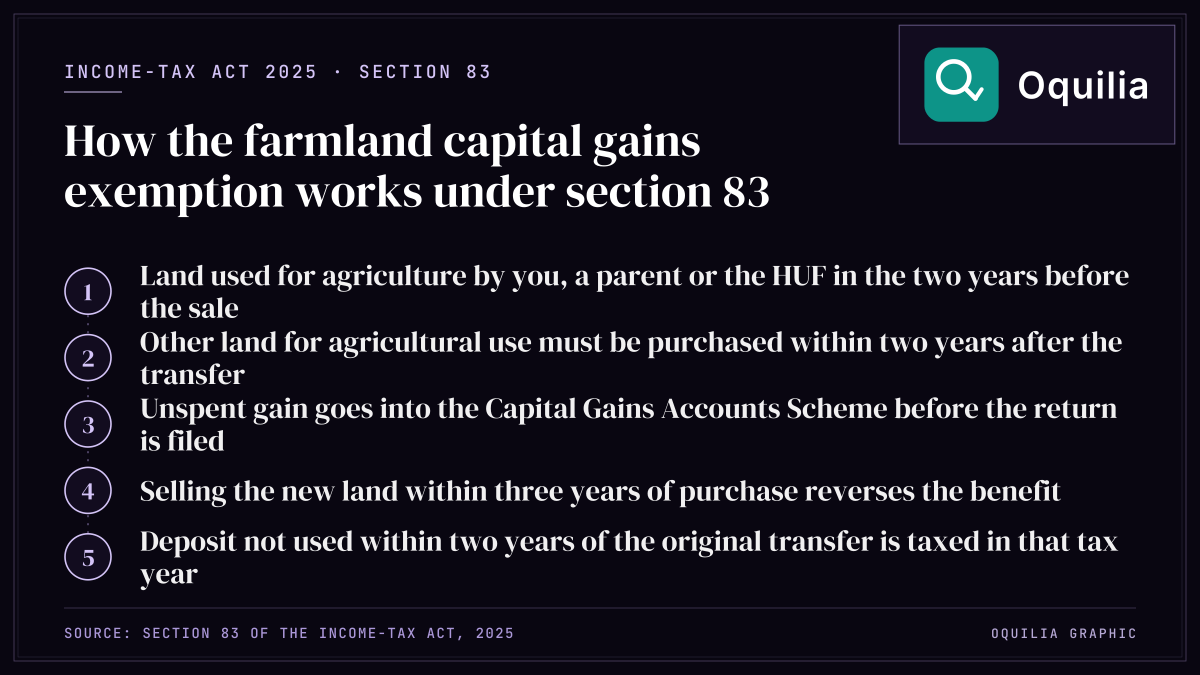
Section 83 has four working parts.: a two-year use test, a two-year purchase window, a deposit route and a three-year lock-in.
Sub-section (1): who qualifies and how the exemption works
The relief is available to two kinds of taxpayer only: an individual and an HUF. Three conditions must all be met:
- The original asset. There must be capital gains from the transfer of land that, in the two years immediately preceding the date of transfer, was used for agricultural purposes by the assessee or a parent of the assessee (for an individual), or by the HUF.
- The new asset. Within two years after the date of transfer, the assessee must purchase other land for agricultural use.
- The comparison. The gain is set against the cost of the new asset, with two possible outcomes, set out in clauses (i) and (ii).
| Situation | What is taxed now | Cost of new land if sold within 3 years of purchase |
|---|---|---|
| Clause (i): gain is more than the cost of the new land | Only the excess, charged under section 67 | Treated as nil |
| Clause (ii): gain is equal to or less than the cost of the new land | Nothing | Cost is reduced by the gain |
The trade-off: relief today, but if you sell the replacement land within three years of buying it, the exempted gain is clawed back through a lower cost base on that later sale.
Sub-section (2): the Capital Gains Accounts Scheme route
The two-year purchase window will often run past the date on which your return falls due. Section 83(2) deals with that. Any part of the gain not used to buy new agricultural land before you file your return under section 263 must be deposited in a specified bank or institution under a Central Government scheme, the Capital Gains Accounts Scheme. The deposit must be made before filing and not later than the due date under section 263(1), and proof of the deposit must be furnished with the return.
Sub-section (3): the deemed cost
The amount already spent on new land plus the amount deposited under the scheme is treated as the cost of the new asset. This is what lets a taxpayer claim the full exemption in the return even though the land has not yet been bought.
Sub-section (4): what happens if the deposit is not used
If any part of the deposit is not used to buy agricultural land within the period, that unused amount is charged under section 67 as income of the tax year in which the two years from the transfer of the original asset expire. Only then can it be withdrawn under the scheme.
| Sub-section | Deadline or trigger | Consequence |
|---|---|---|
| 83(1) | 2 years before transfer: agricultural use | Without this, no exemption |
| 83(1) | 2 years after transfer: purchase of new land | Exemption up to cost of new land |
| 83(1)(i)/(ii) | 3 years after purchase of new land | Sale within this period reverses the benefit |
| 83(2) | Due date under section 263(1) | Unspent gain must be in the deposit scheme |
| 83(4) | End of 2 years from original transfer | Unused deposit taxed in that tax year |
The Income-tax Act, 2025 replaced the 1961 Act from 1 April 2026, so the familiar section 54B mechanics now sit in section 83, and the "previous year" vocabulary has given way to the "tax year". Forms and notifications are on the Income Tax Department e-filing portal; income from growing crops (as opposed to selling land) can be checked in our agricultural income calculator.
Worked Example
The example below is hypothetical and uses round figures. It assumes the land is a capital asset, the gain is long-term, the land was acquired on or after 23 July 2024 so the rate is 12.5% without indexation, the taxpayer's total income keeps them below the Rs 50 lakh surcharge threshold, and health and education cess applies at 4%. For land acquired before 23 July 2024, a 20% rate with indexation is available as an alternative; run both through the capital gains calculator before you decide.
Scenario A: partial reinvestment (clause (i))
A farmer sells inherited farmland worked by her father for the preceding two years. The capital gain is Rs 40 lakh. Within two years she buys new farmland for Rs 30 lakh.
| Line item | Without section 83 | With section 83 |
|---|---|---|
| Capital gain | Rs 40,00,000 | Rs 40,00,000 |
| Exemption (cost of new land) | Nil | Rs 30,00,000 |
| Taxable gain | Rs 40,00,000 | Rs 10,00,000 |
| Tax at 12.5% | Rs 5,00,000 | Rs 1,25,000 |
| Cess at 4% | Rs 20,000 | Rs 5,000 |
| Total tax | Rs 5,20,000 | Rs 1,30,000 |
Because the Rs 40 lakh gain exceeds the Rs 30 lakh cost, clause (i) applies: Rs 10 lakh is charged under section 67, and Rs 3,90,000 of tax is saved. The catch is the three-year rule. If she sells the new land within three years of buying it for, say, Rs 35 lakh, its cost is taken as nil, so the entire Rs 35 lakh becomes a capital gain on that sale.
Scenario B: full reinvestment (clause (ii))
Now assume she buys new land for Rs 45 lakh. The Rs 40 lakh gain is less than the cost, so nothing is charged. If she then sells the new land within three years for Rs 50 lakh, its cost is reduced by the Rs 40 lakh gain, from Rs 45 lakh to Rs 5 lakh, and the gain on that sale is Rs 45 lakh rather than Rs 5 lakh.
Scenario C: using the deposit scheme
Suppose the return falls due before she has found suitable land. By that date she has bought one plot for Rs 25 lakh. She deposits the remaining Rs 15 lakh under the Capital Gains Accounts Scheme before filing and attaches the proof.
| Step | Amount |
|---|---|
| Capital gain | Rs 40,00,000 |
| Spent on new land before filing | Rs 25,00,000 |
| Deposited in scheme before due date | Rs 15,00,000 |
| Deemed cost under section 83(3) | Rs 40,00,000 |
| Taxable gain in the year of sale | Nil |
| Deposit used for second plot within 2 years | Rs 10,00,000 |
| Unused deposit taxed under section 83(4) | Rs 5,00,000 |
The Rs 5 lakh is not taxed in the year of the original sale. It is charged as income of the tax year in which the two-year period from the original transfer ends, and only then can it be withdrawn. At 12.5% plus 4% cess, that is Rs 65,000 of tax in that later year. You can check your overall liability for both years in the income tax calculator.
Common Mistakes
These are the errors that most often cost taxpayers the exemption under section 54B, and section 83 carries forward the same conditions.
1. Claiming it for a company, firm or LLP. Section 83(1) names only an individual or an HUF. A partnership firm or company that sells farmland gets no relief under this section, whatever it does with the money.
2. Ignoring the two-year user test. The original land must have been used for agricultural purposes in the two years immediately before the transfer, by you, a parent, or the HUF. Land lying fallow or leased for non-agricultural use for that period fails the test.
3. Buying land that is not for agricultural use. The new asset must be "other land for being used for agricultural purposes". A residential plot, a farmhouse plot or commercial land does not qualify, even if it sits in a rural area.
4. Missing the deposit deadline. Unspent gains must be in the scheme before the return is filed and no later than the due date under section 263(1). Depositing after filing, or putting the money in an ordinary fixed deposit or savings account, does not satisfy section 83(2).
5. Forgetting the proof. Section 83(2) requires evidence of the deposit to be furnished with the return. Keep the passbook or deposit receipt and the account number ready when you fill in the capital gains schedule of your ITR.
6. Selling the new land too soon. A sale within three years of purchase triggers either a nil cost (clause (i)) or a cost reduced by the exempted gain (clause (ii)).
7. Losing track of unused deposits. Under section 83(4), any unused balance is taxed in the tax year in which the two-year period expires. That income has to be reported in that year's return; it does not wait until you choose to withdraw.
FAQ
Who can claim the exemption under section 83?
Only an individual or a Hindu undivided family. For an individual, the land must have been used for agriculture by the individual or a parent in the two years before the sale; for an HUF, by the HUF itself.
How long do I have to buy the new agricultural land?
Two years after the date of transfer of the original land. Money not spent before you file your return for the year of sale must be deposited under the Capital Gains Accounts Scheme by the due date under section 263(1).
What if the new land costs less than my capital gain?
Only the excess of the gain over the cost of the new land is charged under section 67. In the worked example, a Rs 40 lakh gain and Rs 30 lakh of new land leaves Rs 10 lakh taxable.
Can I sell the new land after buying it?
Yes, but a sale within three years of purchase reverses the benefit. If the gain was more than the cost, the new land's cost becomes nil; if the gain was equal to or less than the cost, the cost is reduced by the gain.
What happens to money in the Capital Gains Accounts Scheme that I never use?
It is charged under section 67 as income of the tax year in which two years from the original sale expire, and can then be withdrawn under the scheme.
Is section 83 the same as the old section 54B?
Section 83 of the Income-tax Act, 2025 is the successor to section 54B of the 1961 Act and keeps the same structure: two-year use test, two-year purchase window, deposit scheme and three-year lock-in.
Does section 83 apply if my farmland is not a capital asset?
No. Rural agricultural land that falls outside the definition of capital asset in section 2 does not produce a capital gain, so there is nothing for section 83 to exempt. Check the definition before you plan the reinvestment, and see our note on tax exemptions for how exemptions interact with total income.
This explainer is general information based on the text of section 83 of the Income-tax Act, 2025. It is not advice on which land to buy or whether to sell. Confirm your facts with a chartered accountant before filing.