

Got Salary Arrears or Family-Pension Arrears in One Year? Claiming Relief Under Section 157 of the Income-tax Act 2025
Section 157 of the Income-tax Act 2025, successor to section 89, gives relief when salary or family-pension arrears push you into a higher slab. How it is computed, with a worked example.
Key points
- Section 157 of the Income-tax Act 2025, in force from 1 April 2026, replaces section 89 and gives relief when arrears are taxed at a higher rate.
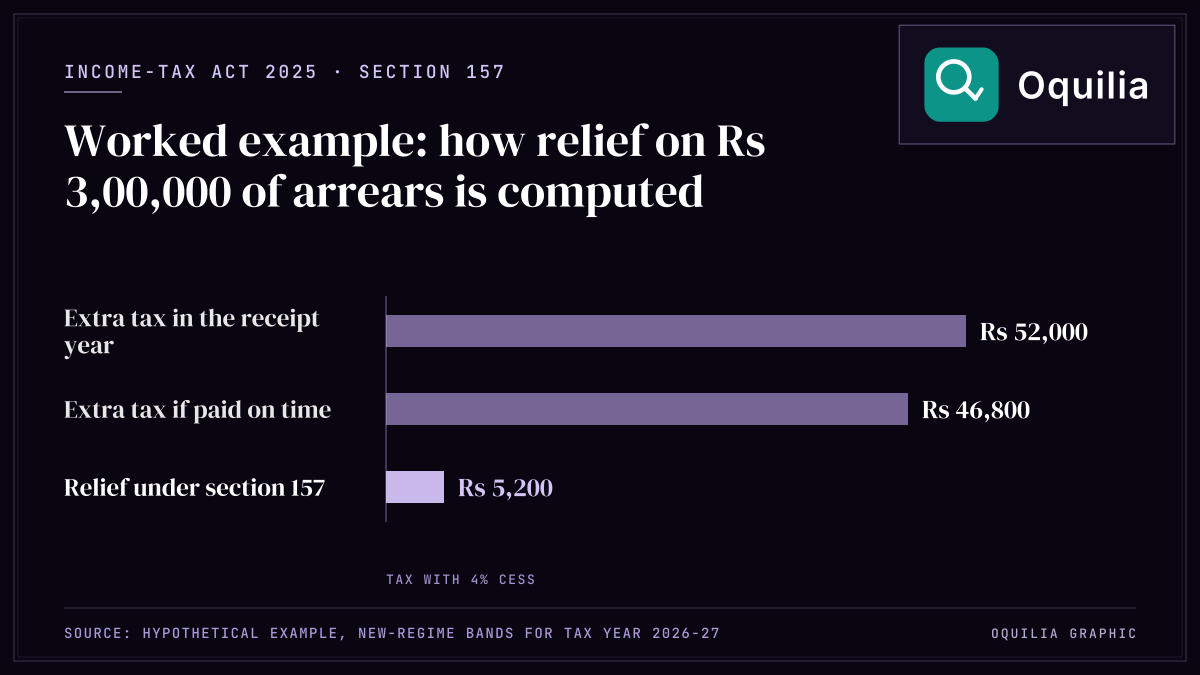
- In a hypothetical case, Rs 3,00,000 of arrears adds Rs 52,000 of tax in the receipt year against Rs 46,800 had it been paid on time, so relief is Rs 5,200.
- Relief is granted only on an application in the prescribed form, so file it before the return and recompute each earlier year at that year's rates.
A pay-commission revision, a delayed increment or a family pension that took three years to sanction can land in your bank account as one lump sum. Because India taxes income in the year it is received, that lump sum is added to a single year's salary and can push part of it into a higher slab. Section 157 of the Income-tax Act, 2025, in force from 1 April 2026, exists to undo that bunching effect. It is the successor to section 89 of the Income-tax Act, 1961, and the full text can be read on Indian Kanoon.
This guide sets out what section 157 says, works through a two-year example with real slab arithmetic, and lists the errors that most often cost salaried taxpayers and pensioners their relief.
What the Section Says
Section 157 is titled "Relief when salary, etc., is paid in arrears or in advance". Sub-section (1) applies where an assessee's total income is assessed at a rate higher than it would otherwise have been, because the income includes one of four kinds of receipt:
| Clause | Receipt covered | Typical real-world trigger |
|---|---|---|
| 157(1)(a) | A sum in the nature of arrear or advance salary | Pay-commission arrears, DA arrears, delayed increments |
| 157(1)(b) | Salary for more than 12 months received in one tax year | Two years' pay settled together after a dispute |
| 157(1)(c) | "Profits in lieu of salary" under section 18(1) | Certain lump-sum payments from an employer |
| 157(1)(d) | Arrears of "family pension" as defined in section 93(1)(d) | Pension arrears released to a widow or dependant |
In each of these four cases the Assessing Officer "shall, on an application by the assessee, grant such relief as may be prescribed". Three words in that sentence matter. "Shall" means the relief is not discretionary once the conditions are met. "Application" means you have to ask for it; nothing is granted automatically. "Prescribed" means the method of computation sits in the Income-tax Rules, not in the Act itself.
The logic of the relief
The computation compares two numbers. The first is the extra tax the arrears cause in the year you actually receive them. The second is the extra tax the same arrears would have caused had they been taxed in the earlier year or years to which they relate. Relief equals the first figure minus the second, and only when the first is larger.
| Step | What you compute | Purpose |
|---|---|---|
| 1 | Tax on income of the receipt year, with arrears included | Actual position |
| 2 | Tax on income of the receipt year, with arrears excluded | Removes the bunching |
| 3 | Step 1 minus Step 2 | Extra tax caused by arrears in the receipt year |
| 4 | Tax on the earlier year's income, with and without its share of arrears | What the arrears would have cost on time |
| 5 | Step 3 minus the Step 4 difference | Relief under section 157 (nil if negative) |
If the arrears relate to more than one earlier year, Step 4 is repeated for each of those years and the differences are added together.
The application form
Under the 1961 Act, the application for relief under section 89 was made online in Form 10E on the Income Tax e-filing portal, and it had to be filed before the return claiming the relief. Under the 2025 Act the application is made in the form prescribed by the Income-tax Rules. Check the current form number on incometax.gov.in before you file; this article refers to it as "the prescribed form" rather than guess a number.
Worked Example
The example below is clearly hypothetical. To keep the arithmetic readable, it applies the new-regime bands for tax year 2026-27 under section 202(1) of the 2025 Act to both years. In a real claim, each earlier year is recomputed at the rates, slabs and regime that actually applied in that year, and those may differ.
Facts. Meera, a central government employee, receives Rs 3,00,000 of pay-revision arrears in tax year 2026-27. All of it relates to one earlier year. Her taxable salary, after the Rs 75,000 new-regime standard deduction, is Rs 14,00,000 in the receipt year and was Rs 13,00,000 in the earlier year.
The slabs used are: nil up to Rs 4 lakh, 5% from Rs 4 lakh to Rs 8 lakh, 10% from Rs 8 lakh to Rs 12 lakh, 15% from Rs 12 lakh to Rs 16 lakh and 20% from Rs 16 lakh to Rs 20 lakh, plus 4% health and education cess. Because both incomes exceed Rs 12,00,000, the section 87A rebate of up to Rs 60,000 does not apply in either year.
Receipt year (tax year 2026-27).
| Item | Without arrears | With arrears |
|---|---|---|
| Taxable income | Rs 14,00,000 | Rs 17,00,000 |
| Tax on Rs 4-8 lakh at 5% | Rs 20,000 | Rs 20,000 |
| Tax on Rs 8-12 lakh at 10% | Rs 40,000 | Rs 40,000 |
| Tax on Rs 12-16 lakh at 15% | Rs 30,000 | Rs 60,000 |
| Tax on Rs 16-20 lakh at 20% | Nil | Rs 20,000 |
| Tax before cess | Rs 90,000 | Rs 1,40,000 |
| Tax with 4% cess | Rs 93,600 | Rs 1,45,600 |
The arrears add Rs 52,000 of tax in the receipt year (Rs 1,45,600 minus Rs 93,600). Rs 1,00,000 of the Rs 3,00,000 was taxed at 20%, a rate Meera would never have reached on her regular pay.
Earlier year (the year the arrears belong to).
| Item | Without arrears | With arrears |
|---|---|---|
| Taxable income | Rs 13,00,000 | Rs 16,00,000 |
| Tax before cess | Rs 75,000 | Rs 1,20,000 |
| Tax with 4% cess | Rs 78,000 | Rs 1,24,800 |
Had the arrears been paid on time, they would have added Rs 46,800 of tax (Rs 1,24,800 minus Rs 78,000), all at 15%.
Relief. Rs 52,000 minus Rs 46,800 gives relief of Rs 5,200 under section 157. Meera's net tax on the arrears falls to the Rs 46,800 she would have paid had her employer paid on time.
Two points follow from this example. First, the relief is only the slab difference, not the whole tax on the arrears; in Meera's case 90% of the extra tax (Rs 46,800 of Rs 52,000) is still payable. Second, if her earlier-year income had been in a higher slab than her receipt-year income, Step 5 would turn negative and the relief would be nil. You can test both years yourself with the income tax calculator and the new regime calculator, and compare regimes for each year with the old vs new regime tool.
Common Mistakes
These are the errors that most often lead to relief being reduced or disallowed when a return is processed.
1. Claiming relief in the return without filing the application. Section 157(1) grants relief "on an application by the assessee". A relief figure entered in the ITR without the application on record risks being disallowed at processing, which turns into a demand. Under the 1961 regime the application was Form 10E. File the prescribed form first, then the return.
2. Recomputing the earlier year at today's rates. The worked example above uses one set of 2026-27 bands only for illustration. A real claim must use the slab rates, standard deduction, rebate and regime that applied in each earlier year. Getting this wrong in either direction can understate or overstate relief by thousands of rupees.
3. Forgetting that arrears can span several years. Arrears for a revision or a delayed sanction can cover more than 12 months. Each earlier year gets its own share of the arrears and its own recomputation; lumping the full amount into a single earlier year distorts the result.
4. Expecting a refund in every case. Relief exists only when the arrears are taxed at a higher rate than they otherwise would have been. If your income has stayed in the same slab, or fallen, the computation can produce nil. No refund is promised by the section.
5. Overlooking family pension arrears. Section 157(1)(d) expressly covers arrears of family pension as defined in section 93(1)(d). Widows and dependants who receive several years of pension arrears in one go are often unaware that the relief applies to them, not only to employees.
6. Mismatch with Form 16 and TDS figures. The arrears should appear in the salary figures on your Form 16 and in the TDS deducted. If the arrears shown in the application differ from the employer's figures, the claim is likely to be questioned. Ask your employer for a year-wise break-up of the arrears before you file.
| Mistake | Likely consequence | Fix |
|---|---|---|
| No prescribed form filed | Relief disallowed, demand raised | File the form before the return |
| Wrong year's rates used | Relief misstated | Use each year's own slabs and regime |
| Arrears not split by year | Distorted computation | Get a year-wise break-up from employer |
| Pension arrears ignored | Relief never claimed | Apply under section 157(1)(d) |
FAQ
Does section 157 replace section 89?
Yes. Section 157 of the Income-tax Act, 2025 is the successor to section 89 of the Income-tax Act, 1961. The 2025 Act came into force on 1 April 2026, so arrears received from tax year 2026-27 onwards are claimed under section 157.
Which receipts qualify for relief?
Four, under clauses (a) to (d) of section 157(1): arrear or advance salary, salary for more than 12 months received in one tax year, profits in lieu of salary under section 18(1), and arrears of family pension as defined in section 93(1)(d).
Is the relief automatic?
No. The Assessing Officer grants it "on an application by the assessee". You must file the prescribed form; under the 1961 Act this was Form 10E, filed online before the return.
Can I claim relief if I chose the new regime?
Section 157(1) does not limit the relief to either regime; the test is whether the arrears are assessed at a higher rate. The computation uses whichever regime and rates applied in each year involved, so check each year separately with the old vs new regime calculator.
Can a family pensioner claim this relief?
Yes. Clause (d) of section 157(1) covers arrears of family pension as defined in section 93(1)(d), so a widow or dependant who receives pension arrears in one year can apply. See our glossary entry on pension for how pension income is treated.
What if the computation shows a negative figure?
Then the relief is nil. In the worked example, relief is positive (Rs 5,200) only because the arrears pushed Rs 1,00,000 into the 20% slab in the receipt year, while they would have been taxed at 15% in the earlier year.
Where can I read the text of section 157?
The text of the Income-tax Act, 2025 is available on Indian Kanoon and on India Code, and the prescribed forms are on incometax.gov.in.
This article explains the law as it stands on 19 November 2026 and uses a hypothetical example. It is not tax advice; the actual relief depends on your year-wise income and the rates in force in each year.
Sources & Citations
- Section 157, Income-tax Act, 2025: Relief when salary, etc., is paid in arrears or in advance — Indian Kanoon
- Income Tax e-filing portal — Income Tax Department
- India Code — Government of India