

Karnataka High Court dismisses sugar firm's writ against banks' SARFAESI notices
The Karnataka High Court on 12 November 2026 dismissed Bhalkeshwar Sugars' writ petition against three SARFAESI demand notices, holding that such a challenge cannot be entertained in a writ.
Key points
- The Karnataka High Court dismissed a writ petition by Bhalkeshwar Sugars Limited against banks' recovery notices under the SARFAESI Act.
- The order was passed on 12 November 2026 by the Kalaburagi Bench, which left the company free to pursue its remedies in accordance with law.
- The court held that a writ cannot be entertained against action started by banks under the SARFAESI Act, citing a Supreme Court ruling.
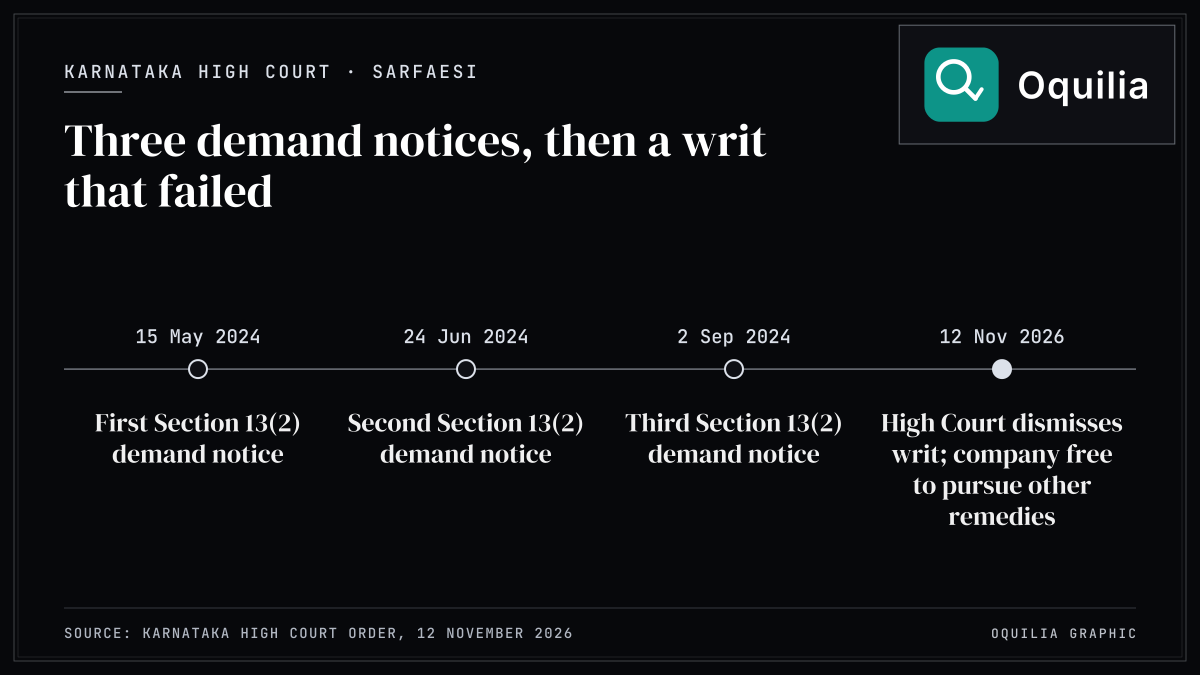
The Karnataka High Court has dismissed a writ petition filed by Bhalkeshwar Sugars Limited, a sugar company in Bidar district, against recovery notices issued by its lenders under the SARFAESI Act, 2002. The Kalaburagi Bench passed the order on 12 November 2026. The court held that a writ petition cannot be entertained where the challenge is to action started by banks under that law.
What Happened
The company asked the High Court to direct Union Bank of India, The Karnataka State Co-operative Apex Bank, Punjab National Bank and Central Bank of India to accept its restructuring proposal. It also asked the court to have the banks consider its representations of October and November 2024, made under the Reserve Bank of India (Prudential Framework for Resolution of Stressed Assets) Directions 2019. The Reserve Bank of India was also a respondent.
The company further sought to quash three demand notices under Section 13(2) of the SARFAESI Act, dated 15 May 2024, 24 June 2024 and 2 September 2024. A Section 13(2) notice is the first formal step a lender takes to recover a secured loan by enforcing its security without going to court. According to the petition, the notices were issued without due consideration of the viability of the company's proposal.
In a short oral order, the court said it is settled law that such a writ petition under Article 226 of the Constitution cannot be entertained, relying on the Supreme Court's decision in United Bank of India vs Satyawati Tondon (2010). It dismissed the petition and said the company was free to work out its remedies in accordance with law.
What It Means
For borrowers, the order is a reminder that the High Court will not usually step in through a writ when a bank has started recovery under the SARFAESI Act, even where a restructuring proposal is pending with the lenders. The court did not rule on the merits of the restructuring proposal or of the notices; it left the company to pursue the other remedies the law provides. The order of a single judge may be challenged before a higher bench.
Source: High Court judgment
Sources & Citations
- High Court judgment — Karnataka High Court