

A bank refuses your dispute. The branch is sympathetic and unhelpful. The call centre closes the ticket. At this point most people give up, because the only remaining option looks like litigation. It is not: there is an adjudicator in between, it costs nothing, and it was built precisely for this moment.
What it covers
The Reserve Bank – Integrated Ombudsman Scheme, 2021 merged what used to be three separate schemes for banks, NBFCs and digital transactions into one. The Reserve Bank – Integrated Ombudsman Scheme, 2026, which replaced it on 1 July 2026, keeps that single scheme. The practical effect is that you no longer need to work out which scheme your grievance belongs to, or whether the entity that wronged you is technically a bank.
It covers deficiency in service across the regulated entities it names — commercial, regional rural and co-operative banks (smaller non-scheduled urban co-operative banks, with deposits under Rs 50 crore, are left out); NBFCs that take deposits, or that deal with customers and have assets of Rs 100 crore or more, with housing finance companies and a few other types excluded; non-bank prepaid payment instrument issuers, such as wallet companies; and credit information companies. Loan servicing, unauthorised transactions, charges levied wrongly, failed payments, delayed refunds, non-payment of compensation the RBI itself has prescribed: all of it sits inside the scheme.
The one precondition
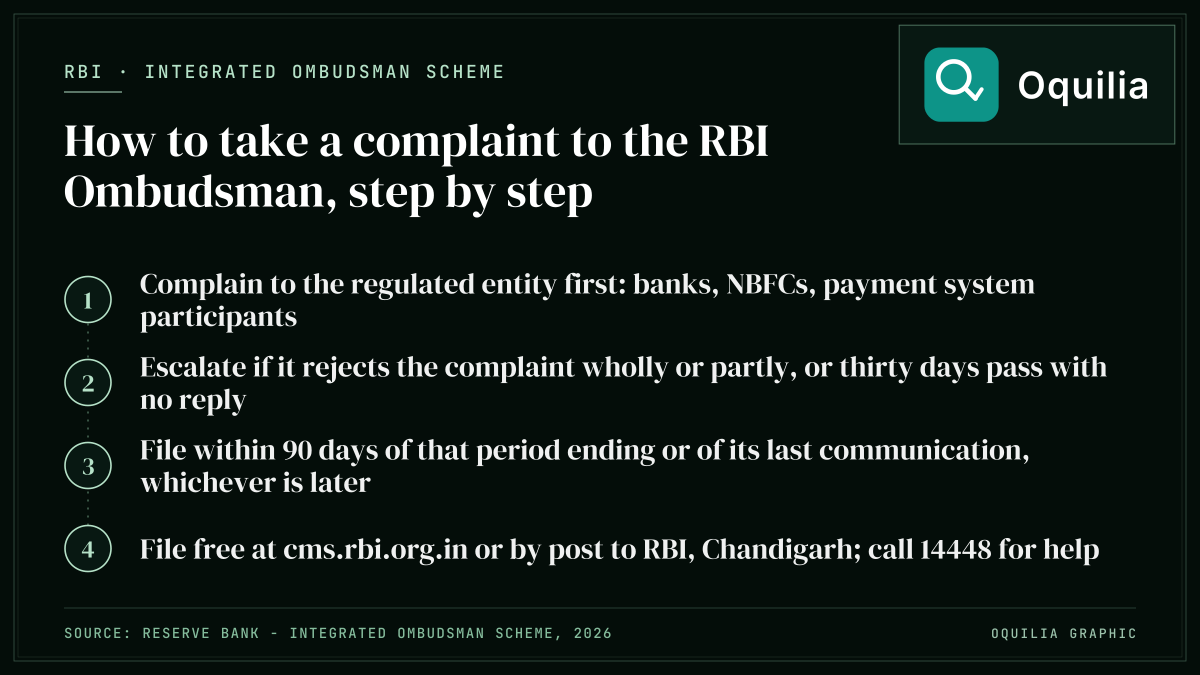
You must complain to the regulated entity first. Then one of two things opens the door:
- The entity rejected your complaint wholly or partly and you are not satisfied with the reply; or
- Thirty days have passed since the entity received your complaint and no reply has come.
This is why the complaint reference number matters so much. It is what proves the date the clock started.
The outer limit
File with the ombudsman within 90 days of the end of the entity’s thirty-day reply period or of its last communication to you, whichever is later. That is the 2026 scheme’s limit; the 2021 scheme allowed a year, and it now governs only complaints the ombudsman received before 1 July 2026. Complaints do go time-barred, and a dispute someone has been arguing with a branch about for a few months may have passed the limit while they were arguing.
How to file
- Online at cms.rbi.org.in, which is the simplest route and gives you a tracking number.
- By post to the Centralised Receipt and Processing Centre, RBI, Chandigarh — a single address for the whole country.
- By phone on 14448, for help with the process.
There is no fee, and no lawyer or agent is needed to file or to follow up. Anyone offering to file an ombudsman complaint for a fee is charging you for something you can do yourself in an evening.
What makes a complaint work
Ombudsman complaints are decided on documents. The ones that succeed tend to share a shape:
- A clear date sequence — what happened, when you complained, what the entity said, when.
- The rule you say was breached, named specifically. “The reversal took 22 days and no compensation was paid under the RBI turn-around-time framework” is a complaint. “The bank treated me badly” is not.
- The documents attached — statements showing the debit, the complaint acknowledgement, the entity’s reply.
- A specific remedy asked for, in rupees where possible.
Why so few people get here
Not because the scheme is obscure — every regulated entity is required to display it — but because the thirty-day wait sits exactly where most people give up. The gap between complaining and escalating is where disputes go to die, and the entity has no incentive to remind you that the next step exists. Diarise day 31 when you file the original complaint, and the scheme starts working the way it was designed to.
How to use this page
This page describes statutory provisions and published regulatory schemes, identified so you can verify them. It is general information about how those processes work, not advice on your particular dispute, and the documents governing your own account, policy or transaction control the specifics.
Every route here is free
The ombudsman schemes, the official portals and the complaint channels described on this page cost nothing to use and require no intermediary. No agent, consultant or recovery service can obtain an outcome you cannot obtain yourself. Oquilia takes no fee from readers, offers no recovery service, and refers no one to any legal practice.
If a process here is not followed
For banks, NBFCs and payment systems, escalate free of charge to the RBI Ombudsman at cms.rbi.org.in. For insurers, the Insurance Ombudsman. For listed companies and market intermediaries, SEBI’s SCORES platform at scores.sebi.gov.in.
Source
Reserve Bank — Integrated Ombudsman Scheme, 2026 (RB-IOS), in force from 1 July 2026 in place of the 2021 scheme (RBI press release 2025-2026/1936, 16 January 2026); RBI Complaint Management System (cms.rbi.org.in); Centralised Receipt and Processing Centre, Chandigarh; helpline 14448