

Can a court reopen your bank loan interest? Section 21A Banking Regulation Act after Jayant Verma (SC, 2018)
Section 21A of the Banking Regulation Act bars courts from cutting bank interest as excessive. The Supreme Court upheld it in 2018 in Jayant Verma, with a carve-out for farm debt.
Key points
- The Supreme Court upheld Section 21A of the Banking Regulation Act on 16 February 2018 in Jayant Verma v. Union of India.
- Section 21A, inserted in 1983, bars courts from reopening a bank loan only because the interest charged is excessive.
- Farm borrowers in States with a Debt Relief Act covering bank debts can still seek relief, and other defences remain open.
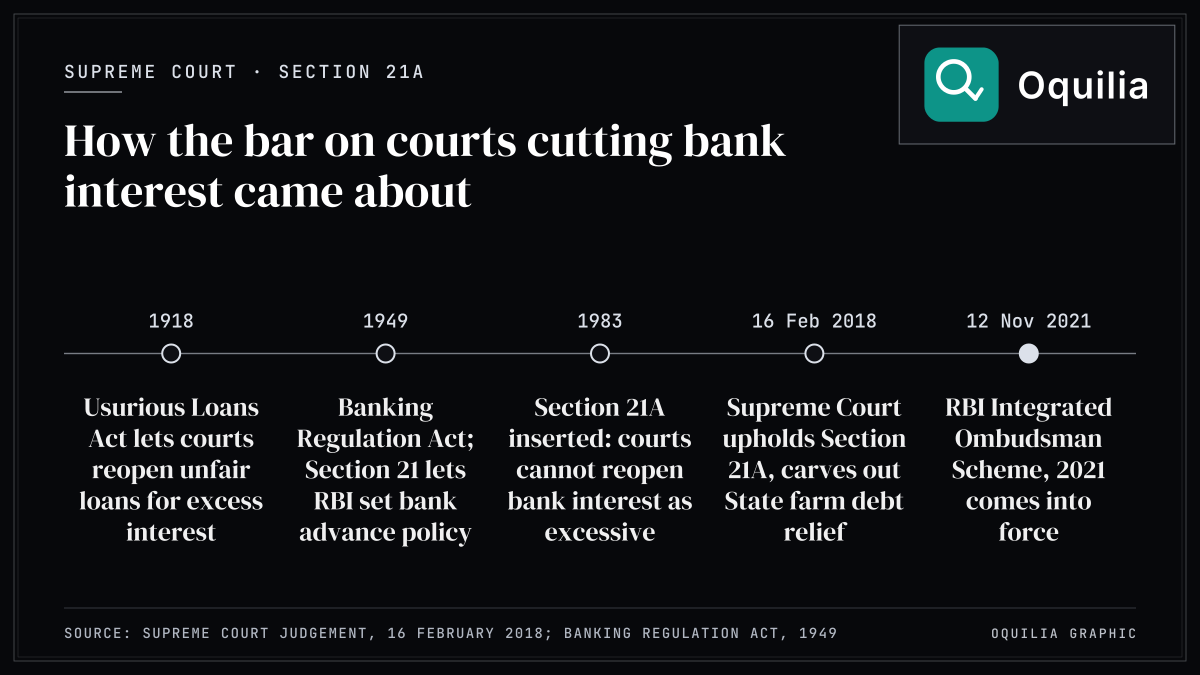
A borrower who feels a bank has charged too much interest usually asks one question first: can a court cut the rate down? Since 1983 the short answer in most of India has been no. Section 21A of the Banking Regulation Act, 1949 bars any court from reopening a loan transaction with a bank merely because the interest is excessive. On 16 February 2018, in Jayant Verma & Ors. v. Union of India (WP (C) 134 of 2013, reported at (2018) 4 SCC 743), a two-judge bench of the Supreme Court comprising R.F. Nariman and Navin Sinha JJ upheld that bar, but carved out one important exception for farm debt. This playbook explains what Section 21A says, where the 2018 judgement leaves borrowers, and which defences remain open when a recovery notice under SARFAESI or the Recovery of Debts and Bankruptcy Act, 1993 (RDDB Act) lands.
This article, current as of 8 November 2026, is general legal information prepared by the Oquilia Research Desk from the 2018 judgement and the statutes. It is not legal advice on any individual loan.
The Statutory Position
Section 21A was inserted into the Banking Regulation Act, 1949 by the Banking Laws (Amendment) Act, 1983. Its operative words are short: notwithstanding anything in the Usurious Loans Act, 1918, or any other law relating to indebtedness in force in any State, a transaction between a banking company and its debtor "shall not be re-opened by any court on the ground that the rate of interest charged by the banking company in respect of such transaction is excessive".
The provision was written to override the Usurious Loans Act, 1918. Under Section 3 of that 1918 Act, a court that finds interest excessive and the transaction substantially unfair may reopen the transaction and relieve the debtor of liability for interest beyond what it considers reasonable. Section 21A switches that power off for bank loans, on the footing that bank interest rates are already regulated by the Reserve Bank of India (RBI) under Section 21 of the same 1949 Act.
The constitutional question in 2018 was about legislative competence under Article 246 and the Seventh Schedule. Paragraph 14 of the judgement frames the contest between two entries:
| Entry | List | Subject | Who legislates |
|---|---|---|---|
| Entry 45 | List I (Union) | Banking | Parliament |
| Entry 30 | List II (State) | Money-lending and money-lenders; relief of agricultural indebtedness | State legislatures |
The petitioners argued that Section 21A, by stopping State debt-relief laws from reaching bank loans, intruded into Entry 30 of the State List. The Union argued that regulating the interest a bank charges is part of "banking" under Entry 45.
At paragraph 45 the court held that Section 21A is constitutionally valid and, in pith and substance, a law on banking under Entry 45 of List I. It also held that the provision incidentally encroaches on Entry 30 of List II, and that it will not operate in States that have a State Debt Relief Act covering debts due to banks. In those States, the State law on relief of agricultural indebtedness governs.
The practical result can be set out in one table:
| Your situation | Can a court reopen bank interest as "excessive"? | Source |
|---|---|---|
| Any bank loan in a State without a Debt Relief Act covering bank debts | No: Section 21A applies | Section 21A, BR Act 1949; Jayant Verma, para 45 |
| Agricultural debt to a bank in a State whose Debt Relief Act covers bank debts | Section 21A does not operate; the State Act decides | Jayant Verma, para 45 |
| Loan from a private money-lender (not a bank) | Section 21A does not apply at all; the Usurious Loans Act 1918 or State law may apply | Section 21A text |
| Interest charged contrary to RBI directions or the loan contract | Not an "excessive interest" claim; can be challenged on that ground | Section 21, BR Act 1949 |
The last row matters. Section 21A only stops a court from reopening a loan because the rate is excessive. It does not protect a bank that charges a rate different from the one it contracted for, compounds where it agreed not to, or ignores a binding RBI direction.
Procedure Step by Step
A borrower who believes the interest on a bank loan is wrong, whether a farm loan, a home loan or a business loan, should work through the following sequence. The steps run from the cheapest forum to the most formal.
- Collect the paper trail. Ask the bank in writing for the sanction letter, the loan agreement, the full statement of account and the interest rate history. Recompute the outstanding using the simple interest calculator and the EMI calculator so that every disputed rupee is identified by date.
- Classify the complaint. Decide whether the grievance is that the rate is "too high" (barred by Section 21A in most States since 1983) or that the bank broke its contract or an RBI direction (not barred). Only the second category survives Section 21A outside the Jayant Verma exception.
- Check your State law. If the loan is agricultural, find out whether your State has a Debt Relief Act that extends to debts due to banks. Under paragraph 45 of the 2018 judgement, Section 21A does not operate in such a State.
- Write to the bank's grievance cell. File a written complaint with the branch and the bank's nodal officer, keeping a dated copy.
- Escalate to the RBI Ombudsman. Under the Reserve Bank - Integrated Ombudsman Scheme, 2021, in force from 12 November 2021, a complaint can be filed on the RBI's complaint portal if the bank rejects the complaint or does not reply within 30 days. It must normally be filed within one year of the bank's reply, or within one year and 30 days of the original complaint if no reply came. There is no fee.
- Respond to any SARFAESI notice in time. If the bank has issued a demand notice under Section 13(2) of the SARFAESI Act, 2002, the borrower has 60 days to pay or object. A written representation under Section 13(3A) must be answered by the bank within 15 days, with reasons, if it rejects the objection.
- Appeal to the DRT if measures are taken. Once the bank takes possession or other measures under Section 13(4), an application lies to the Debts Recovery Tribunal under Section 17 within 45 days. See the DRT glossary entry and the SARFAESI glossary entry for the forum basics.
- Go to the DRAT only with the deposit ready. An appeal from a Section 17 order to the Debts Recovery Appellate Tribunal must be filed under Section 18 within 30 days, and is not entertained unless 50% of the debt is deposited (reducible to 25% for recorded reasons). An appeal under Section 21 of the RDDB Act in a bank's recovery case requires a 75% deposit, which the tribunal may waive or reduce.
| Forum | Statute | Time limit | Deposit |
|---|---|---|---|
| Bank grievance cell | Bank's own policy | Before the Ombudsman | Nil |
| RBI Ombudsman | Integrated Ombudsman Scheme, 2021 | 30 days after complaint; within 1 year | Nil |
| Objection to demand notice | SARFAESI Act 2002, Section 13(3A) | Within the 60-day notice period | Nil |
| DRT application | SARFAESI Act 2002, Section 17 | 45 days from the measure | Not mandatory; tribunal may direct |
| DRAT appeal (SARFAESI) | SARFAESI Act 2002, Section 18 | 30 days | 50%, reducible to 25% |
| DRAT appeal (RDDB) | RDDB Act 1993, Section 21 | As prescribed | 75%, may be waived or reduced |
Borrower Defences Available
Section 21A narrows the menu, but it does not empty it. The defences below are the ones that remain after 16 February 2018.
1. The State Debt Relief Act defence (farm loans only). Paragraph 45 of Jayant Verma holds that Section 21A will not operate in a State with a Debt Relief Act covering debts due to banks. A farmer in such a State can invoke the relief machinery of that Act, including any power it gives to scale down interest. The borrower must show three things: that the debt is agricultural, that the State Act exists, and that it expressly or by necessary implication reaches bank debts.
2. Contract breach, not excessiveness. If the sanction letter fixed a rate and the bank charged more, the claim is for breach of the agreed terms. Section 21A speaks only of a rate that is "excessive", so a claim that the bank simply did not follow its own contract falls outside it. A borrower should pin each disputed debit to a clause of the agreement.
3. Breach of RBI directions. Section 21 of the Banking Regulation Act, 1949 empowers the RBI to determine the policy on bank advances, including interest rates, and banks must follow those directions. Paragraph 2 of Jayant Verma records RBI advice that total interest on short-term loans to small and marginal farmers should not exceed the principal, and that there should be no compounding of interest on crop loans. As an illustration, on a Rs 1,00,000 short-term crop loan to a small farmer, that advice would put the ceiling on total interest at Rs 1,00,000. A borrower who can show interest was compounded on a crop loan has a regulatory complaint for the bank's grievance cell and the RBI Ombudsman, quite apart from Section 21A. The effect of compounding can be checked against the compounding frequency glossary entry.
4. Procedural defects under SARFAESI. Section 21A has nothing to say about how a bank enforces security. A demand notice under Section 13(2) must give 60 days; an objection under Section 13(3A) must be answered within 15 days with reasons. A failure on either point is a ground before the DRT under Section 17, within 45 days.
5. Agricultural land is outside SARFAESI. Section 31 of the SARFAESI Act, 2002 excludes agricultural land from the Act's enforcement provisions. A bank holding a mortgage over farmland cannot use the Section 13(4) route against that land, and must go to a civil court or, where the debt is Rs 20 lakh or more, the DRT under the RDDB Act. This is often the strongest defence for the same farmer borrowers whose interest dispute Jayant Verma addressed.
6. Wrong forum on the amount. Since a 2018 notification, the DRT's jurisdiction under the RDDB Act starts at Rs 20 lakh. A recovery application for a lower amount does not belong in the DRT.
| Defence | Who can use it | Blocked by Section 21A? | Where to raise it |
|---|---|---|---|
| State Debt Relief Act | Agricultural borrowers in qualifying States | No (Jayant Verma, para 45) | Forum under the State Act |
| Breach of loan contract | Any bank borrower | No | Grievance cell, Ombudsman, DRT, civil court |
| Breach of RBI direction | Any bank borrower | No | Grievance cell, RBI Ombudsman |
| SARFAESI notice defects | Secured borrowers | No | DRT, Section 17, within 45 days |
| Agricultural land exemption | Farmland mortgagors | No | DRT, Section 17 |
| "Rate is simply too high" | Any bank borrower | Yes, outside qualifying States | Not available since 1983 |
Recent Tribunal/HC Position
The governing authority is the Supreme Court's decision of 16 February 2018 in Jayant Verma & Ors. v. Union of India, WP (C) 134 of 2013, reported at (2018) 4 SCC 743. The judgement was written by R.F. Nariman J for a bench that included Navin Sinha J, and its full text is on Indian Kanoon.
Because the decision comes from the Supreme Court, it binds every High Court, DRT and DRAT under Article 141 of the Constitution. Four propositions emerge:
- Validity (para 45). Section 21A, inserted in 1983, is constitutionally valid and is, in pith and substance, a law on "banking" under Entry 45 of List I.
- Incidental encroachment (para 45). The provision incidentally touches Entry 30 of List II, which covers relief of agricultural indebtedness.
- The farm-debt carve-out (para 45). Section 21A will not operate in States that have a State Debt Relief Act covering debts due to banks.
- The RBI's stated position (para 2). The court recorded RBI advice that total interest on short-term loans to small and marginal farmers should not exceed the principal, and that crop loans should not carry compound interest.
For a tribunal hearing a SARFAESI or RDDB matter, the 2018 ruling sets a clear filter. An argument that a bank rate was simply too high will be met with Section 21A in every State without a qualifying debt relief law. An argument built on the loan contract, an RBI direction, a defective Section 13(2) notice, or the Section 31 exclusion of agricultural land is not touched by Section 21A at all.
The ruling also clarifies the role of the Usurious Loans Act, 1918. That Act survives for private money-lenders, and Section 21A has never applied to them. For banks, the 1918 Act's power to reopen is switched off, save where a State Debt Relief Act covering bank debts takes over in agricultural cases.
For borrowers comparing their options after a notice, the foreclosure calculator and the debt consolidation calculator help put a number on a settlement offer before a tribunal date. The RBI's consumer pages on rbi.org.in carry the current text of the Integrated Ombudsman Scheme, 2021, and the Banking Regulation Act, 1949 can be read on India Code.
FAQ
Can a court reduce my bank loan interest because it is too high?
In most of India, no. Section 21A of the Banking Regulation Act, 1949, inserted in 1983, bars courts from reopening a bank loan only because the interest is excessive. The Supreme Court upheld the provision on 16 February 2018 in Jayant Verma, (2018) 4 SCC 743.
What exception did Jayant Verma create?
At paragraph 45 the court held that Section 21A will not operate in States that have a State Debt Relief Act covering debts due to banks. In those States, agricultural debtors can use the State law, which falls under Entry 30 of List II.
Does Section 21A apply to money-lenders?
No. Section 21A covers transactions between a banking company and its debtor. Loans from private money-lenders remain subject to the Usurious Loans Act, 1918 and State money-lending laws.
Is compound interest allowed on crop loans?
Paragraph 2 of the 2018 judgement records RBI advice that there should be no compounding of interest on crop loans, and that total interest on short-term loans to small and marginal farmers should not exceed the principal. A breach can be raised with the bank and the RBI Ombudsman under the 2021 scheme.
Can I still challenge a SARFAESI notice if I cannot argue excessive interest?
Yes. Section 21A does not touch enforcement procedure. A Section 13(2) notice must give 60 days, an objection must be answered within 15 days, and measures under Section 13(4) can be challenged before the DRT under Section 17 within 45 days.
Can a bank use SARFAESI against agricultural land?
No. Section 31 of the SARFAESI Act, 2002 excludes agricultural land from the Act's enforcement provisions, so the bank must use a civil suit or, for debts of Rs 20 lakh and above, the DRT under the RDDB Act, 1993.
How much must I deposit to appeal to the DRAT?
For a SARFAESI appeal under Section 18, 50% of the debt, which the DRAT may reduce to 25% for recorded reasons, within 30 days. For an RDDB Act appeal under Section 21, 75% of the debt determined, which the tribunal may waive or reduce.