

Gold Loan in Default? RBI's 2025 Gold and Silver Collateral Directions on Auction Notice, 90% Reserve Price and Rs 5,000-a-Day Release Penalty
RBI's 2025 gold and silver loan Directions set a 90% reserve price floor, two-newspaper auction notice, 7-working-day release and Rs 5,000-a-day compensation. What defaulting borrowers can use.
Key points
- The RBI issued its Lending Against Gold and Silver Collateral Directions on June 6, 2025, binding lenders no later than April 1, 2026.
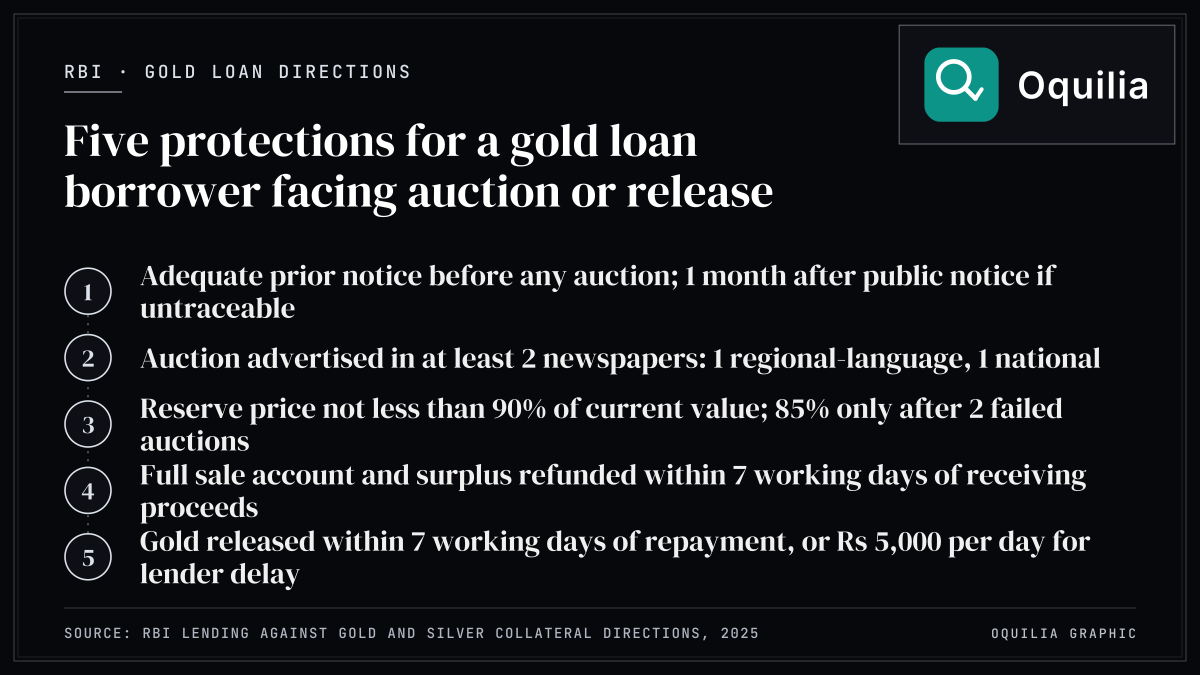
- Pledged gold cannot be auctioned below 90% of current value, falling to 85% only after two failed auctions, and must be released within seven working days of repayment.
- Borrowers can claim Rs 5,000 a day for lender-caused release delays and a surplus refund within seven working days, and can escalate breaches to the RBI Ombudsman.
A gold loan is the fastest secured credit most Indian households ever take, and for years the rules on what happens when it goes bad were thin. That changed with the Reserve Bank of India (Lending Against Gold and Silver Collateral) Directions, 2025, issued as RBI/2025-26/47, DOR.CRE.REC.26/21.01.023/2025-26 on June 6, 2025 and updated as on September 29, 2025. Lenders must comply as early as possible and in no case later than April 1, 2026, which means the full rulebook now binds every regulated gold lender.
This playbook sets out what the 2025 Directions say about auction notice, the 90% reserve price, release timelines and the Rs 5,000-a-day compensation for delayed release, and what a borrower in default can do with each rule. It is written by the Oquilia Research Desk for borrowers; it is general information, not legal advice on any individual loan.
The Statutory Position
The 2025 Directions are the controlling text for gold and silver loans from regulated lenders. Under paragraph 5, they apply to commercial banks (excluding payments banks), urban co-operative banks (UCBs), rural co-operative banks (RCBs) and all NBFCs including housing finance companies, for consumption loans and income-generating loans (including farm credit) secured by gold or silver jewellery, ornaments or coins. The full text is on the RBI notification page.
Paragraph 4 contains the transition rule that matters most to an existing borrower: loans sanctioned before a lender adopts the Directions stay under the earlier guidelines. So a borrower whose loan was sanctioned in, say, 2024 must first find out whether the loan predates the lender's adoption, because the auction and release protections below attach to loans governed by the 2025 framework. The outer limit for adoption is April 1, 2026.
A gold loan is a pledge of movable goods, not a mortgage of land, so it is usually not enforced through the SARFAESI route used for home loans and loans against property. Section 31 of the SARFAESI Act, 2002 lists the securities the Act does not reach, including liens and financial assets below Rs 1 lakh (the Act is on India Code). Under the general law, Section 176 of the Indian Contract Act, 1872 allows a pawnee to sell pledged goods on the pawnor's default after giving reasonable notice of the sale. The 2025 Directions layer specific, enforceable conditions on top of that general power.
The key numbers in the 2025 Directions, paragraphs 15 to 43, are set out below.
| Rule | What the 2025 Directions say | Paragraph |
|---|---|---|
| LTV, loan up to Rs 2.5 lakh | Maximum 85% of gold value | Para 19 |
| LTV, above Rs 2.5 lakh to Rs 5 lakh | Maximum 80% | Para 19 |
| LTV, above Rs 5 lakh | Maximum 75% | Para 19 |
| Consumption bullet loan tenor | Maximum 12 months | Para 15 |
| Release after full repayment | Same day; in no case later than 7 working days | Para 35 |
| Compensation for delayed release | Rs 5,000 per day, for delay attributable to the lender | Para 46 |
| Public notice if borrower untraceable | Auction only 1 month after public notice | Para 37 |
| Newspaper advertisement | At least 2 newspapers: 1 regional-language, 1 national | Para 38 |
| Reserve price | Not less than 90% of current value; 85% only after 2 failed auctions | Para 40 |
| Surplus refund | Within 7 working days of receiving auction proceeds | Para 43 |
Two further rules shape every default. For bullet loans, paragraph 19 says the loan amount for LTV purposes is the total payable at maturity, that is, principal plus interest. Paragraph 20 requires the LTV ratio to be maintained throughout the tenor, not just at sanction. And paragraph 11 permits renewal of a loan only after accrued interest has been paid.
Procedure Step by Step
The 2025 Directions do not reproduce a single numbered procedure, but read together, paragraphs 17 to 46 produce a clear sequence from sanction to auction or release. Each step below names the paragraph that governs it.
- Valuation at sanction (paras 17 and 18). The lender values the gold at the lower of the 30-day average closing price or the previous day's closing price for that purity, taken from the India Bullion and Jewellers Association (IBJA) or a SEBI-regulated commodity exchange. Stones and other non-gold components add no value.
- Assaying in the borrower's presence (para 23). The borrower must be present when the purity is tested.
- Certificate in duplicate (para 27). The borrower receives a certificate recording purity, gross weight, net weight, deductions, any damage, an image of the collateral and the value at sanction. This is the single most important document in any later dispute.
- Disclosure of charges and triggers (para 26). All charges, including assaying and auction charges, must appear in the loan agreement and the Key Facts Statement (KFS), along with the events that trigger an auction, the notice period, the release timelines and the procedure for refunding any surplus.
- Communication in the borrower's language (para 28). Documents and communication must be in the regional language or a language the borrower chooses.
- Tenor and renewal (paras 11 and 15). A consumption bullet loan cannot exceed 12 months, and renewal is allowed only after accrued interest is paid.
- Default and prior notice (para 37). Before an auction, the lender must give adequate prior notice so the borrower can repay. If the borrower cannot be traced, the auction can take place only one month after a public notice.
- Advertisement (para 38). The auction must be advertised in at least two newspapers, one in the regional language and one national.
- Reserve price and venue (paras 40 and 41). The reserve price cannot be less than 90% of the current value of the gold. It may fall to not less than 85% only after two auctions have failed. The first auction must be held physically in the district of the lending branch.
- No related-party bids (para 42). The lender and its related parties cannot bid.
- Sale account and surplus (para 43). The lender must give the borrower a full account of the sale and refund any surplus within seven working days of receiving the proceeds.
- Release on repayment (paras 35 and 46). If the borrower repays in full instead, the gold must be released the same day, and in no case later than seven working days. Delay attributable to the lender attracts compensation of Rs 5,000 per day.
The arithmetic of the reserve price is worth working through, because it is the number most likely to protect a borrower's equity. The table below uses illustrative current values; the percentages are from paragraph 40.
| Current value of pledged gold | Minimum reserve price, first and second auction (90%) | Minimum reserve price after 2 failed auctions (85%) |
|---|---|---|
| Rs 1,00,000 | Rs 90,000 | Rs 85,000 |
| Rs 2,00,000 | Rs 1,80,000 | Rs 1,70,000 |
| Rs 5,00,000 | Rs 4,50,000 | Rs 4,25,000 |
Take a borrower whose gold is currently worth Rs 2,00,000 and who owes Rs 1,60,000 including interest. If the lender auctions at the floor of Rs 1,80,000, the surplus of Rs 20,000 (before any auction charges disclosed in the KFS under para 26) must be refunded within seven working days of the lender receiving the proceeds, under para 43. Use the gold loan calculator to model how interest accrual eats into that surplus month by month.
Borrower Defences Available
A borrower facing an auction is rarely trying to stop the lender from recovering a genuine debt. The realistic aim is to make sure the gold is not sold cheaply, without notice or in breach of the 2025 Directions, and that every rupee of surplus comes back. The nine grounds below are each tied to a paragraph of the 2025 Directions.
1. No adequate prior notice (para 37). The lender must give adequate prior notice to repay before an auction. If the borrower is untraceable, the minimum gap after a public notice is one month. A borrower who received no notice at the address or in the language recorded under para 28 has a direct ground of complaint.
2. Defective advertisement (para 38). An auction advertised in only one newspaper, or only in an English national daily with no regional-language paper, does not meet the two-newspaper rule.
3. Sale below the reserve floor (para 40). A first or second auction at less than 90% of current value, or a later auction at less than 85%, breaches the floor. Because para 17 fixes how value is measured, the borrower can recompute the floor from IBJA or exchange prices for the auction date.
4. Wrong venue (para 41). The first auction must be physical and in the district of the lending branch. An online-only first auction, or one held in another district, is open to challenge.
5. Related-party bidding (para 42). If the lender or a related party bought the gold, the sale breaches para 42.
6. Missing sale account or late surplus (para 43). The borrower is entitled to a full sale account and to the surplus within seven working days of the lender receiving the proceeds.
7. Weight or purity mismatch (paras 27, 44 and 45). The para 27 certificate fixes purity and weight at sanction. If the gold comes back damaged, the lender bears the repair cost under para 44. If there is a loss, or a discrepancy in purity or weight, the lender must compensate under para 45.
8. Undisclosed charges (para 26). Any charge, including assaying or auction charges, that was not in the loan agreement and KFS should not be deducted from the sale proceeds.
9. LTV and renewal practice (paras 11, 19 and 20). Because LTV must be maintained throughout the tenor, a falling gold price can trigger a margin call. Borrowers should check whether the loan agreement and KFS, which under para 26 must list auction triggers, actually treat an LTV breach as a trigger, and on what notice.
The timelines and money at stake under paragraphs 35 to 46 are summarised here.
| Borrower right | Time limit or amount | Paragraph |
|---|---|---|
| Gold released after full repayment | Same day; outer limit 7 working days | Para 35 |
| Compensation for lender's delay in release | Rs 5,000 per day | Para 46 |
| Gap between public notice and auction (untraceable borrower) | 1 month minimum | Para 37 |
| Surplus refund after sale | 7 working days from receipt of proceeds | Para 43 |
| Reserve price floor | 90% of current value; 85% after 2 failed auctions | Para 40 |
On release, the money can be significant. A borrower who repays in full and gets the gold back on the 10th working day, three working days beyond the seven-working-day outer limit in para 35, would on the face of para 46 be owed Rs 15,000 (3 days at Rs 5,000) if the delay is attributable to the lender. Keep the repayment receipt and note the date and time of every visit to the branch.
Practical sequence for a borrower. First, write to the lender's grievance officer, quoting the paragraph numbers above and attaching the para 27 certificate and the KFS. Second, if the lender does not resolve the complaint, escalate to the RBI under the Reserve Bank - Integrated Ombudsman Scheme, 2021, which covers banks and NBFCs. Third, where the breach is serious, such as a sale below 90% of value or a related-party purchase, a civil claim for the shortfall may be considered with a lawyer. If the default is part of wider debt stress, the debt consolidation calculator and the foreclosure calculator help compare the cost of closing the gold loan against other borrowing.
Recent Tribunal/HC Position
The briefing for this playbook, drawn from the RBI notification itself, does not cite a tribunal or High Court judgement interpreting the 2025 Directions, and the Oquilia Research Desk has not located one it can verify. That is not surprising: the Directions were issued on June 6, 2025, updated on September 29, 2025, and lenders were given until April 1, 2026 to comply. We do not cite a case we cannot verify.
What can be said with confidence is the legal footing a court or ombudsman would start from. Gold-loan enforcement rests on a pledge, and Section 176 of the Indian Contract Act, 1872 conditions the pawnee's right to sell on reasonable notice to the pawnor. The 2025 Directions now give that notice requirement a regulatory form in paras 37 and 38 and add price, venue, bidding and refund conditions in paras 40 to 43. A borrower arguing a breach can therefore point to an RBI direction, not just to general reasonableness.
Gold loans also sit largely outside the DRT and SARFAESI machinery that dominates secured-loan litigation. Section 31 of the SARFAESI Act, 2002 excludes several categories, including financial assets below Rs 1 lakh, and the DRT route under the Recovery of Debts and Bankruptcy Act, 1993 is used for larger recoveries. For most gold borrowers, the practical forums are the lender's grievance desk and the RBI Ombudsman, with civil courts for larger disputes. Oquilia will update this playbook when a reported judgement on the 2025 Directions is available on Indian Kanoon.
FAQ
When do the RBI 2025 gold loan auction rules apply to my loan?
The Directions dated June 6, 2025 had to be adopted by lenders no later than April 1, 2026. Under para 4, loans sanctioned before your lender adopted them stay under the earlier guidelines, so ask the lender in writing which framework governs your loan.
What is the minimum price at which my pledged gold can be auctioned?
Under para 40, the reserve price cannot be less than 90% of the gold's current value. It can fall to not less than 85% only after two auctions have failed. On gold worth Rs 2,00,000, that is Rs 1,80,000 and then Rs 1,70,000.
How much notice must the lender give before auctioning my gold?
Para 37 requires adequate prior notice to repay before an auction. If you cannot be traced, the auction can take place only one month after a public notice, and para 38 requires advertisement in at least two newspapers, one regional-language and one national.
What if the lender delays returning my gold after I repay?
Para 35 requires release the same day and in no case later than seven working days after full repayment. Para 46 provides compensation of Rs 5,000 per day for delay attributable to the lender.
Will I get the surplus if my gold sells for more than I owe?
Yes. Para 43 requires the lender to give you a full sale account and refund any surplus within seven working days of receiving the auction proceeds. Charges deducted must have been disclosed in the agreement and KFS under para 26.
How much can I borrow against my gold under the new rules?
Para 19 caps the loan at 85% of gold value for loans up to Rs 2.5 lakh, 80% above Rs 2.5 lakh to Rs 5 lakh, and 75% above Rs 5 lakh. For bullet loans, the cap applies to the total payable at maturity including interest. The loan eligibility calculator helps compare this with other options.
Can the bank or its staff buy my gold at the auction?
No. Para 42 bars the lender and its related parties from bidding, and para 41 requires the first auction to be held physically in the district of the lending branch.
Sources & Citations
- Reserve Bank of India (Lending Against Gold and Silver Collateral) Directions, 2025 — Reserve Bank of India
- SARFAESI Act, 2002 and Indian Contract Act, 1872 — India Code
- Indian Kanoon judgement database — Indian Kanoon