

Kerala High Court refuses discharge to KSEB senior assistant K. Bimal in vigilance case
The Kerala High Court on 24 October 2026 refused to discharge a KSEB senior assistant accused by the prosecution of misappropriating board funds, upholding the sanction to prosecute.
Key points
- The Kerala High Court dismissed a KSEB senior assistant's pleas for discharge in two vigilance cases on 24 October 2026.
- The court held that sanction issued by KSEB's Chief Engineer (HRM) was valid under Section 19(1)(c) of the Prevention of Corruption Act.
- The accused, presumed innocent, must now face trial; the court directed that its order be sent to the special court to expedite trial.
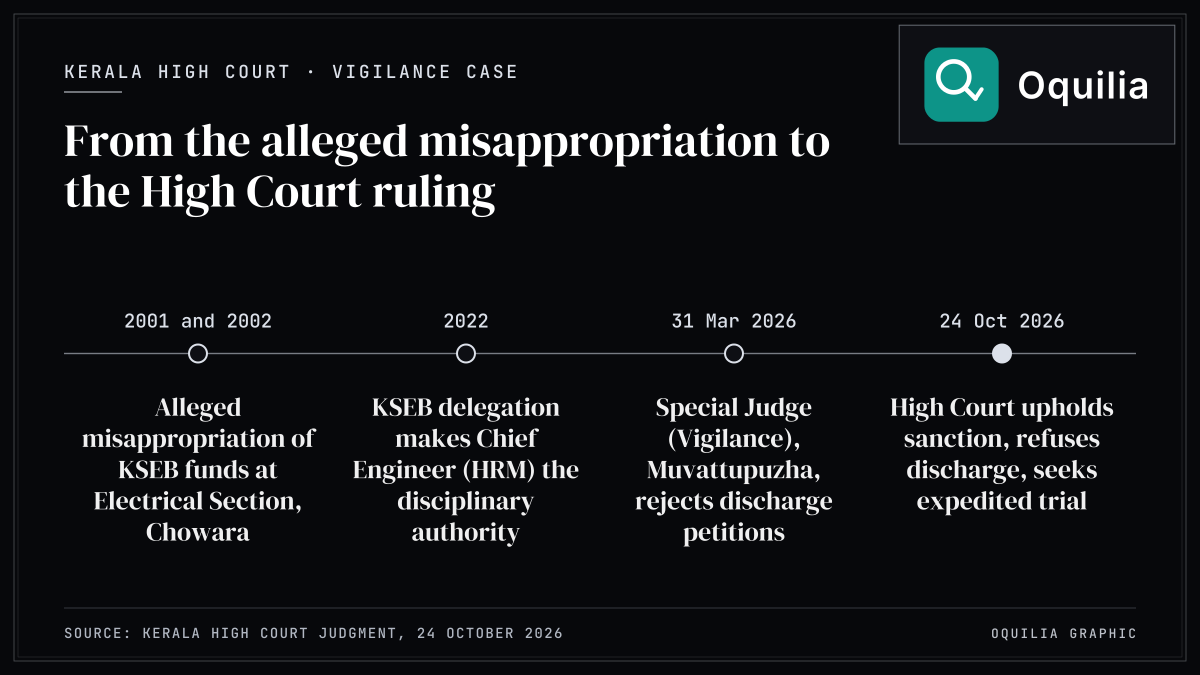
K. Bimal, who was senior assistant at the Kerala State Electricity Board's (KSEB) Electrical Section, Chowara, in 2001 and 2002, must face trial in two vigilance cases over alleged misappropriation of board funds, after the Kerala High Court on 24 October 2026 refused to discharge him. The court held that the sanction to prosecute him, issued by KSEB's Chief Engineer (HRM), was valid.
What Happened
According to the prosecution, as recorded in the judgment, the section's then cashier and the senior assistant conspired in 2001 and 2002 to misappropriate KSEB funds. The prosecution alleges the senior assistant's share was Rs 15,983 in 2001 and Rs 35,457 in 2002, and the cashier's Rs 75,411 and Rs 98,432. The charges are under Sections 13(1)(c) and 13(1)(d) read with 13(2) of the Prevention of Corruption Act, 1988, and Sections 477A, 465, 409, 201 and 120B of the Indian Penal Code.
The Enquiry Commissioner and Special Judge (Vigilance), Muvattupuzha, rejected his discharge petitions on 31 March 2026. Before the High Court, he argued that only the Board itself, as his appointing authority, could sanction his prosecution, and that a senior assistant's role was only supervisory.
The High Court rejected both points. Under Section 19(1)(c) of the Act, sanction must come from the authority competent to remove the employee, and KSEB's 2022 delegation of powers makes the Chief Engineer (HRM) the disciplinary authority for cadres up to assistant executive engineer, the court held. On the merits, it upheld the trial court's view that the senior assistant prepared the consumer ledger from duplicate bills, should have noticed short collections against the daily demand statements, and that false entries were found in that ledger.
These are allegations, not findings of guilt; the accused are presumed innocent until proven guilty in court, and due process continues.
What It Means
The ruling clarifies that for a KSEB employee in these cadres, sanction from the Chief Engineer (HRM) is enough to prosecute under the Prevention of Corruption Act. The court dismissed both revision petitions, vacated any stay, and directed that its order be sent to the special court so that the trial is expedited.
Anyone asked for a bribe by an official can report it to their state's anti-corruption bureau; Oquilia's guide to every state's helpline is at https://www.oquilia.com/report-a-bribe.
Source: High Court judgment
Sources & Citations
- High Court judgment — Kerala High Court