

SEBI lets NRIs and OCIs in FATF-compliant countries complete KYC digitally from abroad
SEBI has relaxed its KYC rules so NRIs, OCI cardholders and foreign nationals in FATF-compliant countries can complete KYC digitally from abroad, from 3 December 2026.
Key points
- SEBI has dropped the rule that a client must be in India during digital KYC, for individuals abroad in FATF-compliant countries.
- The change, announced in a circular dated 4 November 2026, takes effect from 3 December 2026.
- NRI and OCI investors can open trading or demat accounts online from abroad; clients in FATF non-compliant countries stay under the old process.
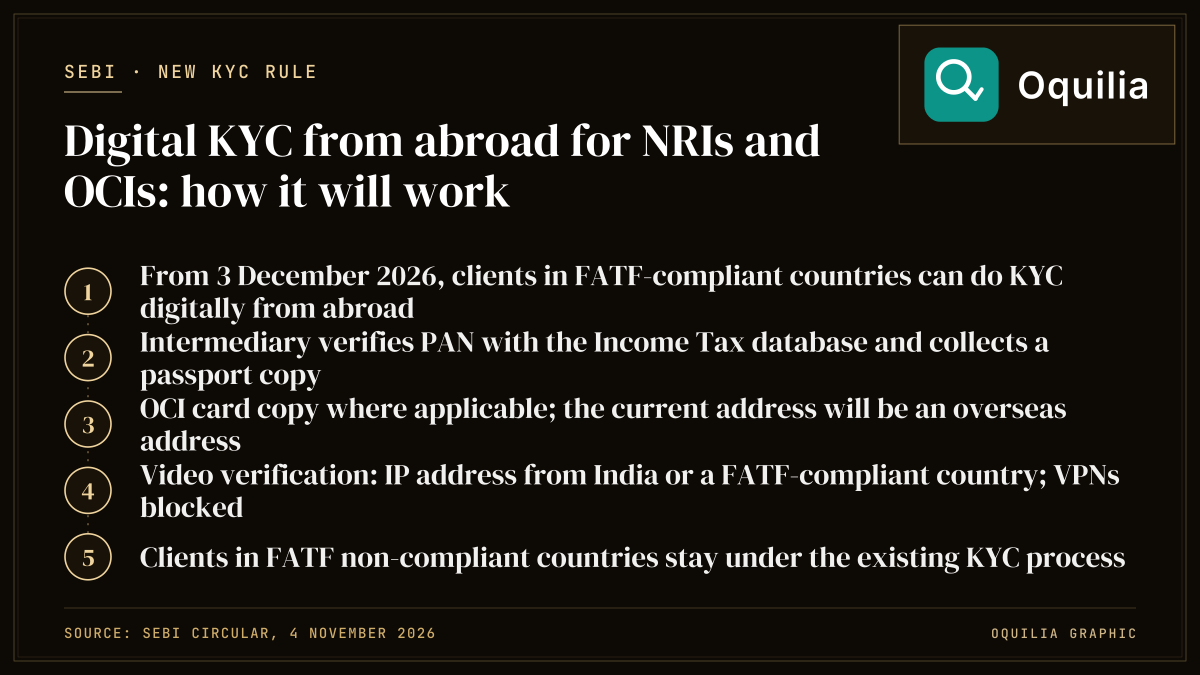
NRIs, Overseas Citizens of India and foreign nationals living in a country that complies with Financial Action Task Force standards will be able to complete their KYC with a broker or other SEBI-registered intermediary digitally from abroad. SEBI announced the change in a circular dated 4 November 2026. It takes effect from 3 December 2026.
What Happened
Know Your Client (KYC) is the identity check an intermediary must run before opening an account. Until now, SEBI's KYC rules required a client's physical location to be in India during digital KYC, which in effect stopped a person abroad from completing the process online at the time of opening an account.
SEBI said it has now relaxed that requirement for an individual "person resident outside India" (an NRI, an OCI cardholder or a foreign national) located in a FATF-compliant country. The intermediary may accept KYC information and documents submitted digitally by such a client.
Under the circular, the intermediary will verify the client's PAN with the Income Tax database and collect a copy of the passport, and the OCI card where applicable. The current address for such a client will be an overseas address. If original documents are not shown, a client may use DigiLocker, Aadhaar-based e-KYC, or a copy attested by a notary, an Indian embassy or consulate, or certain bank officials. Where a video in-person verification is used, the client's IP address must come from India or a FATF-compliant country and match the country in the KYC form, VPNs and proxy servers must be blocked, an official of the intermediary must be present, and the process will be subject to concurrent audit. Documents in another language must be translated into English and attested.
What It Means
For an NRI or OCI investor in a FATF-compliant country, opening a trading or demat account, or redoing KYC, need no longer wait for a visit to India. KYC records held by a KYC Registration Agency will be portable, so another intermediary can rely on them. Clients in FATF non-compliant countries stay under the existing KYC process, and KYC completed before 3 December 2026 stays governed by the old rules. A complaint about an intermediary can be filed at https://scores.sebi.gov.in.
Source: SEBI circular
Sources & Citations
- SEBI circular — Securities and Exchange Board of India