

Letting a relative in India run your NRE account: what a resident power of attorney holder can and cannot do under RBI rules
RBI's Master Direction lets a resident power of attorney holder use an NRE account only for local payments, remittances to the NRI and eligible investments. Here are the four things they cannot do.
Key points
- The RBI's Master Direction on Deposits and Accounts allows a resident power of attorney holder to operate an NRI's NRE account only within limits set in paragraph 4.11.
- The POA holder may make local payments, remit money only to the account holder abroad and facilitate eligible investments, but cannot open an account, gift funds or transfer to another NRE account.
- NRIs who add a resident relative as joint holder gain nothing extra, because paragraph 4.3 lets that relative operate the account only as a power of attorney holder.
An NRI living in Dubai, London or New Jersey often needs someone in India to pay a property tax bill, settle a hospital invoice for a parent or sign off a mutual fund purchase. The usual answer is a power of attorney in favour of a resident relative. The Reserve Bank of India allows this, but within tight limits written into paragraph 4.11 of its Master Direction on Deposits and Accounts (FED Master Direction No. 14/2015-16, dated 1 January 2016 and updated as on 2 September 2026).
This guide sets out, paragraph by paragraph, what a resident power of attorney (POA) holder may and may not do with an NRE account, how the same rules carry across to FCNR(B) deposits under paragraph 5.3, and where the NRO account rules in paragraph 6.11 differ. It also covers the tax paperwork that still applies when money leaves India, using the forms in force from 1 April 2026.
| Quick reference | Source in the Master Direction |
|---|---|
| POA operations on NRE allowed | Para 4.11 |
| Joint NRE account with a resident relative | Para 4.3 |
| Permitted NRE debits | Para 4.6 |
| Loans against NRE deposits | Para 4.8.1 |
| Death of the account holder | Para 4.10 |
| FCNR(B) follows NRE conditions | Para 5.3 |
| POA operations on NRO | Para 6.11 |
FEMA / DTAA Position
The NRE account is a creature of the Foreign Exchange Management Act, 1999. Paragraph 4.1 of the Master Direction lets NRIs and Persons of Indian Origin (PIOs) open these accounts with authorised dealers and authorised banks, and paragraph 4.2 allows them in any form: savings, current, recurring or fixed deposit. The account belongs to the non-resident. A POA does not change that, and the RBI text treats the resident only as an agent acting on the holder's authority.
What the POA holder is allowed to do
Paragraph 4.11 permits operations "in terms of Power of Attorney or other authority granted in favour of a resident by the non-resident account holder", provided they are restricted to two kinds of transaction:
- Withdrawals for local payments in India, such as paying a society maintenance bill, school fees or a contractor.
- Remittance to the account holder himself through banking channels, for example sending money from the NRE account to the NRI's own account abroad.
The same paragraph adds a third, conditional power. Where the account holder, or a bank designated by the account holder, is eligible to make investments in India, the POA holder may operate the account to facilitate that investment. Paragraph 4.6 confirms that investments in India are a permitted debit from an NRE account, alongside local disbursements and transfers to other NRE or FCNR(B) accounts.
The four things the POA holder cannot do
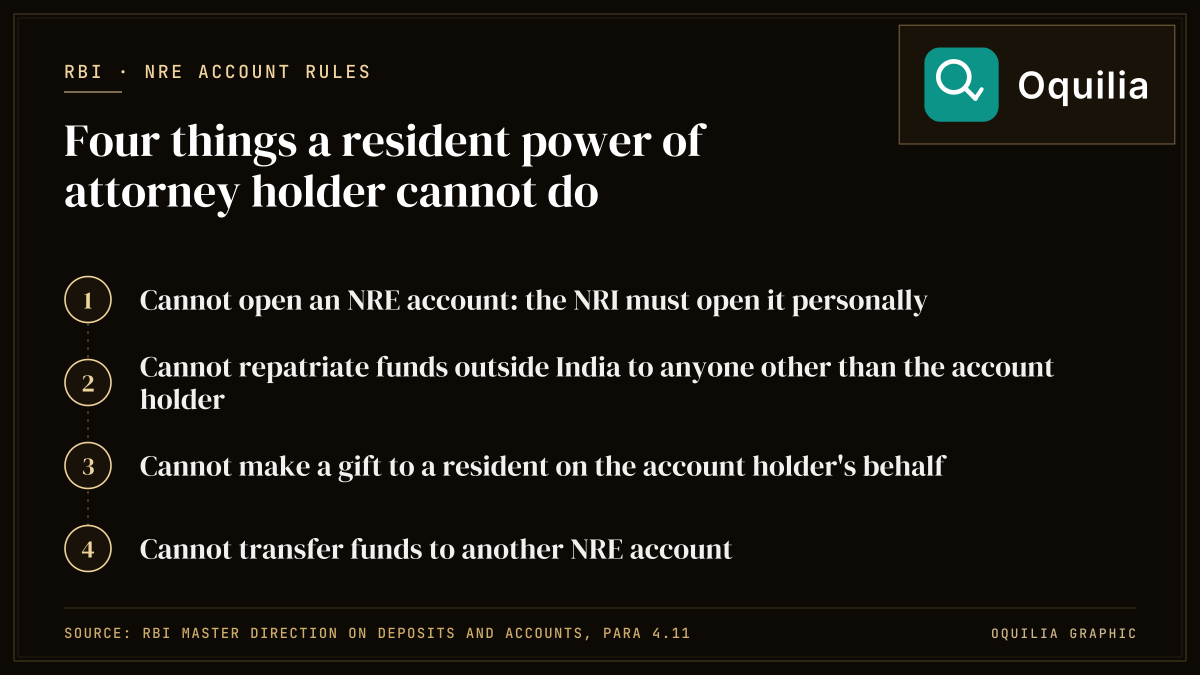
Paragraph 4.11 then lists four prohibitions in plain terms. A resident POA holder is not allowed to:
| Prohibited act (para 4.11) | What it means in practice |
|---|---|
| (a) Open an NRE account | The NRI must open the account personally; the POA cannot be used to create a new one |
| (b) Repatriate funds to anyone other than the account holder | Money may go abroad only to the NRI's own account, never to a child studying overseas or a third party |
| (c) Make a gift to a resident on the holder's behalf | The POA holder cannot transfer NRE money as a gift to a relative, including to himself or herself |
| (d) Transfer funds to another NRE account | Even a transfer to a sibling's NRE account is outside the POA's reach |
Prohibition (d) sits awkwardly beside paragraph 4.6, which lists transfers to other NRE and FCNR(B) accounts among permitted debits. The two are consistent once the actor is identified: the account holder may make such a transfer, but a resident acting under a POA may not. The distinction matters because a bank will check who is giving the instruction, not just what the instruction is.
Joint accounts: the 'former or survivor' route
Many families try to avoid a POA by adding a resident parent as a joint holder. Paragraph 4.3 permits joint NRE accounts held by two or more NRIs and/or PIOs, or by an NRI/PIO with resident relative(s), on a 'former or survivor' basis. The catch is in the same paragraph: during the NRI/PIO holder's lifetime, the resident relative can operate the account "only as a Power of Attorney holder". In other words, joint holding gives the resident no wider powers than a POA; the four prohibitions in paragraph 4.11 apply in full.
Where the DTAA fits
A DTAA does not govern who may operate an Indian bank account; that is purely a FEMA question. The treaty becomes relevant only when income earned through the account (for example, gains on investments made from it) is taxed in India and again abroad. The table below shows the rates held in Oquilia's DTAA reference data for the three largest NRI destinations.
| Treaty country | Interest | Portfolio dividends | Long-term capital gains | In force from |
|---|---|---|---|---|
| United States | 15% | 25% | 12.5% (India retains taxing right) | 12 September 1991 |
| United Kingdom | 15% | 15% | 12.5% (India retains taxing right) | 26 October 1993 |
| United Arab Emirates | 12.5% | 10% | 12.5% (India retains taxing right) | 22 September 1993 |
None of these three treaties makes gains on Indian shares or property tax-free. India keeps the right to tax them at the domestic long-term rate of 12.5%, so an investment placed by a POA holder from an NRE account does not escape Indian tax because the investor lives abroad.
Tax Treatment in India
A POA is an authority to act, not a transfer of ownership. Income generated from an NRE account remains the income of the non-resident account holder, and any return of income in India is filed in the holder's name for the relevant year, not the POA holder's. This guide does not cover the treatment of NRE interest or deposit rates, which Oquilia has addressed separately; the points below are about the transactions a POA holder actually puts through.
Investments made through the POA
When a POA holder uses paragraph 4.11's investment power, for instance to buy listed shares or mutual fund units for the NRI, the resulting gains are taxed in India in the NRI's hands. Using the rates in Oquilia's rate configuration, long-term gains on listed equity are taxed at 12.5%. The NRI tax calculator applies the current slabs, the 4% health and education cess and the surcharge bands of 10%, 15% and 25% at incomes above Rs 50 lakh, Rs 1 crore and Rs 2 crore; the 37% top band applies only under the old regime for income above Rs 5 crore, while the new regime caps surcharge at 25%.
Outward remittances: Forms 145 and 146
When the POA holder sends money abroad to the account holder under paragraph 4.11(b), the bank will ask for the tax-side paperwork. From 1 April 2026, under the Income-tax Act, 2025 and the Income-tax Rules, 2026, Form No. 145 (the remitter's declaration) and Form No. 146 (the Chartered Accountant's certificate) replace the old Forms 15CA and 15CB. The governing provision is Section 397(3)(d) of the 2025 Act, in place of Section 195(6) of the 1961 Act, as the Income Tax Department explains in FAQs 20 to 27 on its Income Tax Forms help page.
| Part of Form 145 | When it applies | Form 146 needed? |
|---|---|---|
| Part A | Aggregate remittances up to Rs 5 lakh in the financial year | No |
| Part B | Taxable remittance above Rs 5 lakh, with an Assessing Officer certificate | No |
| Part C | Taxable remittance above Rs 5 lakh, with a CA certificate | Yes |
| Part D | Remittance not taxable, other than payments referred to in Rule 220(3) | Per Rule 220 |
Oquilia's full explainer on Form 145 and Form 146 walks through each part. The practical point for a family using a POA is that the resident relative can sign and submit the remittance request, but the declaration still relates to the non-resident's income and liability.
Gifts the POA cannot make
Prohibition (c) of paragraph 4.11 also closes off a common tax question before it arises. Because a resident POA holder cannot make a gift to a resident from the NRE account, there is no route under the RBI rules for the POA holder to move NRE money into his or her own name as a gift. If the NRI wishes to make a gift, the NRI must give that instruction personally, and the tax consequences then follow the NRI's own decision.
Tax Treatment Abroad
The country where the NRI lives will usually tax worldwide income on its own rules, and the POA arrangement in India does not alter the account holder's position there. What the treaty adds is relief from double taxation. Oquilia's reference data records, for the India-US treaty, that Article 24 provides a foreign tax credit in the country of residence, and that portfolio dividends attract a 25% treaty ceiling unless the recipient holds at least 10% of the voting stock, in which case the rate is 15% under Article 10.
For the United Kingdom, the reference data notes that Article 4 contains the tie-breaker rule for individuals who are resident in both countries. For the UAE, a Tax Residency Certificate (TRC) requires proof of UAE establishment, and capital gains on shares of an Indian company remain taxable in India. The foreign tax credit calculator and the DTAA benefit calculator let readers model how Indian tax at 12.5% on gains interacts with the credit claimed abroad.
To claim treaty relief in India, a non-resident now furnishes details on Form 41 under Section 159 of the Income-tax Act, 2025, which Oquilia covered in its guide to Form 41 and DTAA relief. The TRC and Form 41 are the NRI's own filings: a POA holder may assemble documents, but the residence being certified is the account holder's, not the relative's.
| Country | Treaty note in Oquilia's reference data | What the NRI must hold |
|---|---|---|
| United States | Article 24: foreign tax credit in country of residence | Proof of tax paid in India |
| United Kingdom | Article 4: tie-breaker for dual residents | Residence evidence if both countries claim residence |
| UAE | TRC needs UAE establishment proof | Tax Residency Certificate |
Repatriation Mechanics
The POA rules differ by account type, and that difference decides how money can leave India. The comparison below draws on paragraphs 4.11, 5.3 and 6.11 of the Master Direction.
| Account | POA may do | Repatriation by POA holder |
|---|---|---|
| NRE (para 4.11) | Local payments; investments where the holder is eligible | Only to the account holder through banking channels |
| FCNR(B) (para 5.3) | Same conditions as NRE; deposits held only as fixed deposits (para 5.2) | Only to the account holder |
| NRO (para 6.11) | Local payments and remittances to non-residents | Within the USD 1 million per financial year facility (para 6.8) |
NRE and FCNR(B)
Paragraph 4.4 permits remittances outside India from an NRE account, and paragraph 4.11(b) confines a POA holder's remittances to the account holder alone. Paragraph 5.3 extends the NRE conditions on credits and debits, joint accounts, loans and overdrafts, and operation by POA to FCNR(B) accounts. Since paragraph 5.2 allows FCNR(B) only in fixed-deposit form, a POA holder's role there is mostly confined to handling maturity proceeds on the holder's instructions.
NRO accounts
NRO accounts follow a separate rule. Under paragraph 6.11, authorised banks may allow operations under a POA granted to a resident, provided they are restricted to local payments and remittances to non-residents. Paragraph 6.8 allows NRO balances beyond current income to be repatriated by NRIs and PIOs up to USD 1 million per financial year, subject to the Foreign Exchange Management (Remittance of Assets) Regulations, 2016, and transfers to an NRE account are permitted within that same USD 1 million facility. The NRO to NRE calculator and the repatriation calculator model these limits.
Loans against NRE deposits
Paragraph 4.8.1 lets banks lend against NRE deposits to the account holder or to a third party in India, without any limit, subject to the usual margin requirements. The loan cannot be repatriated, and where it goes to a third party there must be no direct or indirect foreign exchange consideration for the NRI who pledges the deposit. A POA holder seeking such a facility is acting within the NRI's own pledge, not creating a new right.
Return to India and death of the holder
Paragraph 4.9 requires NRE accounts to be redesignated as resident accounts, or moved to an RFC account at the holder's option, immediately on the holder's return to India for employment or on a change in residential status. At that point the POA framework in paragraph 4.11 no longer applies to an NRE account. Under paragraph 4.10, on the holder's death the balance can be transferred to a non-resident nominee, while a resident nominee's request to remit funds abroad for the deceased's liabilities or similar purposes must be forwarded to the RBI for consideration.
FAQ
Can my mother in India withdraw cash from my NRE account under a POA?
Yes, for local payments. Paragraph 4.11 of the RBI Master Direction allows a resident POA holder to make withdrawals for local payments and remittances to the account holder through banking channels.
Can the POA holder send money from my NRE account to my daughter studying abroad?
No. Prohibition (b) in paragraph 4.11 bars the POA holder from repatriating funds outside India to anyone other than the account holder. The money must first go to the NRI's own account abroad.
Does adding a resident parent as joint holder give them full access?
No. Paragraph 4.3 permits joint NRE accounts with a resident relative on a 'former or survivor' basis, but during the NRI's lifetime the resident can operate the account only as a POA holder, subject to all four prohibitions in paragraph 4.11.
Can the POA holder open a new NRE fixed deposit for me?
Paragraph 4.11(a) bars a resident POA holder from opening an NRE account. Paragraph 4.2 allows an NRE account to be held as a fixed deposit, but the account must be opened by the NRI.
Do the same POA limits apply to FCNR(B) deposits?
Yes. Paragraph 5.3 applies the NRE conditions on joint accounts, loans and operation by POA to FCNR(B) accounts, which paragraph 5.2 permits only as fixed deposits.
Can the POA holder buy shares or mutual funds for me from the NRE account?
Paragraph 4.11 allows the POA holder to operate the account to facilitate investment where the account holder, or a bank designated by the holder, is eligible to invest in India. Long-term gains on such investments are taxed in India at 12.5%.
What forms are needed when the POA holder remits money to me abroad?
From 1 April 2026, Form No. 145 and, where required, Form No. 146 under Section 397(3)(d) of the Income-tax Act, 2025 replace Forms 15CA and 15CB. Part A of Form 145 covers aggregate remittances up to Rs 5 lakh in a financial year without a CA certificate.
This explainer is for information only. It summarises the RBI Master Direction on Deposits and Accounts as updated on 2 September 2026 and the Income Tax Department's published FAQs; account holders should confirm operational requirements with their bank.
Sources & Citations
- Master Direction - Deposits and Accounts (FED Master Direction No. 14/2015-16), updated as on 2 September 2026 — Reserve Bank of India
- Income Tax Forms: FAQs on Forms 145 and 146 — Income Tax Department