

Loan taken before Sept 2016? Why amended Section 13(8) still ends your redemption right: M. Rajendran v KPK Oils (SC, 2025)
Supreme Court in M. Rajendran v KPK Oils (22 Sep 2025) held amended Section 13(8) SARFAESI applies to pre-2016 loans: redemption ends when the auction notice is published.
Key points
- The Supreme Court on 22 September 2025 held in M. Rajendran v KPK Oils that amended Section 13(8) of the SARFAESI Act applies to loans taken before September 2016.
- Where a claim was alive on 1 September 2016 and the auction notice came later, the borrower's right to redeem ends on publication of that notice (para 185).
- Borrowers facing a SARFAESI sale must tender dues or settle before the sale notice is published, and should appeal DRT orders to the DRAT within 30 days.
On 22 September 2025, the Supreme Court of India settled a question that had split Debt Recovery Tribunals and High Courts for nearly nine years: does a borrower whose loan was sanctioned before 1 September 2016 keep the older, wider right to redeem a mortgaged property right up to the date of sale? In M. Rajendran & Ors. v. M/s KPK Oils and Proteins India Pvt. Ltd. & Ors. (Civil Appeal No. 12174 of 2025, reported as 2025 INSC 1137), a bench of J.B. Pardiwala and R. Mahadevan JJ. answered no. The full judgment is on Indian Kanoon, and it runs to 139 pages.
The practical message for any borrower facing a notice under the SARFAESI Act is blunt. Once the bank publishes its auction notice, the statutory window to pay off the dues and stop the sale has closed, regardless of when the loan was signed. This playbook sets out the law, the procedure, the defences that remain open and the dates that matter.
The Statutory Position
The provision at the centre of the case is Section 13(8) of the SARFAESI Act, 2002. Before 1 September 2016, it allowed a borrower to tender the full dues, with all costs, charges and expenses, "at any time before the date fixed for sale or transfer". Act 44 of 2016, the Enforcement of Security Interest and Recovery of Debt Laws and Miscellaneous Provisions (Amendment) Act, 2016, replaced those words with "at any time before the date of publication of notice for public auction or inviting quotations or tender from public or private treaty" (para 84 of the judgment).
| Feature | Section 13(8) before 1 Sep 2016 | Section 13(8) from 1 Sep 2016 |
|---|---|---|
| Deadline to tender full dues | Before the date fixed for sale or transfer | Before the date of publication of the sale notice |
| What must be tendered | Dues plus all costs, charges and expenses | Dues plus all costs, charges and expenses |
| Leading Supreme Court reading | Mathew Varghese v. Amritha Kumar, (2014) 5 SCC 610 | Celir LLP v. Bafna Motors, (2024) 2 SCC 1, and M. Rajendran (2025) |
| Source of the right | Statute (Section 13(8)), not contract | Statute (Section 13(8)), not contract (para 191) |
The amended provision works in 2 parts, the Court explained at para 55: first, it fixes the time limit up to which the borrower may redeem; second, it fixes the point from which the secured creditor may proceed to lease, assign or sell.
Three other provisions frame the timetable. Section 13(2) requires a 60-day demand notice once the account is classified as a non-performing asset; Section 13(3A) lets the borrower object, and the lender must reply with reasons within 15 days. Section 13(4) then lets the lender take possession, sell, lease or appoint a manager without going to court. Section 17 gives the borrower an appeal to the Debt Recovery Tribunal within 45 days of a Section 13(4) measure.
The sale itself is governed by the Security Interest (Enforcement) Rules, 2002. Rule 9(1) says no sale of immovable property shall take place, in the first instance, "before the expiry of thirty days" from publication of the public notice or service of the notice on the borrower. If a sale fails and has to be re-run, the second proviso requires a fresh notice of not less than 15 days.
Procedure Step by Step
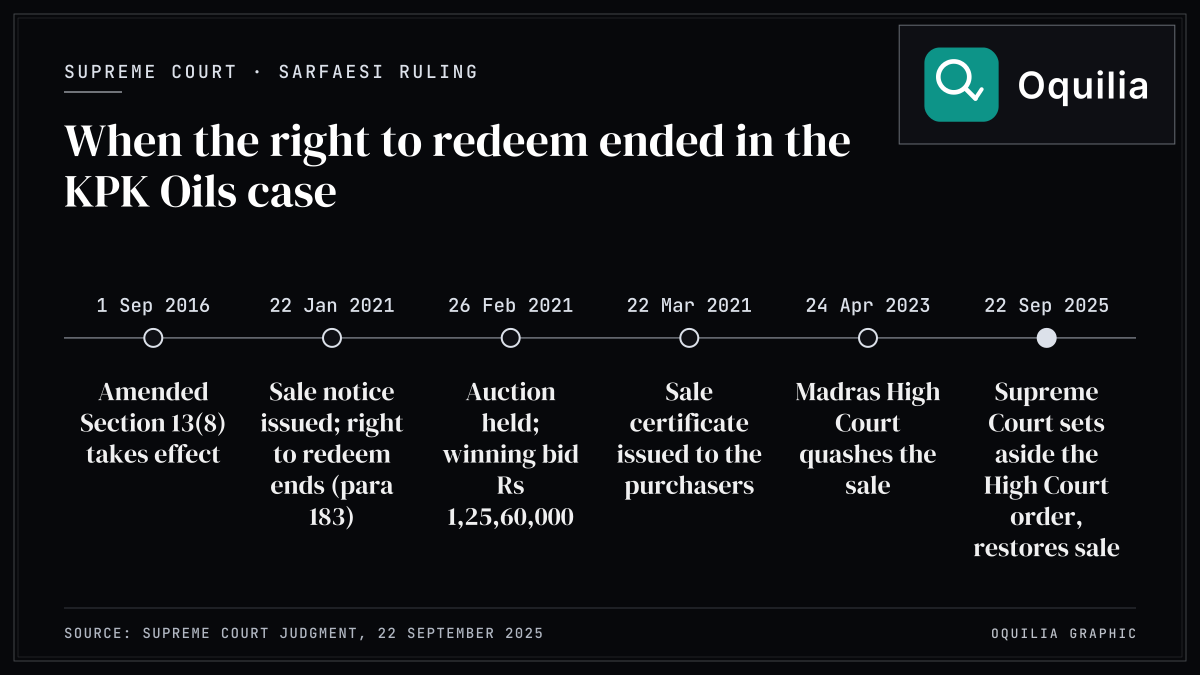
The KPK Oils file is a useful template because the Supreme Court recorded every date at paras 5 to 25. Below is the statutory sequence, mapped against what happened in that case.
- Loan and security created. On 6 January 2016, the borrowers took a cash credit facility of Rs 5 crore and a term loan of Rs 30 lakh. Guarantors created an equitable mortgage by deposit of title deeds over 1.92 acres of land in Dharapuram Taluk, Tiruppur District (paras 5-6).
- NPA classification. The bank classified the account as a non-performing asset on 31 December 2019 (para 8).
- Section 13(2) demand notice. Issued on 12 February 2020 for Rs 3,96,15,672 due as on 31 December 2019, giving 60 days to pay (para 9). The borrowers filed no Section 13(3A) representation (para 10).
- Section 13(4) possession notice. Issued on 28 October 2020 for Rs 4,39,82,862.20 due as on 30 September 2020, and published in 2 newspapers on 31 October 2020 (paras 11-12).
- First Section 17 challenge. On 28 December 2020, the borrowers went to the DRT, Coimbatore against the possession notice (para 13).
- Sale notice. Issued on 22 January 2021 under Rules 8 and 9 for Rs 4,55,64,590.20 due as on 31 December 2020, and published in newspapers on 24 January 2021 (paras 14-15).
- Auction. Held on 26 February 2021, more than 30 days after publication; the winning bid was Rs 1,25,60,000 (para 17).
- Payment and sale certificate. The purchasers paid the full price on 20 March 2021 and received the sale certificate on 22 March 2021 (paras 17-18).
- Late tender by borrowers. After confirmation, in March 2021, the borrowers paid Rs 2.88 crore; on 7 May 2021 they paid Rs 62,74,123.74 and the bank closed the account (paras 19, 21-22).
- DRT dismissal. On 19 January 2023, the DRT dismissed both securitisation applications (para 25).
- Writ instead of appeal. The borrowers skipped the statutory appeal to the Appellate Tribunal and filed a writ; the Madras High Court quashed the sale on 24 April 2023 (paras 3, 26).
- Supreme Court reversal. On 22 September 2025, the High Court order was set aside and the auction purchasers' title restored (para 202).
The Rules also impose deadlines on the buyer, which matter when a borrower is counting the days. Under Rule 9(3) the purchaser must pay 25% of the sale price on the same day or the next working day. Under Rule 9(4) the balance is due on or before the 15th day after confirmation, extendable in writing to a maximum of 3 months.
| Stage | Provision | Time limit |
|---|---|---|
| Demand notice | Section 13(2) | 60 days to pay |
| Lender's reply to objection | Section 13(3A) | 15 days |
| Appeal to DRT | Section 17 | 45 days from the Section 13(4) measure |
| Gap before first sale | Rule 9(1) | 30 days from the later of service or publication |
| Notice before a re-run sale | Rule 9(1), second proviso | Not less than 15 days |
| Purchaser's initial deposit | Rule 9(3) | 25% of price, same or next working day |
| Purchaser's balance | Rule 9(4) | 15th day after confirmation, maximum 3 months |
| Appeal to DRAT | Section 18 | 30 days, with pre-deposit |
Borrower Defences Available
The judgment closes one door but leaves several others open. Each depends on acting within a fixed number of days.
1. Pay before publication, not before the auction. Under the amended Section 13(8), the deadline is the date of publication of the sale notice. In KPK Oils, the Court held that the right to redeem "stood extinguished on 22.01.2021" (para 183), the date of the auction notice, which was 35 days before the auction itself. Money tendered after that date, even Rs 2.88 crore within weeks, did not revive the right.
2. Use the Section 13(3A) objection. Within the 60-day window after a Section 13(2) notice, the borrower may object, and the lender must reply with reasons within 15 days. The KPK Oils borrowers filed no objection at all (para 10), which left the bank's figure of Rs 3,96,15,672 unchallenged on the record.
3. Check the 30-day gap under Rule 9(1). Para 169 holds that the notice served on the borrower and the newspaper publication are one single composite "notice of sale". The 30-day gap runs from whichever of service, affixation or publication is later. A sale held on day 29 after the last of these steps is open to challenge before the DRT.
4. File the Section 17 application in time. The DRT appeal must be filed within 45 days of the Section 13(4) measure. The DRT may direct a deposit but it is not mandatory. In this case the DRT, Coimbatore granted status quo on 26 March 2021 after noting that about 50% of the claim had been paid, but that came 4 days after the sale certificate was issued (para 20).
5. Appeal to the DRAT, not straight to the High Court. Section 18 gives an appeal to the Appellate Tribunal within 30 days of the DRT order. The pre-deposit is 50% of the debt claimed by the lender or determined by the DRT, whichever is less, and the Tribunal may cut it to not less than 25% for recorded reasons. The KPK Oils borrowers by-passed this route (para 26), and the Supreme Court restored the sale.
6. Negotiate a settlement early. A one-time settlement is a contract with the lender, separate from the statutory right in Section 13(8). Use the loan settlement cost calculator to model what a lump-sum offer costs against the outstanding dues, and the loan foreclosure calculator to compare full closure. Any settlement should be signed before publication of the sale notice, because after that date the borrower has no statutory lever.
| Defence | Deadline | Deposit or cost | Status after M. Rajendran |
|---|---|---|---|
| Tender full dues under Section 13(8) | Before publication of sale notice | 100% of dues plus costs | Available, but cut-off is publication |
| Section 13(3A) objection | Within 60 days of 13(2) notice | Nil | Available |
| Rule 9(1) 30-day gap challenge | Before or after sale, via Section 17 | DRT may direct a deposit | Strengthened by para 169 |
| Section 17 appeal to DRT | 45 days | Discretionary | Available |
| Section 18 appeal to DRAT | 30 days | 50%, reducible to 25% | The proper route after DRT |
| Argue loan pre-dates 2016 amendment | Not applicable | Not applicable | Rejected (paras 185, 192) |
Recent Tribunal/HC Position
What the High Court had said. On 24 April 2023, the Madras High Court quashed the sale certificate dated 22 March 2021 and ordered the bank to close the loan account. Relying on Mathew Varghese (2014) 5 SCC 610, it held that the right of redemption is not lost "on the fall of the hammer", ordered a refund of Rs 1,25,60,000 to the purchasers, and fixed interest at 9% a year, payable by the borrowers (paras 29-31).
What the Supreme Court held. The bench reversed that view on 4 points:
- Claims alive on 1 September 2016. At para 185, the Court said that "if the claim is alive on 01.09.16 when the Section 13(8) is amended and the notice for auction is issued after 01.09.16, then the amended section should apply". Treating the Act as reaching pre-2002 debts while treating its 2016 amendment as prospective-only "would create absurd situations".
- Remedial and procedural statute. At para 188(v), the Court described SARFAESI as "a remedial statute intended to deal with problem of pre-existing loan transactions which need speedy recovery". At para 187, it repeated that the presumption against retrospection does not apply to procedural provisions.
- Statutory, not contractual, right. Para 191 holds that redemption "is not a contractual right, and rather a statutory right", and para 192 calls the argument tied to the loan date "completely misconceived". It also relied on Central Bank of India v. Shanmugavelu, 2024 INSC 80 (para 193).
- Single composite sale notice. Para 169 holds that Rules 8(6), 8(7) and 9(1) contemplate one composite notice, with the 30-day count running from the later of service, affixation or publication.
The judgment builds on Celir LLP v. Bafna Motors (Mumbai) Pvt. Ltd., (2024) 2 SCC 1, which the purchasers cited at para 33, and extends it to loans sanctioned before 1 September 2016. At para 195, the Court also warned that any third-party rights created over the land to defeat the auction purchaser "would be non-est".
The anomaly the Court flagged. At paras 170-171, the Court noted that sales by private treaty or by inviting quotations need no published notice under Rules 8 and 9, so the phrase "before the date of publication" has nothing to attach to in those modes. Para 199 calls this a "glaring anomaly" that "renders the very mandate of the provision otiose". Para 201 says: "We humbly urge the Ministry of Finance to take a serious look at these provisions and bring about necessary changes." Under para 203, a copy was sent to every High Court and to the Ministries of Finance and Law. As of this article's date, Oquilia has not verified any amendment made in response, so borrowers should read Section 13(8) as the Court read it on 22 September 2025.
FAQ
My home loan was sanctioned in 2014. Does the old Section 13(8) protect me?
No. Under para 185 of M. Rajendran, decided on 22 September 2025, the amended Section 13(8) applies to any claim alive on 1 September 2016 where the auction notice is issued after that date. The loan date does not matter.
When exactly does my right to redeem end?
On the date of publication of the notice for public auction, quotations, tender or private treaty. In KPK Oils, the Court fixed that date as 22 January 2021, 35 days before the 26 February 2021 auction (paras 181 and 183).
Can I stop the auction by paying everything after the notice appears?
Not as of right. The borrowers in KPK Oils paid Rs 2.88 crore after confirmation and Rs 62,74,123.74 on 7 May 2021, and the Supreme Court still restored the Rs 1,25,60,000 sale. After publication, any deal depends on the lender agreeing.
How many days must pass between the sale notice and the auction?
At least 30 days under Rule 9(1) for a first sale, counted from the later of service on the borrower or newspaper publication (para 169). A re-run sale needs a fresh notice of not less than 15 days.
Should I file a writ petition in the High Court?
The Supreme Court noted at para 26 that the KPK Oils borrowers by-passed the statutory appeal to the Appellate Tribunal. Section 18 gives a 30-day appeal to the DRAT, with a pre-deposit of 50% that may be reduced to 25%.
What is the deadline for challenging possession before the DRT?
45 days from the Section 13(4) measure, under Section 17 of the SARFAESI Act. The DRT may order a deposit, but the statute does not make one mandatory.
Is a one-time settlement still possible after this judgment?
Yes, because a settlement is a contract with the lender rather than a statutory right. The safest window is before the sale notice is published; compare offers with the debt consolidation calculator and the settlement cost tool.
This article explains a published judgment for general information and is not legal advice. The Oquilia Research Desk does not represent clients before any court or tribunal. Borrowers facing a SARFAESI notice should consult a qualified advocate within the 45-day Section 17 window.
Sources & Citations
- M. Rajendran vs M/S KPK Oils And Proteins India Pvt. Ltd, 22 September 2025 — Indian Kanoon (Supreme Court of India)
- Section 13 in the SARFAESI Act, 2002 — Indian Kanoon