

Kerala High Court upholds civil prison for co-op bank debtor over unpaid decree
The Kerala High Court upheld a one-month civil prison order against a debtor of Calicut City Service Co-operative Bank, holding he failed to prove he could not pay.
Key points
- The Kerala High Court on 10 November 2026 upheld a one-month civil prison order against a co-operative bank's debtor.
- The bank sought to recover a decree debt of Rs 8,35,066 plus costs of Rs 17,821, the court recorded.
- The court held that a debtor claiming no means to pay must prove it once the lender shows evidence of means.
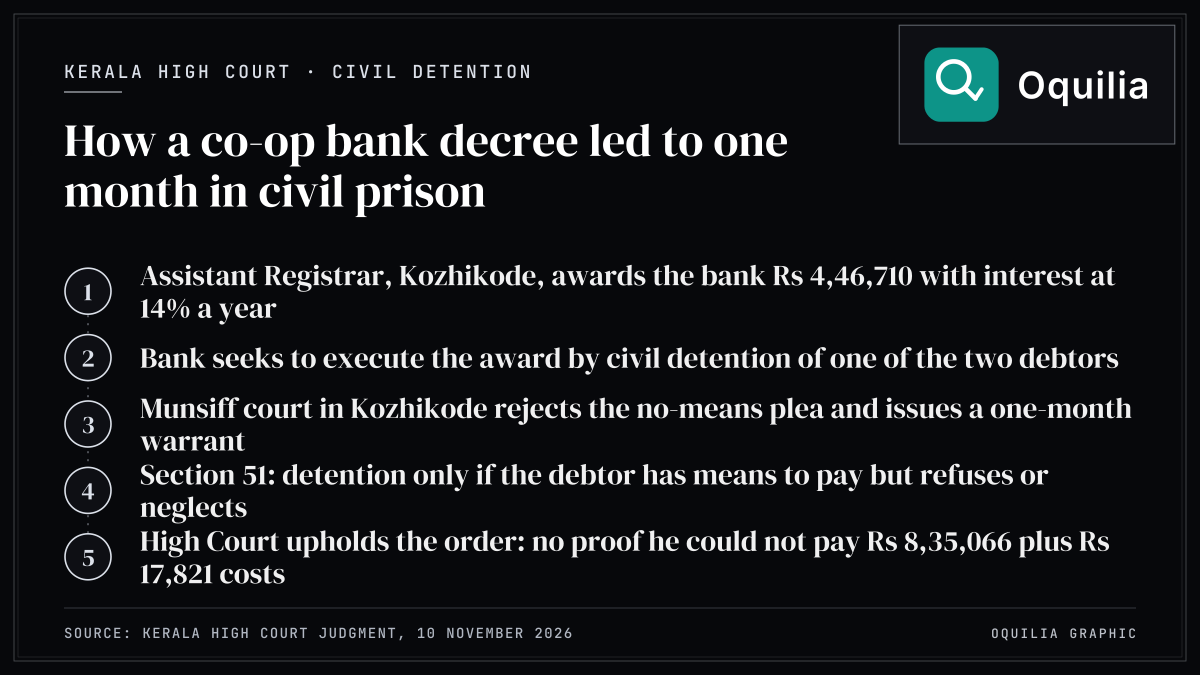
The Kerala High Court on 10 November 2026 upheld an order sending a borrower of the Calicut City Service Co-operative Bank to civil prison for one month for not paying a decree debt. This is a civil debt-recovery case, not a criminal one. The court held that he had failed to prove he lacked the means to pay Rs 8,35,066, plus costs of Rs 17,821.
What Happened
According to the order, the Assistant Registrar of Co-operative Societies, Kozhikode, had passed an award letting the bank recover Rs 4,46,710 with interest at 14% a year from two people. The bank sought to execute it by having one of them detained in civil prison. The other had died during the execution proceedings.
The man said he had no means to pay, was a heart patient, depended on his wife's support, and was only a guarantor for the loan. A munsiff court in Kozhikode rejected that plea and issued a warrant for one month's detention in civil prison.
The High Court explained that under Section 51 of the Code of Civil Procedure, a court can order civil detention for a money decree only after recording that the debtor has, or has had since the decree, the means to pay but has refused or neglected to do so. Once the lender leads evidence of such means, the burden shifts to the debtor to prove he cannot pay.
The court noted that in cross-examination the man admitted he had worked as a teacher, later taught abroad, and had sold six cents of land at Rs 50,000 per cent, but gave no dates for any of it. It held that medical records and his reliance on his wife did not establish financial incapacity, and dismissed his revision petition.
What It Means
For borrowers and guarantors, the ruling shows that a plea of "no means" must be backed by evidence. A lender's evidence, including the debtor's own admissions in cross-examination, can shift the burden to the debtor, and a court can then order civil detention. The court also said that a spouse's job is not, by itself, proof that the debtor can pay.
Source: High Court judgment
Sources & Citations
- High Court judgment — Kerala High Court