

Pension for Gig and Platform Workers: PFRDA Extends the NPS e-Shramik Incentive for FY 2026-27
PFRDA has extended the Rs 100 PoP onboarding incentive under the NPS e-Shramik model to 31 March 2027. How gig workers join, how withdrawals are taxed, and a worked drawdown.
Key points
- PFRDA's circular of 18 August 2026 extends the NPS e-Shramik onboarding incentive for Points of Presence to FY 2026-27.
- PoPs can earn up to Rs 100 per new gig or platform worker account for enrolments made up to 31 March 2027, and cannot charge an onboarding fee.
- Workers face no minimum contribution, exit under All Citizen rules, and should note Section 10(12A) exempts only 60% of the lump sum.
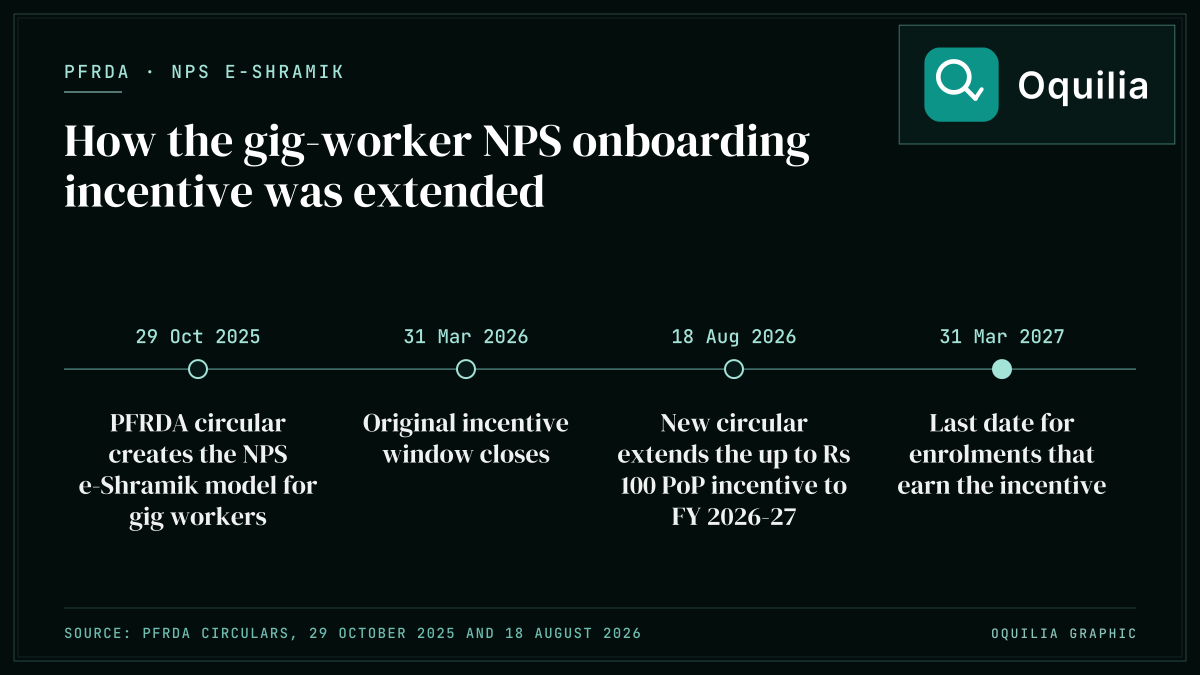
On 18 August 2026, the Pension Fund Regulatory and Development Authority (PFRDA) issued Circular No. PFRDA/2026/43/P&DCORP/02, extending the incentive framework under the "NPS e-shramik (Platform Service Partner) Model" to the financial year 2026-27. The practical effect is simple: Points of Presence (PoPs) that enrol gig and platform workers into the National Pension System (NPS) through aggregators can keep earning an onboarding incentive of up to Rs 100 per new account for enrolments made up to 31 March 2027. The original incentive window closed on 31 March 2026.
For a delivery rider, cab driver or home-services professional who has never had an employer-run pension, this matters for one reason: PoPs that are paid to onboard you have a reason to build the systems, run the awareness drives and keep the zero-fee onboarding in place. This explainer sets out how the model works, how NPS withdrawals are taxed, and what a realistic corpus and drawdown could look like for a worker who starts small. You can model your own numbers on the NPS calculator.
The Scheme Explained
Where the model came from
The model was created by PFRDA Circular No. PFRDA/2025/19/PDES/02 dated 29 October 2025. That circular states that service partners in the platform economy "often remain outside the traditional social security framework, including retirement planning", and extends NPS to them by working through aggregators such as Zomato, Swiggy, Blinkit, Ola, Uber and Urban Company. It was introduced for the informal sector under Section 12(1)(a) and Section 20 of the PFRDA Act, 2013.
The circular defines two terms. A "Platform Aggregator" is an online marketplace or digital platform that connects buyers or users of a service with service partners. A "Platform Service Partner" is an individual, including a gig worker, engaged for consideration with an aggregator "under a contract for service". In other words, the model is built for people who are not employees in the legal sense, which is exactly the group the salaried-employee routes into NPS and EPF tend to miss.
What the 18 August 2026 circular changed, and what it did not
The 2026 circular is short, running to four paragraphs. Paragraph 3 extends the Rs 100 onboarding incentive to FY 2026-27, "valid for enrollments up to 31st March 2027", and says all other stipulations of the October 2025 circular "shall remain completely unchanged and in force". The circular is issued under Section 14 of the PFRDA Act, 2013.
| Feature | October 2025 circular | August 2026 circular |
|---|---|---|
| Circular number | PFRDA/2025/19/PDES/02 | PFRDA/2026/43/P&DCORP/02 |
| Date | 29 October 2025 | 18 August 2026 |
| PoP incentive | Up to Rs 100 per new account | Up to Rs 100 per new account (unchanged) |
| Enrolment window | Registered till 31 March 2026 | Enrolments up to 31 March 2027 |
| Other rules | Set out in sections 3.1 to 3.8 | "Completely unchanged and in force" |
How the incentive is earned
The incentive is paid to the PoP, not to the worker. Under section 3.6 of the 2025 circular, a PoP earns up to Rs 100 per capita for each new service partner enrolled through an aggregator, provided two conditions are met: the account remains active for a minimum of 1 year, and the initial contribution has been received. An "active account" is one where the subscriber has contributed at least Rs 1,000 during the year. PoPs "shall not charge any on-boarding fee from subscribers under this framework", and section 3.5 adds that no onboarding fee applies for as long as the incentive framework is available. With the extension, that zero-fee period now runs at least until 31 March 2027.
Contributions: no floor, no ceiling
Section 3.3 mirrors the Corporate model of NPS. Contributions can be made jointly by the aggregator and the worker, by the worker alone, or by the aggregator alone. "No minimum or maximum contribution thresholds shall be applicable." The aggregator or worker may fix a minimum per credit, and the circular gives Rs 99 per month as an example, not a mandatory figure.
Onboarding in two phases
Under section 3.4, Phase I generates a Permanent Retirement Account Number (PRAN) quickly using minimum KYC details: name, address, PAN, mobile number and bank account, verified through Aadhaar-based eKYC or another PFRDA-specified mode. The aggregator may select the pension fund and investment scheme at onboarding, and the worker can change both later. Phase II completes the record, and nominee details must be recorded by the PoP within 60 days of onboarding.
Portability and exit
A worker may work with many aggregators at once, but under section 3.7 the pension account can be opened through only one aggregator; it can later be ported to another aggregator or switched to the Common Scheme. Under section 3.8, exit and withdrawal follow the All Citizen Model rules in the PFRDA (Exit and Withdrawals) Regulations, 2015. Those regulations were amended in December 2025, and the current non-government rules are summarised below.
| Event (non-government sector) | Rule under the amended regulations |
|---|---|
| Normal exit, corpus up to Rs 8 lakh | Up to 100% may be withdrawn |
| Normal exit, corpus above Rs 8 lakh and up to Rs 12 lakh | Lump sum capped at Rs 6 lakh; balance via systematic unit redemption |
| Normal exit, corpus above Rs 12 lakh | Up to 80% lump sum; at least 20% to an annuity |
| Premature exit, corpus up to Rs 5 lakh | Up to 100% may be withdrawn |
| Premature exit, corpus above Rs 5 lakh | Up to 20% lump sum; at least 80% to an annuity |
| Partial withdrawal | Up to 25% of own contributions, after 3 years; up to 4 times before 60 |
| Maximum exit age | 85 |
Tax on Withdrawal
The lump sum: two ceilings, not one
The single most important tax point is that PFRDA's withdrawal limit and the Income-tax Act's exemption limit are no longer the same. Section 10(12A) exempts the payment on closure or opting out only to the extent it does not exceed 60% of the total amount payable. PFRDA's December 2025 amendment lets non-government subscribers, which includes e-shramik members under the All Citizen rules, withdraw up to 80%. The 60% exemption has not been realigned by any Finance Act provision we have found, so a withdrawal above 60% of the corpus is not covered by Section 10(12A). We do not state that the excess is taxable or exempt; check the treatment with the Income Tax Department or a qualified adviser before you take more than 60%.
Partial withdrawals
Section 10(12B) exempts a partial withdrawal of up to 25% of the subscriber's own contributions. That matches PFRDA's partial-withdrawal limit of 25%, so a partial withdrawal within PFRDA's rules is covered.
Annuity income
Pension received from an annuity is taxed as income at the subscriber's slab rate in the year it is received. Under the new regime for FY 2026-27, the slabs set out in our rate configuration are:
| Taxable income band | Rate |
|---|---|
| Up to Rs 4 lakh | Nil |
| Rs 4 lakh to Rs 8 lakh | 5% |
| Rs 8 lakh to Rs 12 lakh | 10% |
| Rs 12 lakh to Rs 16 lakh | 15% |
| Rs 16 lakh to Rs 20 lakh | 20% |
| Rs 20 lakh to Rs 24 lakh | 25% |
| Above Rs 24 lakh | 30% |
Health and education cess of 4% applies on the tax. The Section 87A rebate in the new regime is up to Rs 60,000 for resident individuals with taxable income up to Rs 12 lakh, so a worker whose total slab-rate income stays at or below Rs 12 lakh pays no tax in practice. In the old regime the rebate is Rs 12,500 up to Rs 5 lakh.
Contributions
Tier I contributions made by the worker can be claimed under Section 80CCD(1) within the overall Section 80CCE ceiling, and the additional deduction under Section 80CCD(1B) is available only in the old tax regime, not the new one. Many gig workers file under the new regime by default, in which case neither deduction applies. The circular does not address whether an aggregator's contribution for a worker on a contract for service qualifies as an employer contribution under Section 80CCD(2), so do not assume it does. The Income Tax Department's return-filing help pages explain which return form suits your income mix.
Worked Drawdown
The examples below are illustrations, not projections. They assume a constant return of 8% a year, compounded monthly, purely to show the mechanics; NPS returns are market-linked and are not guaranteed. Each worker joins at 35 and exits at 60, a 25-year span.
Step 1: building the corpus
| Worker | Monthly contribution | Total paid in 25 years | Illustrative corpus at 60 |
|---|---|---|---|
| A | Rs 500 | Rs 1,50,000 | Rs 4,78,683 |
| B | Rs 1,000 | Rs 3,00,000 | Rs 9,57,367 |
| C | Rs 2,000 | Rs 6,00,000 | Rs 19,14,733 |
All three clear the Rs 1,000-a-year "active account" test in the 2025 circular in every year: even Worker A pays Rs 6,000 a year. A Rs 99-a-month contributor, the circular's own example, pays Rs 1,188 a year and also clears it, but at 8% would reach only about Rs 94,779 after 25 years. You can run other contribution levels through the retirement drawdown calculator.
Step 2: applying the exit rules at 60
- Worker A (Rs 4,78,683): below the Rs 8 lakh threshold, so up to 100% can be withdrawn. Section 10(12A) covers 60%, or Rs 2,87,210; confirm the treatment of the remaining Rs 1,91,473.
- Worker B (Rs 9,57,367): between Rs 8 lakh and Rs 12 lakh, so the lump sum is capped at Rs 6 lakh, with the balance of Rs 3,57,367 paid through systematic unit redemption. Rs 6 lakh is about 62.7% of the corpus, so about Rs 25,580 of it sits above the 60% exemption line of Rs 5,74,420.
- Worker C (Rs 19,14,733): above Rs 12 lakh, so the maximum lump sum is 80%, or Rs 15,31,786, and at least Rs 3,82,947 must buy an annuity. The 60% exemption covers Rs 11,48,840; the slice of Rs 3,82,946 between 60% and 80% needs confirming.
Step 3: a ten-year drawdown of Worker C's lump sum
Suppose Worker C takes the full Rs 15,31,786, keeps it invested at an assumed 7% a year, and withdraws Rs 1,50,000 at the end of each year after growth is credited. The 7% figure is an assumption for illustration only.
| Year | Opening balance | Growth at 7% | Withdrawal | Closing balance |
|---|---|---|---|---|
| 1 | Rs 15,31,786 | Rs 1,07,225 | Rs 1,50,000 | Rs 14,89,011 |
| 2 | Rs 14,89,011 | Rs 1,04,231 | Rs 1,50,000 | Rs 14,43,242 |
| 3 | Rs 14,43,242 | Rs 1,01,027 | Rs 1,50,000 | Rs 13,94,269 |
| 4 | Rs 13,94,269 | Rs 97,599 | Rs 1,50,000 | Rs 13,41,868 |
| 5 | Rs 13,41,868 | Rs 93,931 | Rs 1,50,000 | Rs 12,85,798 |
| 6 | Rs 12,85,798 | Rs 90,006 | Rs 1,50,000 | Rs 12,25,804 |
| 7 | Rs 12,25,804 | Rs 85,806 | Rs 1,50,000 | Rs 11,61,610 |
| 8 | Rs 11,61,610 | Rs 81,313 | Rs 1,50,000 | Rs 10,92,923 |
| 9 | Rs 10,92,923 | Rs 76,505 | Rs 1,50,000 | Rs 10,19,428 |
| 10 | Rs 10,19,428 | Rs 71,360 | Rs 1,50,000 | Rs 9,40,788 |
After ten years, Rs 15,00,000 has been withdrawn and Rs 9,40,788 remains. Because the withdrawal of Rs 1,50,000 exceeds the year-one growth of Rs 1,07,225, the balance falls every year; a withdrawal at or below the growth amount would keep the capital roughly intact. The annuity vs SWP calculator lets you compare this kind of self-managed drawdown with buying a larger annuity.
Step 4: tax on the drawdown
Capital withdrawn is not income; only the annuity and taxable returns count. If part of the lump sum goes into the Senior Citizens Savings Scheme at its 8.2% rate for October to December 2026, Rs 10,00,000 earns Rs 82,000 a year, taxable at slab rate. Even with annuity income added, Worker C stays well below the Rs 12 lakh new-regime threshold, so the Section 87A rebate of up to Rs 60,000 leaves no tax on normal-rate income.
Step 5: if a worker leaves early
A worker who exits before 60 with more than Rs 5 lakh can take only 20% as a lump sum, and at least 80% must buy an annuity. Worker B, for example, would face that rule if the corpus crossed Rs 5 lakh before an early exit. With no lock-in under the amended rules, that 80% annuity requirement is the main cost of leaving early. Partial withdrawals of up to 25% of own contributions after 3 years are the less costly way to meet an emergency.
FAQ
Who is eligible for the NPS e-Shramik model?
Any individual, including a gig worker, engaged with a platform aggregator under a contract for service, as defined in PFRDA Circular PFRDA/2025/19/PDES/02 of 29 October 2025. Enrolment runs through a PoP that has an arrangement with the aggregator.
Do I get the Rs 100 incentive?
No. The up-to-Rs 100 incentive is paid by PFRDA to the PoP for each new account that stays active for 1 year and receives an initial contribution. The benefit to you is indirect: PoPs cannot charge you an onboarding fee while the framework runs, now until at least 31 March 2027.
What is the minimum I must contribute?
There is no mandatory minimum or maximum. The circular cites Rs 99 a month as an example of a floor an aggregator might set. To count as an active account, at least Rs 1,000 must be contributed during the year.
Can I keep my account if I switch from one app to another?
Yes. Under section 3.7 you can port the account to another aggregator, or move from the platform scheme to the Common Scheme. You can hold only one account opened through an aggregator, even if you work for several platforms.
How much can I take out at 60?
The All Citizen exit rules apply. Up to 100% if the corpus is Rs 8 lakh or less; a Rs 6 lakh lump-sum cap between Rs 8 lakh and Rs 12 lakh; and up to 80% above Rs 12 lakh, with at least 20% used to buy an annuity.
Is the whole lump sum tax-free?
Not necessarily. Section 10(12A) exempts only up to 60% of the total amount payable. PFRDA now allows up to 80% (or 100% for small corpuses) to be withdrawn, and the treatment of the slice above 60% should be confirmed before you withdraw it.
Can I claim a deduction for my contributions in the new regime?
The additional Section 80CCD(1B) deduction is available only in the old tax regime. If you file under the new regime, plan your NPS savings on the strength of the scheme itself rather than on a deduction.
This article is general information based on PFRDA circulars dated 29 October 2025 and 18 August 2026 and Oquilia's rate configuration as of 15 November 2026. It is not personal tax or investment advice. Source: PFRDA circular extending the NPS e-shramik incentive for FY 2026-27; PFRDA circular introducing the NPS e-shramik model. Track your projected corpus over time with the NPS calculator.