

Bank took you to a Permanent Lok Adalat? Why conciliation is mandatory before any award (Canara Bank v G.S. Jayarama)
Canara Bank v G.S. Jayarama (SC, 19 May 2022): a Permanent Lok Adalat must conciliate and propose settlement terms before deciding a bank loan claim, even if the borrower is absent.
Key points
- The Supreme Court held on 19 May 2022 in Canara Bank v G.S. Jayarama that conciliation under Section 22-C of the Legal Services Authorities Act is mandatory.
- A Permanent Lok Adalat award of 19 November 2014 for Rs 2,40,583 at 9% interest was set aside because no settlement terms were ever proposed.
- Borrowers served by a Permanent Lok Adalat should take part in conciliation, and can challenge an award that skipped it through a writ petition.
A borrower who owes a bank Rs 2,40,583 does not always meet that claim in a Debts Recovery Tribunal or a civil court. Sometimes the first document to arrive is a notice from a Permanent Lok Adalat, a body set up under Chapter VI-A of the Legal Services Authorities Act, 1987 (the LSA Act). On 19 May 2022, in Canara Bank v. G.S. Jayarama (Civil Appeal No. 3872 of 2022), the Supreme Court of India held that such a body cannot skip conciliation and hand down a binding money award simply because the borrower stayed away.
The ruling cuts both ways. It confirmed that a Permanent Lok Adalat does have the power to decide a loan dispute on merits under Section 22-C(8), and that its award is deemed a civil court decree under Section 22-E. But it also held, at paragraph 27, that the conciliation steps in Section 22-C(4) to 22-C(7) are mandatory, and it upheld the setting aside of a bank's award dated 19 November 2014 on that ground alone. This playbook explains what the law says, how the procedure runs, and what a borrower or guarantor can do at each of the 6 stages.
This article is general legal information prepared by the Oquilia Research Desk from the text of the judgment. It is not legal advice for any particular case.
The Statutory Position
Chapter VI-A was inserted into the LSA Act by the 2002 amendment to create a pre-litigation forum for disputes over "public utility services". Section 22-A(b) lists 6 categories, from transport and postal services to power, water, hospitals and insurance, and adds any service that the Central or State Government declares a public utility service by notification. In the Jayarama case, Syndicate Bank (merged into Canara Bank with effect from 1 April 2020) used this route against a borrower and a guarantor.
The text of Section 22-C and related provisions is reproduced in full in paragraphs 18 to 20 of the judgment. Eight provisions do the work. The table below sets them out as the Supreme Court read them in paragraphs 17 to 22 of the judgment.
| Provision | What it says | Why it matters to a borrower |
|---|---|---|
| Section 22-B | Permanent Lok Adalat chaired by a serving or former District Judge or Additional District Judge, with 2 members experienced in public utility services | The bench is judicially led, so its award carries weight |
| Section 22-C(1) | Any party may apply before the dispute is brought before any court; no jurisdiction over non-compoundable offences | A bank can file first, at the pre-litigation stage |
| Section 22-C(1), 2nd proviso | Value of property in dispute capped at Rs 10 lakh, raised to Rs 1 crore by notification S.O. 803(E) dated 20 March 2015 | Smaller personal, vehicle and business loans fall within range |
| Section 22-C(2) | Once an application is made, no party may invoke any court's jurisdiction in the same dispute | You cannot simply file a parallel civil suit |
| Section 22-C(3) to (7) | Written statements, exchange of documents, conciliation, proposed settlement terms | The mandatory steps the Supreme Court enforced |
| Section 22-C(8) | If parties fail to agree under 22-C(7), the PLA "shall... decide the dispute" | Adjudication is the last step, not the first |
| Section 22-D | Guided by natural justice, objectivity, fair play and equity; not bound by the CPC, 1908 or the Evidence Act, 1872 | Procedure is lighter, but fairness duties remain |
| Section 22-E | Award final and binding, deemed a civil court decree, cannot be questioned in any original suit, application or execution proceeding | No statutory appeal; the remedy is a writ petition |
The contrast with the ordinary Lok Adalat matters. Paragraph 28 of the judgment explains that a Lok Adalat under Section 19 can only conciliate, and under Section 20 returns the record to the referring court if no settlement emerges. A Permanent Lok Adalat under Section 22-B can do both: conciliate first, and then, if that fails, decide. The Court relied on United India Assurance Co. Ltd. v. Ajay Sinha (2008) 7 SCC 454 and Bar Council of India v. Union of India (2012) 8 SCC 243 for this reading.
The PLA route also sits alongside the secured-debt regimes a borrower may already know. Section 31 of the SARFAESI Act, 2002 excludes financial assets below Rs 1 lakh from SARFAESI enforcement, and unsecured or small-ticket loans are often pursued outside the Debts Recovery Tribunal system. For a claim of Rs 2,40,583, as in Jayarama, a Permanent Lok Adalat with a Rs 1 crore ceiling is a practical forum for a lender.
| Feature | Lok Adalat (Section 19/20) | Permanent Lok Adalat (Section 22-B/22-C) |
|---|---|---|
| How a case arrives | Referred by a court or the legal services authority | Direct application by any party under Section 22-C(1) |
| Power to decide on merits | No | Yes, under Section 22-C(8), after conciliation fails |
| If no settlement | Record goes back to the court | PLA decides the dispute itself |
| Pecuniary limit | Not stated in Chapter VI-A | Rs 1 crore since 20 March 2015 |
| Status of award | Decree of civil court (Section 21) | Deemed civil court decree (Section 22-E(2)) |
| Bench | Judicial officers and others | Chairman of District Judge rank plus 2 members |
Procedure Step by Step
Paragraph 24 of the judgment lays out the scheme as a sequence. Paragraph 26 then explains how each step applies when the borrower does not turn up. Read together, the procedure is:
- Application (Section 22-C(1) and (2)). The bank files before any court proceedings start. In Jayarama, Syndicate Bank filed on 31 December 2012 at the Permanent Lok Adalat, Mangalore, claiming Rs 2,40,583 with interest at 15.75% from the borrower and his guarantor. From this date, civil court jurisdiction over the same dispute is ousted.
- Notice and written statements (Section 22-C(3)). The PLA directs each party to file a statement of facts, issues and grounds, with documents. In Jayarama, notice issued on 10 January 2013 and service was treated as complete on 12 March 2013 after the notice went unclaimed.
- Exchange of documents (Section 22-C(3)(c)). The PLA must send each party's statements and documents to the other side. Paragraph 26 says that if the borrower is absent, the PLA must still "make the best efforts" to communicate the bank's filings to the borrower.
- Conciliation (Section 22-C(4) to (6)). Once statements are in, the PLA "shall conduct conciliation proceedings". Section 22-C(5) requires it to act independently and impartially; Section 22-C(6) obliges the parties to cooperate in good faith.
- Proposed settlement terms (Section 22-C(7)). The PLA formulates terms of a possible settlement and gives them to the parties for their observations. Paragraph 26 holds that these terms must be communicated to both parties "regardless of whether they participated in the proceedings". If both sign, the award follows those terms.
- Decision on merits (Section 22-C(8)). Only if the present party rejects the terms, or the absent party fails to respond within "a sufficient period of time", may the PLA decide. Even then, paragraph 26 says it should again notify the absent party of its decision to adjudicate, in case that party wishes to join at that stage.
After the award, Section 22-E(5) lets the PLA transmit it to a local civil court, which executes it as its own decree. In Jayarama, the bank filed execution petition No. 9 of 2019 before the Civil Judge and JMFC, Sullia, Dakshina Kannada, and the borrower went to the High Court only after an arrest notice issued in 2019.
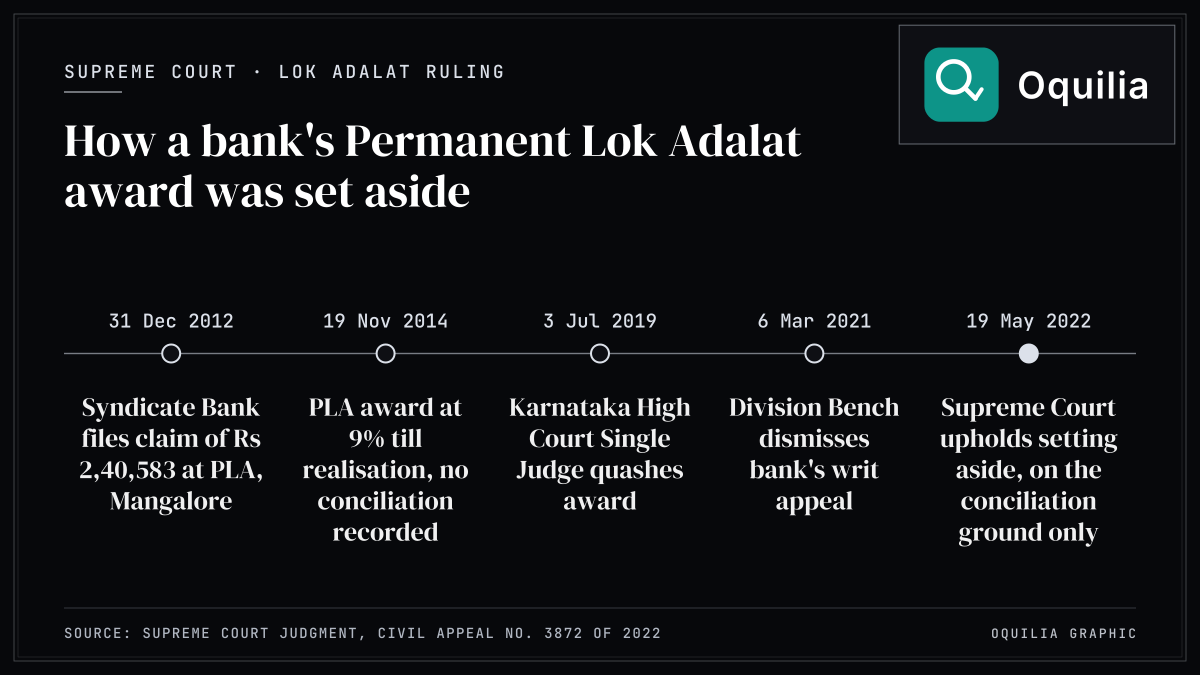
The timeline of the actual case shows how long such matters can run, and why a borrower who ignores the first notice can face execution years later.
| Date | Event |
|---|---|
| 1 October 2012 | Bank says Rs 2,40,583 with interest fell due |
| 31 December 2012 | Section 22-C(1) application filed at PLA, Mangalore |
| 10 January 2013 | Notice issued to borrower |
| 17 November 2014 | Bank's final affidavit; matter reserved |
| 19 November 2014 | PLA award: Rs 2,40,583 at 9% till realisation, no conciliation recorded |
| 3 July 2019 | Karnataka High Court Single Judge quashes award |
| 22 July 2019 | Execution petition dismissed |
| 6 March 2021 | Division Bench dismisses bank's writ appeal |
| 19 May 2022 | Supreme Court upholds setting aside, on the conciliation ground only |
Borrower Defences Available
The Supreme Court did not decide who owed what. Paragraph 34 states that it made no observations on the merits and kept "all rights and contentions of the parties" open. The defences below are therefore procedural and jurisdictional, drawn from the statute and the reasoning in the judgment.
1. No conciliation, no valid award. This is the core holding. Paragraph 33 records that the award of 19 November 2014 did "not indicate any attempt made by it to propose terms of settlement to the parties and their rejection". A borrower facing an award should obtain the full order sheet and check whether the PLA (a) held conciliation under Section 22-C(4), (b) framed written settlement terms under Section 22-C(7), and (c) communicated those terms to the borrower. If any of the 3 is missing, Jayarama supports a challenge.
2. Absence is not consent. The bank argued in paragraph 8 that a borrower who appears through an advocate and then stops participating cannot complain. Paragraph 26 rejected this: "Even if the opposite party does not appear, the Permanent Lok Adalat is still bound to follow the step-by-step procedure." Bypassing conciliation, said paragraph 27, would amount to deciding disputes "ex parte" with awards that are final and deemed decrees, which Parliament did not intend.
3. Pecuniary limit. Under the second proviso to Section 22-C(1), as raised on 20 March 2015, the value of the property in dispute must not exceed Rs 1 crore. A claim above that figure is outside the PLA's jurisdiction. Before 20 March 2015, the limit was Rs 10 lakh, which matters for older applications.
4. Offences are excluded. The first proviso to Section 22-C(1) bars jurisdiction over any matter relating to an offence not compoundable under any law, and Section 22-C(8) allows a decision only "if the dispute does not relate to any offence". If a bank's claim is entangled with a criminal complaint, this is worth raising.
5. Pre-litigation only. Section 22-C(1) allows an application only "before the dispute is brought before any court". If the bank has already filed a recovery suit on the same debt, the PLA route should not be open to it.
6. Natural justice under Section 22-D. The PLA is free of the CPC and the Evidence Act, but it must follow natural justice, objectivity, fair play and equity. Interest is a live point here: the bank claimed 15.75% and the PLA awarded 9%. A borrower can file a written statement under Section 22-C(3) contesting the rate, penal charges and the account statement. A personal loan EMI calculator helps you rebuild the schedule at the contracted rate and test the bank's arithmetic.
7. Guarantor's position. The Jayarama application named both the borrower and his guarantor. Because Section 22-E(1) binds "all the parties thereto", a guarantor served with notice should participate and press the same conciliation requirement, rather than assume the borrower will do so.
8. Use conciliation to settle. The flip side of the mandatory rule is opportunity. Section 22-C(7) obliges the PLA to put settlement terms on the table. A borrower who turns up with a realistic proposal, for example a lump sum or a short instalment plan, can have it recorded as a binding award. Use the loan foreclosure calculator to work out a closure figure, or the debt consolidation calculator if several debts are in play.
There is no appeal from a PLA award. Section 22-E(4) bars any challenge "in any original suit, application or execution proceeding". The route used in Jayarama was a writ petition under Article 226 of the Constitution, filed in the High Court of Karnataka on 1 July 2019. There is no fixed limitation period for writs, but delay can count against a petitioner, so a borrower should act promptly once an award comes to light.
Recent Tribunal/HC Position
The authoritative position is the Supreme Court's own judgment of 19 May 2022, authored by Dr Justice D.Y. Chandrachud on a bench listed with Justice Surya Kant and Justice P.S. Narasimha. It resolved 2 questions that the Karnataka High Court had answered in different ways.
Question 1: Is conciliation mandatory? Yes. At paragraph 27, the Court held that Section 22-C(8) "only comes into effect once an agreement under Section 22-C(7) has failed", so "the proposed terms of settlement under Section 22-C(7), and the conciliation proceedings preceding it, are mandatory". A decision on merits is "always... the last resort".
Question 2: Can a PLA adjudicate at all? Yes. The Single Judge on 3 July 2019 had said the PLA "has no adjudicatory function", and the Division Bench on 6 March 2021 said it "could not have acted as a regular civil Court". At paragraph 32, the Supreme Court held that understanding "clearly incorrect". Relying on Ajay Sinha (2008), Inter Globe Aviation v. N. Satchidanand (2011) 7 SCC 463 and Bar Council of India (2012), it confirmed that a PLA's role "mutates" from conciliator to adjudicator once settlement fails.
Outcome. The Court upheld the Division Bench's final result "on this point only", that is, the failure to conciliate, and set aside the PLA award of 19 November 2014. It made no order as to costs and kept the merits open. In practice, that leaves the bank free to pursue its claim again through a lawful route.
For borrowers, the 2022 ruling has 2 consequences. A PLA award reached after proper conciliation is hard to dislodge, because it is final under Section 22-E and has no appeal. An award reached by skipping conciliation is vulnerable, even where the borrower, as in Jayarama, entered appearance through counsel in 2013 and 2014 but then stopped participating.
FAQ
Can a bank take a loan default to a Permanent Lok Adalat?
Yes, if the service is within the PLA's notified jurisdiction and the claim is within Rs 1 crore. In Canara Bank v. G.S. Jayarama, Syndicate Bank filed under Section 22-C(1) of the LSA Act, 1987 on 31 December 2012, and the Supreme Court treated the forum as competent while setting aside the award on procedure.
Is a Permanent Lok Adalat award binding like a court decree?
Yes. Section 22-E(2) deems every PLA award a decree of a civil court, and Section 22-E(5) allows it to be sent to a local civil court for execution. In Jayarama, the bank filed execution petition No. 9 of 2019 at Sullia on the basis of the 2014 award.
What if I did not attend the Permanent Lok Adalat hearings?
Your absence does not let the PLA skip conciliation. Paragraph 26 of the 19 May 2022 judgment requires the PLA to communicate settlement terms to both parties regardless of participation, wait a sufficient period, and notify the absent party before deciding on merits.
Can I appeal a Permanent Lok Adalat award?
No statutory appeal exists. Section 22-E(4) says the award cannot be questioned in any original suit, application or execution proceeding. The borrower in Jayarama challenged it through a writ petition under Article 226 before the Karnataka High Court on 1 July 2019.
What is the money limit for a Permanent Lok Adalat?
The value of the property in dispute must not exceed Rs 1 crore. The original limit of Rs 10 lakh in the second proviso to Section 22-C(1) was raised by notification S.O. 803(E) dated 20 March 2015.
Does the Jayarama judgment cancel the loan?
No. Paragraph 34 says the Supreme Court made no observations on the merits and kept all rights and contentions open. Only the award of 19 November 2014 went; the underlying claim of Rs 2,40,583 was not decided.
Can I file a civil suit after the bank applies to a Permanent Lok Adalat?
Section 22-C(2) bars any party to the application from invoking a court's jurisdiction in the same dispute once the application is made. Your remedy lies inside the PLA process, and then, if the procedure is breached, in a writ petition.
Sources & Citations
- Canara Bank vs G.S. Jayarama, Civil Appeal No. 3872 of 2022 (19 May 2022) — Supreme Court of India via Indian Kanoon
- Section 22-C, Legal Services Authorities Act, 1987 — Indian Kanoon