

Gave up Indian citizenship without an OCI card? How your NPS account is closed and the full corpus paid to an NRO account
PFRDA's 21 April 2025 circular closes the NPS account of a subscriber who renounces Indian citizenship without an OCI card and pays the entire corpus to an NRO account. Documents, tax and a worked drawdown.
Key points
- PFRDA's circular of 21 April 2025 says a subscriber who renounces Indian citizenship and holds no OCI card must inform NPS Trust and have the account closed.
- The entire accumulated corpus is paid only to the subscriber's NRO account, against an undertaking and a renunciation certificate, surrender certificate or cancelled passport.
- Section 10(12A) exempts a closure payment only up to 60% of the amount payable, so former subscribers should confirm the tax on the rest before filing.
A subscriber to the National Pension System (NPS) who gives up Indian citizenship and does not hold an Overseas Citizen of India (OCI) card can no longer keep the account running. PFRDA Circular PFRDA/2025/02/REG-EXIT/01, dated 21 April 2025 and issued to all NPS stakeholders under Section 14 of the PFRDA Act 2013, sets out what happens next: the PRAN is closed and the entire accumulated pension wealth is paid out, but only into the subscriber's NRO account.
This guide walks through the rule, the two documents NPS Trust asks for, how the payout compares with a normal exit at 60 under the amended exit regulations of 19 December 2025, what is known (and not known) about tax on the payment, and a worked example of drawing the money down over several years. If you are new to the product, our NPS glossary entry covers the basics, and the NPS calculator shows how a corpus builds up.
The Scheme Explained
Who the 21 April 2025 circular covers
The circular deals with one narrow group: a subscriber who has legally renounced Indian citizenship and does not hold an OCI card. NPS is designed for Indian citizens, and it is also open to Non-Resident Indians and OCI holders who meet PFRDA's conditions. A person who is neither a citizen nor an OCI cardholder falls outside every category the scheme admits, so the circular of 21 April 2025 tells NPS Trust to close the account rather than leave it in limbo.
Three groups are worth separating, because the 2025 circular applies only to the third:
| Subscriber status | Can the NPS account continue? | Where the money goes on exit |
|---|---|---|
| Indian citizen living abroad (NRI) | Yes, subject to PFRDA conditions | Normal exit rules at 60 or on premature exit |
| Former citizen holding an OCI card | Yes, subject to PFRDA conditions | Normal exit rules at 60 or on premature exit |
| Former citizen with no OCI card | No, account is closed | Entire corpus to the subscriber's NRO account (Circular of 21 April 2025) |
The duty to inform NPS Trust
Under the 21 April 2025 circular, a subscriber in row three must "promptly" inform NPS Trust that citizenship has been renounced. No number of days is fixed, but "promptly" means not waiting until you turn 60 or need the money.
The two documents NPS Trust asks for
The closure application goes to NPS Trust and must carry two things, both listed in the 21 April 2025 circular:
- An undertaking stating that you have renounced Indian citizenship and that you do not hold an OCI card.
- Proof of renunciation, which can be any one of three documents issued by the competent authority: a valid renunciation certificate, a surrender certificate, or a cancelled Indian passport.
| Document | Required? | Accepted forms (any one for item 2) |
|---|---|---|
| Undertaking on citizenship and OCI status | Yes, always | Signed by the subscriber |
| Proof of renunciation | Yes, always | Renunciation certificate; surrender certificate; cancelled Indian passport |
| NRO account details | Needed for payment | Account must be an NRO account, per the circular |
NPS Trust acts on these requests in coordination with the Central Recordkeeping Agencies (CRAs), according to the 21 April 2025 circular.
Why the money must land in an NRO account
The circular says the accumulated pension wealth is transferred only to the subscriber's NRO account, "in line with RBI FEMA guidelines". An NRO account is the rupee account a non-resident holds in India for income earned in India, and moving money out of it is governed by the Foreign Exchange Management Act 1999 (see our FEMA explainer). The circular names no other destination, so without an NRO account there is nowhere for NPS Trust to send the corpus.
How this differs from a normal exit
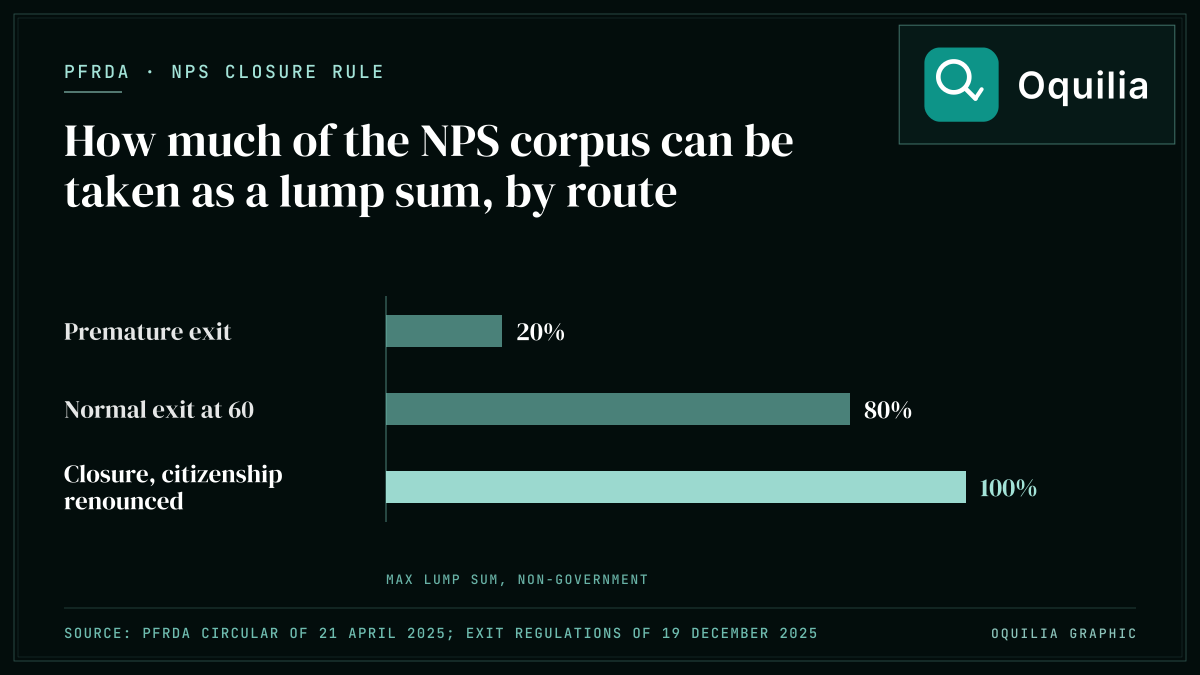
The key difference is that closure on renunciation pays out the whole corpus. A normal exit at 60 for a non-government subscriber is governed by the PFRDA (Exits and Withdrawals under the NPS) (Amendment) Regulations, 2025, notified on 19 December 2025, which require at least 20% of the corpus to buy an annuity once the corpus is above Rs 12 lakh.
| Feature | Normal exit at 60 (non-government) | Premature exit (non-government) | Closure on renouncing citizenship, no OCI |
|---|---|---|---|
| Maximum lump sum | 80% | 20% | Entire corpus |
| Minimum annuity | 20% | 80% | None stated in the circular |
| Full lump sum allowed if corpus is | Rs 8 lakh or less | Rs 5 lakh or less | Any size |
| Band between Rs 8 lakh and Rs 12 lakh | Rs 6 lakh lump sum plus SUR | Not applicable | Not applicable |
| Where paid | Subscriber's bank account | Subscriber's bank account | NRO account only |
| Rule source | Amendment Regulations, 19 Dec 2025 | Amendment Regulations, 19 Dec 2025 | Circular of 21 April 2025 |
For government-sector subscribers, the normal exit split stays at 60% lump sum and 40% annuity under the same December 2025 amendment, and NPS-Lite also stays at 60/40 with a Rs 2 lakh full-withdrawal threshold. The renunciation closure in the April 2025 circular is addressed to all NPS stakeholders and does not carve out a sector, so the full-corpus payout is the rule regardless of which of these three tables the subscriber would otherwise sit in.
Tax on Withdrawal
What Section 10(12A) says
Section 10(12A) of the Income-tax Act exempts a payment from the NPS Trust "on closure of his account" or on opting out, but only "to the extent it does not exceed sixty per cent of the total amount payable". That 60% ceiling has applied since 1 April 2020, and the wording expressly covers closure, so the first 60% of the payout is within the text of the exemption. The full statute is available on incometax.gov.in.
The 40% that the exemption does not reach
The exemption covers 60%, but a renunciation closure pays out 100%. Oquilia has not found any Finance Act provision, CBDT circular or notification that addresses the remaining 40% for this specific situation, and we will not guess. The same gap exists on a normal non-government exit, where PFRDA allows an 80% lump sum from 19 December 2025 while Section 10(12A) still caps the exemption at 60%. Our view is limited to this: the two limits are different, and the treatment of the excess must be confirmed with a chartered accountant before you file.
Residential status and the treaty question
Once citizenship is given up and you live abroad, your residential status for Indian tax is decided by days of stay under Section 6 of the Income-tax Act, not by passport. Your new country of residence may also want to tax the payout. A Double Taxation Avoidance Agreement between India and that country decides which side has the first right to tax and how credit is given; no treaty makes Indian-source income automatically "exempt", and India generally retains its taxing rights on income that arises here. Check the specific treaty text on incometax.gov.in before assuming anything.
TDS on the payment
Payments to non-residents are often subject to TDS in India, which you may later claim as credit in an Indian return or under the relevant treaty. The 21 April 2025 circular does not state a TDS rate for this payout, and rates for non-residents depend on the nature of the income, so we do not quote one here. Ask the CRA or NPS Trust what deduction will be applied, and keep the Form 16A or equivalent certificate for your Indian return and for any foreign tax credit claim.
| Tax point | What is settled | What is not settled |
|---|---|---|
| First 60% of the payout | Within Section 10(12A) wording, which covers "closure" | Nothing further found |
| Remaining 40% | Not covered by the 60% ceiling in 10(12A) | Taxable or exempt: no Finance Act alignment found |
| Partial withdrawals taken earlier | Exempt under Section 10(12B) up to 25% of own contributions | Nothing further found |
| Foreign country tax | Decided by local law and the DTAA | Varies by country; check the treaty |
Worked Drawdown
The example below uses round, illustrative numbers. The corpus, the interest rate on the NRO deposit and the annual withdrawal are assumptions chosen to make the arithmetic easy to follow, not forecasts and not quoted market rates.
The setting
Assume a subscriber aged 52 who joined NPS in the All Citizen Model, moved abroad, and renounced Indian citizenship in 2026 without taking an OCI card. Their PRAN holds Rs 30 lakh. Under the 21 April 2025 circular they apply to NPS Trust with the undertaking and a surrender certificate, and the full Rs 30 lakh is credited to their NRO account.
Comparing the closure with a hypothetical normal exit
To see what the closure changes, compare it with what the same Rs 30 lakh would have produced at a normal non-government exit under the December 2025 rules, if the subscriber had stayed a citizen and the corpus had been the same.
| Item | Normal exit at 60 (non-government) | Closure on renunciation |
|---|---|---|
| Corpus | Rs 30,00,000 | Rs 30,00,000 |
| Lump sum available | Up to 80% = Rs 24,00,000 | 100% = Rs 30,00,000 |
| Compulsory annuity | At least 20% = Rs 6,00,000 | Nil |
| Within the 60% Section 10(12A) cap | Rs 18,00,000 | Rs 18,00,000 |
| Amount above the 60% cap | Rs 6,00,000 of the lump sum | Rs 12,00,000 |
The last row is the one that matters. In the closure, Rs 12 lakh sits outside the 60% ceiling in Section 10(12A), double the Rs 6 lakh in the normal-exit case, simply because nothing is diverted into an annuity. That is why the tax confirmation in the previous section is not optional.
Drawing the money down from the NRO account
Suppose the subscriber leaves the Rs 30 lakh in the NRO account in a deposit earning an assumed 6% a year, and withdraws Rs 3 lakh at the end of each year for living costs, ignoring tax for clarity. Interest is credited on the opening balance.
| Year | Opening balance (Rs) | Interest at assumed 6% (Rs) | Withdrawal (Rs) | Closing balance (Rs) |
|---|---|---|---|---|
| 1 | 30,00,000 | 1,80,000 | 3,00,000 | 28,80,000 |
| 2 | 28,80,000 | 1,72,800 | 3,00,000 | 27,52,800 |
| 3 | 27,52,800 | 1,65,168 | 3,00,000 | 26,17,968 |
| 4 | 26,17,968 | 1,57,078 | 3,00,000 | 24,75,046 |
| 5 | 24,75,046 | 1,48,503 | 3,00,000 | 23,23,549 |
After 5 years the balance is about Rs 23.24 lakh, and Rs 15 lakh has been withdrawn in total. At this pace, with the same assumed 6% and Rs 3 lakh a year, the money lasts roughly 15 years before it runs out. You can test other rates and withdrawal amounts in the retirement drawdown calculator, and compare a self-managed drawdown with buying an annuity in the annuity vs SWP calculator.
What the arithmetic hides
Interest earned in an NRO account is Indian-source income, so the Rs 1,80,000 in year 1 is itself taxable, subject to the treaty. Moving money out of the NRO account is governed by RBI's FEMA directions, which the circular itself points to; the limits are set by RBI at rbi.org.in, not by PFRDA.
When an OCI card changes the plan
If the same subscriber had obtained an OCI card, the 21 April 2025 circular would not apply and the PRAN could stay open. At 60, with Rs 30 lakh, they could take up to 80% (Rs 24 lakh) and would need to put at least 20% (Rs 6 lakh) into an annuity. That choice between a lifetime annuity and a full payout exists only with an OCI card.
A checklist before you apply
- Confirm you hold no OCI card, since the 21 April 2025 closure route applies only to non-OCI holders.
- Obtain one of the three listed proofs of renunciation.
- Open an NRO account in your own name.
- Ask the CRA what TDS will be deducted.
- Have a chartered accountant confirm the treatment of the 40% above the Section 10(12A) cap.
Readers who want to see how retirement rules have moved recently can read our pieces on what happens if a subscriber dies after the lump sum but before the annuity is issued and the April 2026 pension fund fee slabs. The original circular is on the PFRDA website.
FAQ
Do I have to close my NPS account if I give up Indian citizenship?
Only if you also do not hold an OCI card. PFRDA Circular PFRDA/2025/02/REG-EXIT/01 of 21 April 2025 requires closure for a subscriber who has renounced citizenship and is not an OCI cardholder. NPS is open to OCI holders who meet PFRDA conditions, so an OCI card lets the account continue.
How much of my NPS corpus will I get?
The entire accumulated pension wealth, under the 21 April 2025 circular. That differs from a normal non-government exit at 60, where from 19 December 2025 the lump sum is capped at 80% and at least 20% must buy an annuity once the corpus is above Rs 12 lakh.
Can the money be sent straight to my foreign bank account?
No. The circular says the corpus is transferred only to the subscriber's NRO account, in line with RBI's FEMA guidelines. Moving funds abroad from the NRO account afterwards is a separate step under FEMA rules set by RBI.
What documents does NPS Trust need?
Two items, per the 21 April 2025 circular: an undertaking that you have renounced citizenship and do not hold an OCI card, and one of three proofs issued by the competent authority, namely a renunciation certificate, a surrender certificate or a cancelled Indian passport.
Is the closure payment tax-free?
Partly settled. Section 10(12A) exempts a payment on closure up to 60% of the total amount payable, a cap in place since 1 April 2020. The circular pays out 100%, and Oquilia has found no provision dealing with the remaining 40%, so confirm it with a chartered accountant.
Is there a deadline for telling NPS Trust?
The circular says a subscriber must inform NPS Trust "promptly" but does not specify a number of days. Act soon after renunciation, and stop contributions to the PRAN in the meantime.