

Missed the 45-day SARFAESI Section 17 deadline? MP High Court (2025) holds the DRT can condone delay under the Limitation Act
MP High Court held on 3 November 2025 that the DRT can condone delay beyond the 45-day Section 17 SARFAESI limit under the Limitation Act. What borrowers must file, and the limits.
Key points
- A Division Bench of the Madhya Pradesh High Court held on 3 November 2025 that the DRT can condone delay in Section 17 SARFAESI applications.
- Section 17(1) allows 45 days from a Section 13(4) measure, and the court held Sections 4 to 24 of the Limitation Act apply to it through Section 29(2).
- Two DRT orders were set aside and remanded, but High Courts are divided, so borrowers should still file within 45 days and treat condonation as a fallback.
A borrower who receives a possession notice under Section 13(4) of the SARFAESI Act, 2002 has one statutory door to the Debt Recovery Tribunal: a securitisation application under Section 17(1), to be filed within 45 days of the measure. Many borrowers miss that window, often while they are still negotiating a one-time settlement with the bank. On 3 November 2025, a Division Bench of the Madhya Pradesh High Court at Indore held that the 45-day limit is not the end of the road: the DRT can condone delay under Section 5 of the Limitation Act, 1963, if the borrower shows sufficient cause.
The judgement, M/s Shiv Industries v. Punjab National Bank (M.P. No. 4104 of 2023, neutral citation 2025:MPHC-IND:31730), was decided together with Ramesh Pal v. IDFC First Bank (M.P. No. 6432 of 2023) and a review petition filed by Union Bank of India (R.P. No. 453 of 2024). The full text is on Indian Kanoon. This playbook sets out the statutory position, the procedure, the defences it opens up, and the limits of the ruling, because at least some other High Courts have taken the opposite view.
This article is general information from the Oquilia Research Desk, not legal advice. The Research Desk does not practise before any court or tribunal.
The Statutory Position
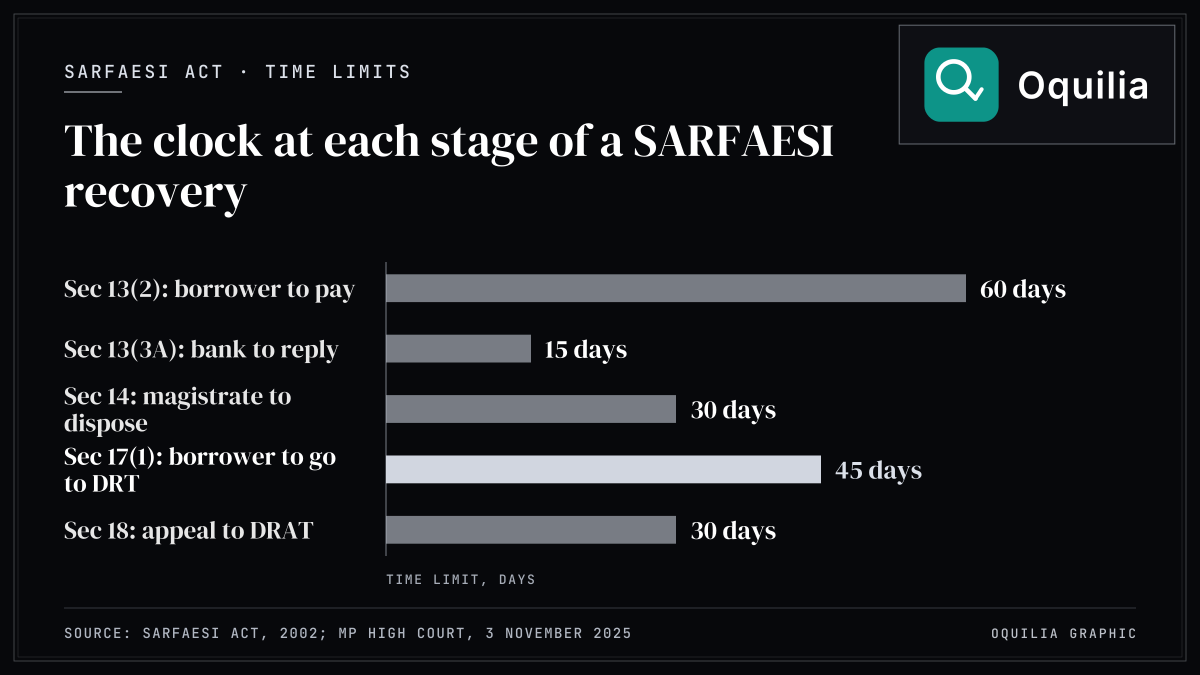
The SARFAESI Act, 2002 lets a secured creditor enforce its security without going to a civil court. The chain of sections that matters for a borrower is short, and each step carries its own clock. The text of the Act is available on India Code, the Government of India's official repository of central statutes.
| Section | What it does | Time limit |
|---|---|---|
| 13(2) | Demand notice once the account is classified as an NPA | 60 days to pay |
| 13(3A) | Borrower's representation or objection to the 13(2) notice | Bank must reply with reasons within 15 days |
| 13(4) | Bank takes possession (symbolic or physical), sells, leases or appoints a manager | No court intervention needed |
| 14 | Bank applies to the CMM or District Magistrate for physical possession | 30-day disposal mandate (post-2016 amendment) |
| 17(1) | Borrower's securitisation application to the DRT against any 13(4) measure | 45 days from the measure |
| 18 | Appeal from the DRT order to the DRAT | 30 days; 50% pre-deposit, reducible to not less than 25% |
Section 17(1) is the provision at the centre of the 2025 ruling. It allows "any person (including borrower)" aggrieved by a Section 13(4) measure to approach the DRT within 45 days. Oquilia's statute brief for Section 17 records that no deposit is mandatory at this stage, though the tribunal may direct one. That makes Section 17 the cheapest and earliest point at which a borrower can test the legality of a possession or an auction.
The question before the High Court was whether that 45-day period is rigid. Two other statutes bear on it. Section 29(2) of the Limitation Act, 1963 says that where a special or local law prescribes its own limitation period, Sections 4 to 24 of the Limitation Act apply to it unless the special law expressly excludes them. Section 5 of the Limitation Act, one of those 21 sections, allows an application to be admitted after the prescribed period if the applicant shows sufficient cause for the delay.
Against that, the banks pointed to Section 36 of the SARFAESI Act, which applies the Limitation Act to claims by secured creditors, and argued that its silence about borrowers was deliberate. They also argued that Section 24 of the Recovery of Debts and Bankruptcy Act, 1993 applies the Limitation Act only to original applications under Section 19 of that Act, and that the DRT is a tribunal, not a "court", so the Limitation Act cannot reach it.
Procedure Step by Step
The ruling changes what a borrower can do after day 45, but it does not change the order of events. A typical SARFAESI timeline runs as follows.
- NPA classification. The bank classifies the loan account as a non-performing asset. Every later step under the Act depends on this date, so the borrower should ask for it in writing.
- Section 13(2) demand notice. The bank serves a notice demanding the full outstanding within 60 days. Keep the envelope and the date of receipt; both matter if service is later disputed.
- Section 13(3A) representation. Within the 60 days, the borrower may object in writing. The bank must reply with reasons within 15 days if it rejects the objection. A missing or unreasoned reply is itself a ground to raise later.
- Section 13(4) measure. After 60 days, the bank may take symbolic or physical possession, publish a possession notice, and later issue a sale notice. Each such measure starts a fresh 45-day clock, as the High Court noted at paragraph A-46 of its judgement.
- Section 14 application (if physical possession is needed). The bank asks the Chief Metropolitan Magistrate or District Magistrate for help taking physical possession, with a 30-day disposal mandate after the 2016 amendment.
- Section 17 securitisation application. The borrower files before the DRT having jurisdiction within 45 days of the measure being challenged. If day 45 has passed, the borrower files the application together with a separate application under Section 5 of the Limitation Act explaining each day of delay.
- DRT hearing on delay first. Following the November 2025 ruling, the DRT in Madhya Pradesh must decide the Section 5 application on its merits before it can reject the securitisation application as time-barred.
- DRAT appeal under Section 18. Either side may appeal the DRT's order to the Debt Recovery Appellate Tribunal within 30 days. The borrower's appeal is heard only after a deposit of 50% of the debt, which the DRAT may reduce to not less than 25% for recorded reasons.
The Oquilia loan settlement cost calculator is useful at step 3 and again at step 6, because a borrower who is negotiating a one-time settlement needs to know what a realistic offer looks like while the limitation clock is running.
Borrower Defences Available
The defences open to a borrower under Section 17 fall into three groups: procedural defects in the bank's notices, substantive challenges to the debt or the measure, and, after this judgement, a route to be heard even when the 45 days have passed.
| Ground | Statutory hook | Deposit at this stage | Deadline |
|---|---|---|---|
| Defective or unserved 13(2) notice | Section 13(2) | None mandatory; DRT may direct | 45 days from the 13(4) measure |
| No reasoned reply to the objection | Section 13(3A) | None mandatory; DRT may direct | 45 days from the 13(4) measure |
| Asset outside SARFAESI (agricultural land, debt of Rs 1 lakh or less, dues under 20% of principal and interest) | Section 31 | None mandatory; DRT may direct | 45 days from the 13(4) measure |
| Defective sale or auction notice | Each separate 13(4) measure | None mandatory; DRT may direct | 45 days from that measure |
| Delay beyond 45 days with sufficient cause | Section 5, Limitation Act (per MP High Court, 3 November 2025) | None mandatory; DRT may direct | No fixed outer limit, but every day must be explained |
| Appeal against the DRT order | Section 18 | 50% of debt, reducible to 25% | 30 days |
Separate cause of action for each measure. The Bench held at A-46 that every Section 13(4) measure gives a fresh cause of action. A borrower who let 45 days pass after the possession notice may still be within time to challenge a sale notice or an auction that follows. This is often the strongest point for a borrower who discovers the problem late, and it does not depend on condonation at all.
Sufficient cause for delay. The court recorded at A-29 to A-31 the practical reasons a borrower in Madhya Pradesh may miss 45 days: a single DRT seat for the whole state at Jabalpur, so a borrower in a distant district loses time just reaching the forum; and time spent in good-faith one-time settlement talks with the bank. A Section 5 application should therefore list dated correspondence on OTS proposals, travel or medical records, and the date the borrower first learnt of the measure. Courts generally require that every day of delay be explained, and a vague plea is unlikely to succeed.
Use the settlement record. If the delay arose because the bank was discussing an OTS, the borrower's best evidence is the bank's own letters and emails. Keep a dated log from the 13(2) notice onwards. The loan foreclosure calculator helps compare a full closure figure with what the bank is offering in a compromise.
What the ruling does not do. Condonation is discretionary. The DRT may still refuse a Section 5 application if the cause shown is not sufficient, and the borrower still has to win the securitisation application on its merits. Nor does the ruling touch the Section 18 pre-deposit of 50% (reducible to 25%) at the appellate stage.
Recent Tribunal/HC Position
The Division Bench of Justice Vivek Rusia and Justice Binod Kumar Dwivedi reserved judgement on 25 September 2025 and delivered it on 3 November 2025. The three matters had a common pattern: banks took possession under Section 13(4) and moved towards auction; the borrowers filed Section 17 applications after 45 days with condonation pleas; and DRT Jabalpur dismissed them, holding that Section 5 of the Limitation Act did not apply.
| Matter | Parties | Outcome on 3 November 2025 |
|---|---|---|
| M.P. No. 4104 of 2023 | M/s Shiv Industries v. Punjab National Bank | Allowed; DRT order set aside; S.A. remanded |
| M.P. No. 6432 of 2023 | Ramesh Pal v. IDFC First Bank | Allowed; DRT order set aside; S.A. remanded |
| R.P. No. 453 of 2024 | Union Bank of India v. Smt. Kiran Turakhiya | Bank's review petition dismissed |
The court's reasoning ran in four steps, each tied to paragraph numbers in the judgement.
No express exclusion. At A-23, A-24 and A-45, the Bench held that Section 17(1) contains no express or implied exclusion of the Limitation Act. Under Section 29(2) of the Limitation Act, Sections 4 to 24 therefore apply to the 45-day period, as they do to any special law that is silent.
Sections 35 and 37 do not exclude it. At A-25 to A-27, the court held that neither the overriding-effect clause in Section 35 of SARFAESI nor Section 37, which says the Act is in addition to other laws, shuts out the Limitation Act. On this point it followed the Supreme Court's ruling in Vishal N. Kalsaria.
An original proceeding. At C-1 and C-2, the court held that the DRT under Section 17(1) is the borrower's only forum against a 13(4) measure, and that the proceeding before it is original, not appellate. Since Sections 4 to 24 of the Limitation Act apply, the DRT can condone delay.
Remand, not relief on merits. At C-3, the court set aside the DRT orders in the two petitions and sent the securitisation applications back to the DRT to decide the Section 5 applications afresh. It dismissed the bank's review petition. None of the borrowers has yet won on the merits of the possession or auction.
The split. High Courts are divided on this question, and some have held that the 45-day limit under Section 17 is mandatory and cannot be extended. A ruling of the Madhya Pradesh High Court binds the DRT within that state; a DRT elsewhere may follow a contrary ruling of its own High Court. Until the Supreme Court settles the point, a borrower outside Madhya Pradesh cannot assume condonation will be available, and even inside the state the safest course is to file within 45 days and treat condonation as a fallback.
For background on how the tribunals fit together, see the Oquilia glossary entries on the SARFAESI Act and the Debt Recovery Tribunal. For context on the bank side of the process, the Reserve Bank of India publishes its directions on NPA classification and compromise settlements.
A Working Timeline for Borrowers
The ruling is most useful when it is read alongside the calendar. Take a hypothetical possession notice published on 1 March. The 45-day window under Section 17(1) closes on 15 April. If the bank then issues a sale notice on 10 June, that sale notice is a separate measure under A-46, with its own window closing on 25 July. A borrower who missed 15 April but files by 25 July is challenging the sale notice in time, and needs condonation only for any challenge to the earlier possession.
Where both windows have passed, the borrower files late with a Section 5 application. Under the November 2025 ruling, a DRT in Madhya Pradesh must hear that application. The borrower should be ready to show, with documents, how each of the days after day 45 was spent, for example through OTS letters dated within that period.
The cost side matters too. A home loan EMI calculator shows how much of the outstanding is interest, which helps a borrower judge whether the bank's claim in the 13(2) notice is arithmetically right, one of the commonest grounds raised in a Section 17 application. A borrower with a secured loan should also check whether the asset falls within one of the Section 31 exemptions, such as agricultural land or a debt of Rs 1 lakh or less.
FAQ
What is the deadline to file a Section 17 application against a SARFAESI measure?
Section 17(1) of the SARFAESI Act, 2002 allows 45 days from the date of the Section 13(4) measure being challenged. Each measure, such as a possession notice or a sale notice, starts its own 45-day period, as the Madhya Pradesh High Court noted at paragraph A-46 of its 3 November 2025 judgement.
Can the DRT condone delay beyond 45 days?
According to the Madhya Pradesh High Court (Indore Bench) in M/s Shiv Industries v. Punjab National Bank, decided on 3 November 2025, yes. It held that Sections 4 to 24 of the Limitation Act, 1963 apply to Section 17 through Section 29(2), so the DRT can condone delay under Section 5 if sufficient cause is shown. Other High Courts have held the 45 days to be mandatory, so the position varies by state.
Does this ruling apply outside Madhya Pradesh?
It binds DRTs within Madhya Pradesh. Elsewhere, a DRT will follow its own High Court's ruling if there is one. A borrower in another state can cite the 2025 judgement as persuasive, but should file within 45 days wherever possible.
What counts as sufficient cause for delay?
The High Court noted at A-29 to A-31 hardships such as a single DRT seat in Madhya Pradesh and time lost in one-time settlement negotiations. The DRT decides each case on its own facts, and dated evidence for the period after day 45 is essential.
Do I need to deposit money to file a Section 17 application?
No deposit is mandatory under Section 17, but the DRT may direct one. A deposit becomes mandatory only on appeal to the DRAT under Section 18: 50% of the debt, which the DRAT may reduce to not less than 25% for recorded reasons.
Did the borrowers in this case get their property back?
No. On 3 November 2025, the High Court set aside the DRT's orders in two petitions and remanded the securitisation applications for the DRT to decide the Section 5 condonation applications afresh. The merits of the possession and auction are still to be decided.
Does negotiating a one-time settlement stop the 45-day clock?
No. Talks with the bank do not pause the limitation period under Section 17(1). The 2025 ruling accepts that OTS negotiations can be part of sufficient cause for delay, but the safer course is to file within 45 days and continue negotiating in parallel.