

The Key Facts Statement: Why a Lender Cannot Charge a Fee Missing From Your Loan KFS and How to Read the APR
RBI's April 15, 2024 KFS circular bars any loan fee missing from the Key Facts Statement without your explicit consent. How to read the APR and dispute undisclosed charges.
Key points
- The Reserve Bank of India's circular of April 15, 2024 requires every retail and MSME term loan borrower to get a Key Facts Statement before signing.
- Under paragraph 8, a fee not mentioned in the KFS cannot be charged at any stage of the loan without the borrower's explicit consent, for loans sanctioned from October 1, 2024.
- Borrowers facing an undisclosed charge can cite the circular to the lender, then its grievance officer, and then the RBI Integrated Ombudsman.
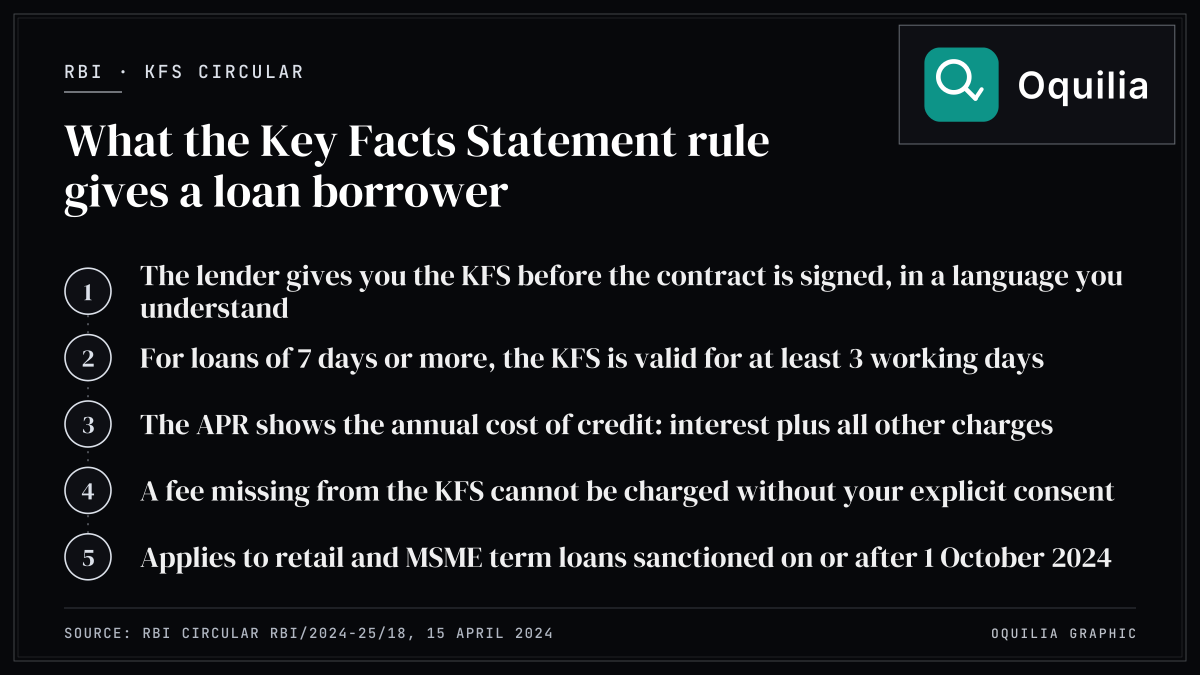
Since October 1, 2024, every new retail and MSME term loan in India has come with a document that most borrowers sign without reading: the Key Facts Statement, or KFS. It is a short, standardised sheet that sets out the loan in plain language, and it carries one rule that turns it from a disclosure form into a working shield for the borrower. Under paragraph 8 of the Reserve Bank of India's circular of April 15, 2024, a fee or charge that is not mentioned in the KFS cannot be levied at any stage during the term of the loan without the borrower's explicit consent.
This playbook explains where that rule comes from, how the KFS is meant to reach you before you sign, how to read the Annual Percentage Rate (APR) printed on it, and what to do when a lender later debits a charge that was never on the sheet. It is written for borrowers of home loans, personal loans, vehicle loans, loans against property and MSME term loans. It is not legal advice, and where the record is silent, this article says so rather than filling the gap.
The Statutory Position
The KFS regime rests on RBI circular RBI/2024-25/18, reference DOR.STR.REC.13/13.03.00/2024-25, dated April 15, 2024, titled "Key Facts Statement (KFS) for Loans & Advances". The full text is on the RBI notifications page. Before April 2024, KFS and APR requirements existed in separate instructions for different lender types and products; the 2024 circular harmonised them into one set of rules for all retail and MSME term loans.
The circular's reach is wide. It covers all regulated entities (REs) lending to retail and MSME borrowers:
| Lender type covered | Examples |
|---|---|
| Commercial banks | Including Small Finance Banks, Local Area Banks and Regional Rural Banks |
| Co-operative banks | Urban Co-operative Banks, State Co-operative Banks, Central Co-operative Banks |
| Non-Banking Financial Companies | All NBFCs, including Housing Finance Companies |
| Exempt product | Credit card receivables |
Three definitions in the circular do most of the work:
- Key Facts Statement — a statement of the key facts of a loan agreement, in simple and easier-to-understand language, provided to the borrower in a standardised format (Annex A of the circular).
- Annual Percentage Rate — the annual cost of credit to the borrower, which includes the interest rate and all other charges associated with the loan.
- Summary box — the KFS must also be included as a summary box in the loan agreement itself, so the same facts appear in the contract you sign.
The 2025 consolidation. In 2025, the RBI consolidated its retail lending conduct rules into the Responsible Business Conduct Directions, 2025. The KFS requirements now sit inside that consolidated framework. This article cites the April 15, 2024 circular as the origin of the rules, and the paragraph 8 reference used here is to that 2024 circular; when you write to your lender, quoting the circular number RBI/2024-25/18 identifies the rule without ambiguity.
The compliance date is fixed by the circular: all new retail and MSME term loans sanctioned on or after October 1, 2024, including fresh loans to existing customers, must comply. A loan sanctioned before that date is governed by whatever disclosure instructions applied at the time it was sanctioned, which is why the date on your sanction letter matters.
Procedure Step by Step
The circular lays down a sequence that the lender must follow before the loan contract is executed. Read as a borrower's checklist, the steps run as follows.
- Receive the KFS before signing. Under the circular, the lender must give the KFS to every prospective borrower before the loan contract is executed. A KFS handed over after you have signed the agreement, or bundled into a disbursement kit, does not meet that sequence.
- Check the language. The circular also requires the KFS to be in a language the borrower understands. If the sheet is in a language you cannot read, ask for a version you can, before you sign.
- Have the contents explained. The lender must explain the KFS contents to the borrower and obtain an acknowledgement that the borrower has understood them. Your signature on that acknowledgement is evidence that the KFS existed on that date, so keep a copy.
- Note the unique proposal number. Every KFS carries a unique proposal number under the April 2024 circular. Record it; it is the single most useful reference in any later dispute.
- Note the validity period. For loans with a tenor of 7 days or more, the KFS must be valid for at least 3 working days. For loans with a tenor under 7 days, the validity period is at least 1 working day. If you agree to the loan within that window, the lender is bound by the terms in the KFS.
- Read the APR computation sheet. The circular requires the KFS to include a computation sheet showing how the APR was arrived at.
- Read the amortisation schedule. The KFS must include the repayment schedule over the loan tenor, showing how each EMI is split between principal and interest. Our glossary entry on amortisation explains how that split shifts over time.
- Match the summary box. When you receive the loan agreement, check that its summary box repeats the same figures as the KFS you were given.
- Collect receipts for third-party charges. Under the circular, charges recovered on an actual basis on behalf of third parties, such as insurance premiums or legal charges, form part of the APR, must be disclosed separately, and the lender must provide receipts for them.
The validity rules can be summarised in one table:
| Loan tenor | Minimum KFS validity | Effect if borrower agrees in time |
|---|---|---|
| 7 days or more | 3 working days | Lender bound by KFS terms |
| Less than 7 days | 1 working day | Lender bound by KFS terms |
The practical point of the 3-working-day window is time to compare. A borrower holding two KFS documents from two lenders, each with its own proposal number and APR, can compare like with like before committing. Our personal loan EMI calculator and home loan EMI calculator let you rerun the instalment at the interest rate quoted, so you can see the gap between the headline rate and the APR printed on the sheet.
How to read the APR against the headline rate
The headline interest rate tells you what the lender charges on the outstanding principal. The APR, as defined in the 2024 circular, is the annual cost of credit including interest and all other charges. The difference between the two numbers is the cost of everything else: the processing fee, documentation charges, and third-party charges such as insurance that the lender collects and passes on.
| Figure on the KFS | What it captures | What to check |
|---|---|---|
| Interest rate | Charge on outstanding principal only | Fixed or floating; reset terms |
| APR | Interest plus all other charges, annualised | Gap versus interest rate |
| Third-party charges | Insurance, legal charges at actual cost | Listed separately; receipt required |
| Amortisation schedule | EMI split across tenor | Number of instalments and amount |
A wide gap between the interest rate and the APR is not by itself a violation; it means the non-interest charges are large. The value of the APR is that it makes those charges visible in a single annualised figure before you sign, rather than leaving you to discover them on a statement months later. If you are weighing an app-based or small-ticket loan, the loan app true cost calculator applies the same logic of adding fees back into the cost of credit.
Borrower Defences Available
The KFS circular gives borrowers four concrete grounds to push back. None of them requires a court; each starts with a written complaint to the lender citing circular RBI/2024-25/18.
Ground 1: the undisclosed charge (paragraph 8). This is the strongest ground. Paragraph 8 states that any fee or charge not mentioned in the KFS cannot be charged at any stage during the term of the loan without the borrower's explicit consent. If a charge appears on your loan statement that is not on your KFS, and you never gave explicit consent to it, you can ask the lender to reverse it. The burden of showing that the charge was disclosed, or that you consented, sits naturally with the lender that issued the KFS and holds the acknowledgement.
Ground 2: no KFS before execution. If your loan was sanctioned on or after October 1, 2024 and you were never given a KFS before signing, or it was not explained to you, the lender has not followed the sequence the circular requires. Your complaint should state the sanction date, the date you signed and the date, if any, you first saw a KFS.
Ground 3: terms changed inside the validity window. If you accepted the loan within the validity period of 3 working days (or 1 working day for a tenor under 7 days) and the lender then sanctioned it on different terms, the circular binds the lender to the KFS terms you agreed to. The unique proposal number links your acceptance to the specific KFS.
Ground 4: third-party charges without receipts. Insurance and legal charges recovered on an actual basis must form part of the APR, be disclosed separately and be supported by receipts. A borrower who has paid such a charge but received no receipt can ask for one in writing.
The escalation ladder for all four grounds is the same:
| Stage | Forum | What to send |
|---|---|---|
| 1 | Lender's customer service or branch | Written complaint citing RBI/2024-25/18 and your KFS proposal number |
| 2 | Lender's grievance redressal officer | Same complaint, with the reply (or lack of one) from stage 1 |
| 3 | RBI Integrated Ombudsman | Online complaint on the RBI Complaint Management System, attaching the KFS, the statement and the lender's response |
Before you escalate, assemble the documents in one file: the KFS with its proposal number, your signed acknowledgement, the loan agreement with its summary box, the loan account statement showing the disputed debit and every written exchange with the lender. Paragraph 8 is a comparison rule, so the case is usually decided by putting the KFS next to the statement.
Two limits are worth stating plainly. First, credit card receivables are exempt from the circular, so a disputed card fee needs a different rule. Second, the circular applies to loans sanctioned on or after October 1, 2024; an older loan is judged by the disclosure instructions that applied when it was sanctioned. If you are deciding whether to exit an expensive older loan rather than dispute it, the foreclosure calculator and balance transfer calculator show what a prepayment or refinance would cost, and our glossary entry on the prepayment penalty explains when one can apply.
Recent Tribunal/HC Position
Oquilia's briefing record for this playbook, as of November 15, 2026, does not contain a High Court or tribunal judgement interpreting paragraph 8 of the April 15, 2024 KFS circular, and this article does not cite one. We would rather say that than attach a case name we have not verified against the official text on Indian Kanoon or a court website.
What the record does establish is the regulatory position, which is the position a lender's grievance officer and the RBI Integrated Ombudsman will start from:
- The KFS rule is a direction of the Reserve Bank of India issued on April 15, 2024 under circular RBI/2024-25/18, binding on all regulated entities named in its scope.
- Paragraph 8 contains no exception for small charges: any fee or charge not in the KFS needs the borrower's explicit consent before it can be levied, at any stage of the loan term.
- The rules took effect for all new retail and MSME term loans sanctioned on or after October 1, 2024, including fresh loans to existing customers.
- In 2025, the RBI moved these conduct rules into the Responsible Business Conduct Directions, 2025, which consolidated them without, on the record before us, withdrawing the paragraph 8 protection.
For disputes over undisclosed loan charges, the route set up by the RBI runs through the lender's own grievance machinery and then the RBI Integrated Ombudsman, not through a tribunal. The Debts Recovery Tribunal and SARFAESI forums that Oquilia's other playbooks cover deal with recovery of defaulted debt; a KFS dispute usually arises while the loan is still performing, which is why the regulator's complaint system is the natural forum. Where a loan has gone into default and the lender has moved to recovery, a disputed undisclosed charge can still be raised as a challenge to the amount claimed, and the KFS is the document that shows what the lender was entitled to add.
When a High Court or tribunal ruling on paragraph 8 enters the record, this desk will report it with the citation and a link to the official judgement.
FAQ
What is a Key Facts Statement for a loan?
A Key Facts Statement is a statement of the key facts of a loan agreement in simple language and a standardised format, set out in Annex A of RBI circular RBI/2024-25/18 dated April 15, 2024. It must be given to every prospective retail or MSME term loan borrower before the loan contract is executed.
Can a lender charge a fee that is not in my KFS?
Not without your explicit consent. Paragraph 8 of the April 15, 2024 circular says any fee or charge not mentioned in the KFS cannot be charged at any stage during the term of the loan without the borrower's explicit consent. If one appears on your statement, ask the lender in writing to reverse it.
What is the difference between the interest rate and the APR?
The interest rate is the charge on the outstanding principal. The APR, as defined in the circular, is the annual cost of credit including interest and all other charges. Third-party charges such as insurance and legal charges recovered at actual cost are also part of the APR.
How long is a KFS valid?
At least 3 working days for loans with a tenor of 7 days or more, and at least 1 working day for loans with a tenor of less than 7 days. If you agree to the loan within the validity period, the lender is bound by the terms in the KFS.
Does the KFS rule apply to my credit card?
No. The circular exempts credit card receivables. The KFS rule covers retail and MSME term loans from banks, co-operative banks and NBFCs, including housing finance companies.
Does the rule apply to a loan I took in 2023?
The circular applies to all new retail and MSME term loans sanctioned on or after October 1, 2024, including fresh loans to existing customers. A loan sanctioned in 2023 is governed by the disclosure instructions that applied when it was sanctioned.
Where do I complain if the lender refuses to reverse an undisclosed charge?
Start with a written complaint to the lender citing circular RBI/2024-25/18 and your KFS proposal number, then escalate to the lender's grievance redressal officer. If the issue is not resolved, file a complaint with the RBI Integrated Ombudsman through the RBI Complaint Management System at cms.rbi.org.in.
Sources & Citations
- Key Facts Statement (KFS) for Loans & Advances, RBI/2024-25/18, April 15, 2024 — Reserve Bank of India
- RBI Complaint Management System — Reserve Bank of India