

Madras High Court: heir of education loan guarantor liable only up to inherited estate
The Madras High Court held that Indian Bank can pursue a deceased guarantor's son over an education loan only to the extent of the estate he inherited, not personally for the whole loan.
Key points
- The Madras High Court on 12 November 2026 dismissed a guarantor's son's plea to throw out Indian Bank's suit over an education loan.
- The court held the son can be proceeded against only to the extent of his late father's estate, for a Rs 4 lakh loan taken in 2007.
- The son may raise all his defences, including on property settled on him in 2006, at the trial court, the High Court said.
The Madras High Court has held that the son of a deceased guarantor of an education loan can be sued by Indian Bank only to the extent of the estate he inherited from his father, and cannot be made personally liable for the whole loan. In a judgment pronounced on 12 November 2026, the court dismissed the son's revision petition and let the bank's recovery suit go ahead on that basis.
What Happened
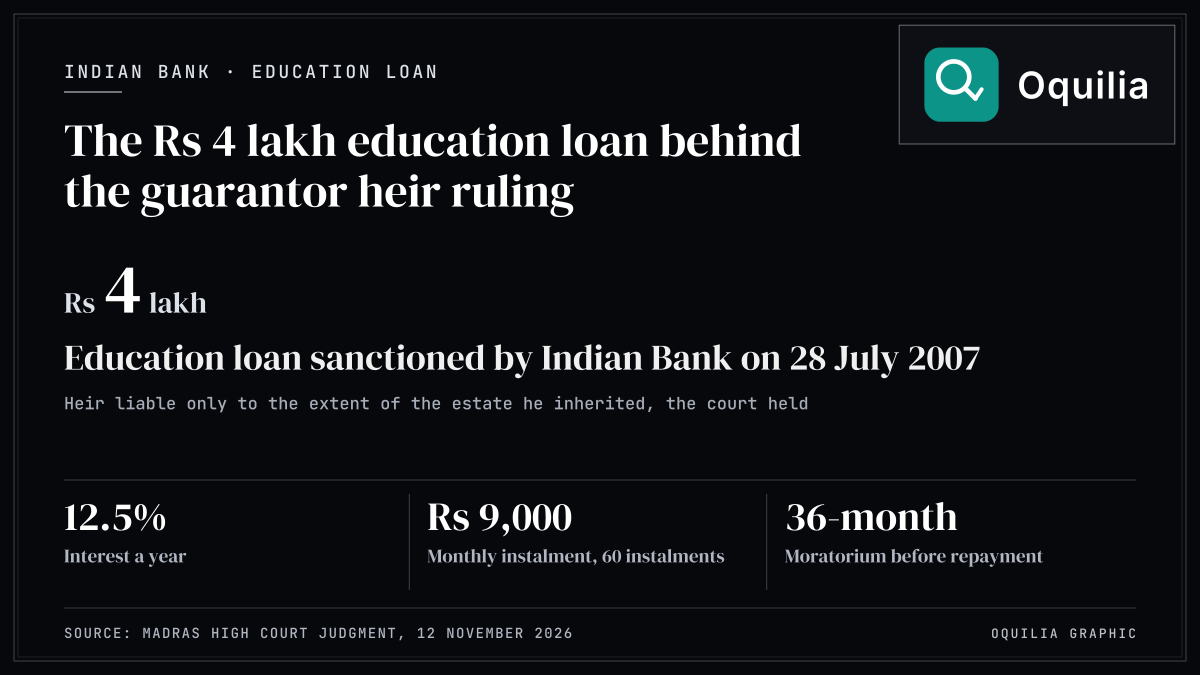
According to the judgment, Indian Bank sanctioned an education loan of Rs 4 lakh on 28 July 2007 to a student and her father, at 12.5% interest a year, repayable in 60 monthly instalments of Rs 9,000 after a 36-month moratorium. Both parents signed a guarantee. After the parents died, the bank filed a recovery suit and added their son as a legal heir.
The son asked the trial court to reject the suit, saying he had signed no loan document, had taken no benefit from the loan, and that his father had settled property on him by a deed of 25 October 2006, before the loan. The trial court refused, and he approached the High Court.
The High Court held that the son may be proceeded against only to the extent of the deceased's estate inherited by him. It said he cannot, merely as a legal heir, be made personally liable for the entire loan without an independent legal basis. Since the bank's counsel told the court the claim against him was confined to the guarantor's estate in his hands, the court found no ground to reject the suit.
The court said the son's other points, including that another heir was not added and that the property was settled on him before the loan, need evidence and can be raised before the trial court. Its order, it said, does not decide whether the bank can recover from any specific property.
What It Means
Families of a guarantor who has died can take from this ruling that, in the court's view, a legal heir's exposure on such a loan is limited to what they inherited from the deceased, not their own money. Whether a particular property counts as part of that estate is for the trial court to decide on evidence.
Source: High Court judgment
Sources & Citations
- High Court judgment — Madras High Court