

Madras High Court: borrowers cannot reclaim title deeds marked by Indian Bank in suit
The Madras High Court held that borrowers cannot use a civil procedure rule to get back title deeds Indian Bank produced in its mortgage suit after the bank moved the loan to an asset reconstruction company.
Key points
- The Madras High Court on 10 November 2026 dismissed borrowers' plea for return of title documents Indian Bank had filed in court.
- The court held a party can seek return only of documents it produced itself, not those the bank marked to prove the mortgage debt.
- The court said the mortgage debt was not paid but transferred to an asset reconstruction company, and left other remedies open.
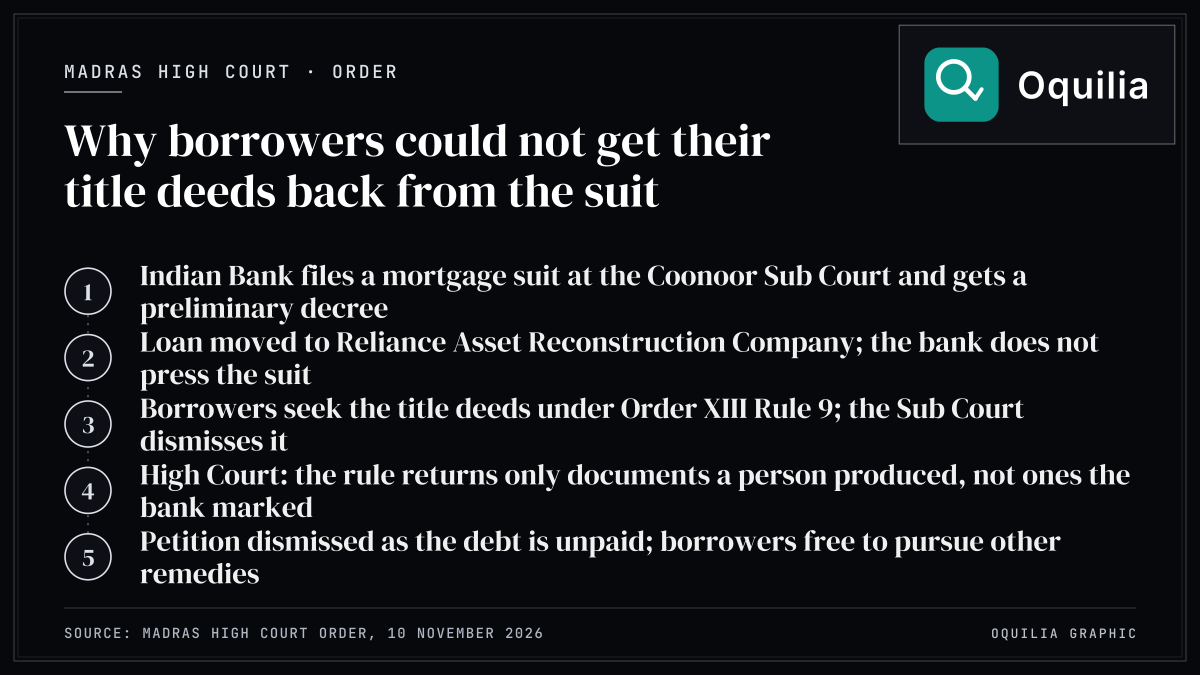
The Madras High Court has refused a plea by borrowers to get back their property title documents that Indian Bank had produced in a mortgage recovery suit, after the bank stopped pursuing the suit because it had transferred the loan account to an asset reconstruction company. In an order dated 10 November 2026, the court held that the borrowers' application was not maintainable.
What Happened
According to the order, Indian Bank filed a suit at the Sub Court in Coonoor, Nilgiris, to recover a mortgage debt, and obtained a preliminary decree. While its application for a final decree was pending, the bank said the loan account had been transferred to Reliance Asset Reconstruction Company Limited, and did not press the suit further.
The borrowers, the legal heirs of the original borrower, then applied under Order XIII Rule 9 of the Code of Civil Procedure for return of the title documents they had deposited with the bank, which the bank had marked as evidence. The Sub Court dismissed the application, and the borrowers approached the High Court.
The High Court held that under this rule, a person can seek return only of a document that person produced in the suit, not one marked by the opposite party. Since the bank had marked the title documents to prove the mortgage debt, the borrowers could not get them back under this rule.
The court also distinguished an earlier judgment the borrowers relied on, saying that in that case the dispute had been settled and the full amount paid. Here, the court noted, the borrowers had not discharged the mortgage debt; it had only been transferred to another company. The court dismissed the petition but gave the borrowers liberty to explore other remedies available to them under law.
What It Means
For borrowers whose home or property loans are sold by a bank to an asset reconstruction company, the ruling indicates that the bank's decision to drop its own suit does not by itself entitle them to the original title deeds under this rule while the debt remains unpaid. The court left them free to pursue other legal remedies. Complaints about a bank's handling of loan documents can be filed with RBI at https://cms.rbi.org.in.
Source: High Court judgment
Sources & Citations
- High Court judgment — Madras High Court