

Filing It Yourself: When a Personal Guarantor Can Apply Under Section 94 of the IBC, and the Bars That Block the Application
Section 94 of the IBC lets a defaulting personal guarantor to a corporate debtor start insolvency resolution on their own. Who can file, and the 12-month, status and partnership bars.
Key points
- Section 94 of the Insolvency and Bankruptcy Code, 2016 lets a debtor who has defaulted apply on their own to start the insolvency resolution process.
- No application can be made if a Part III application was admitted against the debtor in the 12 months before submission, or if the debtor is an undischarged bankrupt.
- Because Part III was notified in 2019 only for personal guarantors to corporate debtors, they are the practical users of Section 94 today.
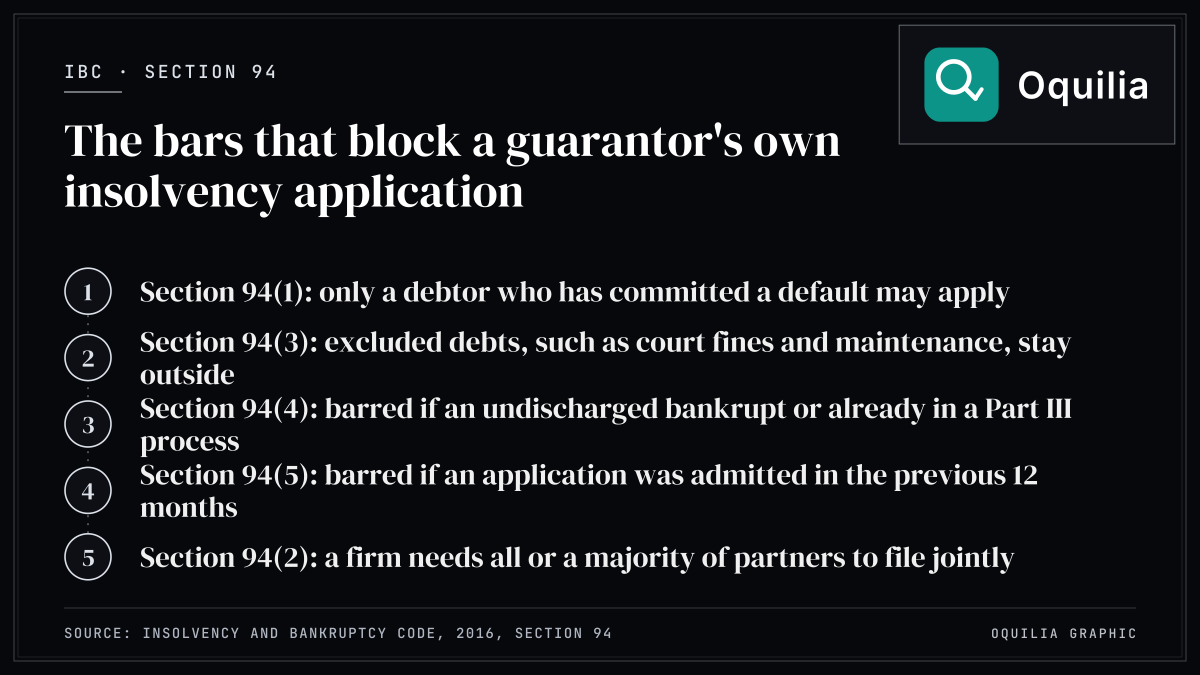
When a company defaults on a bank loan, the lender rarely stops at the company. Promoters and directors who signed a personal guarantee often find themselves facing a demand of their own, and in many cases a creditor's application under Section 95 of the Insolvency and Bankruptcy Code, 2016 (IBC). What fewer guarantors realise is that the same Part III of the Code gives the debtor a door of their own: Section 94, titled "Application by debtor to initiate insolvency resolution process".
This playbook explains what Section 94 says, who can actually use it today, and the four statutory bars that will block an application before it reaches the Adjudicating Authority. It describes the law; it does not suggest that filing is the right course for any individual, which depends on facts only a qualified adviser can assess.
The Statutory Position
Section 94 sits in Part III of the IBC, the part that deals with insolvency resolution and bankruptcy for individuals and partnership firms. The full text is available on Indian Kanoon and on India Code, the official statute repository of the Government of India. The section has six sub-sections, and each one either grants the right to apply or takes it away.
| Sub-section | What it says | Practical effect |
|---|---|---|
| Section 94(1) | A debtor who commits a default may apply, personally or through a resolution professional, to the Adjudicating Authority to initiate the insolvency resolution process | The right to self-file exists only after a default |
| Section 94(2) | A debtor who is a partner of a firm cannot apply in respect of the firm unless all or a majority of the partners file jointly | One partner alone cannot put the firm into the process |
| Section 94(3) | An application may be made only for debts that are not excluded debts | Some liabilities fall outside the process altogether |
| Section 94(4) | No application if the debtor is an undischarged bankrupt, or is undergoing a fresh start, insolvency resolution or bankruptcy process | A debtor already inside a Part III process cannot start another |
| Section 94(5) | No application if an application under this Chapter was admitted against the debtor in the 12 months before the date of submission | A 12-month cooling-off period applies |
| Section 94(6) | The form, manner and fee are as prescribed by regulations | Procedural compliance is governed by subordinate legislation |
Who can use Section 94 today
Part III was drafted for all individuals and partnership firms, but it has not been brought into force for everyone. In 2019 the Central Government notified the Part III provisions only for personal guarantors to corporate debtors. As a result, the practical users of Section 94 in 2026 are individuals who guaranteed the debts of a company, typically promoters and directors who signed a guarantee when the company borrowed from a bank or financial institution.
An individual borrower with a defaulted home loan or personal loan, with no corporate guarantee in the picture, cannot currently use Section 94. For that borrower the familiar routes remain the SARFAESI process for secured loans, recovery proceedings before the Debts Recovery Tribunal, or a negotiated one-time settlement, whose cost can be estimated with the Oquilia settlement cost calculator.
How Section 94 fits with Sections 95 and 96
Section 94 is the debtor's route. Section 95 is the creditor's route, under which a creditor can apply to initiate the insolvency resolution process against a personal guarantor. Section 96 provides the interim moratorium, which begins on the date the application is filed and shields the guarantor from coercive proceedings in respect of the debt while it lasts.
| Feature | Section 94 (debtor applies) | Section 95 (creditor applies) |
|---|---|---|
| Who files | The debtor, personally or through a resolution professional | A creditor, personally or through a resolution professional |
| Trigger | A default by the debtor | A default in respect of a debt owed to that creditor |
| Interim moratorium | Begins on the date of application under Section 96 | Begins on the date of application under Section 96 |
| Who controls timing | The guarantor | The creditor |
| Statutory bars on filing | Section 94(2) to 94(5) | Governed by Section 95 and its own conditions |
The interim moratorium under Section 96 is a large subject in its own right and is not the focus here. The point for this playbook is narrower: Section 94 lets a guarantor choose when the Part III process starts, rather than waiting for a creditor to choose under Section 95.
Procedure Step by Step
The procedure below follows the order of the statute. The exact form, manner and fee are set by regulations under Section 94(6), so the current prescribed form should always be checked against the text published by the Government of India before anything is filed.
- Confirm that a default has occurred. Section 94(1) gives the right to apply only to "a debtor who commits a default". Without a default, there is no Section 94 application.
- Confirm that the debtor is a personal guarantor to a corporate debtor. Because Part III has been notified since 2019 only for this class, an applicant outside it cannot use the section today.
- Separate excluded debts from the rest. Section 94(3) allows the application only for debts that are not excluded debts. The definition of "excluded debt" sits in Section 79 of the Code and should be read on India Code; it covers liabilities such as fines imposed by a court and maintenance obligations.
- Check the four status bars in Section 94(4). The debtor must not be an undischarged bankrupt and must not already be undergoing a fresh start process, an insolvency resolution process or a bankruptcy process.
- Check the 12-month bar in Section 94(5). If any application under the Chapter was admitted in respect of the debtor in the 12 months preceding the date of submission, a fresh application cannot be made.
- For a partner, check the joint-filing rule in Section 94(2). An application in respect of the firm needs all or a majority of the partners to file jointly.
- Decide whether to apply personally or through a resolution professional. Section 94(1) permits both, and the provisions that follow, beginning with Section 97, deal with the appointment of the resolution professional.
- File in the form, manner and with the fee prescribed under Section 94(6) before the Adjudicating Authority. For personal guarantors to corporate debtors, that authority is the National Company Law Tribunal under Section 60 of the Code.
- Note the interim moratorium. Under Section 96, it begins on the date of the application, not on the date of admission.
- Await the resolution professional's report and the admission decision. Under Sections 99 and 100, the resolution professional examines the application and reports, and the Adjudicating Authority then decides whether to admit or reject it.
Pre-filing checklist
| Check | Statutory source | If the answer is "yes" |
|---|---|---|
| Has the debtor committed a default? | Section 94(1) | Proceed to the next check |
| Is the debt an excluded debt? | Section 94(3) read with Section 79 | That debt cannot be included |
| Is the debtor an undischarged bankrupt? | Section 94(4) | Application barred |
| Is a fresh start, insolvency resolution or bankruptcy process already running? | Section 94(4) | Application barred |
| Was a Part III application admitted against the debtor in the last 12 months? | Section 94(5) | Application barred |
| Is the application in respect of a firm without all or a majority of partners? | Section 94(2) | Application barred |
A guarantor working through these questions will also want a clear figure for what is actually owed. Oquilia's loan foreclosure calculator and debt consolidation calculator help put numbers on the outstanding principal and interest, which is the starting point for any discussion with creditors under Part III of the 2016 Code.
Borrower Defences Available
Section 94 is not a defence in the narrow sense of a ground to resist a demand. It is a procedural choice. But the bars in Section 94 cut both ways, and a guarantor who understands them can avoid a defective filing that wastes the protection Part III is meant to give.
Why a guarantor might consider self-filing
There are three reasons a personal guarantor might look at Section 94 rather than wait for Section 95, each of which follows from the text of the Code rather than from any view about whether filing is wise.
- Control over timing. Under Section 94(1), the debtor decides when to apply. Under Section 95, the creditor does.
- The moratorium starts on filing. Section 96 ties the interim moratorium to the date of the application, so the date the guarantor chooses to file is the date the interim protection begins.
- A single, structured forum. Part III brings the guarantor's debts, other than excluded debts under Section 94(3), into one process before the Adjudicating Authority, rather than leaving them spread across separate recovery actions such as SARFAESI enforcement or proceedings before the Debts Recovery Tribunal.
None of these points means filing under Section 94 is advisable. A Part III process has consequences for the guarantor that run well beyond the moratorium, and the decision belongs to the guarantor with professional advice.
The four bars, read closely
The bars in Section 94 are the most common reason a self-filed application is defective, so each deserves a careful reading.
The 12-month bar, Section 94(5). The bar runs from admission, not filing. It applies where an application "under this Chapter" was admitted in respect of the debtor in the 12 months preceding the date of submission. An application that was filed but not admitted does not, on the wording of Section 94(5), trigger the bar. The relevant date for counting is the date the new application is submitted.
The status bar, Section 94(4). A debtor who is an undischarged bankrupt, or who is already undergoing a fresh start process, an insolvency resolution process or a bankruptcy process, cannot apply. The bar is about the debtor's current status on the date of application.
The excluded debts rule, Section 94(3). This is not a bar on the whole application; it limits what the application can cover. Excluded debts, as defined in Section 79, stay outside the process.
The partnership rule, Section 94(2). A partner can apply for themselves in their own capacity where Part III applies to them, but cannot apply in respect of the firm unless all or a majority of the partners file jointly. Because Part III has been notified since 2019 only for personal guarantors to corporate debtors, the firm-level route under Section 94(2) is of limited practical use today.
Deposits and timelines
Section 94 itself prescribes no deposit, unlike the pre-deposit requirements that apply to appeals in some recovery forums. Section 94(6) leaves the form, manner and fee to regulations, and those should be checked at the time of filing. The only timeline written into Section 94 is the 12-month bar in Section 94(5).
| Item | Position under Section 94 |
|---|---|
| Deposit | None prescribed in Section 94 |
| Fee | As prescribed by regulations under Section 94(6) |
| Look-back period | 12 months from admission of a previous application, Section 94(5) |
| Interim moratorium | Begins on the date of application, Section 96 |
Recent Tribunal/HC Position
The constitutional footing of the Part III scheme for personal guarantors was settled by the Supreme Court of India in Dilip B. Jiwrajka v Union of India (2023). Personal guarantors had challenged Sections 95 to 100 of the Code, arguing among other things that the process allowed a resolution professional to act against them without a prior hearing by the Adjudicating Authority.
The Supreme Court upheld the scheme. It held that the resolution professional's role under Sections 99 and 100 is facilitative, not adjudicatory, and that the Adjudicating Authority decides admission or rejection only after the resolution professional's report. The judgement confirmed that Part III, as applied to personal guarantors to corporate debtors since 2019, operates as enacted.
For a guarantor considering Section 94, the significance of the 2023 ruling is practical. The statutory machinery that follows a self-filed application, from the interim moratorium under Section 96 to admission under Section 100, has been held constitutionally valid, so the provisions can be read and applied as they stand. The judgement was concerned mainly with creditor-initiated applications under Section 95, and the detailed analysis of that ruling is beyond the scope of this playbook.
The Oquilia Research Desk reports on these judgements from the published record. It does not appear in, or practise before, any court or tribunal.
FAQ
Can any individual borrower file under Section 94 of the IBC?
Not at present. Part III of the IBC was notified in 2019 only for personal guarantors to corporate debtors, so the practical users of Section 94 today are individuals who guaranteed a company's debt.
Does a guarantor have to wait for a creditor to act under Section 95?
No. Section 94(1) allows a debtor who has committed a default to apply on their own, either personally or through a resolution professional.
What is the 12-month bar in Section 94(5)?
A debtor cannot apply under Section 94 if an application under the same Chapter was admitted in respect of that debtor in the 12 months preceding the date of submission. The bar is linked to admission, not to filing.
Which debts cannot be included in a Section 94 application?
Section 94(3) excludes "excluded debts", a term defined in Section 79 of the Code. These include liabilities such as fines imposed by a court and maintenance obligations. The full definition should be read on India Code.
Can one partner put the whole firm into the process?
No. Section 94(2) says a partner cannot apply in respect of the firm unless all or a majority of the partners file the application jointly.
When does protection from creditors begin after a Section 94 filing?
The interim moratorium under Section 96 begins on the date the application is filed, and protects the guarantor from coercive proceedings in respect of the debt while it lasts.
Did the Supreme Court uphold the personal guarantor insolvency scheme?
Yes. In Dilip B. Jiwrajka v Union of India (2023), the Supreme Court upheld Sections 95 to 100 of the Code as they apply to personal guarantors to corporate debtors.
This article explains the law as written and is not legal advice. The Oquilia Research Desk does not recommend for or against filing an insolvency application; a personal guarantor should take advice from a qualified professional on their own facts.
Sources & Citations
- Section 94, Insolvency and Bankruptcy Code, 2016: Application by debtor to initiate insolvency resolution process — Indian Kanoon
- Insolvency and Bankruptcy Code, 2016 — India Code, Government of India