

NCDRC upholds award against SBI over jeep seized before SARFAESI notice
The National Consumer Commission dismissed SBI's challenge to an award for a borrower whose jeep it seized in 2003, holding that SARFAESI proceedings did not bar the consumer complaint.
Key points
- The National Consumer Disputes Redressal Commission on 11 November 2026 dismissed State Bank of India's revision petition.
- The award of Rs 1,01,580 and Rs 10,000 for mental agony, made in 2004 for a borrower whose jeep was seized, stands.
- The commission held that action under the SARFAESI Act does not bar a borrower's consumer complaint over a seizure.
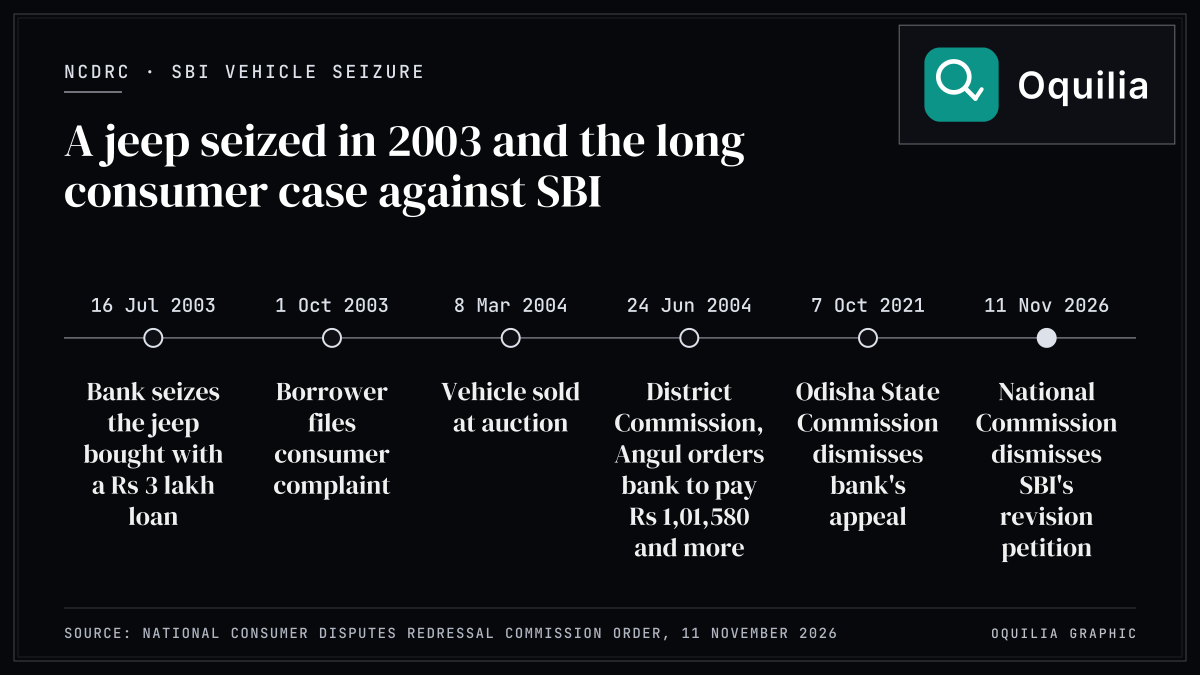
The National Consumer Disputes Redressal Commission on 11 November 2026 dismissed State Bank of India's challenge to an award for a borrower whose jeep the bank seized and auctioned in 2003-04. It held that the consumer complaint could be heard even though the bank had acted under the SARFAESI Act, the law that lets lenders enforce security without going to court.
What Happened
The borrower had taken a loan of Rs 3 lakh from the bank to buy a jeep. The bank said instalments had been missed and seized the vehicle on 16 July 2003. The borrower complained to the Banking Ombudsman, which closed the complaint, and filed a consumer complaint on 1 October 2003. The vehicle was sold at auction on 8 March 2004.
The District Consumer Disputes Redressal Commission, Angul, in Odisha, found that the seizure and auction did not follow the rules under the SARFAESI Act: the auction date was changed without telling the borrower, and the sale price was inappropriate. On 24 June 2004 it ordered the bank to pay Rs 1,01,580, a further amount after depreciation, and Rs 10,000 for mental agony. The Odisha State Commission dismissed the bank's appeal on 7 October 2021.
Before the National Commission, the bank argued that the SARFAESI proceedings barred a consumer complaint. The commission rejected this, holding that remedies under the Consumer Protection Act are in addition to those under other laws and that the complaint was rightly heard. It noted that the vehicle was seized before the bank issued its notice under Section 13(4) of the SARFAESI Act, and that the State Commission had found the seizure, made without any authorised order, to be a deficiency in service. It found no error in the lower commissions' findings and dismissed the revision petition.
What It Means
For borrowers, the order confirms that a lender's use of the SARFAESI Act does not by itself shut out a consumer complaint over how a vehicle or other asset was seized or sold. The order may be appealed. Borrowers with complaints against a bank can use the RBI's complaint portal at https://cms.rbi.org.in or the National Consumer Helpline (1915).
Source: Consumer commission order
Sources & Citations
- Consumer commission order — Consumer commission