

Madras High Court upholds arbitral award for Equitas Small Finance Bank against borrower
The Madras High Court upheld an arbitral award for Equitas Small Finance Bank and held that a lender can pursue arbitration and SARFAESI recovery against a borrower at the same time.
Key points
- The Madras High Court on 18 November 2026 dismissed a borrower firm's challenge to an arbitral award won by Equitas Small Finance Bank.
- The court held SARFAESI action and arbitration can run together, but SARFAESI recovery is limited to the amount the award fixes.
- The bank may not sell the repossessed assets for two more months, giving the borrower time to pursue its remedies.
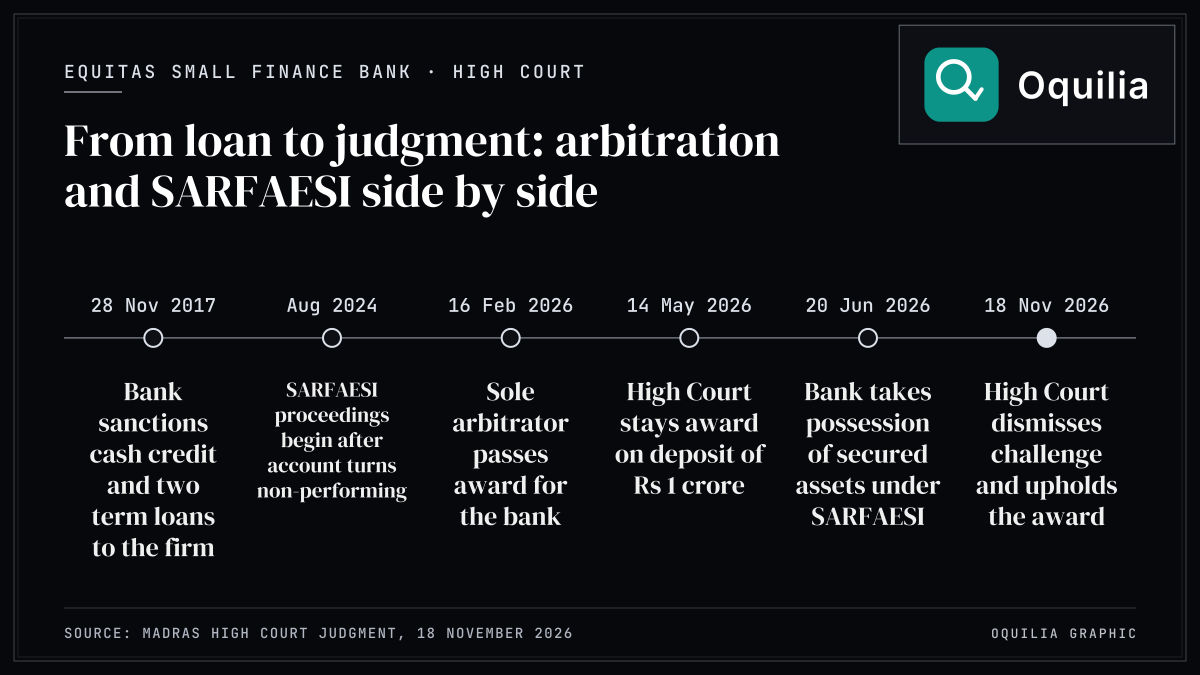
The Madras High Court on 18 November 2026 dismissed a borrower's challenge to an arbitral award won by Equitas Small Finance Bank, holding that a lender can pursue arbitration and recovery under the SARFAESI Act at the same time. The borrower, a Kumbakonam retail firm, had taken credit facilities of Rs 10 crore from the bank.
What Happened
According to the judgment, the bank sanctioned the firm a cash credit of Rs 3,50,00,000 and two term loans of Rs 1,53,00,000 and Rs 4,97,00,000 on 28 November 2017. The firm said a business downturn, worsened by the COVID-19 pandemic, left it unable to repay on time. The bank started arbitration and also used the SARFAESI Act, the law that lets lenders take over secured assets without going to a civil court. A sole arbitrator passed an award for the bank on 16 February 2026.
The firm argued that running arbitration, SARFAESI and related court proceedings for the same debt was an abuse of process. The court rejected this, relying on a Supreme Court ruling that the two remedies can go hand in hand. It found no perversity in the award and rejected the claim for a moratorium and restructuring on account of the pandemic, noting that the pandemic was long gone by 2022 and SARFAESI proceedings began in August 2024 after the account became a non-performing asset.
The court had stayed the award on 14 May 2026 on condition that the firm deposit Rs 1 crore. The bank took possession of the secured assets under SARFAESI on 20 June 2026. The court held this was not contempt, because the stay only stopped enforcement of the award, not possession under SARFAESI. It added that SARFAESI recovery must be limited to the amount the award fixes.
What It Means
For borrowers, the ruling means an arbitration in progress does not stop a lender from acting under SARFAESI, but the lender cannot recover more through SARFAESI than the arbitrator has fixed. The court continued its protection for two months, during which the bank may not sell the repossessed assets, so the firm can pursue its remedies.
Source: High Court judgment
Sources & Citations
- High Court judgment — Madras High Court