

Kerala High Court rejects repeat plea by borrower who missed court-set instalments
The Kerala High Court held on 5 November 2026 that a borrower who missed instalments it had allowed earlier cannot file a fresh petition for the same relief against a bank.
Key points
- The Kerala High Court dismissed a borrower's second petition against Ponnani Co-operative Urban Bank on 5 November 2026.
- The court had allowed the borrower to pay in instalments on 5 June 2025, but held she did not pay as directed.
- Borrowers who miss a court-set instalment plan may not get the same relief again, and the bank can continue recovery.
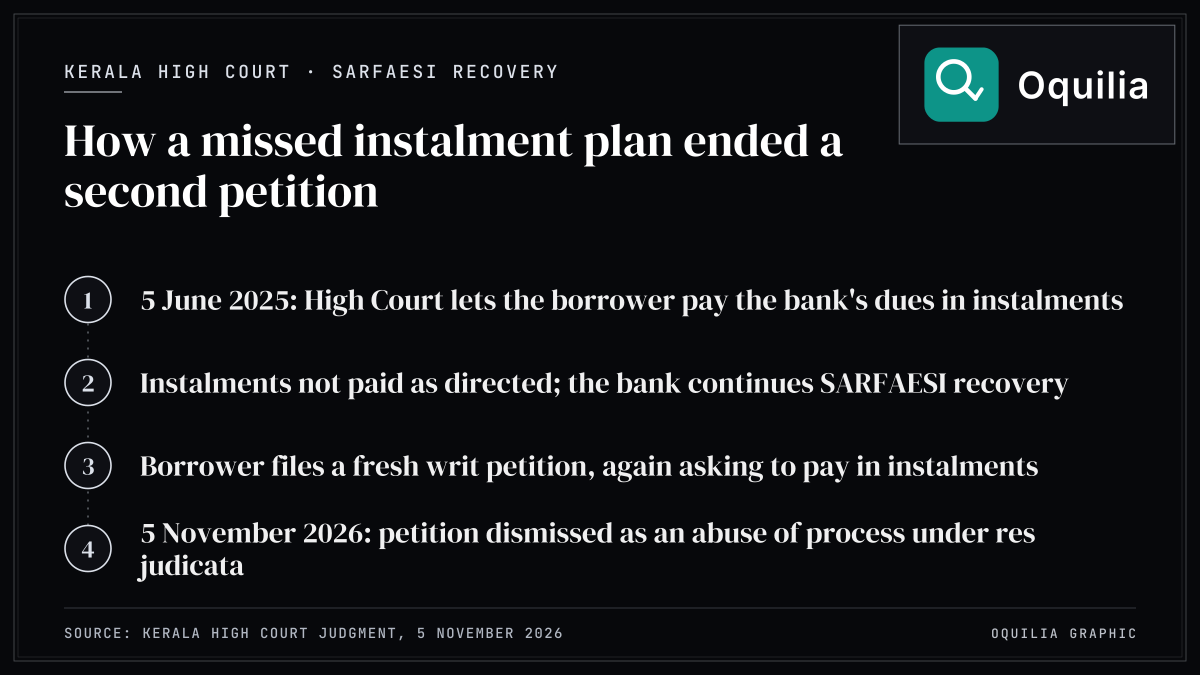
The Kerala High Court on 5 November 2026 dismissed a borrower's second writ petition against recovery action by Ponnani Co-operative Urban Bank under the SARFAESI Act, holding that a borrower who failed to pay instalments allowed by the court earlier cannot come back to seek the same relief again. The court called such a repeat petition an abuse of the court's process.
What Happened
According to the judgment, the borrower had first approached the High Court against the bank's recovery proceedings under the SARFAESI Act, the law that lets banks take over and sell property pledged for a loan. In that earlier case, the court on 5 June 2025 disposed of the petition by giving her time and allowing her to pay the dues in instalments.
The court recorded that she did not pay the instalments as directed and that the bank then continued with recovery. She filed a fresh petition against the later steps in the same proceedings and again asked to be allowed to pay in instalments. She argued that the new petition was about subsequent actions and so could be heard.
The court held that the principle of res judicata, which bars the same dispute from being argued twice, applies to writ petitions. It held that a litigant who has not complied with the conditions set in an earlier writ petition, between the same parties and on the same loan, cannot seek the same directions at a later stage of the same proceedings. Both the parties and the court are bound by the earlier judgment once it is final, the court said. It added that the Supreme Court has held that the scope for a High Court to interfere with SARFAESI proceedings in writ jurisdiction is very limited.
What It Means
For borrowers facing recovery under the SARFAESI Act, the ruling is a reminder that an instalment plan granted by a court has to be followed. If the instalments are missed, the same borrower may not get a second chance by filing a fresh writ petition over the same loan, and the bank can carry on with recovery. Borrowers with a complaint about a bank's service can approach RBI at https://cms.rbi.org.in.
Source: High Court judgment
Sources & Citations
- High Court judgment — Kerala High Court