

Punjab and Haryana High Court declines to quash CBI cases in bank fraud tag pleas
The Punjab and Haryana High Court held on 26 November 2026 that setting aside a bank's fraud declaration does not by itself end CBI criminal cases, and gave borrowers three months' protection.
Key points
- The Punjab and Haryana High Court disposed of 20 writ petitions by borrowers against banks' fraud declarations on 26 November 2026.
- The court held the fraud declarations under RBI's 2016 Master Directions infructuous in 19 petitions and set one aside.
- Banks may proceed afresh under RBI's revised directions; borrowers keep interim protection for three months to challenge CBI cases.
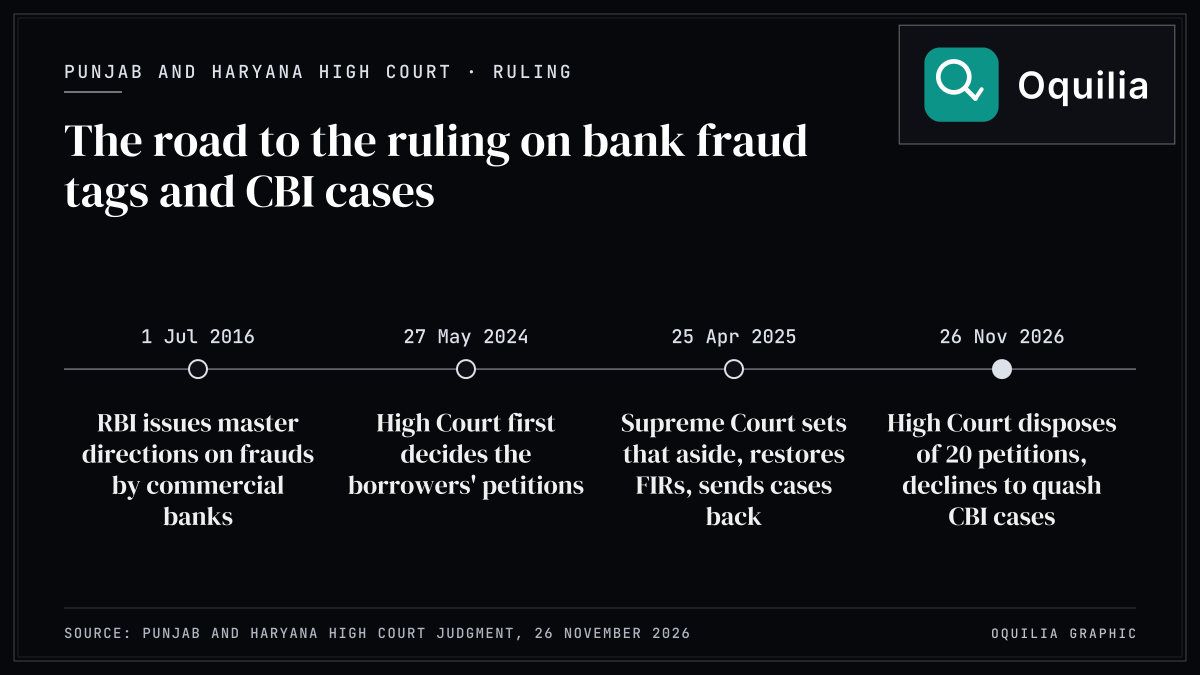
The Punjab and Haryana High Court on 26 November 2026 disposed of a bunch of 20 writ petitions in which borrowers had challenged banks' decisions to classify their accounts as fraud, and the CBI cases that followed. A division bench held that setting aside a fraud declaration does not by itself cancel the criminal cases, and declined to quash them. The lead case is CWP-23794-2022.
What Happened
The borrowers had challenged the Reserve Bank of India's "Master Directions on Frauds - Classification and Reporting by Commercial Banks and Select FIs" of 1 July 2016, the fraud declarations banks made under them, and FIRs the CBI registered. The High Court had decided the petitions on 27 May 2024, but the Supreme Court set that ruling aside on 25 April 2025 and sent the cases back for fresh hearing, restoring the FIRs.
The court recorded that the 2016 directions have since been withdrawn, and that in several cases banks had withdrawn the fraud declarations or issued fresh show cause notices. It held the challenge to the declarations infructuous in 19 petitions and set aside the declaration in one.
On the CBI cases, the court held that a bank's fraud declaration and its report of a crime to the CBI are two distinct actions, so an administrative order set aside for lack of a hearing does not automatically end the criminal case. Some of those cases have reached trial. The accused may challenge them under Section 528 of the Bharatiya Nagarik Suraksha Sanhita or before another forum. These are allegations, not findings of guilt; the accused are presumed innocent until proven guilty in court, and due process continues.
What It Means
Banks are free to proceed afresh against these borrowers under RBI's revised directions, and the borrowers may challenge any fresh fraud declaration. The court continued the interim protection the Supreme Court had granted for three months from 26 November 2026, so that the borrowers can file separate challenges to the criminal cases. The ruling confirms that a borrower is entitled to a hearing before a bank tags an account as fraud, but that this hearing is not required before an FIR is registered. Bank customers with a complaint against a bank can approach RBI at https://cms.rbi.org.in.
Source: High Court judgment
Sources & Citations
- High Court judgment — Punjab and Haryana High Court