

Punjab consumer commission orders Edelweiss Tokio Life to pay rejected death claim
The Punjab State Consumer Commission held that Edelweiss Tokio Life could not reject a Rs 25 lakh life cover claim over a proposal form it had not explained, and ordered it to pay with 9% interest.
Key points
- The Punjab State Consumer Disputes Redressal Commission on 4 November 2026 set aside a district order and allowed a claim against Edelweiss Tokio Life Insurance.
- The insurer must pay the claim under a Rs 25,00,000 policy with 9% annual interest from the date of rejection, plus Rs 50,000 as compensation and costs.
- The commission held that an insurer that does not explain a policy's terms to the buyer cannot use those terms later to reject a claim.
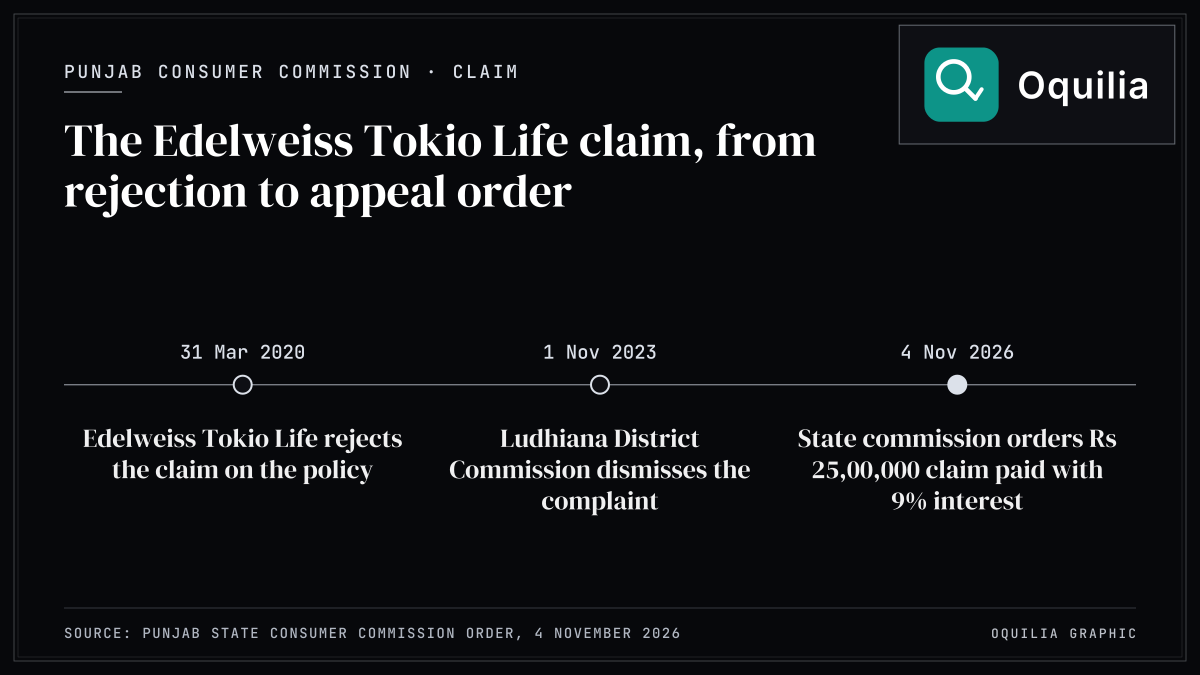
The Punjab State Consumer Disputes Redressal Commission on 4 November 2026 ordered Edelweiss Tokio Life Insurance Company Limited to pay a death claim under a life policy with a sum assured of Rs 25,00,000, with 9% annual interest from the date the claim was rejected until payment. The commission set aside a 1 November 2023 order of the Ludhiana District Commission, which had dismissed the claimant's complaint.
What Happened
The policyholder bought a "Zindagi Plus" life policy from the insurer and died on 19 February 2020. The insurer rejected the claim on 31 March 2020, saying he had hidden that he had applied for 21 other insurance policies when he bought this one.
The claimant told the commission that the insurer's representative had filled in the proposal form without explaining anything to the policyholder. The commission examined the electronic proposal form the insurer relied on. It found that it showed the policyholder as "Single" though he was married and his wife was listed as nominee, carried no digital signature of the proposer, and had the declaration column and the column confirming the form was explained left blank.
Citing Supreme Court rulings that the duty of good faith runs both ways, the commission held that an insurer that fails to explain a policy's terms, conditions or exclusions to the buyer cannot later use them to reject a claim. It also held that the district commission was wrong to doubt that the death was natural, since the insurer itself had accepted in its reply that the policyholder died of a heart attack.
What It Means
Besides the claim amount and interest, the insurer must pay Rs 50,000 as composite compensation for mental agony, harassment and litigation expenses. The order says that if the insurer does not comply, it will pay interest at 18% on the claim amount from the date of rejection. The order may be appealed to the National Consumer Disputes Redressal Commission.
For policy buyers, the ruling puts weight on what the insurer did at the point of sale: a proposal form that is blank where the buyer should have declared and confirmed the terms is weak evidence against them.
Families whose claims are rejected can complain through the National Consumer Helpline (1915) or online on e-Daakhil.
Source: Consumer commission order
Sources & Citations
- Consumer commission order — Consumer commission