

Millions of people across north India put money into land-linked investment schemes run by the Chandigarh-based PACL group. For most of them the story since has been silence punctuated by rumour. There is an actual process, it does pay, and almost everything else circulating about it is someone trying to make money from the wait.
Correction, 5 November 2026: An earlier version of this guide said claims were still being invited and that claimants in higher slabs were waiting while lower slabs were cleared. The committee’s claim windows closed on 31 July 2019, and its status report to the Supreme Court of 9 May 2026 shows it had paid eligible claims in all 13 slabs by 26 February 2026. The guide also linked the portal without “www”, an address that does not load; the working address is below. Attachment figures have been brought up to date from the Directorate of Enforcement’s releases.
Refund status for all schemes: Oquilia’s Refund Tracker follows the PACL, Sahara, Royal Twinkle Star Club, Rose Valley and Agri Gold refunds, with deadlines and the official portal for each.
What the process is
Refunds are supervised by a committee set up on the Supreme Court’s order of 2 February 2016, headed by a former Chief Justice of India, which sells the group’s assets and applies the proceeds to investor claims. Claims were collected through the committee’s official portal in two windows — early 2018 for claims up to Rs 2,500, and 8 February to 31 July 2019 for all others — and paid in slabs — smallest claims first, working upward as recoveries permitted.
That sequencing is why so many people concluded nothing was happening: claimants in the higher slabs waited years while the lower ones were paid. According to the committee’s status report of 9 May 2026, the last of the 13 slabs, for claims above Rs 30,000, was paid between 24 January and 26 February 2026; by the time of the report it had paid Rs 3,720.67 crore on 35,74,401 eligible applications. The portal now reports Rs 4,005.72 crore paid on 37,41,045 eligible applications as of September 2026.
The one official channel
The committee’s portal is www.sebipaclrefund.co.in — type the “www”, because the address without it does not load. That is the channel. Use it to check the status of a claim you filed, with your PACL registration number, and to read the committee’s public notices: it opens limited windows to correct deficient applications, such as wrong bank details. The latest ran from 7 May to 6 October 2026. There is no fee, no agent with privileged access, and no way to move up the queue.
What decided each claim was documentary: the original PACL certificate and outstanding payment receipts, PAN, and bank details in the claimant’s own name. The committee’s rules require claimants to keep the originals of what they uploaded, so if the documents exist in a family cupboard somewhere, keep them safe. If you did not file in 2018 or 2019, or are the nominee or legal heir of an investor who has died, the committee told the Supreme Court it receives complaints from both groups; it has not announced a new claim window for them, so watch the portal’s public notices rather than anyone who says they can file for you.
Why the pool keeps growing
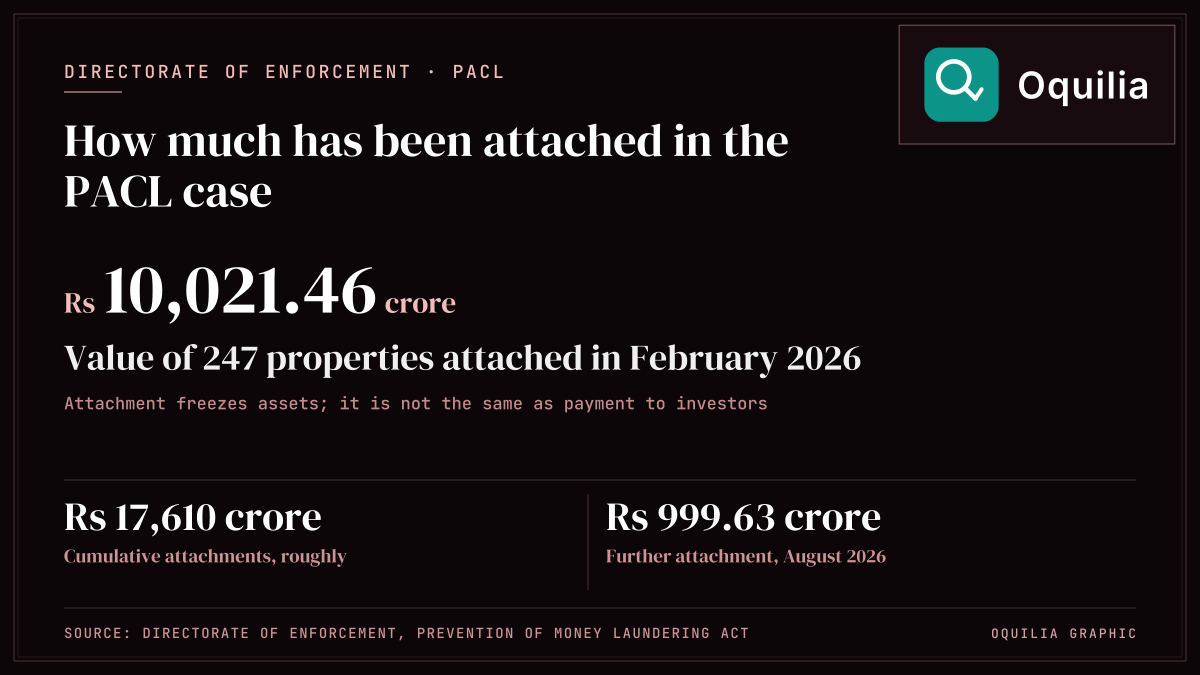
Alongside the refund committee, the Directorate of Enforcement has been attaching assets under the Prevention of Money Laundering Act. In February 2026 it issued what it described as its largest single attachment order — 247 properties valued at Rs 10,021.46 crore — with attached land in SAS Nagar (Mohali), Rupnagar and Zirakpur. By 30 March 2026 the ED put total attachment in the case at Rs 27,030 crore, and by 9 June 2026 at Rs 28,626 crore. A further attachment of properties valued at Rs 999.63 crore followed in August 2026.
Attached property is also being handed to the committee. The ED says the Special Court (PMLA) ordered 455 properties, worth about Rs 15,582 crore, restored to the committee in March 2026, and a further 282 properties, worth Rs 9,420.57 crore, in June 2026.
Attachment is not the same as payment. It freezes assets so they cannot be dissipated; converting them into money that reaches investors is a separate, slower process. But it is the reason the recoverable pool is larger now than it was.
The second fraud
A refund process with millions of waiting claimants and a slow queue is close to ideal conditions for a follow-on scam, and it has attracted one. The pattern is consistent:
- A call or message claiming your refund is “approved” and needs a processing fee, GST, or a legal charge to release.
- A person claiming to be from the committee, SEBI, or a law firm handling claims.
- A website that resembles the official portal at a slightly different address.
- A request for your bank credentials or an OTP to “verify the account for credit”.
All four are fraud without exception. No fee of any kind is payable to receive a refund you are owed, no official will ask for an OTP, and nobody can move a claim up the queue. If you have already paid such a fee, that is itself a cybercrime — report it at cybercrime.gov.in or on 1930.
What to do now
- Find and preserve the original documents.
- If you filed a claim, check its status on the official portal with your PACL registration number, and keep the acknowledgement number.
- Keep the registered mobile number and bank account current, and watch the portal’s public notices for any window to correct bank details, because payment is made to the claimant’s own verified account.
- Ignore every intermediary. Check status only on the official portal.
How to use this page
This page describes statutory provisions and published regulatory schemes, identified so you can verify them. It is general information about how those processes work, not advice on your particular dispute, and the documents governing your own account, policy or transaction control the specifics.
Every route here is free
The ombudsman schemes, the official portals and the complaint channels described on this page cost nothing to use and require no intermediary. No agent, consultant or recovery service can obtain an outcome you cannot obtain yourself. Oquilia takes no fee from readers, offers no recovery service, and refers no one to any legal practice.
If a process here is not followed
For banks, NBFCs and payment systems, escalate free of charge to the RBI Ombudsman at cms.rbi.org.in. For insurers, the Insurance Ombudsman. For listed companies and market intermediaries, SEBI’s SCORES platform at scores.sebi.gov.in.
Source
Supreme Court-appointed committee supervising the sale of PACL assets and refunds to investors: its official portal www.sebipaclrefund.co.in, its public notice of 3 August 2026 and its status report to the Supreme Court of 9 May 2026; Directorate of Enforcement releases in the PACL matter, including those of 30 March and 9 June 2026